GCSE English Literature Mock Results: Use Them Well
GCSE English Literature mock results become useful when you diagnose lost marks, choose focused revision actions and retest before the real exam.
A mock result can change the mood of an entire day. A higher grade brings relief; a lower one can make months of effort feel invisible. Yet GCSE English Literature mock results are most useful when you stop treating them as a verdict and start treating them as evidence.
The practical answer is simple: check how the mock was constructed, identify where and why marks were lost, turn those patterns into a short revision list, then retest the same skills. The grade matters, but the information beneath it matters more.
This is also valuable if maths is currently your main concern. The same feedback loop works across subjects: attempt, mark, diagnose, repair and retest. MathsGenie's guide to finding your weakest GCSE topics applies that principle directly to maths revision.
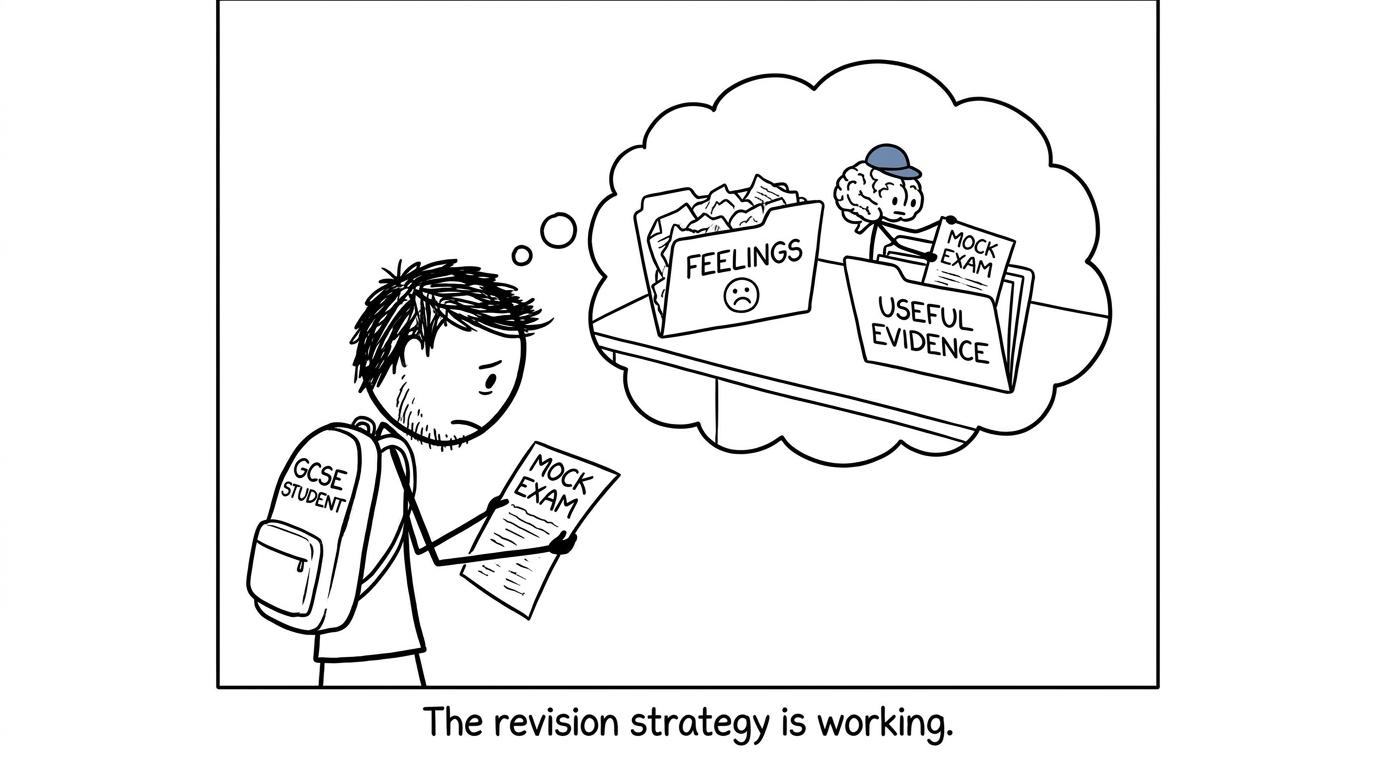 A student files a mock paper under useful evidence rather than feelings
Your mock-results checklist
Before beginning more revision, do these things:
- Confirm which texts, questions and papers the mock covered.
- Ask how your school converted marks into a grade.
- Read the question-level marks and teacher feedback, not only the total.
- Sort lost marks into knowledge, analysis, evidence, timing and communication.
- Choose no more than three priorities for your next revision cycle.
- Practise those exact skills under controlled conditions.
- Retest them using a different question.
This turns a result into a plan. Without that final retest, however, you only know that you revised something, not that it improved.
Read the grade in context
GCSE English Literature is untiered. Unlike GCSE maths, there is no foundation or higher paper, so your mock grade is not being shaped by a tier entry. It can still be affected by the paper your school used, the texts included, the time allowed and the boundaries chosen for that particular mock.
Official grade boundaries are set for completed exam series. A school mock may use a previous paper and historical boundaries, an adapted paper, or an internal assessment assembled from several sources. If only part of the course was tested, your school may also have adjusted the conversion from marks to grades.
That does not make the result meaningless. It means you should ask:
- Was this a complete paper or a shortened assessment?
- Were the conditions similar to the real examination?
- Which grade boundaries were used?
- Were all the relevant assessment objectives marked?
- Is the reported grade based on one component or a broader collection of work?
Avoid making precise comparisons with friends in other schools or on different exam boards. AQA, Edexcel, OCR and Eduqas use the assessment objectives established for GCSE English Literature, but paper structures, question demands and the distribution of marks differ. Compare like with like wherever possible.
Look beneath the total mark
A total can tell you how the paper went. It cannot tell you what to do on Tuesday evening.
To find that out, inspect each response. Record the available mark, your mark, the relevant skill and the main reason marks were lost. Use your teacher's comments alongside the mark scheme or assessment grid where available.
| Evidence from the mock | Useful question to ask |
|---|---|
| Low marks across one text | Is my knowledge of plot, character, themes or quotations insecure? |
| Ideas are relevant but thin | Do I need to develop interpretations more fully? |
| Quotations are included but unexplored | Am I analysing the writer's choices and their effects? |
| Context appears in separate paragraphs | Am I connecting context to the text and argument? |
| The final response is unfinished | Did planning, pacing or hesitation consume too much time? |
| Similar comments appear repeatedly | Is this a recurring habit rather than a one-off mistake? |
Treat repeated weaknesses as more important than an isolated lapse. Forgetting one quotation is different from repeatedly making claims without textual support.
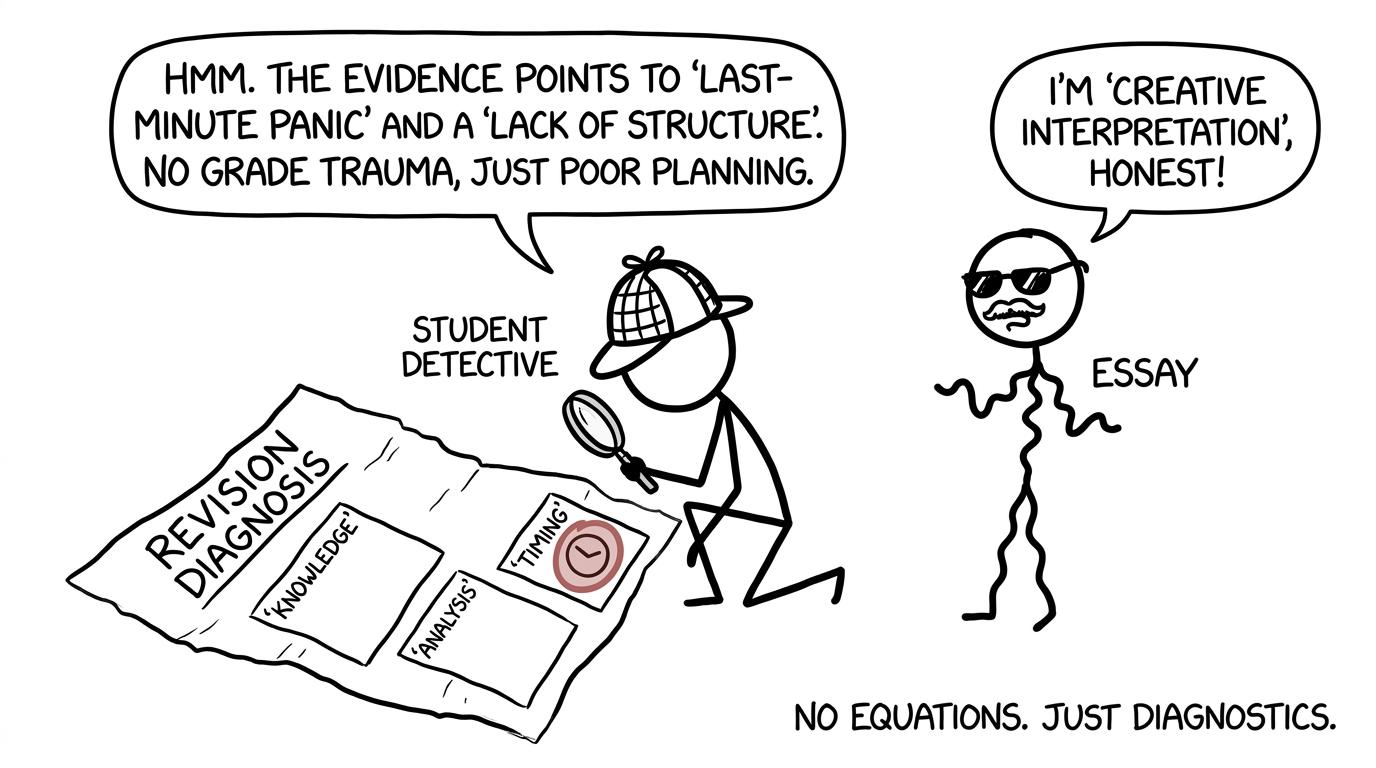 A student detective investigates knowledge, analysis and timing clues
Translate assessment objectives into revision actions
The assessment objectives provide a clearer language for interpreting GCSE English Literature mock results. Their broad purpose is shared across specifications, although their weighting and application to individual questions can vary. Check the specification and guidance for your own exam board.
AO1: response, interpretation and evidence
AO1 concerns understanding the text, developing an informed personal response and supporting interpretations with textual references.
If this is weak, rereading model essays is not automatically the answer. You may need to:
- rebuild your knowledge of characters, themes and key moments;
- practise forming a clear argument from the question;
- select shorter, more purposeful quotations;
- explain how each reference supports your interpretation.
A quotation bank is helpful only if you can use it flexibly. Knowing many lines without knowing what they reveal can create the illusion of readiness.
AO2: language, form and structure
AO2 rewards analysis of how writers create meanings and effects through language, form and structure. Relevant terminology can support analysis, but naming a technique is not the same as analysing it.
If your feedback mentions limited analysis, practise moving from identification to explanation. Ask what the writer's choice suggests, how it shapes the reader's response and how it supports your overall interpretation. You may also need wider structural thinking: changes across a play, contrasts between characters, narrative perspective, poetic form or the placement of an important scene.
AO3: texts and contexts
AO3 concerns relationships between texts and the contexts in which they were written. Context should normally illuminate an interpretation rather than sit beside it as a memorised history paragraph.
If context is weak, connect each relevant detail to the writer's choices or ideas. If context dominates your answer, practise selecting only what helps answer the question. Requirements vary between questions, so use your board's materials and your teacher's guidance rather than assuming every response needs the same balance.
AO4: accuracy and control
AO4 concerns vocabulary, sentence structures, spelling and punctuation. It is not applied identically to every question, so check where it is assessed on your specification.
If accuracy cost marks, look for patterns: sentence boundaries, apostrophes, paragraph control, repeated misspellings or expression that becomes unclear under time pressure. Repair one pattern at a time. A specific rule such as “check sentence endings during the final review” is more useful than “improve spelling and grammar”.
Separate knowledge gaps from performance problems
Two students can lose the same number of marks for completely different reasons. One may not know the text securely. Another may understand it but struggle to retrieve quotations, organise an argument or finish within the time.
Use four categories:
- Knowledge: insecure understanding of events, characters, themes or context.
- Interpretation: ideas are descriptive, unsupported or insufficiently developed.
- Execution: weak paragraph control, imprecise evidence or unclear expression.
- Exam conditions: poor pacing, misunderstood questions or unfinished answers.
Your revision method should match the cause. Knowledge gaps need retrieval and close reading. Weak analysis needs deliberate paragraph practice and feedback. Timing problems need timed planning and writing, not another evening highlighting notes.
This distinction transfers directly to maths. A wrong answer might reveal a missing method, an execution error or a problem reading the question. MathsGenie's guide to using GCSE mark schemes as a revision coach explains how to make that diagnosis rather than merely counting marks.
Build a revision plan from the evidence
Choose the three areas that would make the greatest difference across several questions. A useful priority is specific and observable: “select evidence that directly supports my argument” is actionable; “get better at English” is not.
For each priority, create a short cycle:
- Review the relevant text knowledge or skill.
- Complete a small, focused task.
- Check it against the question and assessment criteria.
- Get feedback where possible.
- Attempt a fresh task without notes.
Keep revision proportionate. Writing complete essays every evening can be exhausting and may hide the skill you are trying to improve. Sometimes a timed plan, one analytical paragraph or a quotation-retrieval task gives cleaner feedback.
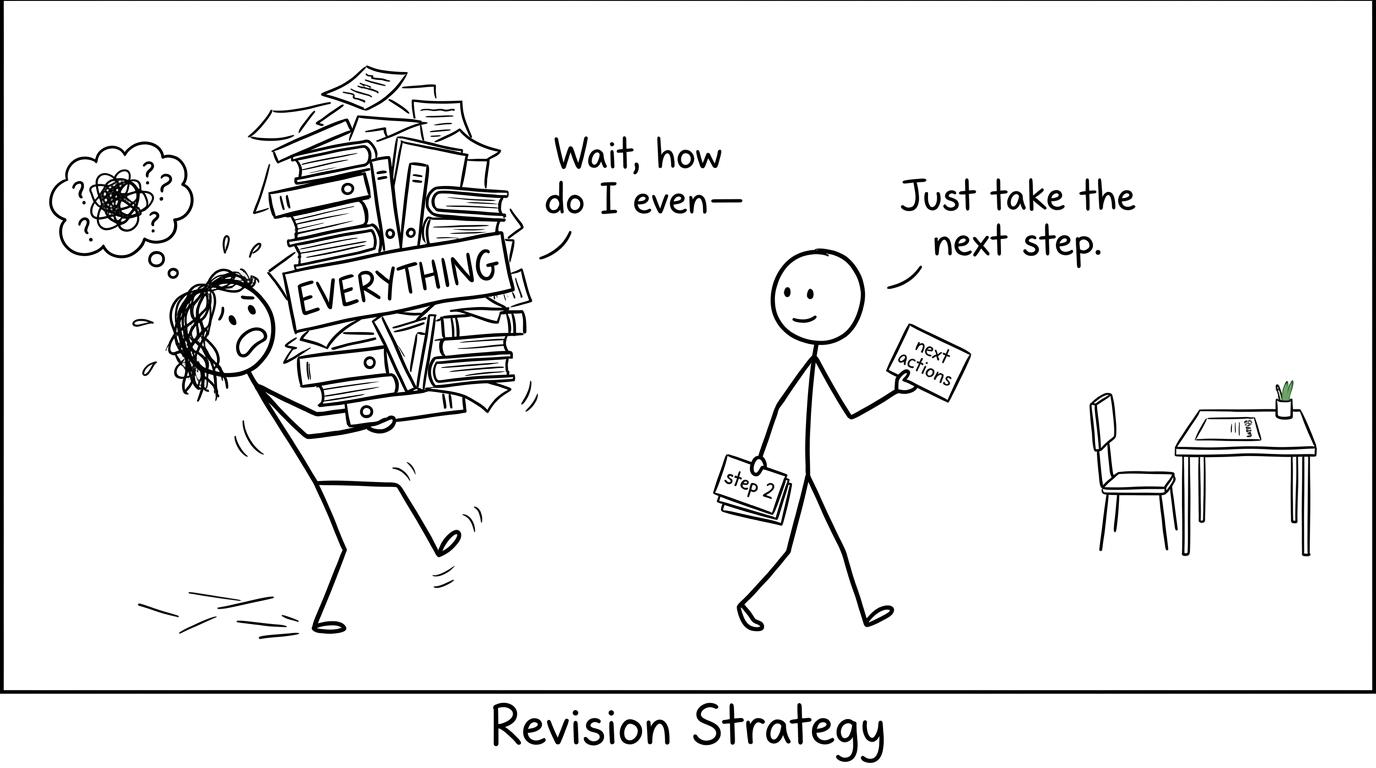 One student carries everything while another carries three calm next actions
The same principle can organise your maths week. Start from the GCSE maths revision hub, select the topics revealed by your own mock, and use revision lessons followed by practice questions. If time is limited, the GCSE one-week maths revision plan shows how to prioritise diagnosis and repair rather than trying to cover everything equally.
Retest instead of assuming the problem is fixed
Revision can feel productive because the material becomes familiar. Familiarity is not the same as being able to produce a strong answer independently.
After repairing a weakness, attempt a fresh question under tighter conditions. Do not simply rewrite the original response from memory. You need to know whether the skill transfers to a different theme, extract, poem or wording.
Look for evidence of change:
- Is the argument clearer from the beginning?
- Is textual evidence better selected?
- Does analysis explain effects rather than label techniques?
- Is context integrated only where relevant?
- Is the response complete within the available time?
For maths, this is the moment to move from a lesson into a mini test, then into paper practice. MathsGenie's past-paper platform keeps papers, mark schemes and available solutions together, while Edexcel GCSE maths past papers provide board-specific practice. The guide to when to start GCSE past papers also explains how paper practice should develop over time.
Common mistakes when using mock results
Treating the grade as a prediction
A mock captures performance on particular questions, on a particular day, under your school's assessment arrangements. Use it as a baseline, not a guaranteed final outcome.
Revising the whole subject equally
Equal revision feels fair but is rarely efficient. Give more attention to recurring weaknesses while maintaining areas that are already secure.
Copying teacher feedback without converting it
“Analyse more” is a comment, not yet a plan. Convert it into an action such as practising explanations of how specific language choices shape meaning.
Memorising content without practising retrieval
Recognising a quotation on a page is easier than selecting it during an exam. Close the notes, answer from memory, check and repeat.
Writing more without checking quality
Volume alone does not guarantee improvement. Every substantial attempt should lead to feedback, a correction and a later retest.
Ignoring what went well
Your strongest response contains useful evidence too. Identify what made it successful so that you can repeat the approach deliberately.
Turn one result into your next useful action
Your mock result has already happened. Its real value now depends on what it changes.
Read the grade in context. Analyse the marks by skill. Choose three priorities. Practise narrowly, then retest independently. That sequence replaces vague worry with decisions you can control.
And when you apply the same system to maths, MathsGenie gives you everything needed to complete the loop: free revision lessons, practice questions, mini tests, past papers, predicted papers, mark schemes and video solutions. Open the GCSE maths revision hub, choose the first weakness revealed by your latest assessment and begin with one focused session. A mock should not merely tell you how you performed. It should improve what you do next.