GCSE English Literature Exam Time of Day Explained
GCSE English Literature exam time of day: discover whether morning or afternoon affects performance and how to prepare confidently for either session.

The night before an exam, the mind becomes strangely interested in details it previously ignored. Is a morning paper harder because you are tired? Will an afternoon paper catch you after your concentration has faded? Could the timetable affect your grade?
The short answer to the GCSE English Literature exam time of day question is reassuring: morning versus afternoon may influence how alert you feel, but there is no strong evidence that either session automatically produces better GCSE English Literature results. Your sleep, preparation, food, stress and familiarity with timed writing are likely to matter more.
The useful goal is not to secure the supposedly perfect session. You cannot control the national timetable. You can prepare your brain to perform when the exam is actually taking place.
The quick answer
Before exploring the evidence, here is what GCSE students need to know:
- There is no universally superior time for an English Literature exam.
- Research suggests that time of day can affect attention, but the effect varies between students and tasks.
- Research on general school tests cannot automatically be applied to a UK GCSE Literature paper.
- Your school or college will confirm the exact start time and arrival arrangements.
- Sleep, calm preparation and realistic timed practice are more controllable than the timetable.
- If you also have maths papers approaching, use the same routine with GCSE maths revision lessons and practice questions.
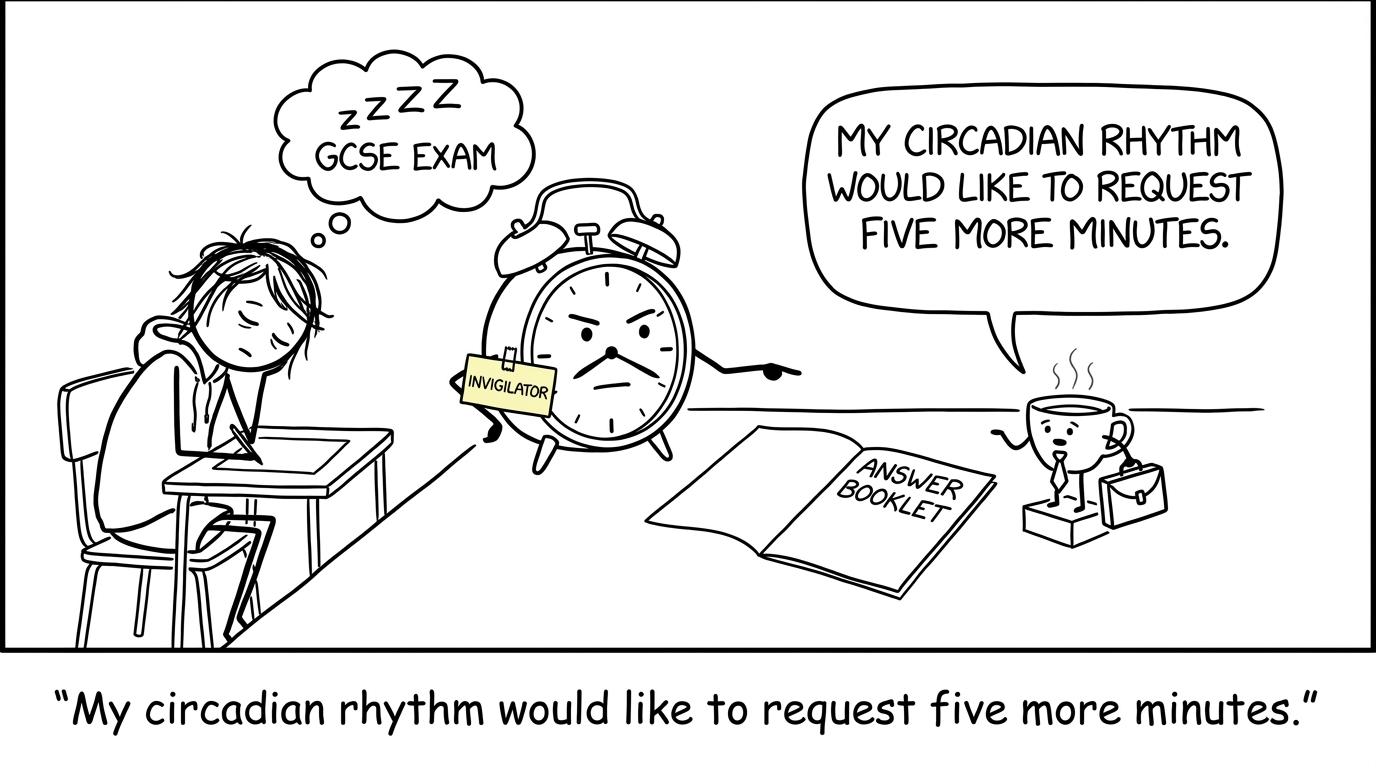 A sleepy student asks an alarm clock for five more minutes before an exam
Does a morning or afternoon exam affect performance?
It can affect how you feel. That is not quite the same as determining how well you perform.
A morning exam may begin while a student still feels sleepy, particularly after a late night. An afternoon exam creates different difficulties: there is more time to worry, lunch can leave you sluggish, and an entire morning of lessons or revision may consume some attention.
Research into school testing offers a mixed and qualified picture. A widely discussed study of Danish school tests found an association between later test times and slightly weaker performance, while breaks appeared to reduce the effect of mental fatigue. However, those tests involved a different education system, a broad age range and different kinds of assessment. It would be misleading to treat the findings as proof that a morning GCSE English Literature paper is easier.
Other research into adolescent sleep and chronotypes suggests that teenagers do not all reach peak alertness at the same time. Some students function well early; others become mentally sharper later. Performance may also depend on the task. Recalling a quotation, planning an argument and sustaining analytical writing are not identical cognitive demands.
The fairest conclusion is modest: time of day can be one influence, but it is not destiny. There is no reliable basis for assuming that every student would gain more marks in one session than the other.
Why exam timetables use morning and afternoon sessions
GCSE examinations are nationally coordinated. Awarding organisations such as AQA, Edexcel, OCR and Eduqas publish timetables showing whether a paper belongs in a morning or afternoon session. Schools then provide candidates with their exact arrival and start-time instructions under the relevant examination regulations.
This coordination protects the security and fairness of the papers. It also means that students generally cannot choose whether to sit a scheduled paper in the morning or afternoon because one feels more convenient.
Always use your current candidate timetable or school-issued examination information. Do not rely on a friend's timetable, a social-media post or a schedule from a previous year. If an examination clashes with another paper or you have approved access arrangements, your school’s exams officer will explain the arrangements that apply to you.
The same principle applies to maths. Check the date, session, paper and tier carefully before using GCSE maths past papers to rehearse the experience.
What matters more than the session
Students understandably focus on timing because it is visible. Yet several quieter factors are easier to influence and often more important.
Sleep and wake time
One unusually late night is rarely improved by setting an unusually early alarm for last-minute revision. A more useful approach is to keep sleep and wake times reasonably consistent in the days before the examination.
For a morning paper, allow enough time to wake fully, eat if that is part of your normal routine and travel without rushing. For an afternoon paper, still get up at a sensible time. Sleeping far later than usual can leave you groggy rather than refreshed.
Familiarity with the examination window
Revision usually happens when it is convenient. Performance, however, is required at a fixed time.
Once you know your session, complete some timed essay planning or sustained writing at approximately that part of the day. This is not because your brain must be trained to a precise minute. It is because familiarity removes surprises. You learn whether you need more time to become alert in the morning or whether concentration tends to dip after lunch.
Maths students can use the same strategy with GCSE predicted papers. Sit a complete paper under timed conditions during the relevant session, then use the mark scheme and video solutions to identify what needs attention.
Food and hydration
Exam day is not a good moment for experiments. Choose familiar food that is comfortable for you, and follow your school’s rules about water in the examination room.
For an afternoon exam, avoid turning lunch into an event so large that the body seems to redirect every available resource towards digestion. For a morning exam, do not force down an unfamiliar breakfast because somebody online called it the perfect exam meal. Consistency is usually more helpful than novelty.
Anxiety before the paper
Afternoon examinations leave more waiting time. That can become useful preparation or several hours of escalating worry.
Decide in advance what the morning will contain. A short review of themes, quotations or essay structures may help. Attempting to relearn an entire text usually will not. Stop revision early enough to arrive calmly and follow your school’s instructions.
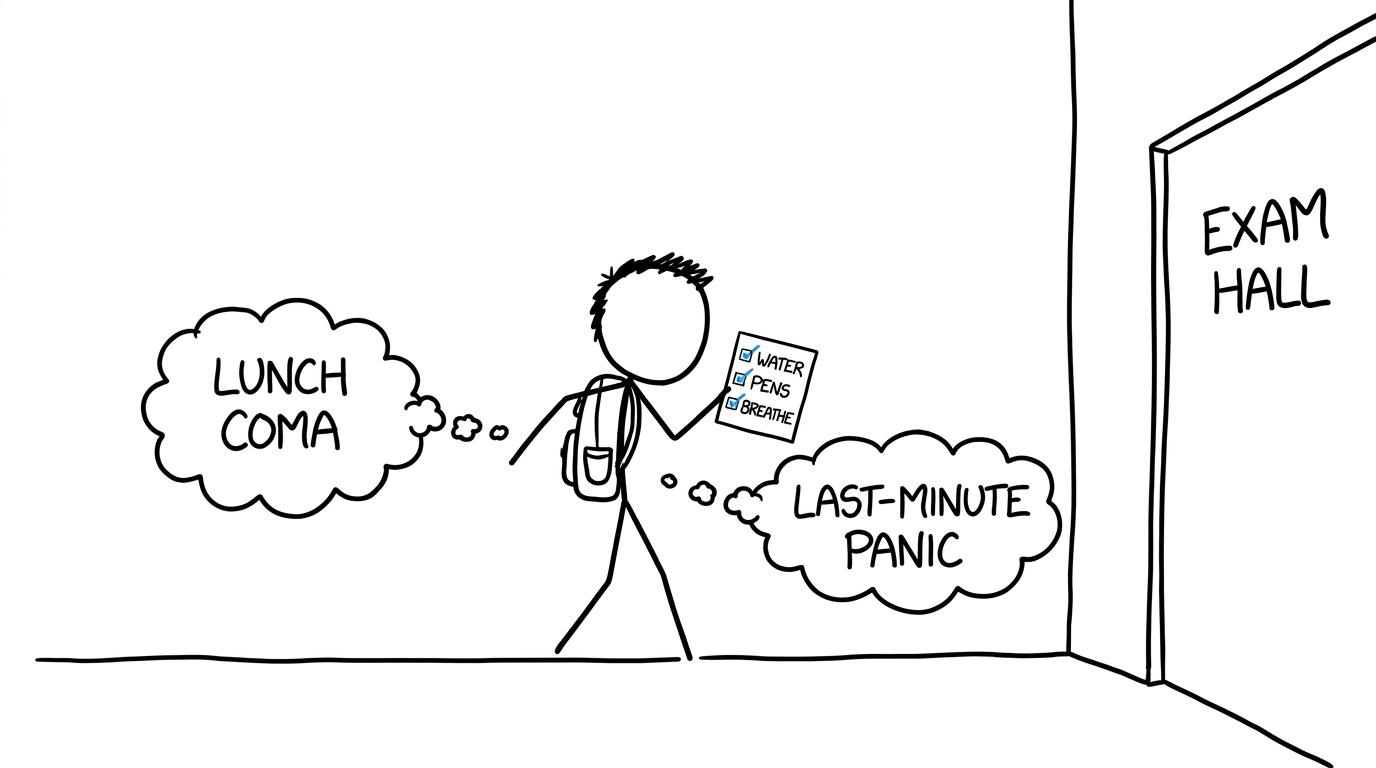 A student avoids lunch coma and last-minute panic with a simple exam checklist
Preparing for a morning English Literature exam
A morning paper rewards organisation before the day begins. Pack permitted equipment, check travel arrangements and confirm where you need to report. Your school will tell you what can be taken into the examination room.
Use this simple routine:
- Wake with enough time to become properly alert.
- Follow a familiar breakfast and hydration routine.
- Review only a small, pre-selected set of prompts if revision settles you.
- Arrive at the time specified by your school.
- Use the opening moments of the paper to read instructions carefully and settle into the task.
The biggest temptation is sacrificing sleep to secure another hour of revision. That trade can feel productive because the extra hour is visible. The cost to concentration the next morning is less visible.
Preparing for an afternoon English Literature exam
The challenge of an afternoon paper is managing the hours before it. Treat that time as part of the examination plan rather than an empty space to fill.
A helpful approach is to:
- get up at your normal time rather than shifting the whole day;
- complete only targeted, low-pressure revision;
- take a genuine break before leaving;
- eat a familiar lunch that does not feel excessively heavy;
- avoid lengthy post-mortems about any morning examination;
- arrive according to your school’s instructions.
If you have another paper in the morning, mentally close it when it ends. Comparing answers in a corridor cannot recover marks, but it can carry distraction into the next session.
A Level students face the same problem during a busy timetable. A Level maths revision resources and A Level past papers can be used to build realistic session practice rather than relying only on short questions at convenient times.
Build an exam routine that works for every subject
The deeper lesson is not really about English Literature. It is about reducing the number of decisions you must make when pressure is high.
Create one repeatable process for English, maths and your other GCSE subjects:
- confirm the paper, date and session;
- identify the knowledge or skills still needing attention;
- practise under timed conditions;
- mark the work honestly;
- revisit weak areas;
- prepare equipment and travel arrangements the previous evening.
For maths, the MathsGenie GCSE revision hub organises revision lessons, videos and exam-style practice by topic and grade. Past papers then test whether separate skills can be selected and applied when the method is not named for you.
That shift matters. Revision can create the comforting feeling that something looks familiar. An examination asks whether you can produce the response independently, at the required time and under pressure.
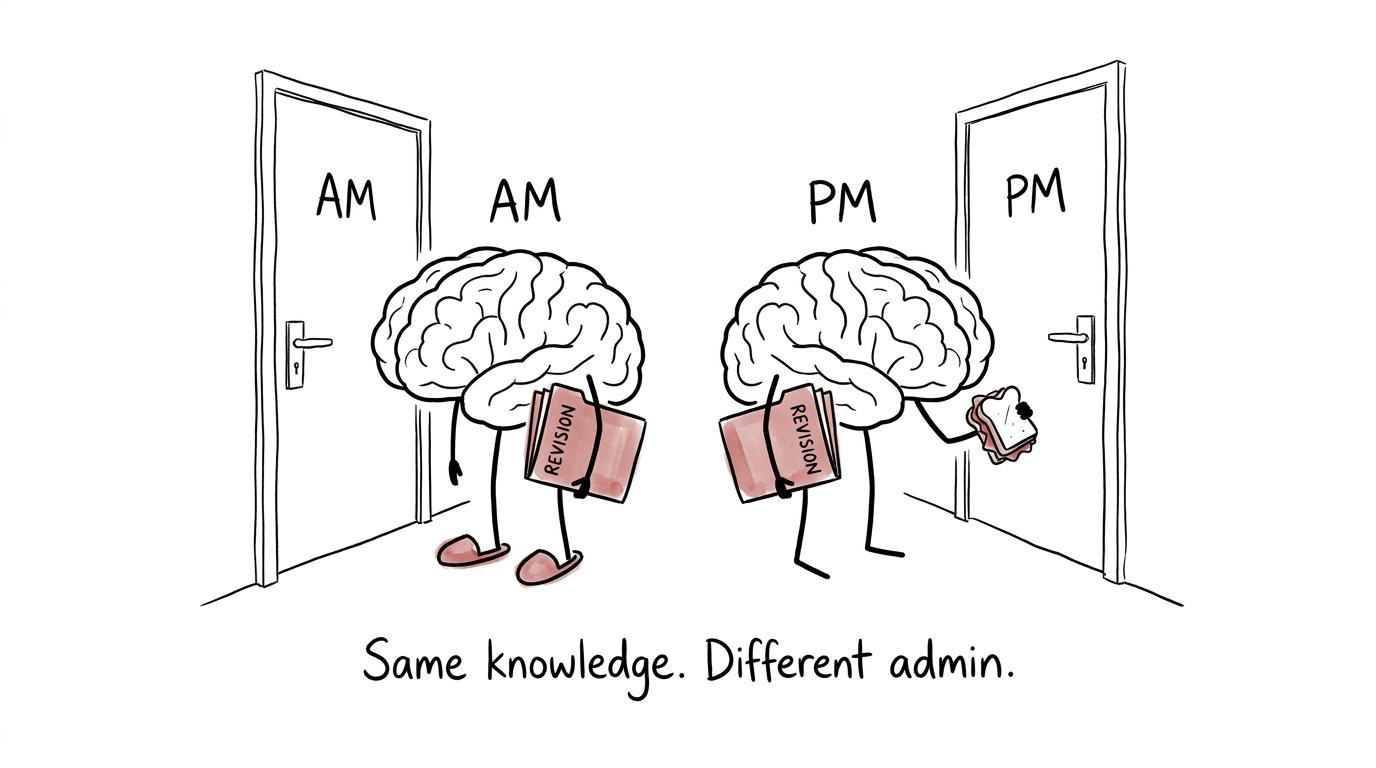 Two identical brains discover that morning and afternoon exams involve the same knowledge but different distractions
Common mistakes when thinking about exam timing
Assuming an afternoon paper will be easier
The paper is not made easier because it begins later. Difficulty and grade boundaries are handled through awarding processes, not through individual preferences about the clock.
Changing your entire routine the night before
An extreme early bedtime, unfamiliar meal or sudden caffeine habit can make the day less predictable. Use routines your body already knows.
Revising intensely until the examination starts
Last-minute review can help when it is selective. Continuous cramming can increase anxiety and mental fatigue, particularly before an afternoon session.
Practising only in short bursts
Knowing quotations or individual techniques is not the same as sustaining a complete analytical response. Similarly, answering isolated maths questions does not fully reproduce a whole paper. Include some full timed practice alongside topic revision.
Trusting an unofficial timetable
Exam dates and sessions can change between series. Your school’s current candidate timetable and instructions are the sources to follow.
Treating tiredness as proof that failure is inevitable
Feeling nervous, sleepy or imperfectly prepared does not tell you what grade you will receive. Begin with the paper in front of you. Read carefully, plan sensibly and collect the marks available.
Make the timetable a detail, not a verdict
So, does the time of day matter? A little, perhaps, because human attention is not perfectly constant. But there is no convincing reason to believe that morning or afternoon automatically decides a GCSE English Literature result.
The timetable is fixed. Your response to it is trainable.
Confirm your session, rehearse at a similar time, protect your sleep and keep exam-day routines familiar. Then apply the same calm process to maths: work through MathsGenie’s free revision lessons and practice questions, test yourself with past papers, and use predicted papers, mark schemes and video solutions to sharpen your exam technique.
Start with the free GCSE maths revision resources, choose the topic that currently costs you marks, and make the next revision session specific. Confidence tends to arrive after useful practice, not before it.