GCSE English Literature Exam Season Results
GCSE English literature exam season results explained: discover whether summer or winter sittings change grades, boundaries or your best revision plan.
A summer exam can feel different from a winter one. The room is warmer, the school year has a different rhythm, and your preparation may have lasted longer. It is easy to assume that the season must influence the grade too.
The direct answer on GCSE English literature exam season results is reassuring: the season itself should not make a grade easier or harder to achieve. Awarding organisations are expected to maintain comparable standards between available exam series. However, for mainstream GCSE English Literature in England, the more important fact is that students normally sit the qualification in the summer. The regular November GCSE series is for English Language and maths, not English Literature.
Where a particular specification or exceptional arrangement offers both summer and winter assessment, differences in published results usually reflect the students entering, the papers and the circumstances of the sitting, not a deliberate seasonal advantage.
The short answer: does the exam season affect results?
Keep these points in mind:
- Mainstream AQA, Pearson Edexcel, OCR and Eduqas GCSE English Literature examinations are normally taken in the summer series.
- In England, the routine November GCSE series covers English Language and mathematics for eligible students aged 161616 or over.
- A winter or autumn English Literature sitting may exist under a different qualification, jurisdiction or exceptional arrangement, so you must check the exact specification.
- When two series are available, grade boundaries can differ because the papers differ in difficulty.
- Different boundaries do not mean one series was intentionally easier.
- Overall pass rates can vary because the groups of candidates are not alike.
- Your preparation, knowledge and exam technique matter more than the month printed on the timetable.
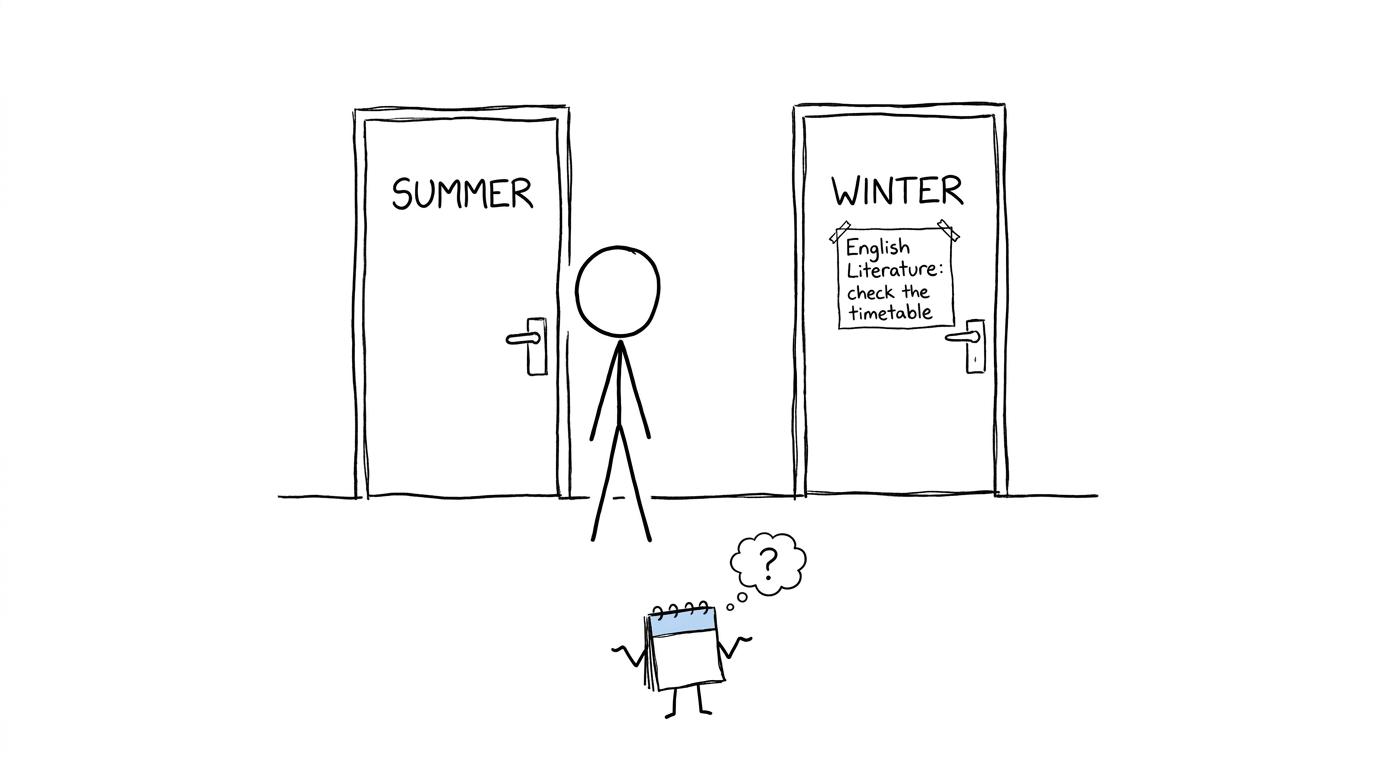 A student choosing between summer and winter exam doors while a calendar points to the timetable
Is there a winter GCSE English Literature exam?
For most students following a mainstream GCSE specification in England, no regular November English Literature sitting is available. GCSE English Literature is assessed in the May and June examination window. If it needs to be retaken, the next standard opportunity is generally the following summer.
This is easily confused with GCSE English Language. English Language and maths are routinely available in November, subject to eligibility rules. Ofqual’s current guidance states that these November entries are restricted to students who were aged 161616 or over at the relevant cut-off date.
The distinction matters. “English” on a college timetable might mean English Language, while an online article may be discussing an International GCSE or an arrangement outside England. Before making plans, confirm all of the following with your school, college or examination centre:
- the full qualification title;
- the awarding organisation;
- the specification code;
- the available examination series;
- whether you are eligible to enter;
- whether every required component is available.
Exceptional autumn examinations held after pandemic disruption should not be treated as evidence of a normal winter route. They were created for unusual circumstances and do not establish an enduring seasonal pattern.
What happens where summer and winter are both options?
Suppose your exact qualification genuinely permits both. The awarding organisation still aims to apply the same grade standard in each series. A grade 777 should represent comparable attainment whether it was awarded in summer or winter.
That does not require identical raw-mark boundaries. Question papers cannot be perfectly equal in difficulty. After marking, awarding organisations review statistical evidence and the quality of candidates’ work around possible boundaries. A slightly more accessible paper may need a higher mark for a particular grade; a more demanding paper may need a lower mark.
This is why historical boundaries are context rather than a forecast. MathsGenie’s guide to GCSE English Literature grade boundary history shows how thresholds can move between summer series. The separate guide to GCSE English Literature marks per grade explains why you must match the boundary to the correct board, specification and series.
The boundary moves to account for the paper. The expected standard does not move simply because it is cold outside.
Why published summer and winter results may look different
National results describe groups, not the fate of an individual student. This is where apparently simple comparisons become misleading.
A summer cohort usually contains a broad population of Year 111111 students taking the qualification for the first time. A winter cohort, where one exists, may contain more resit candidates, private candidates, adult learners or students who missed an earlier series. Those groups can differ in prior attainment, preparation time and reasons for entering.
Ofqual makes the same caution when discussing the regular November English Language and maths series: its candidates are different from the summer cohort, so comparing the percentage achieving each grade does not reveal whether November is easier or harder.
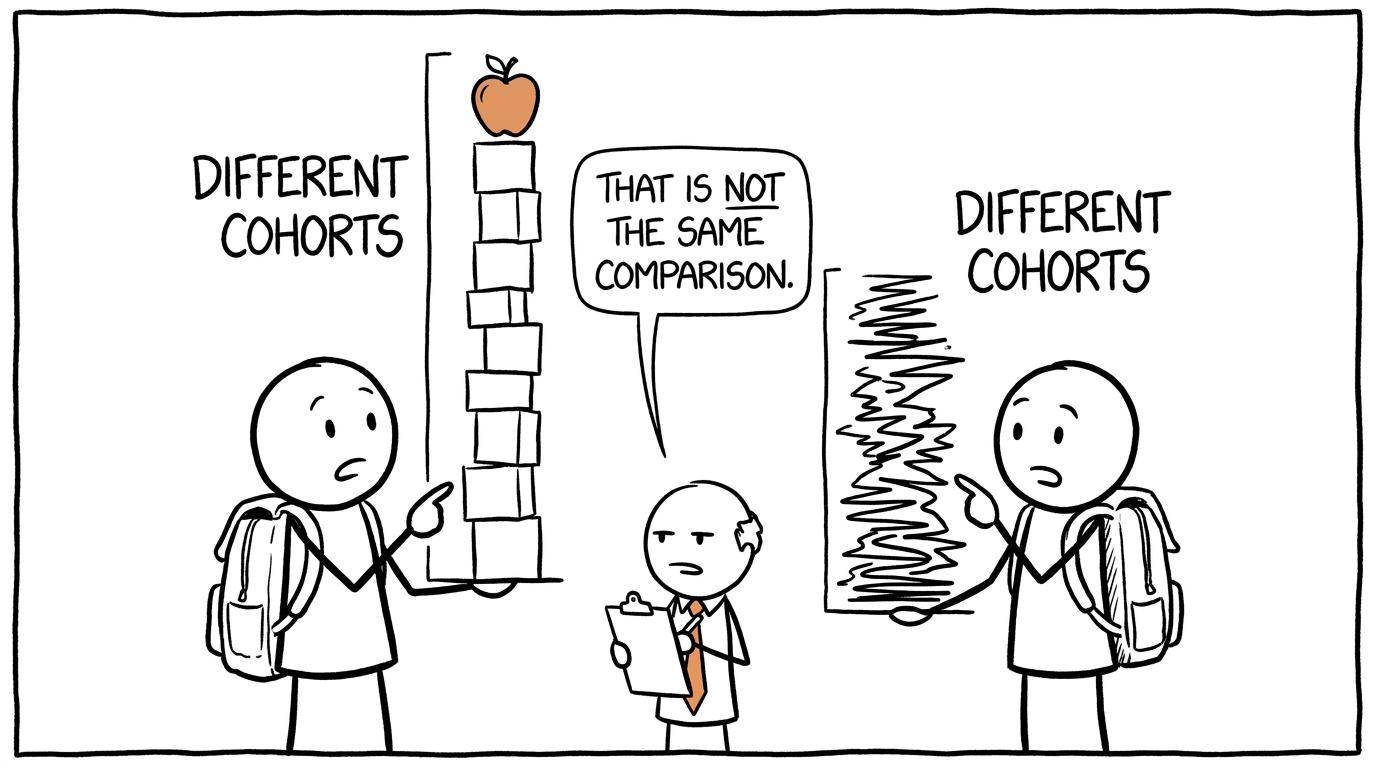 Students comparing charts for different candidate groups while an examiner questions the comparison
Three factors can therefore change headline outcomes without the season changing the grade standard:
The candidate population
A resit-heavy group is not directly comparable with a full Year 111111 cohort. It may include students trying to cross a particular grade threshold rather than candidates spread evenly across grades 999 to 111.
The question paper
Different papers create different patterns of marks. Boundaries are set after evidence from that series has been considered, rather than copied mechanically from the previous examination.
The circumstances of entry
A candidate entering later may have gained extra teaching time. Equally, they may be balancing college courses, employment or several resits. These personal circumstances affect preparation, but they are not an automatic winter penalty or bonus.
Why grade boundaries cannot prove a seasonal advantage
Students often compare two boundary documents and conclude that the series with the lower threshold was easier. The logic is backwards.
A lower boundary can be evidence that the assessment was more demanding. A higher boundary can reflect a paper on which candidates generally gained more raw marks. Boundaries help preserve the meaning of the grade across papers of varying difficulty.
You should also avoid comparing raw marks across exam boards. AQA, Edexcel, OCR and Eduqas organise their papers differently and may use different qualification totals. The useful comparison is your performance against the official overall boundary for your own specification and series.
For the latest confirmed context, use the GCSE English Literature grade boundaries guide. Treat any boundary prediction published before results day as an estimate, never as a guaranteed threshold.
What maths students should learn from this
Although the question concerns English Literature, it contains an important lesson for GCSE maths revision. Maths is available in the regular November series for eligible students, so summer-versus-November comparisons appear frequently.
The same principle applies: Ofqual maintains standards between series, while grade boundaries respond to the assessment evidence. November maths outcomes may look different because most entrants are resitting and the cohort is unlike the summer Year 111111 population.
Do not choose a series because someone claims its boundaries are “always lower”. Choose according to eligibility, readiness and the timetable agreed with your centre. Then prepare for your actual board and tier.
MathsGenie’s GCSE maths revision hub organises free lessons, worksheets, exam questions and papers by board. If you are unsure how Foundation and Higher content differs, use the GCSE maths topics by exam board and tier checklist before building your plan.
Focus on the variables you can control
The season is mostly background noise. Your actions are the useful signal.
Start by confirming the correct specification and sitting. Next, use the relevant assessment objectives or maths topic list to identify what will actually earn marks. Complete timed practice, mark it carefully and turn each error into a specific revision task.
For maths, a reliable cycle is:
- learn or revisit one method through a revision lesson;
- complete focused practice questions;
- check the mark scheme and video solution;
- record why any marks were lost;
- retest the skill with a short mixed assessment;
- apply it later in a full paper.
The Edexcel GCSE maths mini tests are useful for short checks, while Edexcel predicted papers provide fresh exam-style practice near the examination window. Predicted papers should supplement official past papers, not replace them.
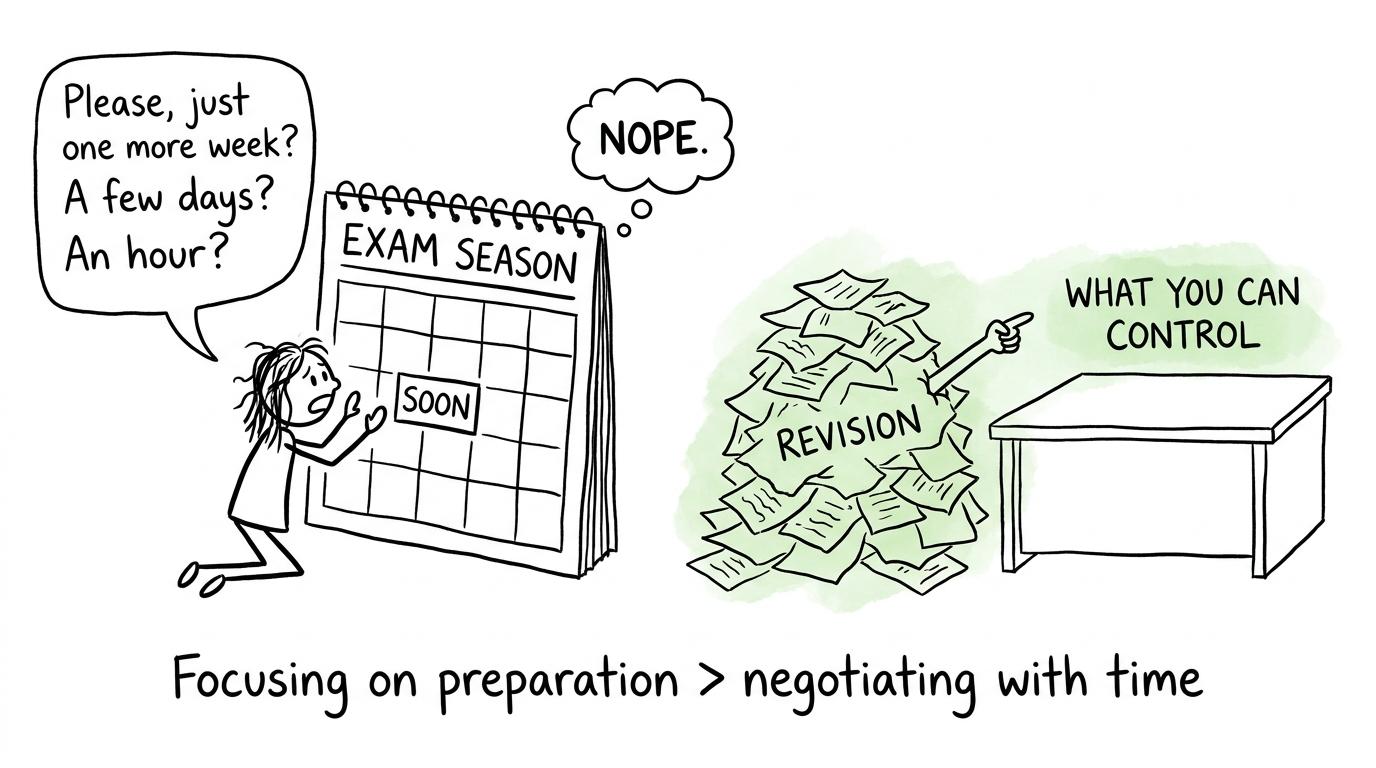 A student stops arguing with a calendar and turns towards the revision desk
Common mistakes when comparing exam seasons
Confusing English Language with English Literature
The regular November opportunity in England is for English Language and maths. Do not assume that “English resit” includes Literature.
Comparing pass rates without comparing candidates
Different cohorts produce different headline outcomes. A lower pass rate does not establish that the winter paper was harder or that grading was harsher.
Treating a lower boundary as an easier route
Boundaries respond to paper difficulty. They are not advance targets and cannot tell you which future series will feel easier.
Using the wrong board or specification
A boundary from AQA cannot be applied to an Edexcel result. Even within one board, check the qualification code, series and overall qualification boundary.
Waiting for the “better” season
Delaying revision while searching for a supposedly favourable sitting gives away the one advantage you can create: better preparation. If a resit is necessary, agree the suitable series with your centre and begin a structured plan.
A calmer conclusion
For mainstream GCSE English Literature, summer is normally the available examination season. Where summer and winter sittings genuinely exist, the awarding process is designed so that the same grade represents a comparable standard. Boundaries may change and cohort outcomes may look different, but neither fact proves a seasonal advantage.
The productive question is not, “Which month gives me the easier grade?” It is, “What can I improve before my valid examination date?”
For maths, begin with MathsGenie’s free revision lessons and practice questions, then move through mini tests, past papers, mark schemes and video solutions. Use predicted papers when the examination approaches, and place each task into the MathsGenie revision planner. If you need a disciplined paper routine, follow the guide to using GCSE past papers properly.
You cannot control the weather outside the examination hall. You can control what you practise before entering it.