GCSE English Literature Exam Dates 2026 Guide
GCSE English Literature exam dates 2026, paper times and exam-room rules, plus a clear plan for balancing Literature revision with GCSE maths confidently.
There is a particular kind of exam stress that has little to do with knowing the content. It comes from uncertainty: Which paper is first? How long is it? What time should I arrive? And where does maths fit around it?
For the main English exam boards, the GCSE English Literature exam dates 2026 were Monday 11 May for the first paper and Tuesday 19 May for the second paper. Both were scheduled for the morning. However, paper titles and durations differed between AQA, Pearson Edexcel, OCR and Eduqas, so your personalised school timetable remained the document to follow.
This guide brings together the dates, paper lengths, test-day arrangements and a practical way to protect your maths revision during a busy part of the GCSE timetable.
GCSE English Literature exam dates 2026 at a glance
The published summer timetables placed the two main English Literature examinations on the same dates across AQA, Pearson Edexcel, OCR and Eduqas.
| Exam board | First examination | Second examination |
|---|---|---|
| AQA | Monday 11 May, morning: Paper 1, one hour 45 minutes | Tuesday 19 May, morning: Paper 2, two hours 15 minutes |
| Pearson Edexcel | Monday 11 May, morning: Paper 1, one hour 45 minutes | Tuesday 19 May, morning: Paper 2, two hours 15 minutes |
| OCR | Monday 11 May, morning: Paper 1, two hours | Tuesday 19 May, morning: Paper 2, two hours |
| Eduqas | Monday 11 May, morning: Component 1, two hours | Tuesday 19 May, morning: Component 2, two hours 30 minutes |
These dates apply to the main qualifications offered by those boards. Qualifications in Wales and Northern Ireland may use different structures, units or dates. Always check the exam board, specification code and paper code shown on your statement of entry.
Published morning sessions normally use a start time of 9.00 am, although centres can make limited adjustments and many schools ask students to arrive considerably earlier. Follow the time printed on your school timetable rather than assuming that every centre begins at exactly the same moment.
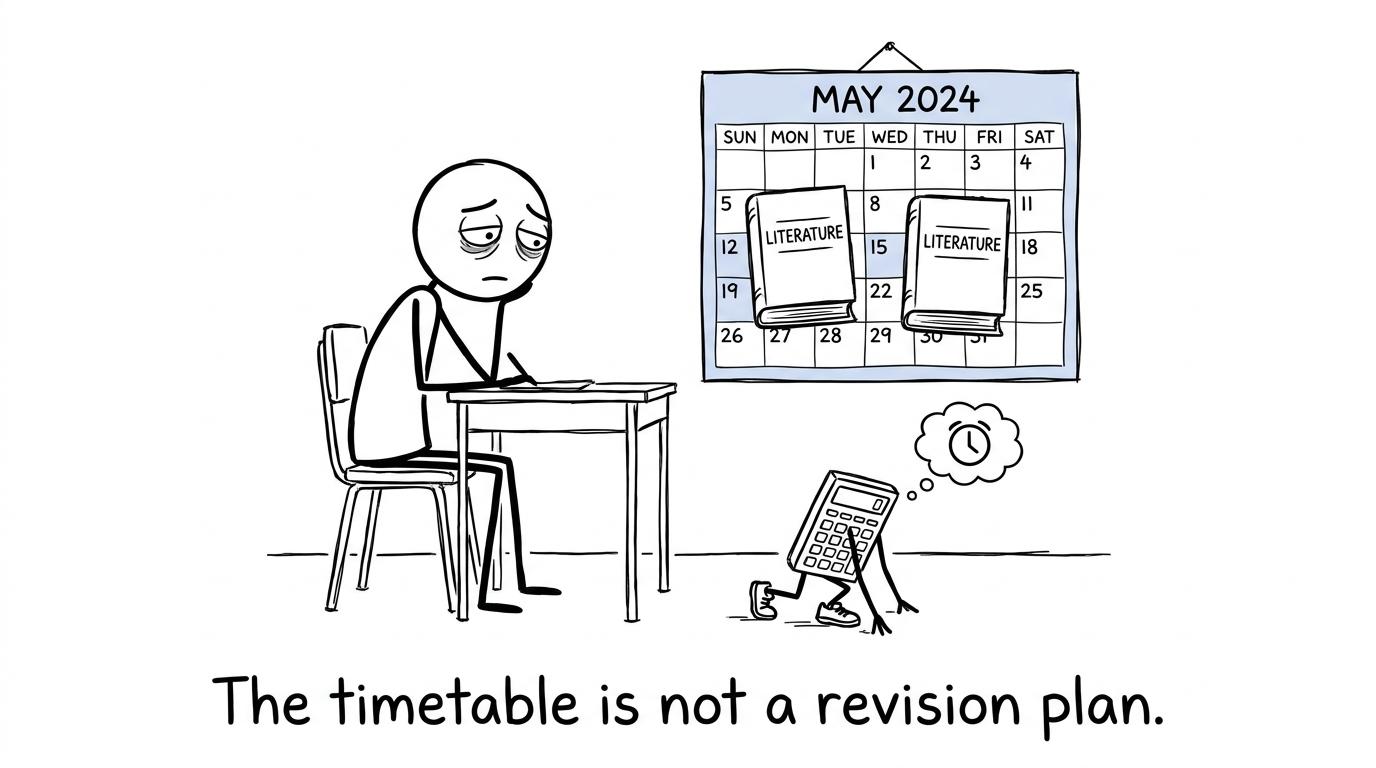 A student discovers that knowing the timetable is not the same as having a revision plan
Your essential pre-exam checklist
Before the first Literature paper, make sure you can answer every item below without searching through emails on the morning of the exam:
- Which exam board and specification are you taking?
- What is the exact paper or component code?
- Which texts, poems and Shakespeare play have you prepared?
- Where is your examination room or meeting point?
- What time does your school expect you to arrive?
- What is your candidate number?
- Have you checked any approved access arrangements with the exams team?
- Do you have at least two working black pens?
- Have you removed your phone, watch, earbuds and revision notes before entering?
- Do you know whom to contact if illness or disruption makes you late?
Do not rely only on a date saved months earlier. Exam boards can update timetable documents, and your school may have venue or arrival instructions that do not appear in the national timetable.
What each English Literature paper covers
The common dates can make the qualifications look identical. They are not. Text combinations, assessment objectives, extract arrangements and question choices depend on your board and specification.
AQA English Literature
AQA Paper 1 covers Shakespeare and the nineteenth-century novel. It lasts one hour 45 minutes. Paper 2 covers modern texts and poetry and lasts two hours 15 minutes.
The second paper is longer because it combines several areas of the course. Your revision should therefore include the content as well as the stamina required to organise several extended responses within one sitting.
Pearson Edexcel English Literature
Edexcel Paper 1 covers Shakespeare and post-1914 literature. Paper 2 covers the nineteenth-century novel and poetry since 1789. The papers last one hour 45 minutes and two hours 15 minutes respectively.
Do not use an AQA revision timetable simply because a friend studies the same play. The assessment structure and permitted choices may be different.
OCR English Literature
OCR Paper 1 is Exploring Modern and Literary Heritage Texts. Paper 2 is Exploring Poetry and Shakespeare. Each lasts two hours.
OCR students should use the wording from their own specification and classroom materials when planning revision. Generic labels such as “the poetry paper” can hide important differences in what must be answered.
Eduqas English Literature
Eduqas Component 1 lasts two hours, while Component 2 lasts two hours 30 minutes. That longer second component makes pacing and concentration especially important.
English Literature is generally assessed through closed-book examinations for these specifications, although papers may provide extracts or other material where required. Prepare according to the exact rules for your paper rather than expecting to take your studied text into the room.
How the exam morning usually works
A calm exam morning is mostly built the evening before. Pack what you need, check transport, set an alarm and stop revising at a sensible time. The final hour of tired rereading rarely compensates for arriving exhausted.
At school, you will usually report to a designated area before being taken into the examination room. Staff may check attendance, seating information and candidate details. Once you enter, silence matters: JCQ rules prohibit communicating with or disturbing another candidate.
At your desk:
- check that the paper shows the correct subject, board and component;
- write the required candidate and centre information;
- listen to the invigilator before opening the paper;
- read the instructions and question choices carefully;
- raise your hand if you need help with procedure, extra paper or illness.
Invigilators cannot explain a question or tell you whether your interpretation is correct. They can help with practical issues, such as a missing page or the need for another answer booklet.
If you feel unwell, tell an invigilator immediately. If illness or an emergency affects you before arriving, contact your school’s exams team straight away. A missed examination cannot simply be taken on another convenient day, and the national contingency session is not a personal resit date.
What must stay outside the exam room
For examinations held during the 2025/26 academic year, JCQ rules prohibit candidates from possessing unauthorised materials and devices. This includes:
- mobile phones, even if switched off;
- all watches, including analogue watches;
- earbuds, headphones and music players;
- smart glasses, tablets and other smart devices;
- revision notes, books or loose papers not authorised for the examination.
Possession can be treated as breaking the rules even when you did not intend to use the item. Use your school’s collection or storage system and check your pockets before entering.
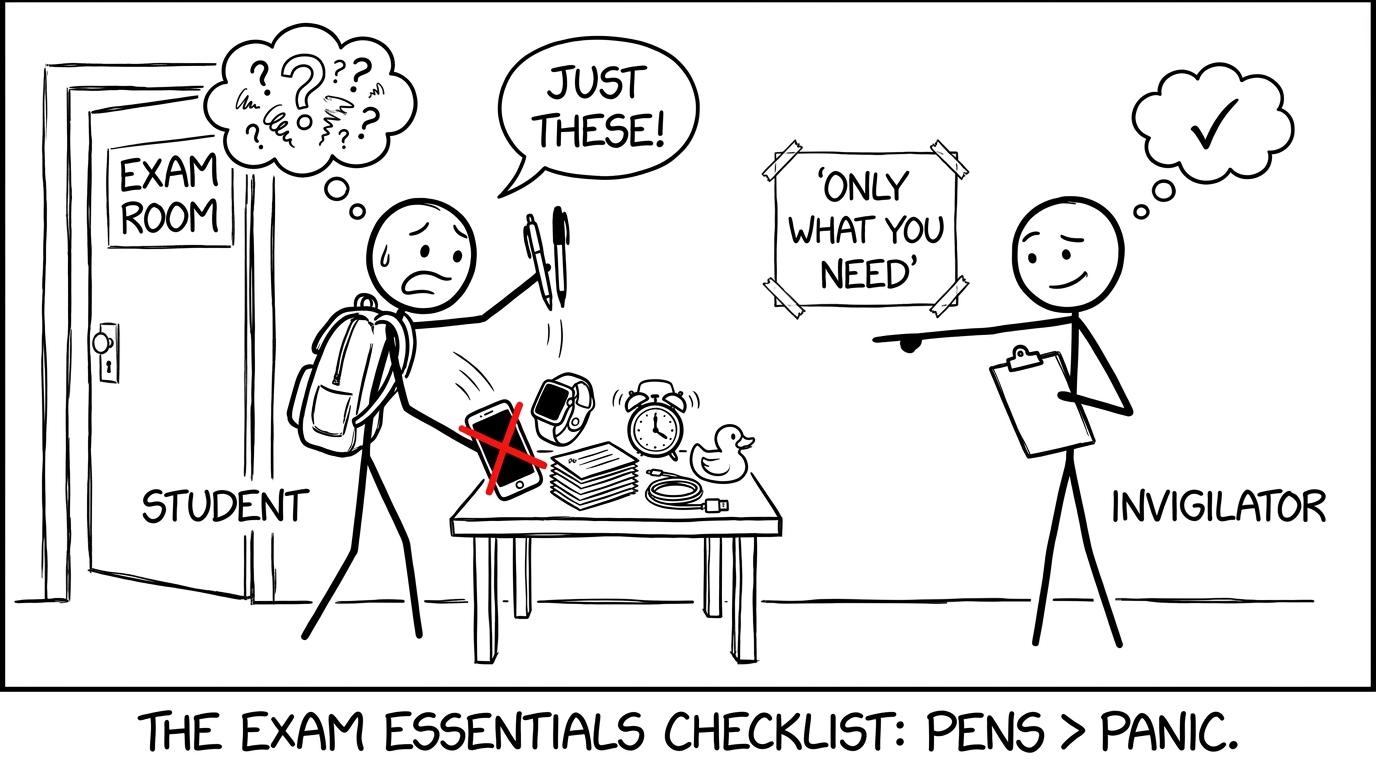 A student removes an impressive collection of forbidden gadgets before the exam
Bring black pens and any other equipment specifically requested by your centre. Water arrangements vary, although schools commonly require a clear bottle with labels removed. Your school’s candidate handbook should settle any uncertainty.
How Literature fits around GCSE maths
For students also preparing for maths, the calendar becomes important immediately. AQA, Pearson Edexcel and OCR scheduled their first GCSE Maths examination for the morning of Thursday 14 May 2026, only three days after the first Literature examination. The remaining maths mornings were Wednesday 3 June and Wednesday 10 June.
The exact calculator order differs. AQA and Edexcel begin with a non-calculator paper, whereas OCR students sit a calculator paper first and their non-calculator paper second. Eduqas uses a different two-component structure. Check your own board before organising equipment or timed practice.
The wrong response to a crowded timetable is to abandon one subject until the other is over. A better plan uses handovers:
- In the week before Literature Paper 1, keep one short daily maths session.
- After the Literature examination, take a proper break before switching subjects.
- Use the following two evenings for focused maths preparation rather than an unfocused full-course review.
- After the first maths paper, return to Literature Paper 2 while maintaining brief maths retrieval.
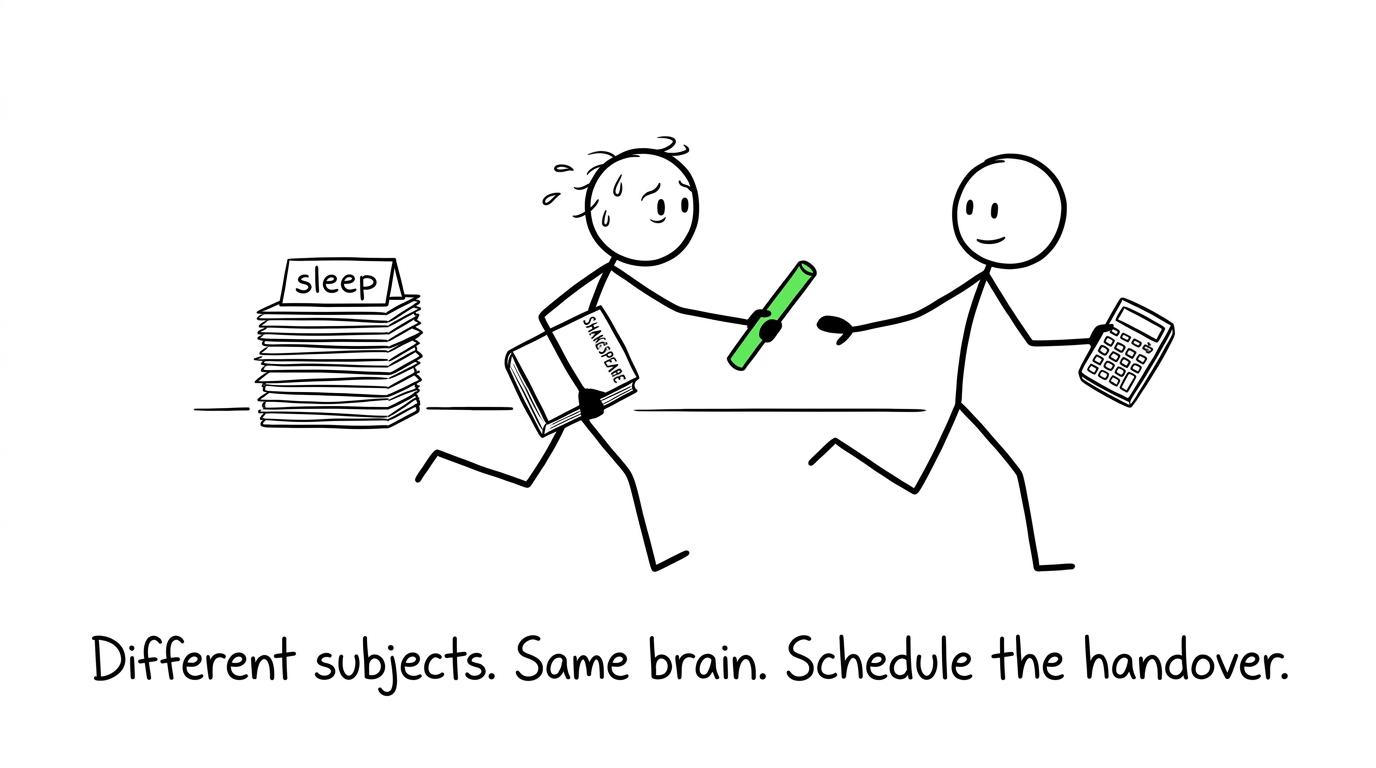 Literature and maths revision pass the baton while sleep waits behind them
The GCSE Maths revision hub lets you choose your board and move between revision lessons, exam questions and papers. When time is limited, use a mini test or a tightly selected topic set rather than opening a full paper you cannot review properly.
If the first maths paper is approaching, the GCSE maths night-before plan provides a calm checklist. Students building a longer schedule can use the guidance on when to begin GCSE past papers.
A revision plan between the two Literature papers
There are eight calendar days between the two English Literature examinations. That gap looks generous until maths, science and other subjects begin claiming pieces of it.
Start by placing every fixed examination on one calendar. Then assign short, specific tasks. “Revise English” is too vague. “Recall five quotations for one character, plan one poetry comparison and check it against the assessment objectives” creates a finish line.
Use the same principle for maths. Select a weak topic, complete practice questions, mark them and record the correction. The article on turning maths notes into active recall explains how to replace passive reading with retrieval.
As maths papers approach, Edexcel GCSE Maths predicted papers can provide fresh timed practice for Edexcel students. Predicted papers are practice resources, not promises about what will appear. Their value comes from marking them carefully and repairing the weaknesses they expose.
Common mistakes before test day
Remembering the date but not the paper
Knowing “English is on Monday” is insufficient. Confirm the board, paper code, duration and content. English Language and English Literature are separate qualifications with different examinations.
Assuming every board has the same structure
The main Literature dates align, but the content and durations do not. Revise from resources matched to your specification.
Taking a watch or switched-off phone inside
All watches and phones are unauthorised. “I was not using it” does not make possession acceptable.
Revising Literature at the expense of maths
Maths Paper 1 followed soon after Literature Paper 1 for several major boards. Protect short maths sessions throughout the English revision period.
Completing papers without reviewing mistakes
A marked paper should produce a list of actions. The guide to using Edexcel GCSE Maths past papers properly shows how to turn lost marks into targeted revision.
Making travel plans before the contingency date
Wednesday 24 June 2026 was the designated contingency day for national or significant local disruption. Candidates were required to remain available through that date, even if their personal timetable appeared to finish earlier.
Turn the timetable into a plan
Exam dates matter because they give revision a shape. Literature Paper 1 arrives, maths follows, Literature Paper 2 comes next, and the rest of the season continues. The goal is not to treat every subject as an emergency. It is to know when each subject needs your fullest attention while keeping the others warm.
Write the dates down. Confirm them against your school timetable. Pack carefully and learn the exam-room rules before they become a source of stress.
Then use MathsGenie’s free GCSE maths resources to keep maths moving alongside English: begin with revision lessons and practice questions, check progress with mini tests, and build exam readiness through past papers, predicted papers, mark schemes and video solutions. A clear timetable tells you when the exam happens. A good revision routine helps you arrive ready.