GCSE English Literature Cross-Curricular Overlap
GCSE English literature cross curricular overlap can save revision time. See which skills transfer to maths, history and science, and what stays separate.
Revision can feel strangely repetitive. In English Literature, you explain how evidence supports an interpretation. In history, you build an argument from sources. In maths, you present a chain of reasoning. The subjects look separate on your timetable, yet some of the thinking travels between them.
That is the useful truth behind GCSE English literature cross curricular overlap: it can reduce duplicated revision, but only when you separate transferable skills from subject-specific knowledge. Context from history may deepen your reading of a novel, while clear reasoning may improve both essays and mathematical explanations. Neither replaces learning quotations, historical evidence or mathematical methods.
The goal is not to revise several subjects at once. It is to make each revision session do more than one job where that overlap is genuine.
Your cross-curricular revision checklist
Before combining two subjects, ask:
- Is the knowledge genuinely shared? A historical period may support a text you are studying.
- Is the skill transferable? Selecting evidence, explaining reasoning and evaluating claims appear across several GCSEs.
- Are the exam requirements different? Similar thinking can still require very different answers.
- Have you checked your specification? Edexcel, AQA, OCR and Eduqas may use different texts, paper structures and question wording.
- Can you test the benefit? Use an exam question or mark scheme rather than assuming the connection helped.
If the answer to the final question is no, you may simply be placing two folders on the same desk.
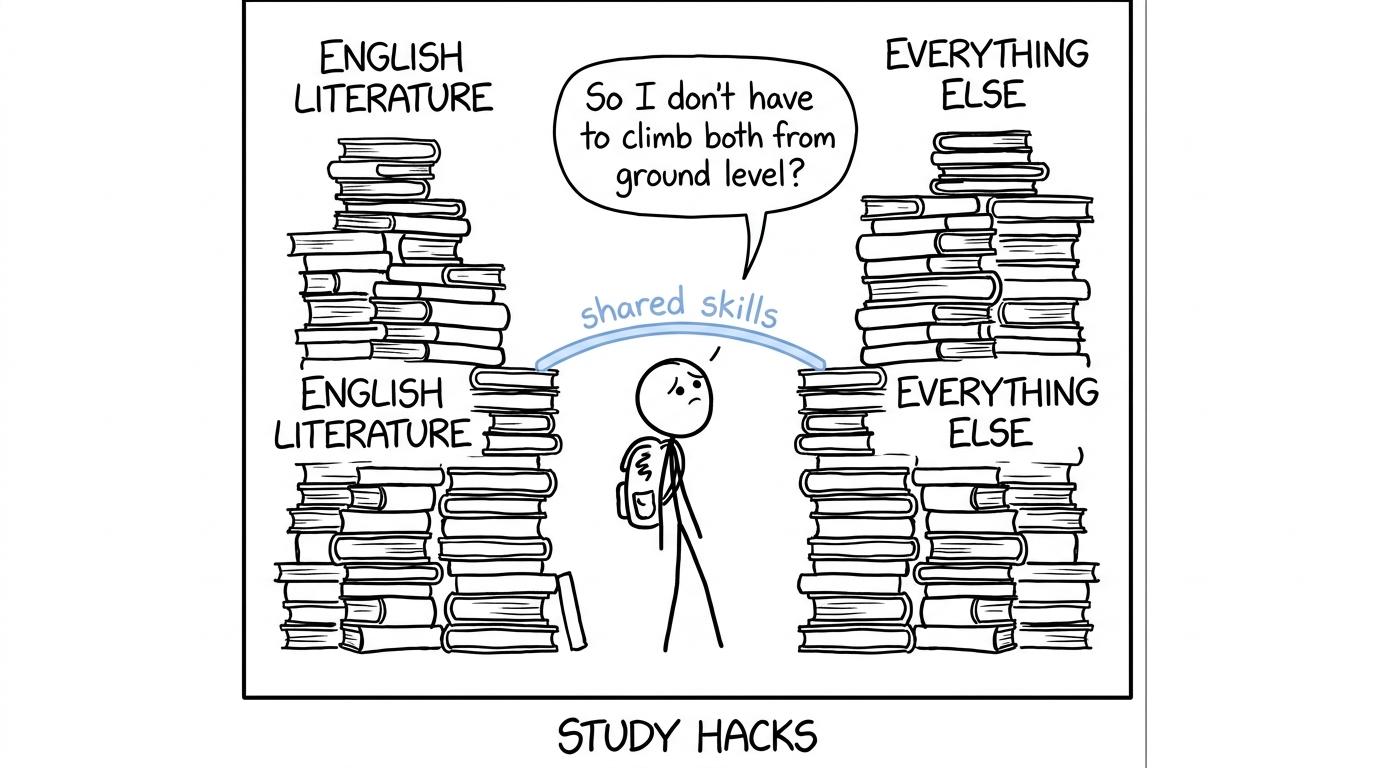 A student discovers a shared-skills bridge between revision piles
Where English Literature genuinely overlaps
GCSE English Literature assessment rewards understanding and responding to texts, supporting interpretations with references, analysing language, form and structure, and understanding relationships between texts and their contexts. Those demands create useful connections with other subjects, although the strength of each connection varies.
History and literary context
History offers the clearest knowledge overlap. A text shaped by industrialisation, social inequality, conflict, empire, gender expectations or political change may become easier to interpret when you understand its period.
The important word is interpret. Historical knowledge earns its place in literary revision when it helps explain a writer's choices, a character's position or how an audience might respond. A page of disconnected dates is not automatically useful literary context.
The transfer works in the other direction too. Literature makes broad historical ideas feel human. A social structure that seems abstract in a history textbook may become visible through who has power, who speaks and whose choices are restricted within a text.
Keep the subjects distinct at the point of assessment. History requires precise evidence used for the particular question. English Literature requires analysis of the text. Context should illuminate the writing rather than replace close analysis.
Religious Studies, ethics and big ideas
Many literary texts explore responsibility, justice, guilt, redemption, prejudice, free will and the use of power. These ideas also appear in Religious Studies and ethics.
This overlap helps you form sharper questions. Is a character morally responsible for an outcome? Does the text present justice as legal, social or personal? Is change motivated by fear, compassion or self-interest?
However, thematic familiarity is not subject knowledge. In Religious Studies, you may need accurate teachings, beliefs and contrasting viewpoints. In literature, you must return to the words and construction of the text. One subject can enrich the question you ask; it cannot supply the evidence required by the other.
English Language and precise communication
English Language and English Literature share reading and writing habits: selecting relevant evidence, analysing choices, organising ideas and communicating accurately. Revision of sentence control, analytical vocabulary and paragraph structure can therefore support both.
The distinction matters. Literature focuses on prescribed literary texts and interpretations. Language papers assess their own reading and writing tasks. Do not assume that one memorised paragraph format will fit every question.
A better shared habit is simpler: make a claim, choose only the evidence that serves it, explain the connection, and check whether each sentence advances the answer.
Drama, art and media
If you study a play, drama can clarify that it was written for performance rather than silent reading. Entrances, exits, pauses, staging and audience knowledge can shape meaning. Art and media may also strengthen your awareness of composition, viewpoint, symbolism and representation.
These are interpretive lenses, not shortcuts. Watching an adaptation can help you notice possibilities, but a director's decision is not automatically the writer's decision. Return to the prescribed text and your exam board's requirements.
Science and evidence-led explanation
The content overlap between science and literature is usually limited. The transferable habit is stronger: make a claim, support it with relevant evidence and explain why the evidence justifies the conclusion.
Scientific conclusions and literary interpretations are not identical. Science assesses explanations grounded in scientific knowledge, data and method. Literature can allow more than one defensible interpretation. What transfers is the discipline of not making unsupported assertions.
Does English Literature overlap with GCSE maths?
There is little direct content overlap. Revising a poem will not teach trigonometry, and completing algebra questions will not secure quotations. Pretending otherwise wastes time.
The useful connection lies in reasoning and communication. Official GCSE mathematics objectives include reasoning, interpreting information, making deductions, constructing chains of reasoning and communicating mathematically. Those habits have close relatives in literary analysis:
- identify exactly what the question asks;
- select relevant information rather than using everything you remember;
- connect each stage of an argument logically;
- use precise subject terminology;
- check whether the conclusion follows from the evidence.
In maths, this becomes correct notation, visible method and an answer interpreted in context. In literature, it becomes a supported interpretation and analysis of the writer's choices. The mental discipline transfers; the required knowledge and answer form do not.
This is particularly useful on reasoning, proof and multi-step problem-solving questions. A student who pauses to ask, “What does this information allow me to conclude?” is using a habit valuable in both subjects.
To build that habit through realistic maths practice, begin with the GCSE Maths revision hub, choosing the correct exam board and foundation or higher tier.
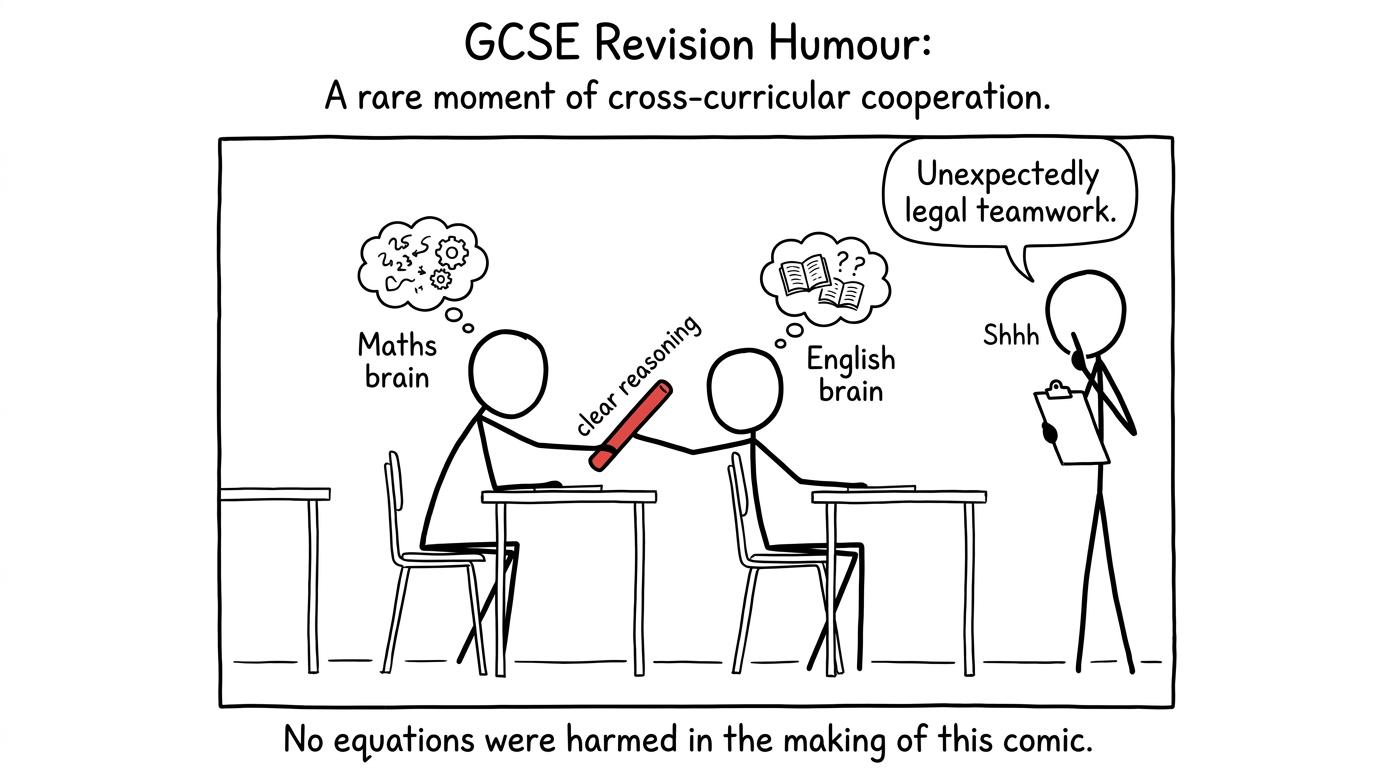 Maths brain passes the clear-reasoning baton to English brain
How to use overlap without revising everything twice
The best approach is to share the asset or habit, not merge entire revision sessions.
Build one shared-theme map
Create a small map for themes that genuinely cross subjects, such as power, conflict or responsibility. Under each subject, record what that idea requires:
- Literature: textual references, methods and interpretation.
- History: factual knowledge, chronology and historical argument.
- Religious Studies: beliefs, teachings and evaluation.
- Maths: no thematic knowledge, but clear logical communication where relevant.
This format exposes false overlap. If two branches require different evidence, they still need separate retrieval practice.
Share command-word awareness, not model answers
Words such as analyse, explain, compare, evaluate, show and prove tell you what kind of thinking is required. Train yourself to circle the command word and translate it into an action.
But never assume it means exactly the same thing in every subject. “Show that” in maths demands a valid mathematical chain. “Show how” in literature directs attention towards the writer's construction of meaning. Always learn the conventions of the paper you will sit.
Use separate retrieval, followed by shared reflection
Recall English quotations without notes. Practise maths methods without notes. Then use the same reflection questions after each task:
- What did I know securely?
- Where did my reasoning jump?
- What evidence or step was missing?
- What should I practise next?
For maths, the twenty-minute revision routine provides a compact structure for retrieval, exam questions and marking. If you are unsure where the gaps are, use the weak-topic diagnostic routine rather than revising comfortable material.
Let mark schemes decide whether transfer worked
Feeling that an answer was thoughtful is not enough. Check whether it met the subject's assessment requirements.
In maths, mark schemes reveal whether your method, notation and final conclusion were sufficient. Video solutions can show where a chain of reasoning broke. Start paper practice early enough to act on those findings; the guide to when to begin GCSE past papers explains how to move from short sections towards full timed papers.
Closer to the exams, Edexcel GCSE Maths predicted papers can provide fresh practice alongside official past papers. Predicted papers should sharpen preparation, not replace full specification coverage.
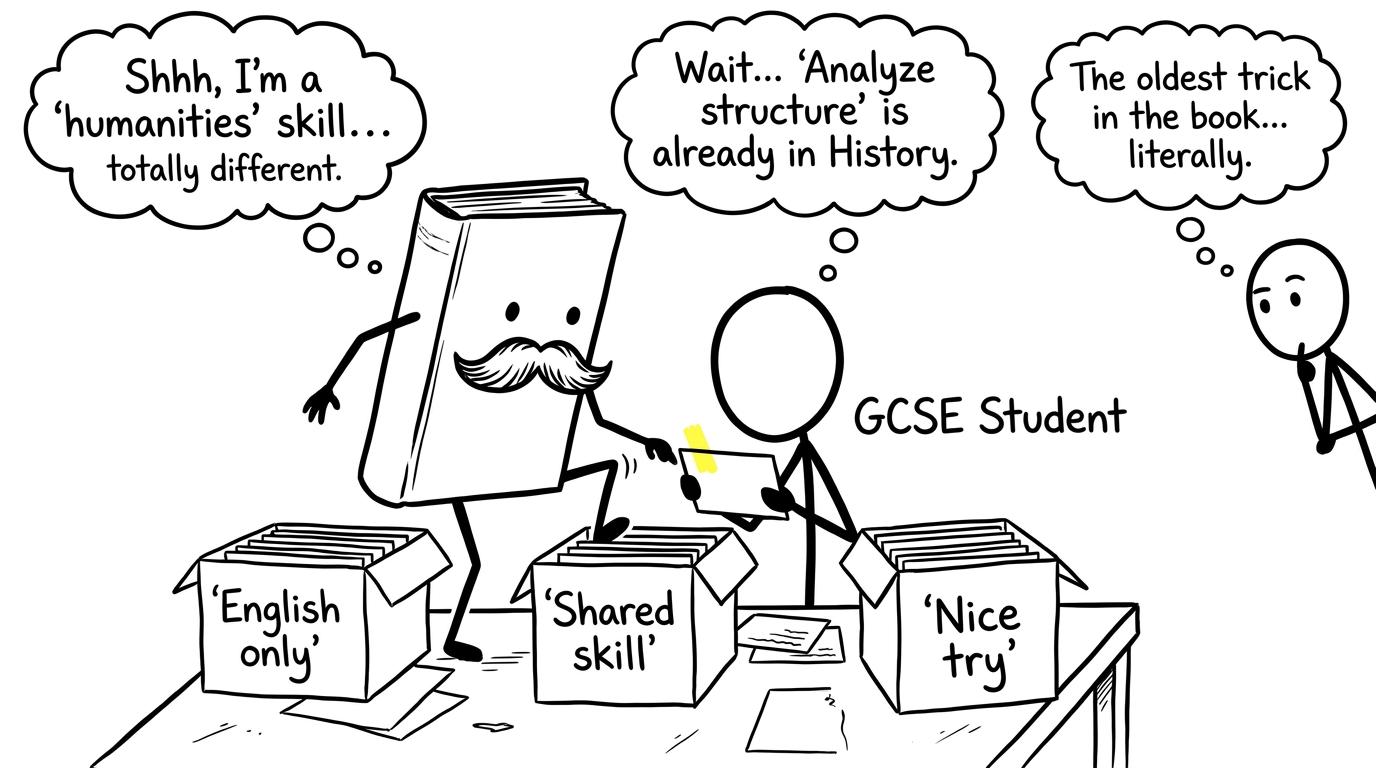 A suspicious textbook tries to sneak into the shared-revision box
A practical weekly structure for maths students
Protect subject-specific practice first. A balanced routine might include:
- short, separate retrieval sessions for quotations, context and maths methods;
- one English Literature essay plan focused on selection and analysis;
- one timed maths set focused on reasoning and accurate communication;
- a brief review comparing where explanations became vague;
- a later retest using new questions.
This is not multitasking. It is sequencing. You concentrate fully on one subject, then carry a useful thinking habit into the next.
During a busy exam week, the GCSE English Literature exam-week checklist can help you protect English preparation while keeping maths active. For maths-specific planning, the one-month GCSE revision plan shows how to combine topic work, mini tests and timed papers.
Common mistakes with cross-curricular revision
Treating context as a substitute for textual analysis
Knowing the period is useful only when it clarifies the text. Keep the writer's words, methods and effects central.
Assuming transferable skills remove the need for practice
Clear reasoning helps across subjects, but it does not produce automatic fluency. You still need to retrieve quotations and complete maths questions independently.
Using one paragraph structure everywhere
Rigid templates can hide weak thinking. Follow the demands of the question and the conventions of each subject.
Combining subjects because their themes sound similar
A shared word such as “power” does not mean the specifications share content. Check what knowledge and evidence each mark scheme rewards.
Spending longer organising than retrieving
Colour-coded maps feel productive, but exams require recall and application. Keep shared resources brief, then test yourself.
Revising the wrong board or tier
Confirm whether you take Edexcel, AQA, OCR or Eduqas, and whether your maths entry is foundation or higher tier. Use resources matching the paper you will actually sit.
Make overlap serve the exam
Cross-curricular overlap helps when it saves a genuine piece of work: one secure understanding of historical context, one stronger habit of selecting evidence, or one clearer chain of reasoning. It fails when “combined revision” becomes a reason to avoid practising either subject properly.
Keep the bargain honest. Share themes where the knowledge really connects. Transfer reasoning and communication habits. Then return to separate exam questions, specifications and mark schemes.
For your maths preparation, make MathsGenie's free GCSE revision hub your next step. Use revision lessons to repair methods, practice questions and mini tests to build fluency, past papers to test exam performance, and predicted papers, mark schemes and video solutions to refine your final preparation. The subjects may support one another, but purposeful practice is what turns that support into marks.