GCSE English Literature Access Arrangements
GCSE English Literature access arrangements: learn how extra time and other support work, what evidence is needed, and when to ask your school.
The hardest part of an English Literature exam is sometimes not knowing what to write. For some students, it is having enough time, reading the paper accurately or physically recording the answer they already have in mind.
GCSE English Literature access arrangements can reduce these barriers. Depending on a student's evidence-based needs, support may include extra time, supervised rest breaks, a reader or computer reader, a scribe, a word processor, modified papers or appropriate rooming. The first practical step is to speak to your school's SENCo, additional learning needs coordinator or exams officer as early as possible. Students and parents do not normally submit the formal application themselves.
This guide explains how the process works under current Joint Council for Qualifications (JCQ) rules. Your school must check the regulations for your examination series and awarding body, whether that is AQA, Pearson Edexcel, OCR or Eduqas.
Access arrangements at a glance
Use this checklist to begin:
- Tell your SENCo or exams officer what makes timed exams difficult.
- Ask which arrangements have already been recorded as your normal way of working.
- Take part in any assessment, classroom trial or mock exam requested by the school.
- Use the proposed support consistently in lessons and internal assessments.
- Ask when the school's internal deadline falls; it will usually be earlier than JCQ's final deadline.
- Confirm the approved arrangements and practise with them before the real examination.
- Report any new illness or injury immediately rather than waiting for exam day.
Access arrangements remove or reduce a disadvantage without changing the knowledge and skills being assessed. They are not bonus marks, and they do not make the literature questions easier.
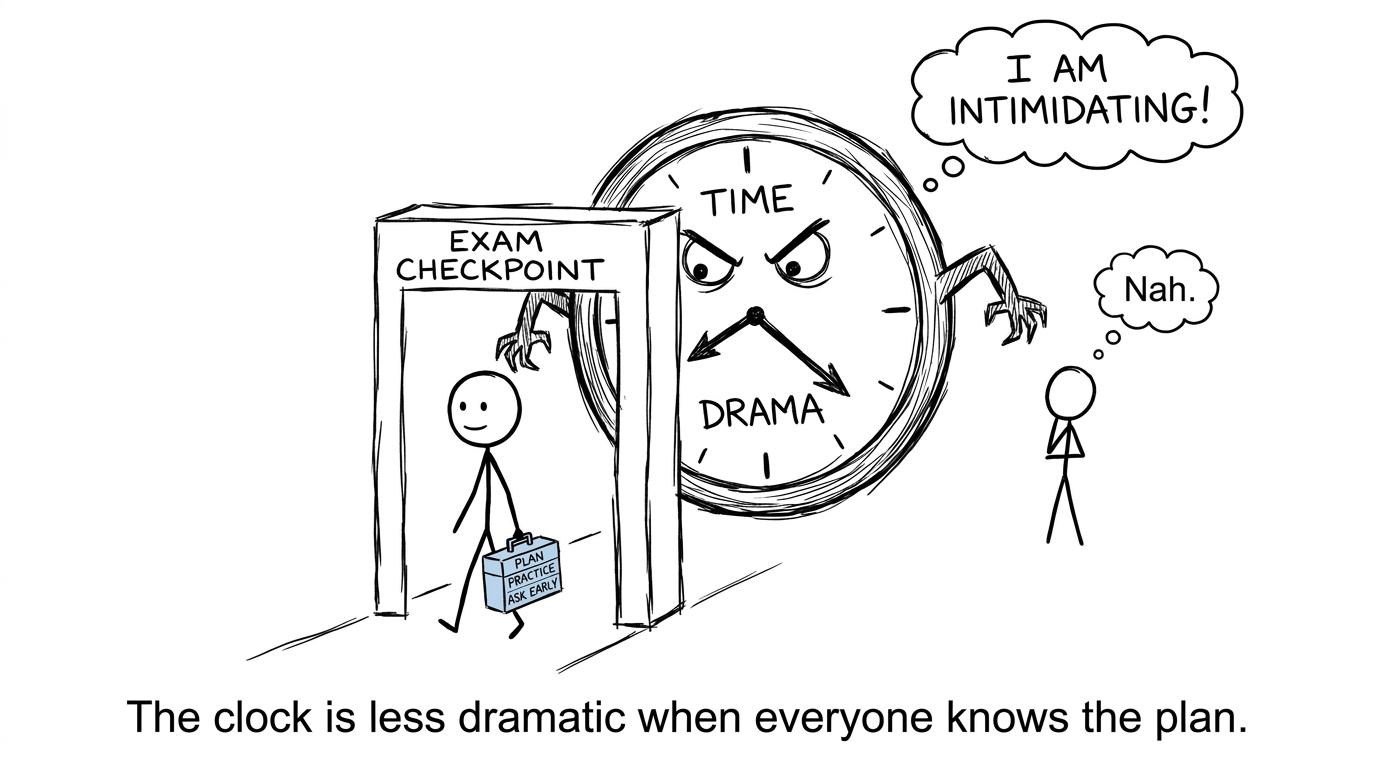 A student calmly approaching an exam with a familiar support plan
What GCSE English Literature access arrangements mean
Access arrangements are agreed before an assessment. JCQ describes them as provisions for candidates with disabilities, special educational needs or temporary injuries, based on evidence of need and the candidate's normal way of working.
For a disabled student who would otherwise face a substantial disadvantage, an arrangement may be a reasonable adjustment under equality law. Exam boards have legal responsibilities in this area. Support may also be available for a temporary access need, such as an injury shortly before the examination.
This is different from special consideration. Access arrangements alter how an assessment is accessed; special consideration deals with certain adverse circumstances affecting a candidate at or around the time of an assessment.
A diagnosis, Education, Health and Care Plan or previous arrangement can be useful evidence, but it does not automatically guarantee a particular adjustment. The school must identify the barrier, establish the appropriate support and follow the current evidence rules.
How extra time works in English Literature
Extra time is one of the most familiar arrangements, but it is not granted simply because a student often runs out of time. For 25%25\%25% extra time, the centre normally needs to show a substantial and persistent difficulty, evidence of need and that extra time reflects how the student ordinarily works in relevant timed assessments.
Under current JCQ requirements, an application for 25%25\%25% extra time in GCSE qualifications must be processed by the centre through Access Arrangements Online. Depending on the reason for the application, evidence may include:
- teacher observations describing the student's difficulty;
- work from timed internal tests or mock examinations;
- records showing how the extra time was used;
- a completed JCQ form and, where required, standardised assessment results;
- appropriate specialist evidence for a disability, medical condition or other impairment.
Applications processed from September 2025 generally require representative internal test or mock evidence across relevant subjects, alongside teaching staff's comments about why the time is needed and how it is used. The SENCo and assessor decide which evidence route applies; a student should not try to commission tests without discussing this with the school first.
Extra time should be used for purposeful work: planning, reading, developing analysis, checking quotations or completing an unfinished response. If fatigue, pain, concentration or anxiety means continuous additional working time is unsuitable, supervised rest breaks may sometimes remove the barrier more effectively.
Does approval apply automatically to every subject?
Not necessarily in exactly the same way. The centre considers the student's needs, normal way of working and the demands of each assessment. An arrangement must not undermine the skill being tested.
English Literature and English Language should not be treated as interchangeable. Current JCQ rules permit reader support in GCSE English Literature where the eligibility requirements are met, while restrictions apply to papers or sections specifically testing reading. Your exams team must check the precise specification and current rules.
Other arrangements that may be available
Supervised rest breaks
During a supervised rest break, the clock is stopped and the student must remain under examination supervision. The break is not extra working time: the student cannot continue writing or receive help with the paper.
Rest breaks can be appropriate where a condition affects concentration, stamina, pain or emotional regulation. They do not currently require the same online application as 25%25\%25% extra time, but the SENCo must document the need in the appropriate records.
A reader or computer reader
An approved human reader or computer reader can read permitted material without explaining, interpreting or simplifying it. GCSE English Literature does not require the candidate to demonstrate unaided decoding in the same way as an assessment section specifically testing reading, so reader support may be possible when approved.
The reader cannot analyse a quotation, suggest an interpretation or tell the student what to write. Those decisions remain the candidate's own.
A scribe or speech recognition technology
A scribe records the candidate's dictated answer. JCQ permits a scribe in GCSE English Literature, subject to approval, evidence and the detailed rules governing its use. The candidate still has to compose the response and direct what is recorded.
Some specifications award marks for spelling, punctuation, vocabulary or sentence construction. The marks accessible when a scribe is used can depend on which elements the candidate independently dictates and what is recorded on the scribe cover sheet. Because the detail can vary by specification, ask your English teacher and exams officer how your board's assessment objectives apply.
A word processor
A word processor may be allowed where it is appropriate to the student's needs and forms part of their normal way of working. Preference for typing, by itself, is not enough.
In normal examination use, internet access is unavailable and functions such as predictive text, spelling and grammar checking are controlled under JCQ and specification rules. A word processor does not usually require an Access Arrangements Online application, but the centre must follow the regulations and retain appropriate records.
Modified papers and rooming arrangements
Modified papers may include Braille, modified enlarged print or other approved formats. These are ordered earlier than many other arrangements, so students with visual or other relevant needs should raise the issue particularly early.
Appropriate rooming may involve a smaller room or alternative location within the centre. It is not automatically awarded alongside extra time. The decision should reflect an established need and the practical requirements of the arrangements being used.
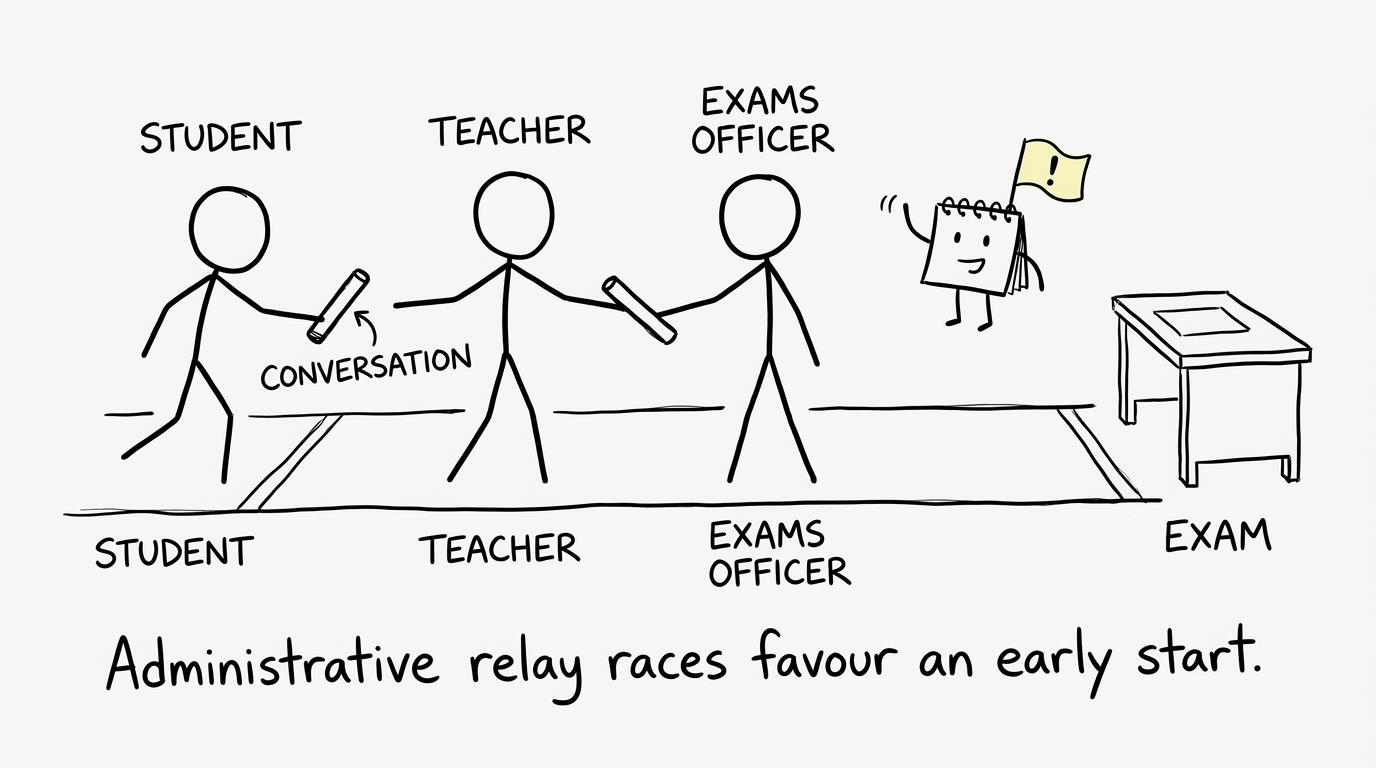 A calendar reminds the school team that early conversations matter
How to request access arrangements
Start with the right person
Contact the SENCo, ALNCo, learning support team or exams officer. Explain the functional difficulty rather than requesting an arrangement only by name. For example, describe whether you lose your place while reading, experience pain when writing, cannot sustain concentration or produce substantially less work under timed conditions.
If you are a private candidate, contact a centre that accepts private entries and can administer the required arrangement. Do this well in advance because the centre must understand your needs, gather acceptable evidence and meet its own deadlines.
Let the centre build a picture of need
Teachers may be asked for observations and samples of work. The school might trial rest breaks, extra time, a word processor or another suitable arrangement in lessons and mock exams. This is not merely paperwork. It tests whether the proposed support actually removes the barrier.
Current rules place considerable importance on the candidate's normal way of working. A tool introduced for the first time on the morning of the examination is unlikely to produce calm, fluent work even if it is permitted.
Complete any required assessment
Where learning difficulties form the basis of an application, the centre's appointed assessor may conduct standardised tests and complete the relevant sections of JCQ documentation. Medical, physical, sensory or mental health needs may follow a different evidence route.
The SENCo should decide what is required. A private report cannot simply replace the centre's obligation to establish the student's current needs and normal way of working.
Wait for the centre to process the request
Some arrangements, including 25%25\%25% extra time, a reader or computer reader, and a scribe or speech recognition technology, normally require online processing. Others can be approved by the centre under delegated rules, although evidence and records may still be necessary.
If an online application is not automatically approved, the centre may refer it to the relevant awarding body with supporting evidence. The school should then tell the student what has been agreed and how it will operate.
When should you apply?
Begin the conversation as soon as a recurring difficulty becomes clear, ideally well before the final GCSE year or early in Year 11 at the latest. Schools need time to observe the student's normal way of working, arrange assessments, trial support and collect evidence from mocks.
JCQ publishes deadlines for each examination series. Modified papers have an earlier ordering deadline than most other arrangements. For example, AQA lists 31 January 2027 as the modified-paper request deadline for the June 2027 GCSE series. Other JCQ deadlines and school procedures must be checked for the relevant series.
Do not treat the final JCQ date as your personal deadline. Schools normally set earlier internal dates so that applications can be checked and any referral resolved. Unexpected injuries or newly arising conditions should be reported immediately; the exams team can ask the awarding body what remains possible.
Practise under your approved conditions
Approval is only part of the preparation. You also need to know how the arrangement feels.
Complete timed English responses with the same breaks, technology or additional time you expect to use. Learn how to direct a scribe clearly, operate approved software or decide when a supervised break is genuinely useful.
The same principle matters in maths. If an arrangement applies to your maths papers, use it while completing GCSE Maths past papers and revision resources, not only in the final exam. The GCSE past-paper timing guide can help you build timed practice gradually.
Students taking Edexcel Maths can combine approved conditions with Edexcel GCSE Maths predicted papers. Begin with shorter sessions if necessary, then use the GCSE one-week revision plan to organise lessons, questions and marking without creating an exhausting schedule.
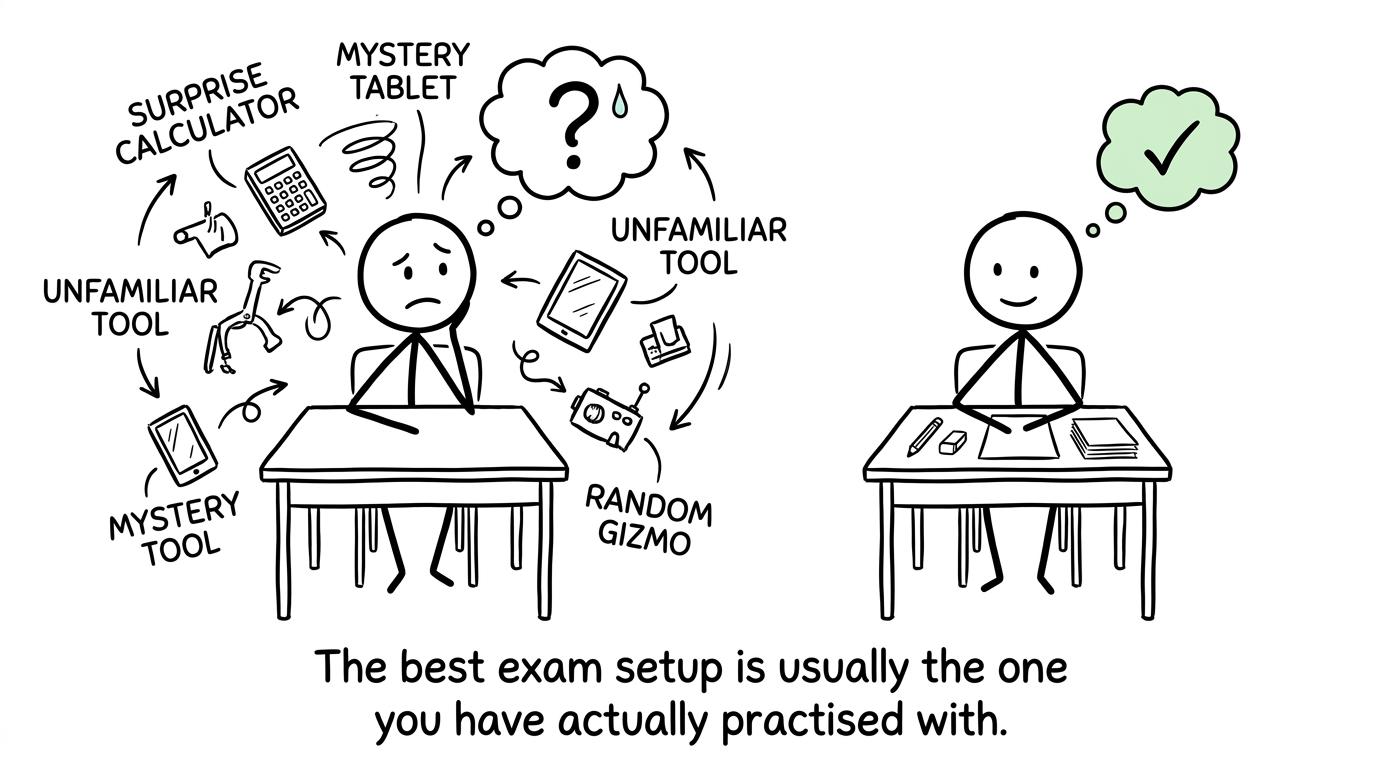 Two exam setups show why familiar support beats a last-minute surprise
Common mistakes to avoid
Waiting until the examination timetable arrives
Evidence and trials take time, while modified papers have particularly early deadlines. Ask as soon as the difficulty is recognised.
Assuming a diagnosis guarantees extra time
The arrangement must address the actual assessment barrier and satisfy the relevant evidence requirements. Equally, do not assume that a lack of diagnosis means you should stay silent. Speak to the SENCo so the school can consider the correct route.
Asking an exam board directly
For school candidates, the centre normally manages applications and communications. Start with your SENCo or exams officer.
Using support only in the real exam
An unfamiliar reader, scribe, keyboard or rest-break routine can become another distraction. Use the approved arrangement in mocks and ordinary timed work.
Confusing access arrangements with easier marking
The literary knowledge, interpretation and analysis remain yours. A scribe may also affect how particular writing-accuracy marks are evidenced, so confirm the rules for your specification.
Forgetting to confirm the final setup
Before the examination period, ask where you will sit, what equipment will be provided, how rest breaks will be recorded and which papers the arrangement covers. For maths preparation, pair that certainty with the GCSE Maths topics by board and tier guide and a calm night-before GCSE maths plan.
Ask early, then make the arrangement ordinary
The purpose of GCSE English Literature access arrangements is simple: to let eligible students demonstrate their own understanding without an avoidable barrier obscuring it. The process works best when it begins early, is supported by appropriate evidence and becomes part of everyday classroom and mock-exam practice.
Speak to your SENCo or exams officer now, even if you are unsure what support is appropriate. Then keep the rest of your GCSE preparation structured. MathsGenie's free GCSE Maths revision hub brings together revision lessons, practice questions, mini tests, past papers and video solutions, while predicted papers and mark schemes help you rehearse under realistic conditions. An approved arrangement creates access; deliberate practice turns that access into marks.