GCSE English Literature 4 to 6: A Practical Guide
GCSE English Literature 4 to 6 guidance: learn how sharper arguments, precise evidence, deeper analysis and timed practice can improve your responses.
A grade 4 answer often shows that a student knows the text. A grade 6 answer tends to show something more valuable: the student can use that knowledge to build and sustain an interpretation.
That is the central idea behind moving from GCSE English Literature 4 to 6. You do not need to memorise every quotation, use unnecessarily complicated vocabulary or produce a perfect essay. You need to answer the exact question, select precise evidence and explain how the writer creates meaning.
The leap can feel large because English Literature does not always provide immediate feedback. In maths, an answer is often right or wrong. In literature, improvement appears in the quality of your reasoning. Yet the revision process can still be systematic; and the changes that earn more marks are remarkably practical.
The grade 4 to grade 6 checklist
Focus on these changes:
- replace retelling with interpretation;
- write a clear argument that answers the question;
- choose short, relevant quotations;
- analyse the writer's methods precisely;
- develop alternative or more nuanced interpretations;
- integrate context instead of attaching it to paragraphs;
- plan briefly before writing;
- complete timed responses and learn from feedback;
- check your exam board's specification and mark scheme.
Grade boundaries vary between exam boards, papers and exam series. There is no universal number of marks that permanently guarantees a grade 6, so your target should be stronger performance across the assessment objectives rather than one fixed raw mark.
What separates a grade 4 from a grade 6?
A grade 4 response commonly demonstrates a sound understanding of characters, themes and events. It may include relevant quotations and identify methods such as metaphor, contrast or dramatic irony. The limitation is often development: the explanation stops just as the analysis should begin.
A grade 6 response is generally more consistent and purposeful. It develops an argument, examines the effects of carefully selected details and considers the writer's intentions without treating those intentions as certain facts.
| A response working around grade 4 | A response moving towards grade 6 |
|---|---|
| Explains what happens in the text | Explores what the text suggests |
| Uses a quotation related to the topic | Selects evidence that proves a specific interpretation |
| Identifies a technique | Explains how the writer's choices shape meaning |
| Adds context as a separate fact | Connects context to the interpretation |
| Makes similar points repeatedly | Develops an argument across the response |
| Uses general comments about the reader | Examines precise effects and possible responses |
These are not official guarantees of a particular grade. Examiners mark against assessment objectives, and the detailed requirements differ across AQA, Edexcel, OCR and Eduqas. Always use the specification and mark schemes for the board your school has entered.
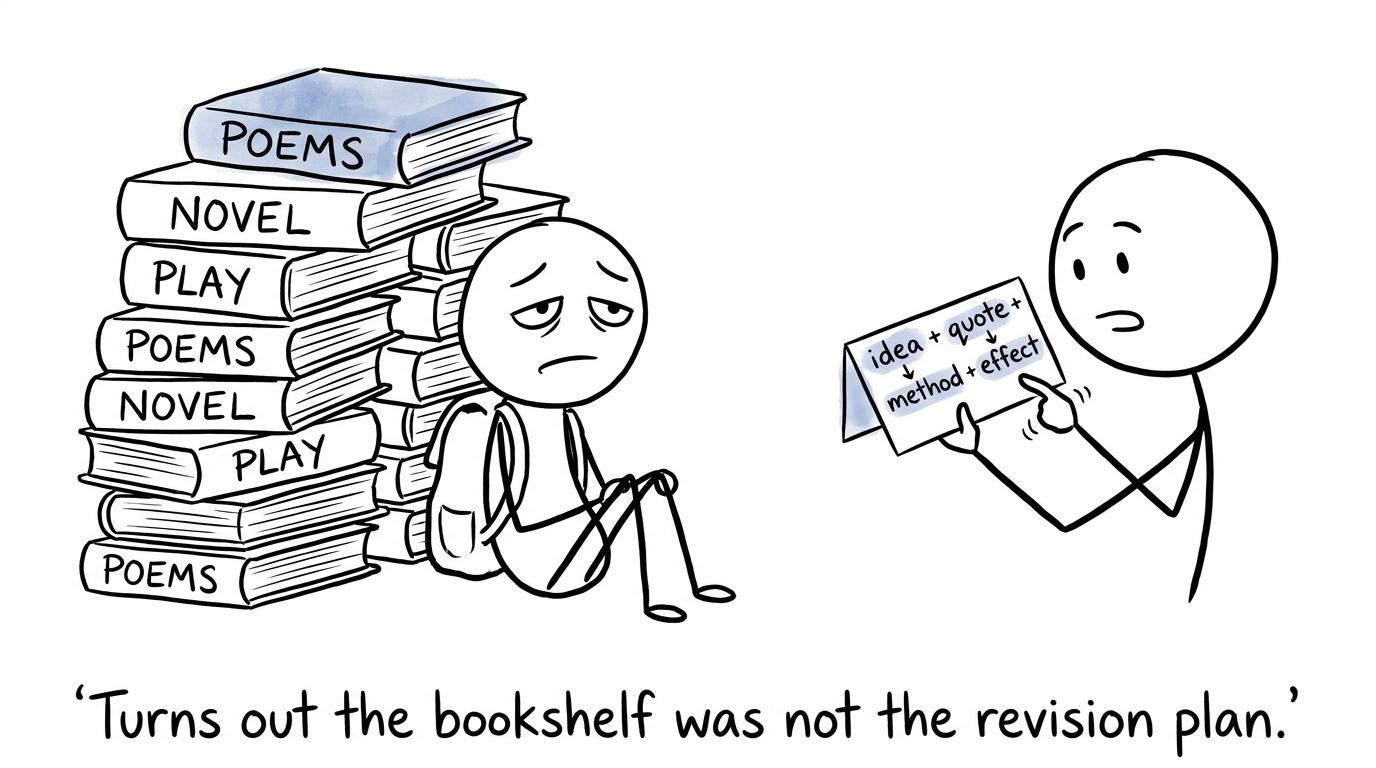 A student discovers that the bookshelf is not a revision plan
Build an argument rather than a collection of paragraphs
The strongest improvement often begins before the first paragraph. Read the question carefully and decide what you think.
Your central argument should be a direct response, not a memorised statement that could fit any theme. If the question asks how a character changes, your argument should describe the nature of that change. If it asks how a writer presents power, decide whether power appears corrupting, unstable, protective or something more complicated.
A useful planning process is:
- underline the question's main focus;
- write your interpretation in one sentence;
- choose two or three moments that develop it;
- note a short quotation for each moment;
- identify the writer's most relevant choices;
- decide how the final paragraph will deepen the argument.
This is similar to organising a longer maths problem: direction matters before detail. A student balancing several subjects can use the Maths Genie revision planner to protect regular time for both essay practice and mathematical revision.
Move from evidence to analysis
Quotations do not earn strong marks merely by appearing on the page. Their value comes from what you do with them.
A developed analytical paragraph usually contains four connected elements:
- a claim that answers the question;
- precise textual evidence;
- analysis of the writer's language, structure or form;
- an explanation of how that analysis supports the wider argument.
Select smaller quotations
Long quotations consume memory and writing time. Short quotations are often easier to embed within a sentence and analyse closely. A single verb, adjective, image or pattern can provide more analytical value than several copied lines.
Build a compact evidence bank for each text. Organise it by major character and theme, then look for versatile quotations that connect to more than one idea. Test yourself from memory rather than repeatedly reading the list.
Name methods only when they matter
Identifying a metaphor is not the same as analysing one. The method is a doorway, not the destination.
After identifying a writer's choice, ask:
- Why might this particular word or image have been chosen?
- What associations does it carry?
- Does its meaning change elsewhere in the text?
- How does it affect the audience's understanding of the character or theme?
- How does it support my main argument?
Language analysis is only part of literary study. Structure and form matter too. Depending on the text, you might examine changes in tone, stage directions, entrances and exits, narrative viewpoint, recurring imagery, contrasts, stanza organisation or the placement of a revelation.
Make interpretations more thoughtful
A grade 6 response does not need to be obscure. It needs to be defensible.
Begin with the most convincing interpretation, prove it and then deepen it. Useful phrases include:
- “This could also suggest...”
- “At this stage of the text...”
- “Although the character initially appears...”
- “The contrast may encourage the audience to...”
- “A different interpretation is...”
These phrases only help when followed by evidence and reasoning. Adding “alternatively” before an unsupported idea does not create sophistication.
Nuance can come from recognising change or tension. A character may be both sympathetic and responsible. An image may suggest safety in one scene but control in another. A poem may admire its subject while quietly questioning it. Literature becomes stronger when you resist forcing every detail into a simple label.
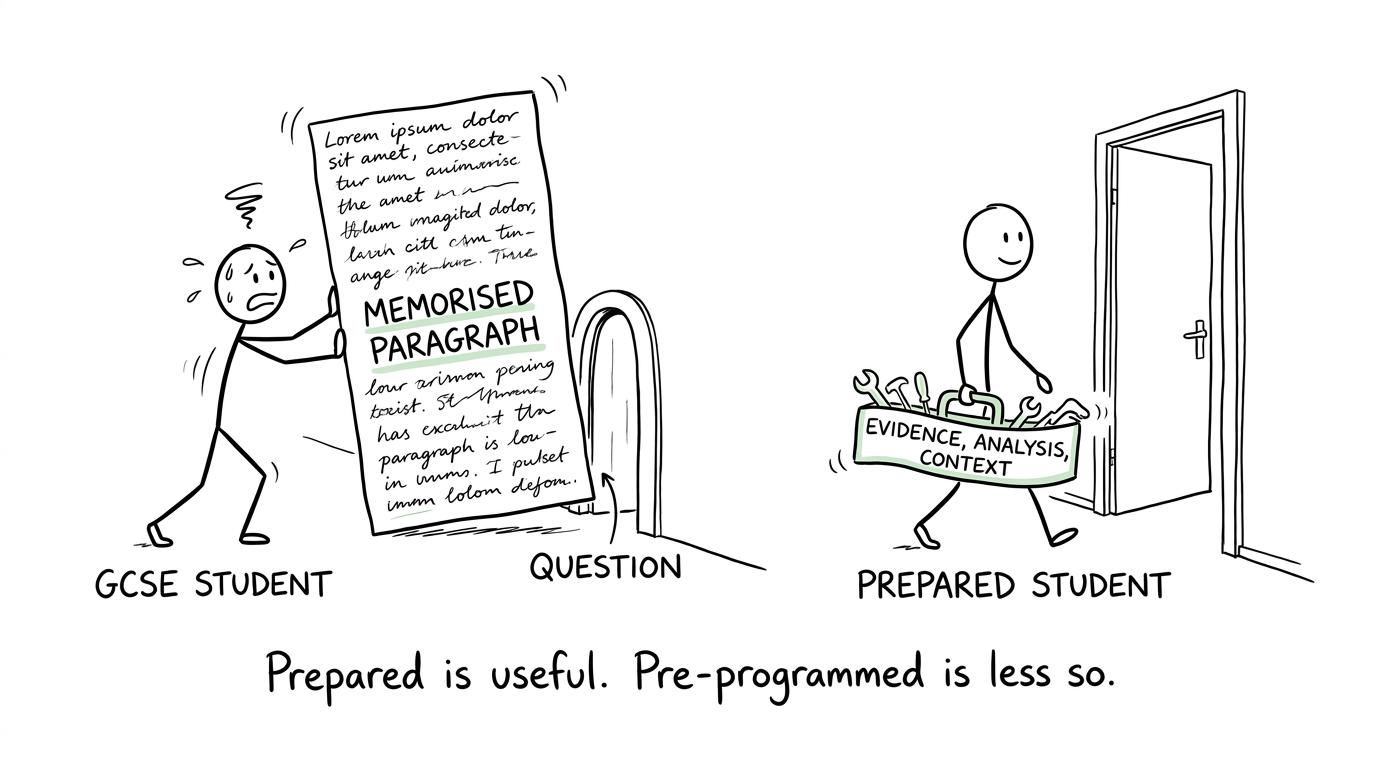 A memorised paragraph struggles to fit through the question
Use context as part of the argument
Context should illuminate the text. It should not become a history paragraph placed beside it.
Relevant context may include the period in which a text was written or set, its genre, literary conventions, social attitudes or the expectations of its original audience. The precise knowledge required depends on your text and exam board.
Connect context directly to interpretation. Ask how a contemporary belief, convention or social tension might shape the writer's presentation of a character or theme. Avoid claiming that every historical reader would have reacted identically. Audiences are not single, predictable groups.
Context should also remain proportionate. If a contextual detail does not help answer the question, leave it out. Knowing more facts is not the same as writing a better response.
Turn revision into retrieval and practice
Rereading can feel productive because the page becomes familiar. Familiarity, however, is not the same as recall under exam conditions.
Use a weekly cycle:
- retrieve quotations without looking;
- create a brief plan for an unseen question;
- write one analytical paragraph;
- complete a timed section or essay;
- compare it with the mark scheme and feedback;
- rewrite the weakest part.
The final step matters. Simply receiving a mark tells you where you are; rewriting teaches you how to move.
Students preparing for maths exams can use the same principle across subjects. MathsGenie's GCSE revision resources combine explanations with questions, while the grade 4 maths topics, grade 5 maths topics and grade 6 maths topics make progression visible. In English, recreate that structure by separating quotation recall, analysis, planning and timed writing.
Practise for the paper you will actually sit
A polished untimed essay does not automatically become a strong examination response. You must practise selecting ideas, planning and writing within the available time.
Check your exam board's current specification for:
- the texts and components you study;
- the assessment objectives for each question;
- paper timings and mark allocations;
- whether any texts or extracts are provided;
- any spelling, punctuation and grammar requirements;
- the rules on bringing texts into the examination.
Arrangements are not identical across AQA, Edexcel, OCR and Eduqas. Use current information supplied by your school and exam board rather than assuming another student's paper follows the same format.
Complete individual questions before attempting whole papers. Then build stamina with full timed practice. This mirrors an effective maths routine: topic questions first, followed by GCSE maths past papers and GCSE predicted papers when preparing for current exam-style demands.
Common mistakes that hold responses near grade 4
Retelling the plot
Plot knowledge is necessary, but narration rarely answers an analytical question. Mention events only when they support an interpretation.
Writing a pre-prepared answer
Memorised material can miss the focus of the question. Memorise flexible evidence and important ideas, then shape them around the wording in front of you.
Listing techniques
A paragraph containing several method names may still lack analysis. Select the most important choice and explore it properly.
Making vague comments about readers
Statements such as “this makes the reader want to read on” are usually too general. Explain the specific emotion, judgement or expectation the writer may create, and identify what causes it.
Adding disconnected context
A historical fact earns little value if it does not illuminate the text or strengthen the argument.
Chasing complicated vocabulary
Accuracy is more persuasive than decoration. Use literary terminology precisely, but prefer a clear interpretation to a sentence made confusing by ambitious words.
Highlighting instead of retrieving
Highlighting can organise notes, but it does not prove that you can recall and apply knowledge independently.
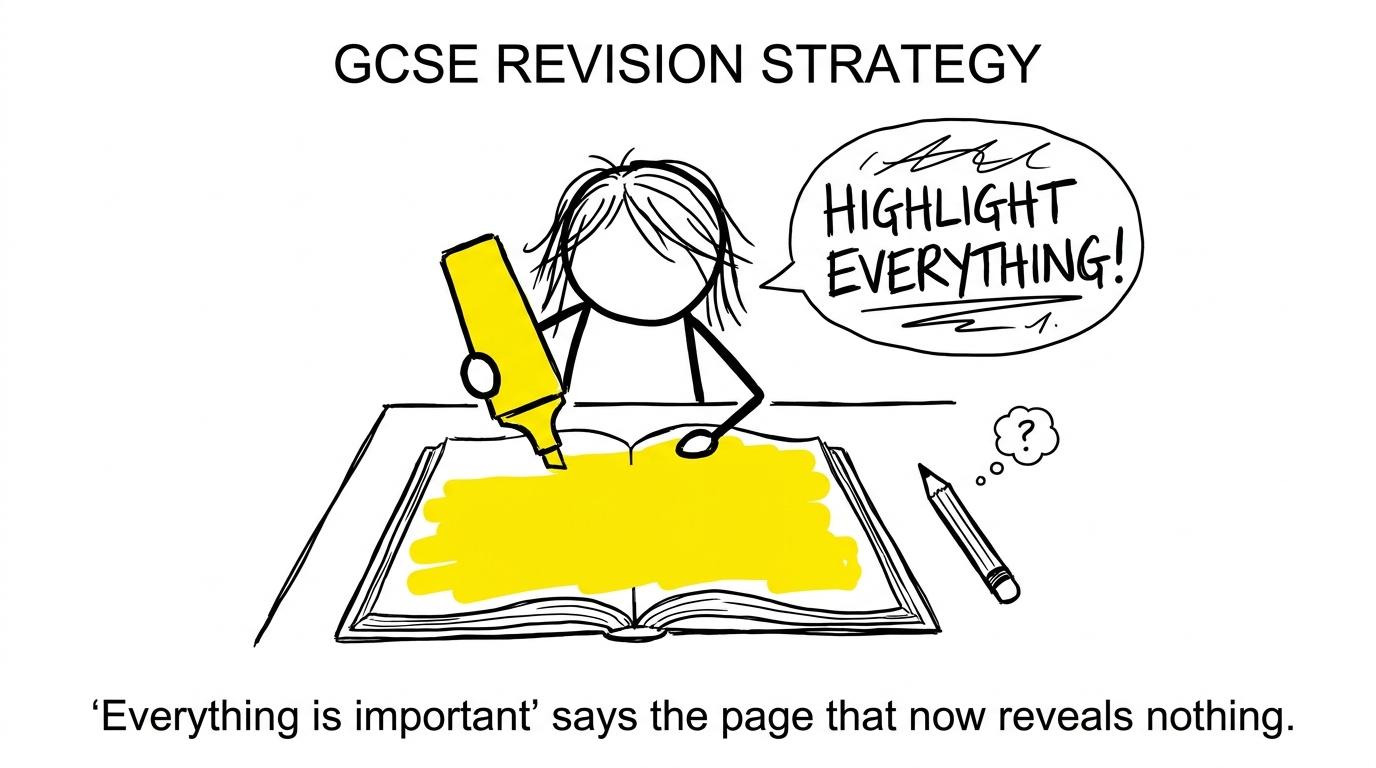 A student highlights everything and therefore reveals nothing
A realistic route towards grade 6
Moving up a grade band usually comes from several modest improvements working together. Set one target at a time: answer the question more directly, reduce plot summary, analyse shorter evidence or connect context more naturally.
Ask your teacher to identify the weakest assessment objective in your recent responses. Turn that feedback into an action you can observe. “Improve analysis” is vague; “explain the associations of one key word in every paragraph” is measurable.
Then repeat the process. Plan. Write. Check. Rewrite.
The same disciplined approach supports your wider GCSE preparation. Use MathsGenie's free GCSE maths revision lessons, practice questions, video solutions, mini tests, mark schemes, past papers and predicted papers to keep maths moving while you strengthen English Literature. Progress rarely arrives through one heroic revision session. It comes from making the next piece of practice slightly better than the last.