GCSE English Language Year 10 Revision Head Start
GCSE English Language Year 10 revision head start: see when early practice helps, how to avoid burnout, and how to balance it with GCSE maths revision.
A revision timetable can become crowded long before the exams feel close. Maths needs practice. Science has content to remember. Then English Language appears with unseen texts, timed writing and the uncomfortable thought that perhaps you should already be preparing.
The short answer is yes: a GCSE English Language Year 10 revision head start can help, provided it means brief, purposeful practice rather than beginning an exhausting Year 11 schedule twelve months early. English Language rewards skills developed over time, including reading closely, analysing choices, writing accurately and managing limited time. Starting gently gives those skills room to mature. Starting intensely can drain the energy you will need later.
The aim is not to revise for longer. It is to make Year 11 less dependent on panic.
The Year 10 head-start checklist
A sensible early plan should include:
- confirming your exam board and paper structure with your teacher
- reading unfamiliar fiction and non-fiction regularly
- completing one short reading or writing task each week
- learning what the assessment objectives reward
- checking work against teacher feedback or a mark scheme
- revisiting weaknesses after a gap rather than repeating tasks immediately
- protecting enough time for maths, science and your other subjects
- avoiding full-paper marathons until you have been taught the necessary skills
If your routine cannot survive an ordinary school week, it is too large. A head start should feel almost modest.
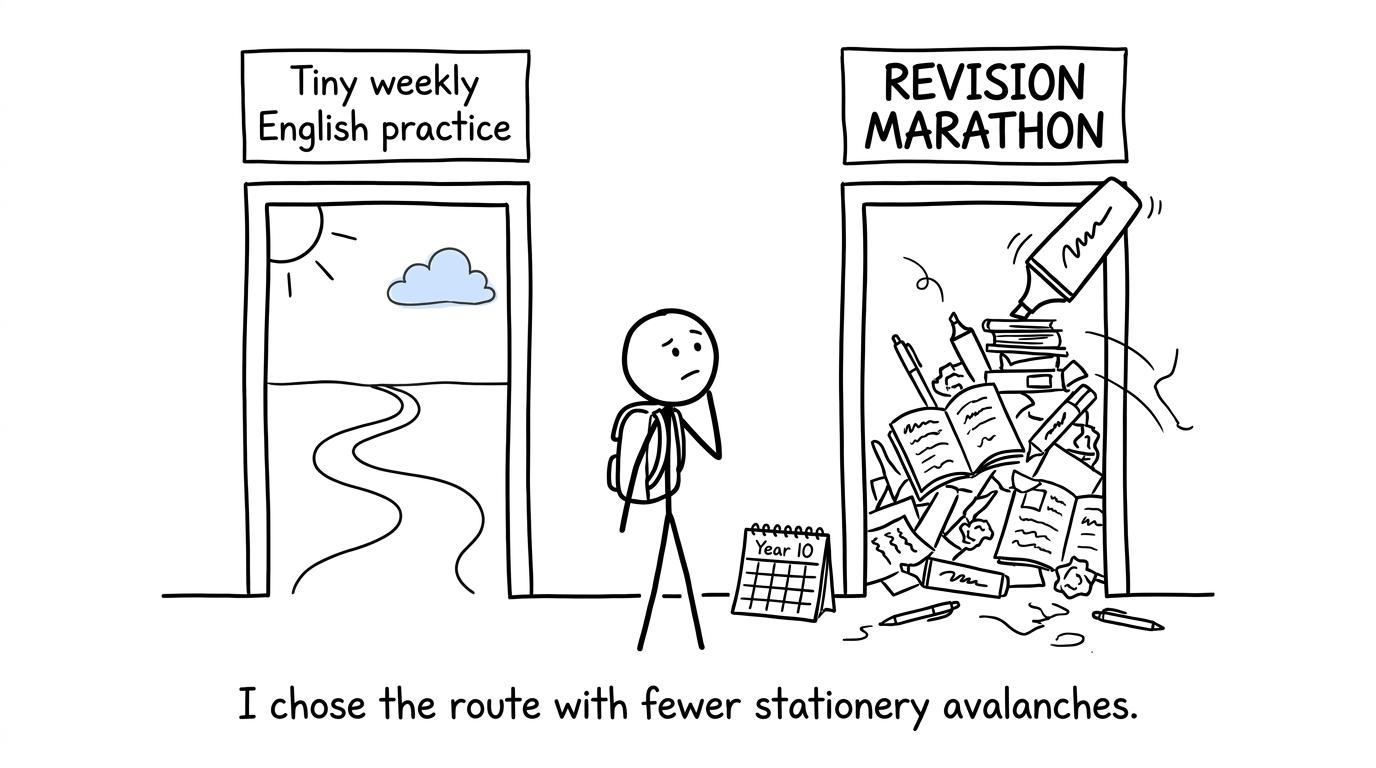 A Year 10 student chooses small weekly practice instead of a revision marathon
Why starting English Language revision in Year 10 can help
GCSE English Language is not mainly a memory test. Across AQA, Edexcel, OCR and Eduqas, students are assessed on connected reading and writing abilities: retrieving and interpreting information, analysing language and structure, comparing or evaluating texts where required, and communicating accurately for a particular purpose and audience.
The assessment objectives are shared across English Language specifications in England, but paper layouts, timings, question sequences and weightings can differ. That is why your first useful action is checking the board and specification used by your school rather than downloading random materials.
You have time to develop, not merely perform
In a rushed revision period, students often practise an answer, see a disappointing mark and immediately attempt another. The mark changes little because the underlying issue has not been repaired.
Year 10 creates space between attempts. You can discover that your analysis identifies techniques without explaining their effects, or that your persuasive writing has strong ideas but weak paragraph control. Feedback can shape the next attempt rather than becoming a comment you read and forget.
Educational guidance on revision supports active retrieval, repeated practice after a delay and feedback. The principle matters here even though English Language is skill-heavy: attempt something from memory, check it, identify a precise weakness and return to that weakness later. Passive rereading may feel fluent, but it provides limited evidence that you can produce an answer independently.
Regular reading improves the raw material available to you
Unseen texts are central to GCSE English Language. You cannot memorise the exact extract in advance, but you can become more comfortable meeting unfamiliar voices, structures and vocabulary.
Read short stories, articles, essays, reviews, speeches and literary non-fiction. Occasionally pause to ask:
- What is the writer trying to make the reader think or feel?
- Which choices create that effect?
- How does the focus change across the text?
- What is implied rather than directly stated?
- How does the tone suit the audience and purpose?
This is revision without constantly recreating an exam hall. It builds attention while keeping the subject alive.
Technical accuracy benefits from gradual correction
Official GCSE English Language requirements give substantial importance to accurate spelling, punctuation, grammar, vocabulary and sentence control. Technical accuracy accounts for a meaningful share of the written assessment, so it should not be treated as decoration added after the ideas are finished.
A Year 10 head start lets you fix recurring habits one at a time. You might focus on sentence boundaries for several weeks, then paragraphing, punctuation or proofreading. Slow correction is often more durable than trying to remember a page of rules the night before a mock.
When early revision becomes early burnout
Starting early is useful only when the workload remains proportionate. Burnout does not become productive because it arrived ahead of schedule.
Warning signs include:
- doing full papers before your class has covered the relevant skills
- sacrificing sleep or regular activities for distant exams
- feeling guilty whenever you are not revising
- repeating the same task without using feedback
- allowing English to crowd out maths and other GCSE subjects
- using all the newest practice papers before Year 11
- measuring success only by hours completed
Early revision should reduce future pressure. If it makes every week feel like exam week, the method has defeated its purpose.
A better Year 10 target is consistency. One focused English session each week, plus ordinary reading, can create useful familiarity without turning the whole year into a countdown.
What effective Year 10 English revision looks like
Keep practice short and specific
Choose one skill for each session. That could be selecting concise evidence, analysing structure, planning a narrative, adapting tone for an audience or proofreading a paragraph.
Avoid targets such as “revise Paper 2”. They are too broad to guide a useful session. “Practise comparing viewpoints in two paragraphs” gives you something observable to complete and review.
Use a simple feedback loop
Each task should move through four stages:
- Attempt: work without copying a model response.
- Check: use teacher feedback, the assessment criteria or an appropriate mark scheme.
- Record: write down one precise improvement.
- Return: try that skill again on another day.
This resembles effective maths revision. On MathsGenie, a student might use the GCSE maths revision hub to learn a method, answer questions, check solutions and revisit errors. English answers are less mechanically marked, but the learning rhythm remains valuable: practise, receive feedback, repair and retest.
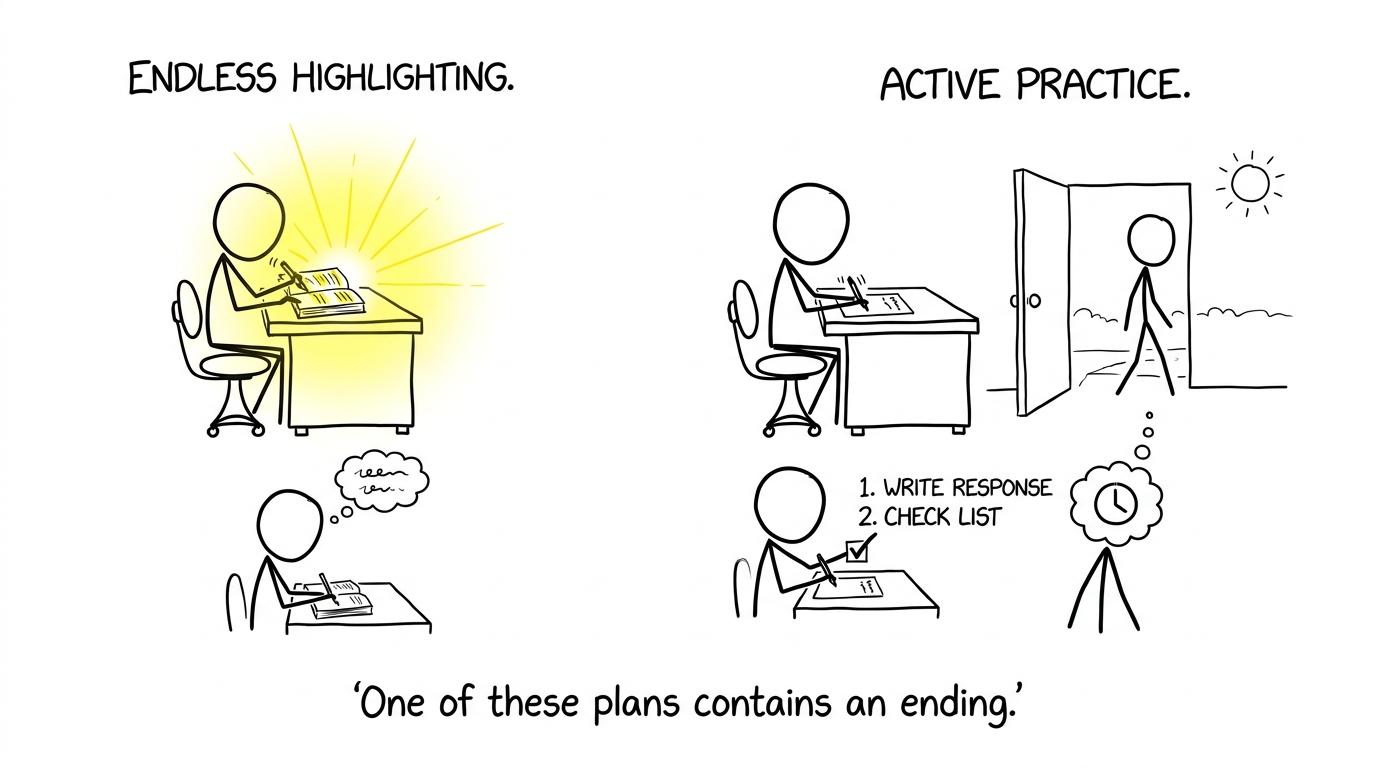 One student highlights endlessly while another completes focused active practice
Build timing gradually
Timing matters, but full papers are not the only way to develop it. Begin with a single question or writing plan under a generous limit. Reduce support as your control improves. Later, combine questions into paper sections before attempting complete papers under formal conditions.
This protects valuable official past papers and separates two problems that students often confuse: not understanding the task and not completing it quickly enough.
Balancing English Language with GCSE maths
For a student already preparing for maths exams, the danger is treating every subject as the only subject. It is easy to design several excellent revision plans that cannot coexist.
A sustainable week might contain one short English Language task alongside two or three focused maths sessions. The exact balance should reflect school assessments, current weaknesses and teacher advice. During a maths mock period, maths may need more attention. Before an English assessment, the balance can temporarily change.
Use the same planning discipline across both subjects:
- decide the exact skill before beginning
- produce something rather than merely reading notes
- check it promptly
- record the reason marks were lost
- schedule a later return
The 20-minute maths revision routine is useful when schoolwork is busy, while the GCSE maths revision timetable helps organise a longer week. If you are unsure where maths time should go, use a diagnostic approach to find your weakest GCSE topics rather than revising familiar material because it feels comfortable.
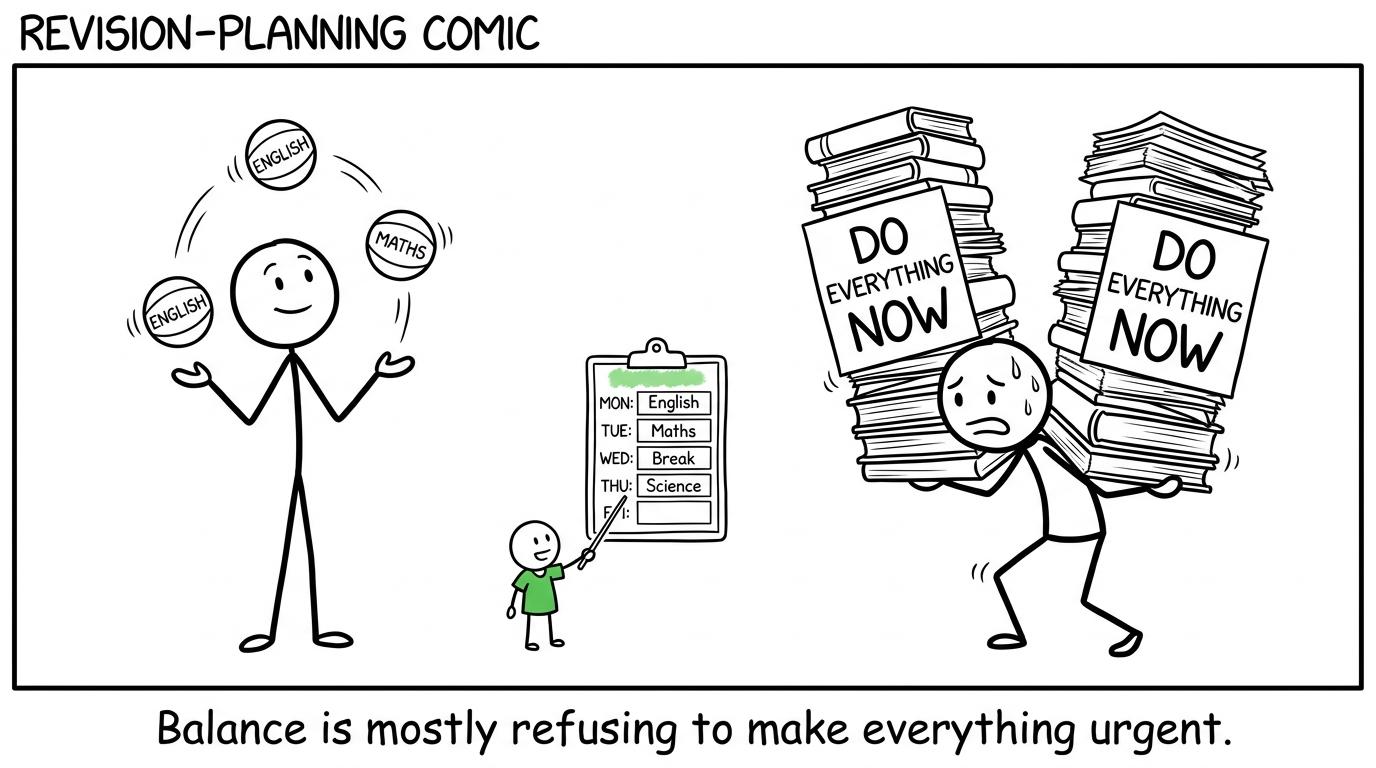 A student balances English and maths while another carries two impossible revision piles
A low-pressure plan for the school year
During the autumn term
Confirm your board and understand the broad reading and writing demands. Establish a small reading habit and keep a list of recurring feedback points from classwork. Your priority is understanding what a strong response does, not completing many papers.
During the spring term
Add occasional timed questions. Alternate reading analysis with creative or transactional writing according to your specification. Revisit earlier feedback after a delay and check whether the same weakness remains.
During the summer term
Complete longer sections only if your teacher has covered the relevant material. Review which skills have improved and choose a small number to maintain over the summer. Rest should remain part of the plan.
For maths, you can apply a similar progression: topic learning first, then mixed questions, then timed assessments. MathsGenie’s GCSE maths mini tests provide shorter checkpoints, while GCSE past-paper timing guidance explains why complete papers are most valuable when there is still time to act on what they reveal.
Common mistakes with a Year 10 revision head start
Beginning with full papers
A paper diagnoses performance but does not automatically teach the missing skill. Use short tasks while you are learning, then introduce full papers when you can benefit from the combined challenge.
Collecting model answers instead of writing
Reading strong responses can clarify expectations, but it can also create false confidence. Close the model and produce your own paragraph, plan or response. Independent output is the test.
Memorising decorative phrases
Sophisticated vocabulary only helps when it is accurate and appropriate. Examiners reward clear communication, coherent organisation and purposeful choices, not unusual words inserted without control.
Ignoring the mark scheme and feedback
Practice without feedback can reinforce the same weakness. Make every correction specific enough to influence the next task.
Revising one subject at the expense of everything else
An early English head start should not damage maths preparation. When maths needs attention, MathsGenie offers free revision lessons, practice questions and video solutions through its GCSE maths resources. Later, you can build exam stamina with Edexcel predicted papers, past papers and mark schemes appropriate to your board and tier.
Start small enough to continue
Starting GCSE English Language revision in Year 10 genuinely can pay off. The advantage comes from spacing, feedback, wider reading and repeated encounters with the skills, not from not from pretending the final exams are already next week.
Choose one manageable English task. Complete it properly. Learn one thing from the feedback, then return to that weakness later. Keep enough space for lessons, sleep, interests and your other GCSEs.
For maths, make MathsGenie your free revision base. Begin with revision lessons and targeted practice questions, check your work with mark schemes and video solutions, then progress to mini tests, past papers and predicted papers when the timing is right. A calm head start is not about doing everything now. It is about making the next step easier to take.