GCSE English Language Similar to GCSE English Literature?
GCSE English Language similar to GCSE English Literature? Discover the genuine overlap, key differences and whether enjoying Language predicts a good fit.
Enjoying English Language can create a tempting assumption: perhaps Literature is simply more of the same. The honest answer to “is GCSE English Language similar to GCSE English Literature?” is yes, but only in its underlying skills. Both reward close reading, clear arguments, relevant evidence and analysis of writers’ choices. However, Literature requires detailed knowledge of set texts, themes, characters and context, while Language places much more emphasis on unseen material and your own creative or persuasive writing.
So, if you enjoy investigating how words shape meaning, Literature may suit you. If you mainly enjoy inventing stories or constructing persuasive speeches, the fit is less automatic. You also need to check whether there is a choice at all: many schools teach and enter students for both qualifications, while individual arrangements vary.
A quick overlap checklist
GCSE English Literature is worth serious consideration if you enjoy:
- finding meanings that are implied rather than directly stated
- explaining why a writer chose a particular word, image or structure
- supporting an interpretation with precise evidence
- discussing more than one possible reading
- building an argument across several paragraphs
- reading plays, novels and poetry closely
- revisiting texts until their patterns become clearer
Pause before assuming it will feel identical if your favourite parts of Language are exclusively creative writing, transactional writing or responding to completely unseen sources.
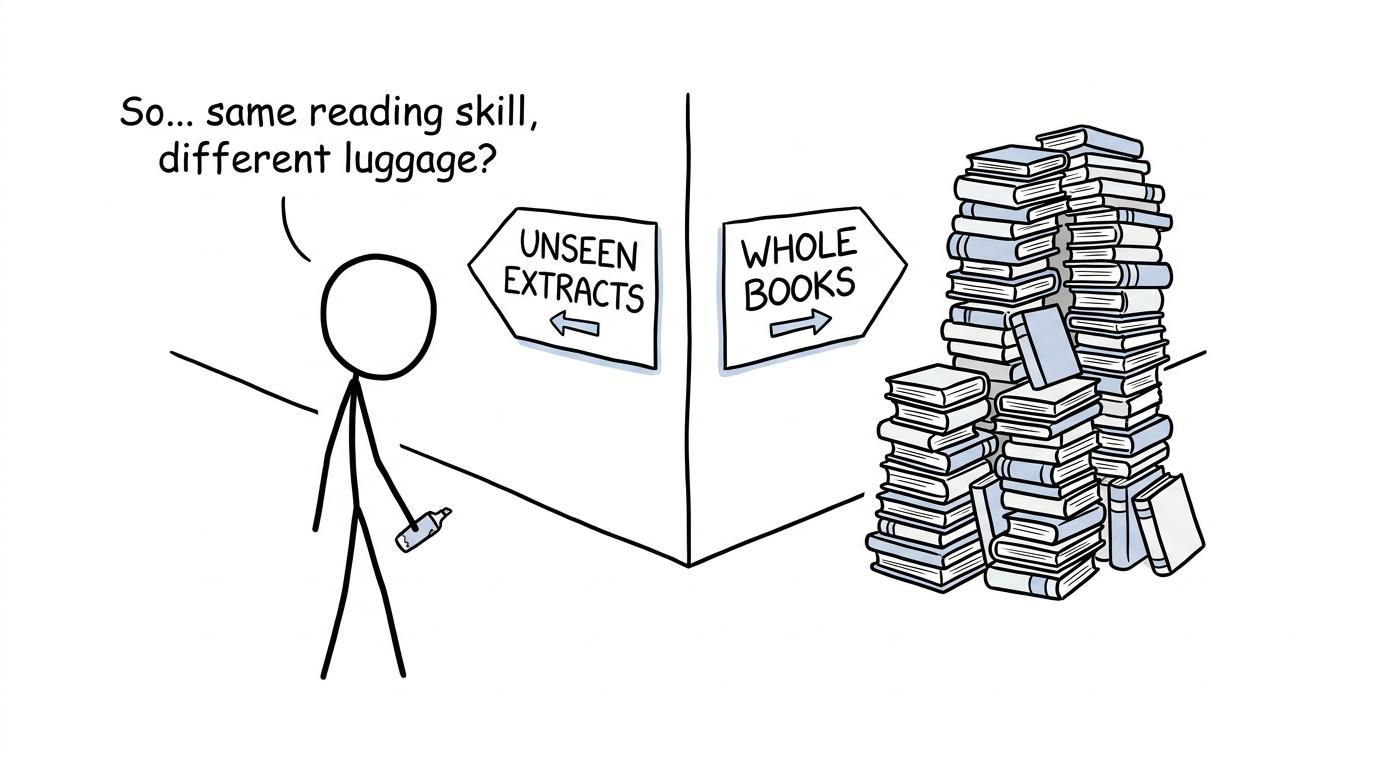 A student choosing between unseen extracts and whole books
How much genuine overlap is there?
The overlap is real rather than cosmetic. Official GCSE subject requirements for both qualifications include critical reading, inference, textual evidence, analysis of language and structure, accurate written expression and comparison.
The centre of gravity is different, though.
Close reading transfers directly
In Language, you may examine how an unfamiliar writer creates tension, establishes a viewpoint or influences a reader. In Literature, you ask closely related questions about a studied poem, play or novel.
Skills such as selecting a short quotation, identifying connotations and connecting a technique to its effect therefore transfer well. A student who can move beyond “this makes the reader want to read on” and explain a precise effect already has an important Literature habit.
This is the strongest overlap between the subjects. AQA describes its Language and Literature specifications as co-teachable, reflecting the transferable reading and analytical skills involved. Other boards, including Edexcel, OCR and Eduqas, assess comparable core skills, although their papers, set texts and question structures differ.
Evidence-based argument matters in both
Neither subject rewards technique spotting by itself. Naming a metaphor is not the destination. You need to make a defensible point, choose evidence and explain how that evidence supports your interpretation.
That process resembles good mathematical reasoning. In maths, an answer without a valid method may miss marks. In English, a claim without evidence or explanation remains unconvincing. The content is different, but the discipline is familiar: show how you reached your conclusion.
Comparison appears in both subjects
Language specifications require students to compare writers’ ideas and perspectives across texts. Literature also includes comparison, particularly through poetry or board-specific tasks.
The transfer is useful because strong comparison is not a list of similarities followed by a list of differences. It is an argument about how two writers treat an idea, shaped by deliberate choices and, in Literature, sometimes by different contexts.
Accurate writing supports both qualifications
Spelling, punctuation, vocabulary and sentence control matter in both, but not to the same extent everywhere. National subject requirements divide English Language assessment equally between reading and writing, with writing accounting for 50%50\%50% of the qualification. In Literature, accurate expression is assessed, but the overwhelming emphasis is on understanding, interpretation and analysis.
That distinction matters. Enjoying Language because you love producing your own writing does not necessarily mean you will enjoy the text-centred demands of Literature.
Where GCSE English Language and Literature differ
The subjects share a toolkit, but they use it for different jobs.
Language is built around unseen material and original writing
GCSE English Language assesses reading through texts that have not been studied in advance. These can include fiction, literary non-fiction, journalism, essays and other substantial writing from different periods. You must read quickly, identify what matters and construct a response under time pressure.
Language also asks you to produce your own writing for specified purposes and audiences. Depending on the paper and exam board, that might involve narrative, descriptive, persuasive or viewpoint writing.
For example, the current AQA course divides its written assessment across two papers: one centred on creative reading and writing, and another on writers’ viewpoints and perspectives. That is an AQA structure, not a universal template, so always check your own specification.
Literature is built around studied whole texts
GCSE English Literature requires sustained study of substantial works. National subject content includes:
- at least one Shakespeare play
- at least one nineteenth-century novel
- poetry published since 178917891789, including representative Romantic poetry
- British fiction or drama written from 191419141914 onwards
- unseen literary material in the examination
The exact titles and paper arrangements depend on your exam board and your school’s choices. Literature asks you to understand how details fit into a complete work: how a character develops, how a theme changes, or why a scene matters within the wider structure.
This creates an extra demand that Language does not place on you in the same way: organised knowledge. You need a secure grasp of plots, characters, themes, useful quotations and relevant context.
Context has a larger formal role in Literature
Historical, social and literary context can help you explain why a text was written and how it might be understood. In Literature, contextual understanding is an explicit assessment objective. Across the national requirements, it accounts for 15%15\%15% to 20%20\%20% of the qualification.
Context should sharpen analysis rather than become a detached history paragraph. The useful question is not simply, “What happened at the time?” It is, “How does this knowledge improve my interpretation of this moment in the text?”
Literature involves more long-term recall
Language revision often focuses on methods, question types, timing and flexible writing skills. Literature needs those things plus retained knowledge of set texts.
That does not mean memorising every page. A compact collection of versatile quotations, strong theme maps and adaptable argument plans is usually more manageable than trying to carry an imaginary library into the examination.
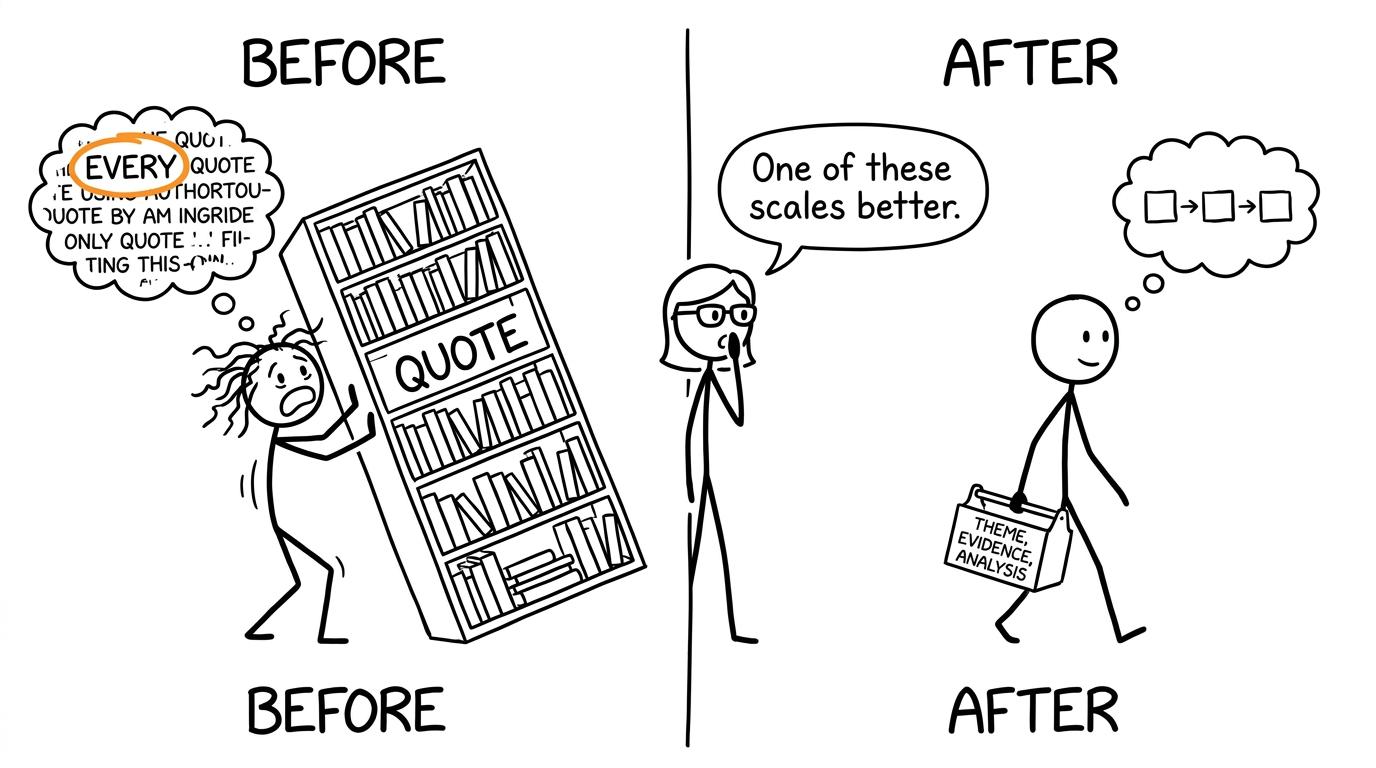 Two very different approaches to remembering quotations
Does enjoying English Language predict Literature success?
It is a positive sign, not a guarantee.
You are more likely to enjoy Literature if your favourite Language tasks involve analysing fiction, tracing structural changes, exploring alternative interpretations or discussing a writer’s intentions. These interests sit close to the heart of Literature.
The prediction is weaker if you mainly enjoy Language because it lets you invent stories or argue your own viewpoint. Literature contains far less original creative writing. Your task is usually to develop an interpretation of someone else’s work.
A better decision test is to separate enjoyment into components:
- Reading: Do you enjoy returning to a text and noticing more each time?
- Analysis: Do you like explaining how language, form and structure create meaning?
- Knowledge: Are you willing to learn quotations, themes and context over time?
- Writing: Do you enjoy extended analytical essays, not only creative pieces?
- Discussion: Are you comfortable with interpretations that may be persuasive without being uniquely correct?
If most answers are yes, Literature is likely to be a sensible fit.
Do students actually choose between them?
This depends on your school and circumstances. English is part of the Key Stage 444 curriculum in England, but schools decide how courses and entries are organised. Many students are taught both English Language and English Literature and receive two separate GCSE grades.
The English Baccalaureate is not itself a qualification. For its English component, pupils must enter both English Language and English Literature examinations. That does not mean every student nationally must take both GCSEs under every circumstance.
Before making plans, ask your English teacher or examinations officer:
- whether both qualifications are part of your school’s core programme
- which exam board you follow
- which Literature texts your class studies
- whether any entry decision has already been made
- how the additional revision load fits your other subjects
This is more reliable than assuming that another school’s arrangement applies to you.
Balancing Literature with GCSE maths revision
For a maths student, the practical question is not only whether Literature sounds interesting. It is whether you can revise it without allowing maths practice to disappear.
The two subjects need different kinds of repetition. Literature benefits from quotation retrieval, paragraph planning and timed essays. Maths improves through practising methods, marking questions and repairing specific errors. A balanced week might alternate short English recall sessions with focused maths practice rather than assigning an entire week to one subject.
Use the GCSE Maths Revision hub to choose resources for your board and tier. If you need a clearer routine, the one-month GCSE maths revision plan shows how to combine retrieval, topic work and timed papers.
During a Literature-heavy week, one maths mini test or short question set can preserve momentum. As maths exams approach, move towards board-specific papers such as AQA GCSE Maths past papers or Edexcel GCSE Maths predicted papers. Mark schemes and video solutions then turn mistakes into a precise next action.
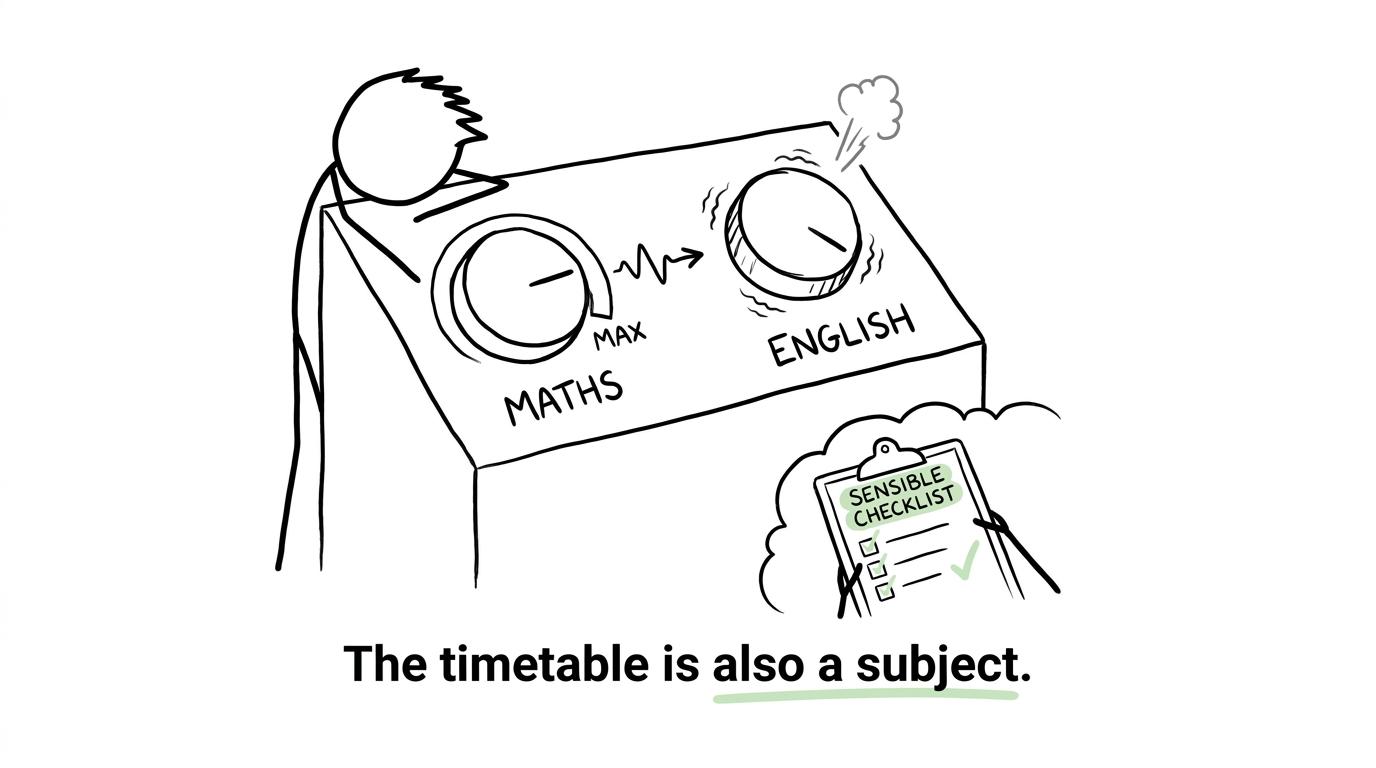 A student balancing the maths and English revision controls
Common mistakes when comparing the subjects
Assuming Literature is just Language with longer extracts
Literature requires knowledge of complete works, recurring themes, character development, form and context. The analytical skills overlap, but the preparation is substantially different.
Choosing Literature only because creative writing was enjoyable
Creative writing is central to parts of Language, not Literature. Look at analytical responses and actual Literature questions before deciding whether the style suits you.
Treating quotation learning as the whole course
Quotations are evidence, not finished analysis. Students also need an argument, precise interpretation and discussion of the writer’s choices.
Memorising essays word for word
A memorised essay may not answer the question set. Flexible plans, versatile evidence and secure knowledge are safer than a script that cannot adapt.
Ignoring the total revision workload
A subject can suit your interests and still require careful scheduling. Use a repeatable system for both English and maths. MathsGenie’s guide to using GCSE past papers properly helps turn each paper into targeted revision rather than another unchecked task. The GCSE English Literature exam-week checklist can help you protect maths practice while preparing for Literature.
The final verdict
GCSE English Language is similar to GCSE English Literature in the skills beneath the surface: inference, close analysis, comparison, evidence and controlled writing. The largest differences are Literature’s reliance on set texts, sustained interpretation, contextual understanding and long-term recall, alongside Language’s unseen reading and original writing tasks.
If the analytical parts of Language were what you enjoyed most, Literature is a promising next step. If creative or persuasive writing was the main attraction, inspect the Literature course carefully before assuming it will feel the same. Most importantly, confirm your school’s entry arrangements and exact exam-board specification.
Then build a revision system that leaves neither English nor maths waiting for a mythical free weekend. Start with MathsGenie’s free GCSE maths resources, learn through revision lessons, practise with topic questions and mini tests, and finish with past papers, predicted papers, mark schemes and video solutions. Good revision is rarely one dramatic effort. It is a manageable loop, repeated until the unfamiliar becomes ordinary.