GCSE English Language Revision Timetable Clash
GCSE English Language revision timetable clash? Build a realistic six-subject plan that protects English, maths, sleep and focused practice each week.

A revision timetable can look perfectly sensible until six subjects compete for the same Tuesday evening. Maths needs regular practice, science seems endless, and English Language is quietly postponed because there is no single list of facts to memorise. That is how a gcse english language revision timetable clash usually begins.
The practical answer is to give English Language a small number of protected sessions each week, then rotate the remaining subjects according to urgency and weakness. You do not need to revise all six subjects every evening. You need a repeatable plan in which no important subject disappears.
Your starting checklist is simple:
- Confirm your exam board and personalised exam timetable.
- Protect three English Language sessions each week.
- Keep maths active through short, frequent question practice.
- Rotate the other four subjects rather than squeezing them into every day.
- Review the timetable weekly and move sessions when exams get closer.
- Protect sleep, meals and genuine breaks.
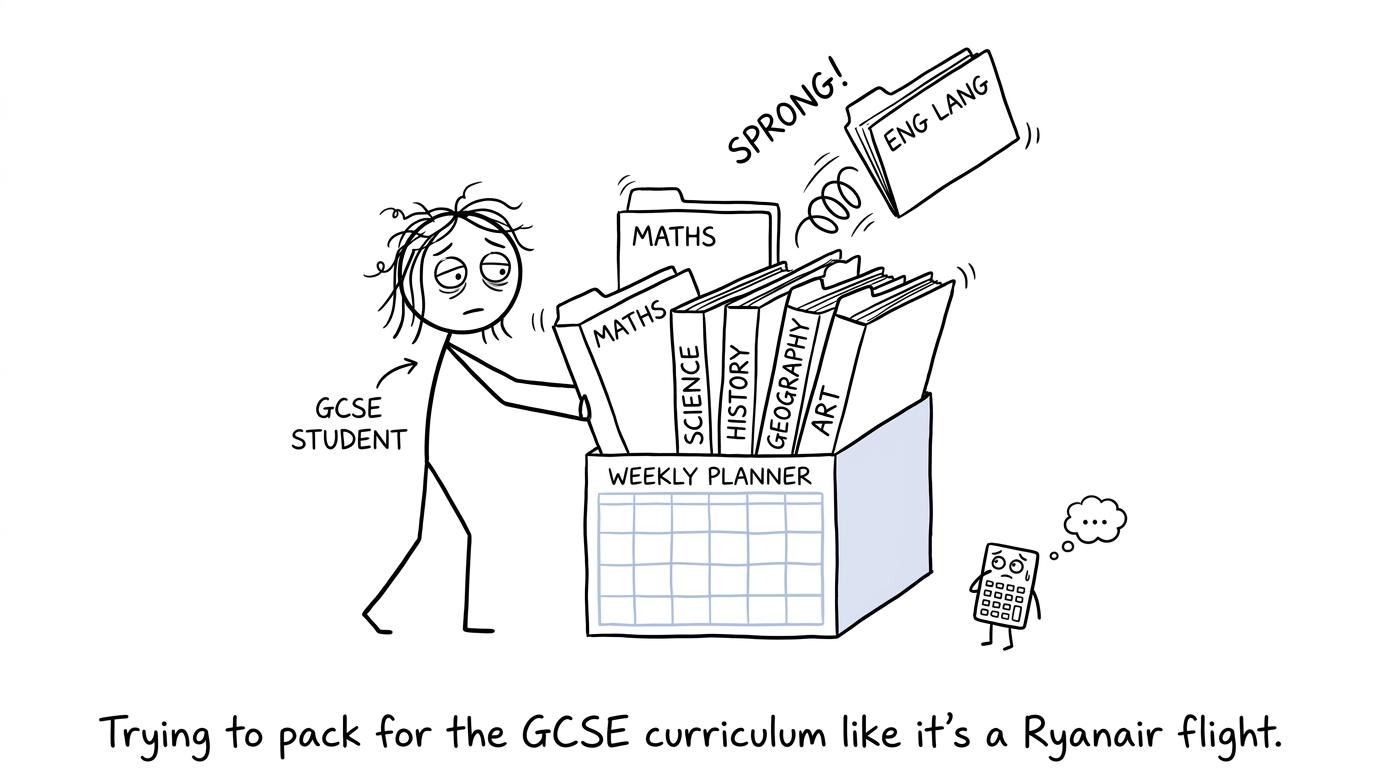 A student attempts to fit six subject folders into a tiny revision calendar
Why English Language keeps losing the timetable battle
English Language revision can feel less urgent than revising a formula, quotation or scientific process. You cannot simply memorise one essay and expect it to fit an unseen text. Progress comes from practising the underlying skills: close reading, inference, analysis, comparison, planning and accurate writing.
That makes postponement tempting. A student may decide to revise English properly at the weekend, only for a science paper or maths mock to take priority. Missing one session does little harm. Missing several means that timed writing feels unfamiliar when the exam arrives.
The solution is not to give English every spare hour. It is to lower the cost of starting. A focused session built around one question is easier to fit around five other subjects than an ambitious promise to complete an entire paper.
Research on learning supports this general approach. Spacing practice over several days and retrieving knowledge or methods from memory are more useful than repeatedly rereading notes. Feedback matters too, because practising an incorrect method without checking it can reinforce the error.
Build the timetable around fixed commitments first
Begin with reality, not aspiration. Put school, travel, meals, clubs, family commitments and bedtime into the week before adding revision. The hours left are your genuine capacity.
Most teenagers need around eight to ten hours of sleep. An extra late-night session is rarely a bargain if it leaves you unable to concentrate in lessons or revision the next day. Treat sleep as a fixed commitment rather than whatever remains after revision.
Next, add the dates from the personalised timetable supplied by your school or college. Paper structures and dates depend on your exam board and specification, whether that is AQA, Pearson Edexcel, OCR or Eduqas. If an online timetable and your school information appear different, ask your exams officer rather than guessing.
Once fixed commitments are visible, divide the available revision time into manageable blocks. On school nights, blocks of roughly 252525 to 404040 minutes are often more realistic than long sessions. Longer weekend blocks can be used for timed papers, but they should include time for marking and correcting mistakes.
A useful principle is:
revision session=attempt+feedback+next action\text{revision session}=\text{attempt}+\text{feedback}+\text{next action}revision session=attempt+feedback+next actionWithout the feedback and next action, a completed paper can become little more than a record of what you could already do.
Protect three different English Language sessions
A workable English Language allocation covers reading, writing and exam timing. The exact questions differ between specifications, so use materials for your own board.
An unseen-reading session
Choose a short passage and answer one focused reading question. Depending on your specification, this might involve selecting information, analysing language or structure, evaluating a statement, or comparing viewpoints.
Do not spend most of the session copying model paragraphs. Attempt the question independently, check the assessment guidance or teacher feedback, and identify one improvement. For example, your next action might be to select shorter evidence or explain an effect more precisely.
A writing session
Alternate between creative and transactional writing where these are required by your specification. The session might focus on planning, openings, paragraph control, vocabulary choices or technical accuracy rather than producing a complete response every time.
English writing improves through decisions made under pressure. A short plan followed by two carefully written paragraphs can therefore be more useful than pages produced without reflection.
A timed and reviewed session
Complete one question under an appropriate time limit, then review it. As the examination approaches, extend some sessions into larger sections or full papers.
Keep a small English error log. Record recurring issues such as weak explanations, missing comparisons, vague topic sentences, punctuation errors or spending too long on an early question. This gives the next session a purpose.
Keep maths secure without taking over the week
Maths also benefits from frequent contact. Leaving all maths revision until one weekend block creates a cycle in which methods are learnt, forgotten and learnt again.
Start in the GCSE Maths revision hub, where you can choose your board and tier. Use short sessions to repair individual gaps with revision lessons and practice questions, then use longer sessions for mini tests or paper sections.
The GCSE Maths revision timetable guide explains how to combine topic work with timed practice. On especially crowded days, the 20-minute GCSE maths routine provides a smaller structure: recall a method, answer questions, mark them and record the next action.
Choose topics from evidence rather than mood. A marked mock, mini test or past paper should reveal which areas are costing marks. The GCSE Maths topics by board and tier guide can help you match those gaps to the correct Foundation or Higher content.
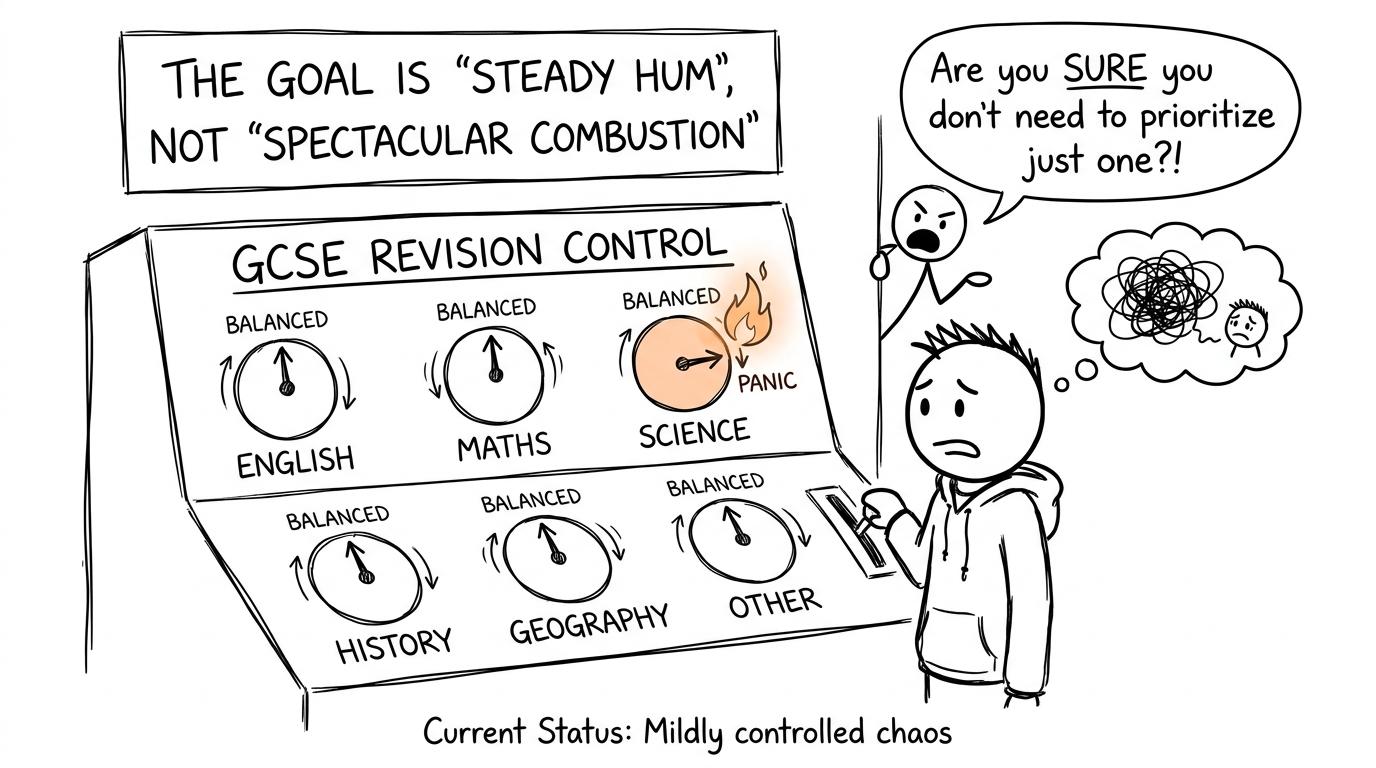 A calm revision control room balances six subject dials
Use rotation instead of revising everything every day
Trying to touch all six subjects every evening creates constant switching and very little meaningful work. A rotation is more sustainable.
| Type of day | First block | Second block |
|---|---|---|
| English-focused day | English reading or writing | One rotating subject |
| Maths-focused day | Maths topic practice | One rotating subject |
| Mixed day | English timed question | Short maths maintenance |
| Weekend paper day | One timed paper or section | Marking and targeted corrections |
| Recovery day | Light recall or error-log review | Rest |
Across a normal week, English Language might receive three protected blocks and maths three or four contacts, including brief maintenance sessions. Science, humanities, languages and other options can occupy the rotating spaces. This is not a permanent allocation. It is a baseline that stops English and maths from vanishing.
Set priorities by asking three questions:
- Which exam comes next?
- Which subject currently has the largest genuine weakness?
- Which task can be completed and marked in the time available?
A nearby exam may temporarily receive more blocks, but avoid removing another core subject completely. Even a short maintenance session makes restarting easier.
Change the balance as examinations approach
A timetable should move with the exam calendar. Several weeks out, focus on topic gaps and individual skills. Closer to each paper, increase timed practice and review common errors. Once a paper is finished, redirect its future blocks towards the next examinations.
For maths, board-specific resources make this transition easier. Students following Pearson Edexcel can use Edexcel GCSE Maths past papers, while OCR students can work from the OCR GCSE Maths revision area. Use the correct tier and paper format.
Past papers should not become a contest to see how many you can complete. The process matters: attempt, mark, diagnose, practise and reattempt. The guide to using Edexcel GCSE Maths past papers properly shows how to turn lost marks into targeted revision.
Nearer the examination, GCSE predicted papers can provide fresh practice. They are not guarantees about what will appear. Their value is in testing whether you can apply familiar skills to unseen questions.
What to do when the plan collapses
A missed session is not evidence that the entire timetable has failed. It is simply an event that needs a decision.
Use this order:
- Keep tomorrow's essential sessions in place.
- Move the missed task to the next suitable rotating block.
- Reduce its size if the original task was unrealistic.
- Remove low-value work before sacrificing sleep.
- Review why the clash happened at the end of the week.
Do not automatically double the following day's workload. That usually creates a second clash. A timetable is a planning tool, not a debt collector.
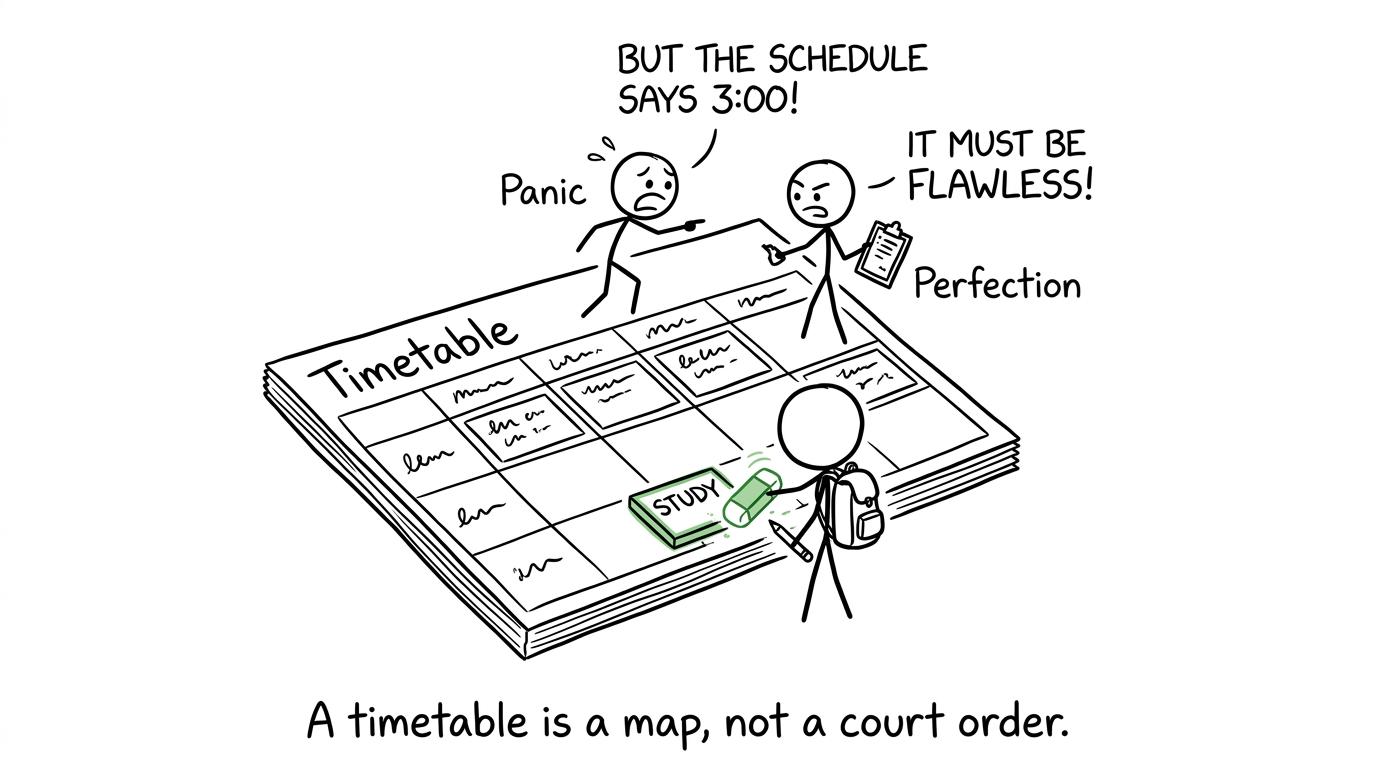 Revision gremlins argue while a student calmly edits the timetable
Common mistakes when balancing six subjects
Giving every subject equal time
Equal time is not always fair or useful. Subjects differ in urgency, confidence and assessment load. Allocate time according to evidence while maintaining a minimum presence for core subjects.
Writing vague timetable labels
“Revise English” or “do maths” leaves too many decisions for the moment when you are already tired. Write a precise action such as “attempt one comparison question” or “complete and mark a ratio mini test”.
Counting passive activity as practice
Rereading notes can support revision, but it should not replace retrieval, writing or exam questions. Close the book, attempt the task and then check your work.
Completing papers without reviewing them
A paper only becomes useful when it changes what you do next. Mark it, classify errors and schedule targeted practice. Use mark schemes and video solutions to understand how marks are awarded rather than merely checking the final answer.
Making the timetable too full
A plan with no spare capacity will break as soon as homework takes longer than expected or an unexpected commitment appears. Leave at least one flexible block and one lighter evening each week.
Treating missed revision as a reason to give up
Perfection is not the goal. A timetable that survives adjustment is better than an impressive plan followed for two days.
Make the plan smaller and more useful
The real solution to a GCSE English Language revision timetable clash is not finding endless extra hours. It is deciding what deserves protected time, defining each task clearly and allowing priorities to change as papers approach.
Give English Language regular reading, writing and timed practice. Keep maths active with short topic sessions and carefully reviewed papers. Rotate the other subjects, protect sleep and adjust the plan weekly rather than rebuilding it every time something changes.
MathsGenie can remove much of the decision-making from your maths blocks. Start with free revision lessons and practice questions, check progress through mini tests, and build exam readiness with past papers, predicted papers, mark schemes and video solutions. Choose one manageable MathsGenie task for your next available block, then leave enough room in the week for English Language to receive the practice it deserves.