GCSE English Language and Literature Weak Topic
GCSE English language and literature weak topic? Use a practical diagnose, practise, mark and retest plan to produce stronger exam answers.
A weak topic has a peculiar way of following you around. You avoid it during revision, recognise it instantly in a practice paper, then promise to deal with it later. Later rarely comes.
If you have a GCSE English language and literature weak topic, the answer is not to reread everything or complete endless essays. Identify the smallest skill causing the problem, practise it under controlled conditions, compare your response with the assessment criteria, correct it and retest it a few days later. That loop turns a vague fear into a specific task.
This article is written especially for students who prefer the certainty of maths. English answers may be open to interpretation, but improvement does not have to be mysterious. You can collect evidence, diagnose errors and measure whether your next response is better.
The weak-topic repair checklist
Use this process whenever one part of English repeatedly costs you marks:
- Name the weakness precisely.
- Find out which assessment objective it tests.
- Attempt one short question without notes.
- Diagnose why marks were lost.
- Learn or review one missing skill.
- Practise that skill in isolation.
- Apply it to a timed exam question.
- Mark the response using the correct mark scheme.
- Rewrite the weakest part.
- Retest with a different question.
The principle is familiar from effective GCSE maths revision: learn, practise, mark, fix and retest. The subject changes, but the feedback loop remains useful.
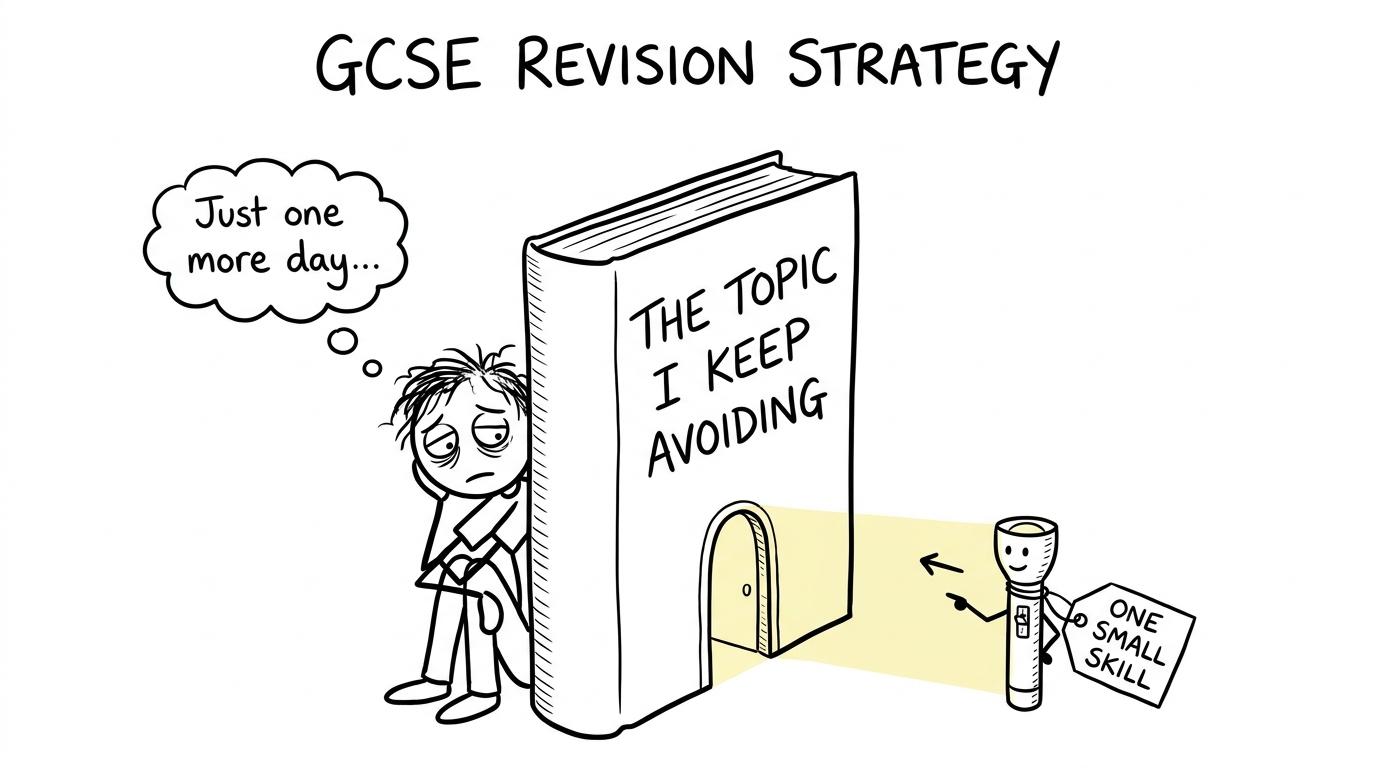 A student discovers a small route around the topic they keep avoiding
Define the problem before trying to solve it
“English Literature” is not a weak topic. Neither is “language analysis”. These labels are too large to produce a sensible revision task.
A useful diagnosis might be:
- selecting quotations that support an interpretation;
- explaining the effect of structural choices;
- comparing writers’ perspectives;
- connecting context to the argument rather than adding it separately;
- remembering evidence from a particular literature text;
- planning narrative or descriptive writing;
- adapting tone to form, audience and purpose;
- maintaining accuracy when writing under time pressure.
Look through marked classwork, mock papers and teacher comments. Record the exact instruction, the assessment objective and the reason marks were missed. If the same issue appears more than once, it deserves priority.
This is the English equivalent of turning “bad at algebra” into “I lose marks when rearranging formulae containing fractions”. MathsGenie’s guide to finding your weakest GCSE topics explains why evidence is more useful than instinct when choosing what to revise.
Match the weakness to the assessment objective
Exam-board papers differ, so always use the specification and mark scheme for your own qualification. Do not assume that an AQA question has the same structure or mark allocation as one from Edexcel, OCR or Eduqas.
Across GCSE English Language specifications in England, the regulated assessment objectives cover retrieving and interpreting information, analysing language and structure, comparison, evaluation, effective communication, and spelling, punctuation and grammar. Reading and writing each account for half of the qualification, while spoken language is reported separately and does not contribute to the final GCSE grade.
GCSE English Literature uses a different set of objectives. Broadly, these assess an informed response supported by textual references, analysis of language, form and structure, understanding of context, and accurate written expression. The precise distribution of marks varies by specification.
That distinction matters. If a literature paragraph contains plenty of historical information but little analysis, learning more context may not fix it. If a language response identifies five techniques but never explains their effects, memorising more terminology will not solve the real problem either.
Turn feedback into an instruction
Teacher comments become useful when converted into actions:
- “Analyse further” becomes “explain how one word shapes meaning and supports my interpretation”.
- “Use context carefully” becomes “connect one relevant contextual idea directly to the writer’s purpose”.
- “Be more evaluative” becomes “state a clear judgement and support it with a precise reference”.
- “Improve accuracy” becomes “reserve the final few minutes for sentence boundaries, spelling and punctuation”.
Your instruction should tell you what to do differently next time. A comment that merely says “do better analysis” is still too vague.
Diagnose the type of error
Repeatedly getting a topic wrong does not always mean that you lack knowledge. Use four categories.
Knowledge gap
You do not know the quotation, terminology, plot detail, form, contextual connection or writing convention required. Repair this with concise notes, retrieval prompts and regular self-testing.
Analysis gap
You can identify evidence but cannot develop its significance. Practise moving from evidence to meaning, then from meaning to the writer’s wider purpose or the reader’s response. Terminology should support that explanation, not replace it.
Question-reading gap
You know the material but answer a nearby question instead of the one set. Underline the focus, command word and scope. A question about how a character changes is not simply an invitation to write everything you know about that character.
Timing or execution gap
Your untimed work is secure, but rushed paragraphs become repetitive or incomplete. The repair is shorter planning, timed paragraphs and deliberate proofreading, not another evening of copying notes.
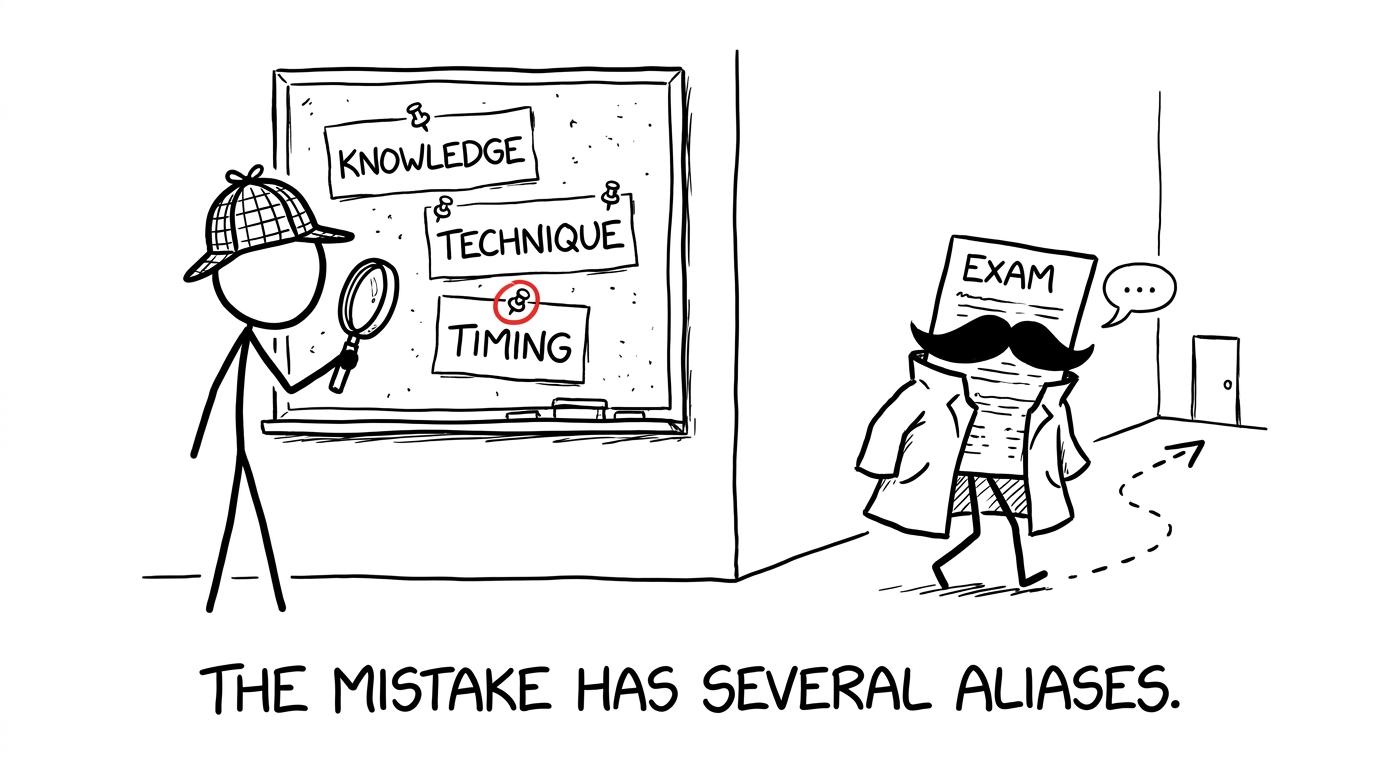 A revision detective identifies the different aliases used by mistakes
Use a short repair cycle
Once the weakness is precise, give it several focused sessions rather than one exhausting evening.
Attempt before reviewing
Begin with one authentic question or a small part of one. Work without notes. This creates an honest baseline and stops familiar-looking material from creating false confidence.
You do not need to write a full essay every time. If the weakness is introductions, comparisons or close language analysis, practise that component first. Build towards complete responses once the smaller skill is stable.
Compare your response with the mark scheme
Read the level descriptors and any indicative content, but remember that indicative content is not normally a compulsory script to copy. English mark schemes reward the quality of the response against stated criteria; valid interpretations can differ when they are supported convincingly.
Ask:
- Did I answer the exact question?
- Is my interpretation clear?
- Is each quotation or reference relevant?
- Have I explained how the writer creates meaning?
- Is context integrated only where it helps?
- Does the response remain coherent and accurate?
If possible, ask your teacher to check whether your self-assessment is realistic. English marking involves professional judgement, so feedback is especially valuable while you are learning to recognise quality.
Rewrite only what needs repairing
Do not automatically rewrite the entire response. Improve the weakest paragraph, opening, comparison or ending. Then annotate the change: what is now clearer, better supported or more closely connected to the question?
This keeps the task manageable. Maths students can use the same habit after a paper: the MathsGenie error-log method turns each lost mark into a defined next action.
Retest with a fresh question
A correction completed while looking at feedback shows that you can follow guidance. A fresh response shows whether you can apply it independently.
Retest after a short gap, using a different extract, theme or question. Keep the conditions comparable. If the same error returns, narrow the skill again or ask for direct teacher guidance.
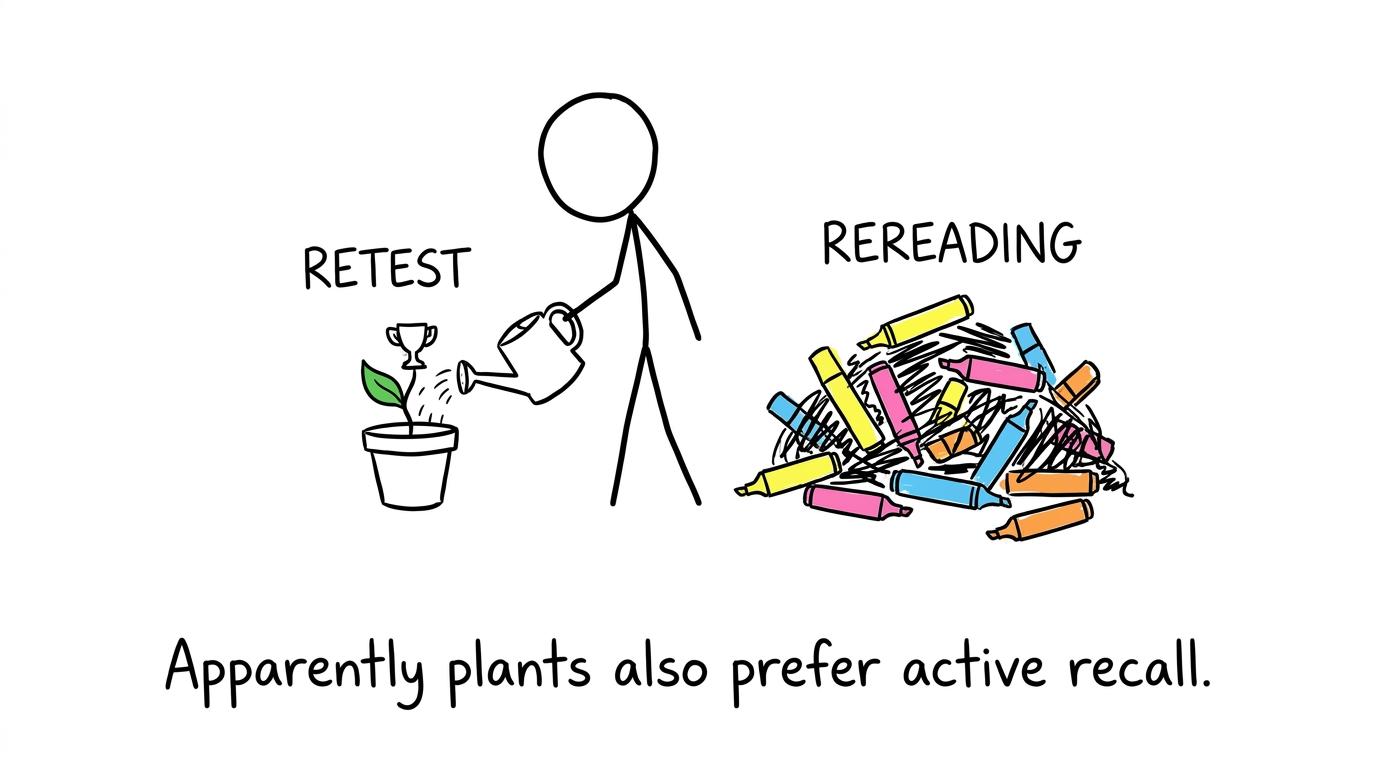 A small retest plant thrives while a pile of passive rereading is ignored
Adapt the method for Language and Literature
For GCSE English Language
Language papers assess transferable reading and writing skills, usually through unseen material. You cannot memorise the exam extract, so practise the decision-making process: selecting evidence, interpreting implications, analysing choices, comparing perspectives, evaluating claims and shaping writing for purpose and audience.
Use short extracts for focused practice, then move to timed sections. Keep a bank of structural and language concepts you genuinely understand, but never force terminology into an answer merely to sound sophisticated.
For GCSE English Literature
Literature revision combines knowledge with argument. Organise quotations around characters, themes and relationships rather than memorising an unconnected list. For each quotation, know where it occurs, why it matters and which interpretations it could support.
Study whole texts, not only isolated quotations. Structure, character development and recurring patterns depend on knowing how the beginning, middle and ending relate. Check your exam board’s rules on texts and question formats rather than relying on advice written for another specification.
Build the repair into your wider revision
A weak topic improves through repeated contact. Put the sessions into a calendar rather than waiting until you feel motivated. MathsGenie’s free revision planner can help you organise your overall workload so English repair sessions do not disappear beneath maths homework and other subjects.
A manageable pattern is:
- first session: diagnose and review;
- second session: focused, untimed practice;
- third session: timed application;
- fourth session: fresh retest;
- later session: mixed-paper check.
Keep the cycle proportionate. Your weakest area deserves attention, but it should not consume all your revision time. Continue maintaining secure topics so that solving one problem does not create another.
For maths itself, use the same structure with the Edexcel GCSE Maths revision hub, AQA GCSE Maths resources or the hub matching your exam board and tier.
Common mistakes when repairing a weak English topic
Avoiding it until the final week
Avoidance protects confidence briefly but gives the weakness time to settle. Start with a ten-minute task if necessary. Small, specific practice is easier to begin than “revise English”.
Rereading instead of producing answers
Notes can refresh knowledge, but the exam asks you to select, interpret and write. Close the book and produce something that can be checked.
Memorising a model response
A polished essay may not fit the wording of the real question. Borrow useful principles, clarity, evidence and development, rather than memorising paragraphs that may become irrelevant.
Counting techniques instead of analysing meaning
Naming a metaphor is not the same as explaining it. Select fewer details and develop their contribution to meaning, viewpoint or effect.
Treating context as a separate history paragraph
Relevant context should sharpen an interpretation. Detached facts can interrupt the argument and may not address the assessment objective effectively.
Completing papers without reviewing them
Practice alone can rehearse the same weakness. The improvement happens during marking, correction and retesting. This is equally true when using Edexcel GCSE Maths past papers: the paper reveals the gap, while the review closes it.
Make the topic smaller, then make it stronger
A weak topic feels permanent when it remains unnamed. Once you reduce it to one observable skill, it becomes trainable. Attempt it, identify the cause, study the relevant assessment objective, practise narrowly and retest independently.
Use that same disciplined approach across your revision. MathsGenie gives you free revision lessons, practice questions, mini tests, mark schemes, video solutions, past papers and predicted papers for GCSE and A Level maths. Start from the GCSE Maths revision hub, choose your board and tier, and turn the next mistake you make into the next skill you fix.