GCSE English Language and Literature Revision Clash
GCSE English language and literature revision timetable clash? Build a realistic seven-subject plan that protects English, maths, rest and exam practice.

There is a particular kind of revision panic that appears when English Language and English Literature land beside maths, science and several other subjects on the same weekly plan. Every subject looks urgent. Every teacher has a different priority. The timetable fills up before the week has even begun.
A GCSE English language and literature revision timetable clash is best solved by giving English regular, purposeful sessions rather than trying to revise both qualifications in occasional marathons. Protect three English blocks each week, keep maths active with shorter question-based sessions, and rotate the remaining five subjects according to weakness and exam proximity.
The aim is not to divide your time equally. It is to use each hour where it can do the most work.
Your realistic revision checklist
Before building the timetable, make these decisions:
- Confirm your exam board for English and maths: Edexcel, AQA, OCR or Eduqas.
- Check your school's examination timetable rather than relying on dates shared online.
- Separate English Language skills from English Literature knowledge.
- Choose three specific English tasks for the week.
- Protect at least three short maths sessions.
- Give extra blocks to subjects with the largest gaps or nearest exams.
- Leave one flexible block for unfinished work, illness or an unexpectedly difficult topic.
- Include rest, meals, schoolwork and sleep before counting your available revision time.
That last point matters. A timetable built around an imaginary version of your week will fail even if it looks impressive.
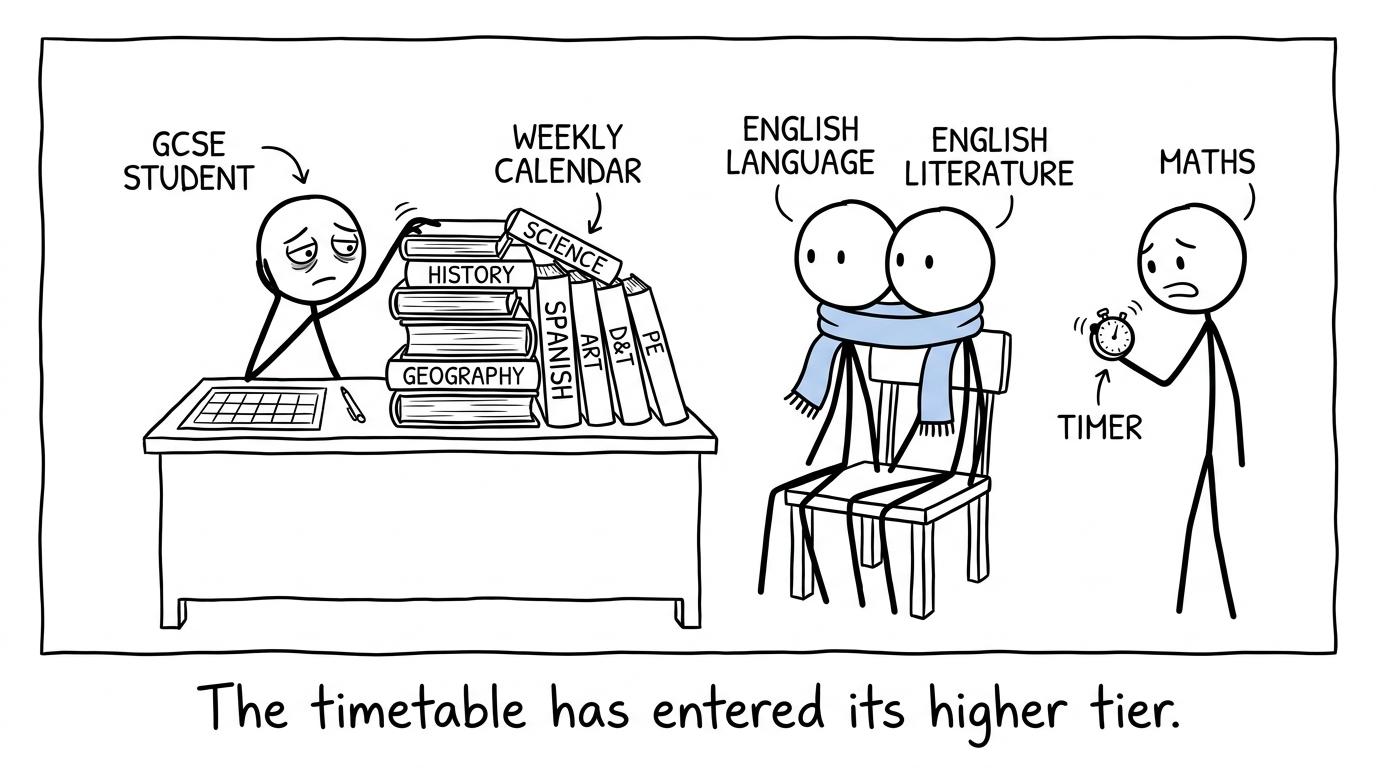 A student trying to fit seven GCSE subjects into a tiny timetable
Treat English Language and Literature differently
The word English can make the two qualifications look like one revision job. They are not.
GCSE English Language assesses transferable reading and writing skills. Across specifications, reading accounts for 50%50\%50% of the qualification and writing accounts for 50%50\%50%. You need to interpret unfamiliar texts, analyse writers' methods, compare ideas where required, evaluate material and produce effective writing for a stated purpose and audience. The precise paper structure and question wording vary by exam board.
English Literature asks you to understand studied texts and construct supported interpretations. The shared assessment objectives include responding to texts, using references, analysing language, form and structure, and understanding context. Your chosen plays, novels and poetry collection depend on your specification and school.
This difference should shape your timetable:
- Language sessions should involve timed reading questions, paragraph planning, writing practice and self-assessment.
- Literature sessions should involve quotation retrieval, theme and character links, essay planning and analytical writing.
Simply writing “English” in three boxes hides the decision you need to make. Write the exact outcome instead: “retrieve quotations for responsibility”, “plan a comparison response” or “complete one timed Language question”.
Build the week from fixed commitments
Start with what cannot move: school, travel, meals, clubs, family commitments and a sensible bedtime. Revision must fit around your actual life, not replace it.
Next, count the blocks you can reasonably complete. A school evening may only have room for two focused sessions of around 252525 to 353535 minutes. A weekend may allow one longer paper-based session, but it should still include a break.
Then assign the blocks in this order:
Protect the minimum for English
Reserve three English sessions before filling the rest of the week:
- one English Language reading or writing session;
- one English Literature retrieval and planning session;
- one timed response, essay section or targeted correction session.
If English is currently one of your weakest areas, add a fourth block. If a Literature examination is approaching, temporarily move the balance towards that paper without abandoning Language entirely.
Keep maths in maintenance mode
Maths becomes harder to recover when it disappears from the timetable for a fortnight. Short, repeated practice is usually more manageable than waiting for a free evening to complete an entire paper.
Use the GCSE Maths revision hub to select work for your board and tier. Your weekly maths minimum might contain:
- one weak-topic lesson followed by practice questions;
- one mini test or mixed question set;
- one timed paper section followed by marking and corrections.
A busy day does not require a full paper. The 20-minute GCSE maths revision routine is designed for days when English or science needs the larger block.
Rotate the five other subjects
Do not assume that all five need identical time every week. Rank them using three questions:
- Which examination comes next?
- Which subject is currently losing the most marks?
- Which subject has not been revisited recently?
Give the strongest priority subject two or three blocks, the next priorities one or two, and place secure subjects into maintenance sessions. Review this ranking every Sunday. Your timetable should respond to evidence rather than remain frozen because it once looked tidy.
Use a repeatable seven-subject pattern
A sustainable week can use different types of day rather than squeezing every subject into every evening.
On two weekdays, pair an English block with a short maths block. On another two weekdays, pair English or maths with science, humanities or an option subject. Keep one weekday lighter, using it for retrieval, marking or catching up. At the weekend, complete one longer timed task and several focused blocks separated by proper breaks.
Across the week, aim to include:
- three or four English sessions split between Language and Literature;
- three maths sessions, at least two of which involve answering questions;
- rotating sessions for the other five subjects;
- one timed task in the subject currently needing exam stamina;
- one catch-up block that can remain empty if everything goes to plan.
This is not a rigid prescription. Homework, intervention sessions and examination order will change the balance. The useful principle is that English and maths remain visible every week while the remaining subjects rotate according to need.
For board-specific maths preparation, use the Edexcel GCSE Maths revision area, AQA GCSE Maths revision area or OCR GCSE Maths revision area. Always choose the correct foundation or higher tier resources.
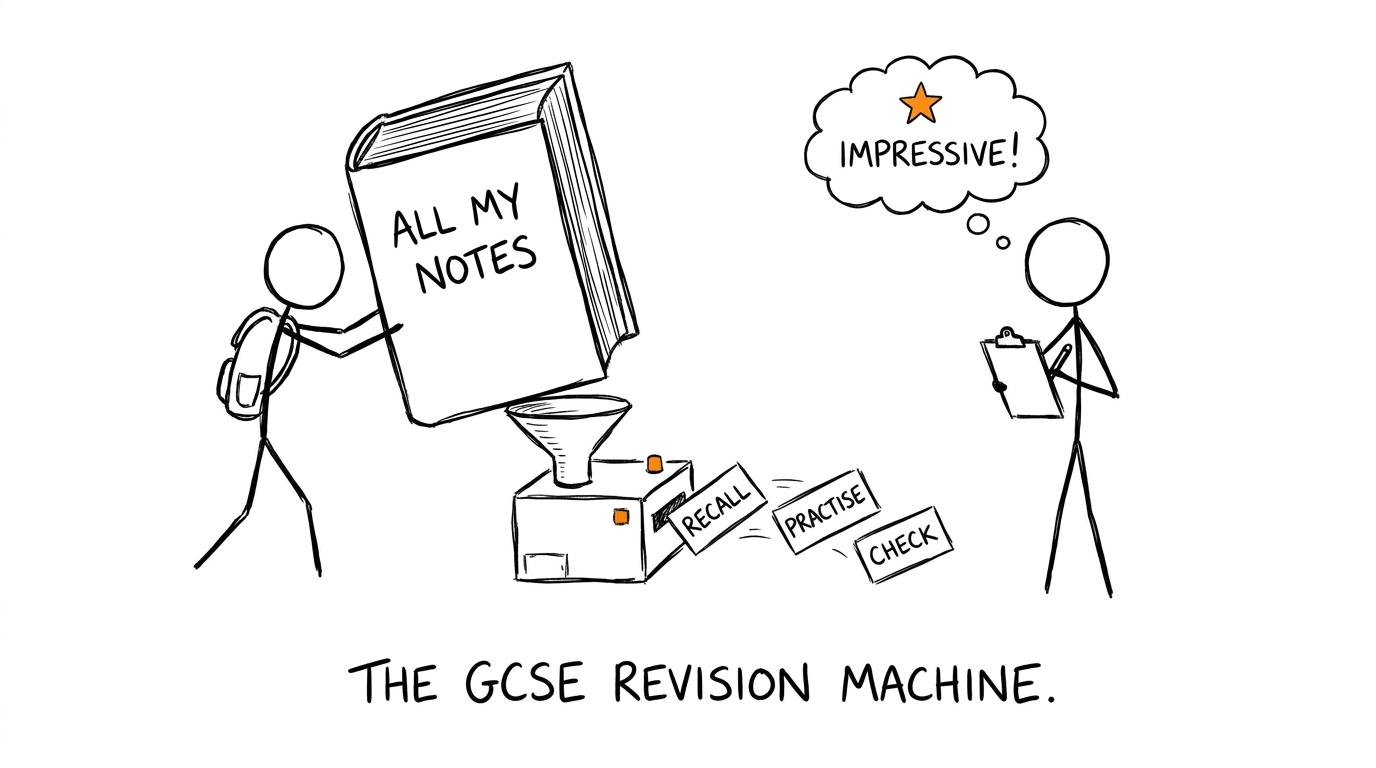 A giant pile of notes being turned into recall, practice and checking
Make every revision block produce evidence
A timetable measures time. Exams measure performance. The bridge between them is a task that produces something you can check.
For English Literature, close the book and retrieve quotations before checking them. Plan a thesis and supporting paragraphs for a theme. Write one analytical paragraph, then compare it with your teacher's feedback or the assessment objectives.
For English Language, answer an exam-board-specific question under a realistic time limit. Afterwards, check whether you addressed the right skill. A beautifully written answer can still underperform if the question assessed comparison but you only analysed one text.
For maths, attempt questions before opening notes. Mark the work, record the reason for each lost mark and schedule the weak topic again. The guide to finding your weakest GCSE topics can help you turn paper results into specific revision decisions.
Active recall and spaced practice are supported by educational research, but they are not magic labels. Recall only helps when you check the answer and correct misconceptions. Spacing only helps when the topic genuinely returns on another day.
A useful block therefore follows four stages:
- retrieve or attempt;
- check against reliable feedback;
- correct precisely;
- schedule a later re-test.
Adjust the timetable as exams approach
Your timetable should change when the examination order changes. Check the final information supplied by your school and note each component separately. English Language and Literature can contain multiple papers, while maths papers may be calculator or non-calculator depending on the board and component.
In the final days before an English Literature paper, increase quotation retrieval, essay planning and timed analytical writing for the relevant texts. The English Literature exam-week checklist provides a focused approach without allowing maths to disappear.
Before a maths paper, move from broad revision towards mixed questions and timed paper sections. If you take Edexcel, the Edexcel GCSE Maths past papers include mark schemes and worked solutions where available. Past papers provide the best evidence of timing and recurring mistakes; predicted papers should add practice rather than replace official papers.
The night before any examination, reduce the workload. Check equipment and arrangements, review a small number of known weaknesses, then stop. Last-minute panic often creates activity without creating much useful feedback.
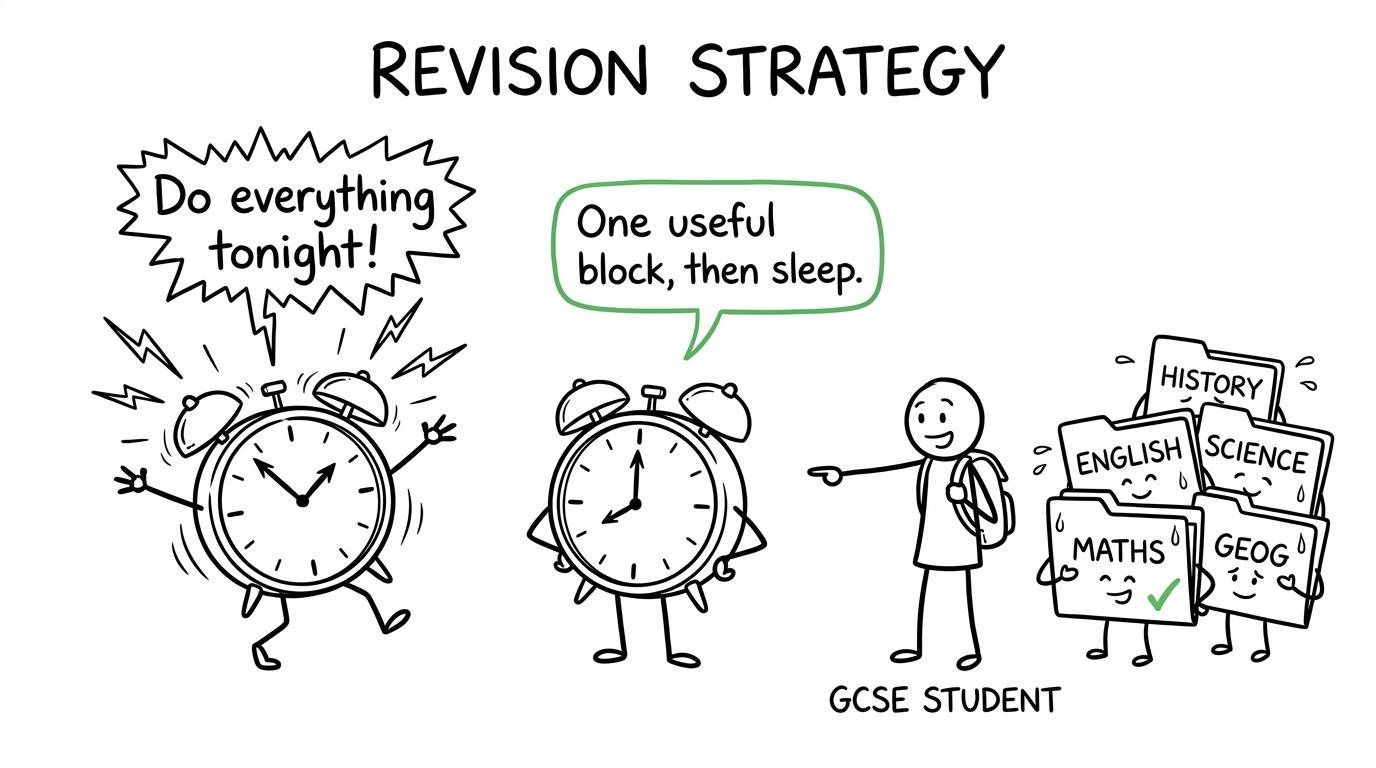 A student choosing one useful revision block and sleep over doing everything tonight
Common timetable mistakes
Giving every subject equal time
Equal is not always sensible. A secure subject with a later examination may need maintenance, while a weak subject with an approaching paper needs several focused returns.
Writing subject names instead of tasks
“Revise Literature” leaves too many decisions for a tired evening. “Retrieve quotations for two themes and plan one response” is clear enough to begin immediately.
Revising English only by rereading
Rereading a novel or revision guide may refresh familiarity, but it does not prove that you can retrieve evidence, analyse methods or organise an examination response.
Dropping maths during English-heavy weeks
Even a short mixed set protects fluency. It is easier to maintain a method than to relearn several topics after a long gap.
Completing papers without reviewing them
A paper is diagnostic evidence, not merely a score. Mark it, classify errors and repair the topics that cost marks. Video solutions can help when the written mark scheme does not explain the full method.
Filling every available space
A timetable with no spare capacity breaks after one difficult homework task or missed evening. A flexible block makes the plan resilient rather than lazy.
A timetable that can survive real life
The best revision plan is rarely the most ambitious one. It is the one you can still follow after a tiring school day, a difficult English essay and a maths topic that takes longer than expected.
Start by protecting three purposeful English sessions and three manageable maths sessions. Rotate the other five subjects according to exam order and genuine weakness. Every Sunday, use completed questions, teacher feedback and lost marks to decide what changes next.
MathsGenie can carry the maths side of that system for free. Begin with the GCSE Maths revision hub, use revision lessons and practice questions to repair individual skills, then move into mini tests, past papers and predicted papers. Mark your work with the available mark schemes and use video solutions when you need to see the reasoning clearly.
Do not wait for a perfectly empty week. Choose one English task, one short maths task and the subject that needs you most. Put them into the next available blocks and begin.