GCSE English Language and Literature Part-Time Job Balance
GCSE English language and literature part-time job balance: plan revision around shifts, protect sleep and keep English and maths moving forward.
A shift does not only take the hours printed on the rota. It takes the journey, the change of clothes and, sometimes, the energy you expected to use afterwards. That is why GCSE English language and literature part time job balance is not solved by squeezing more into every evening. The practical answer is to plan around your real shifts, separate Language from Literature, use short active tasks on working days and reserve demanding exam practice for your clearest hours.
The aim is not a perfect timetable. It is a routine that keeps English moving without allowing maths, sleep or work to fall apart.
Your realistic balance checklist
Start with these decisions:
- Put confirmed shifts, school commitments and travel time into your calendar first.
- Give English Language and English Literature separate revision targets.
- Use short retrieval tasks before or after shifts, not full papers.
- Protect one or two higher-energy periods for timed writing.
- Keep maths alive with brief, focused question practice.
- Mark completed work and turn mistakes into the next task.
- Ask for help early if work is affecting attendance, sleep or schoolwork.
This is deliberately simple. When time is limited, every additional decision creates another place for revision to stall.
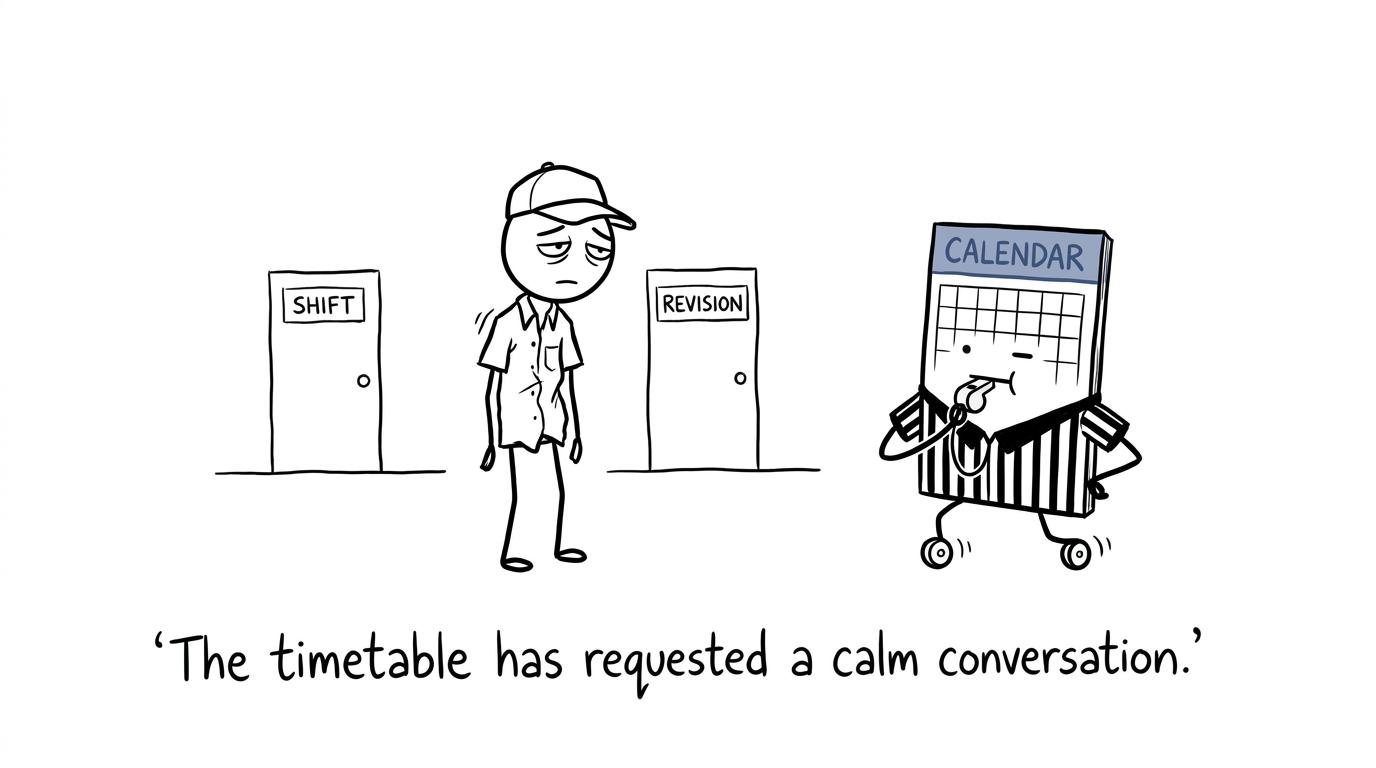 A GCSE student, a work shift and a calendar negotiate the timetable
Build the timetable around energy, not good intentions
A blank weekly planner encourages fantasy. It makes every evening look equally usable, even though an evening after school and a busy shift is not equivalent to a quiet Saturday morning.
Begin with fixed commitments: lessons, shifts, travel, meals and sleep. Then label the remaining periods by likely energy:
- Low energy: quote recall, vocabulary review, reading a short extract or correcting one paragraph.
- Medium energy: planning an essay, analysing an extract or answering a focused maths question set.
- High energy: timed English responses, a substantial Literature essay or a maths paper section.
Place tasks accordingly. A tired hour should not be assigned work that requires sustained judgement and careful writing. That is not laziness; it is honest planning.
If your rota changes, plan only the week ahead. Keep a default routine for predictable weeks and a reduced version for busy ones. The GCSE maths revision timetable guide uses the same principle: a repeatable plan is more useful than an ambitious schedule that survives for three days.
Set a minimum that survives a difficult week
Your minimum might be one short English task and one short maths task on a working day. For example, retrieve quotations without notes, then complete a handful of questions from one weak maths topic. The tasks should be small enough to start when motivation is low but specific enough to produce evidence.
For maths, the twenty-minute GCSE revision routine provides a useful structure for busy school days: recall, practise, mark and choose the next micro-topic.
Keep English Language and Literature separate
English Language and English Literature overlap in reading and writing, but they are not interchangeable revision sessions.
English Language generally requires you to respond to unseen material and produce writing for particular purposes. English Literature requires knowledge of studied texts alongside interpretation, textual references, analysis and, where required, context. Exact paper structures, timings and set texts differ across AQA, Edexcel, OCR and Eduqas, so use your own specification and your teacher's guidance.
A workable weekly plan should contain both:
| English Language tasks | English Literature tasks |
|---|---|
| Analyse a short unseen extract | Retrieve quotations from memory |
| Plan a creative or transactional response | Connect quotations to themes and characters |
| Write one timed paragraph | Plan an essay from a past question |
| Review structure, vocabulary and accuracy | Write or improve an analytical paragraph |
| Compare your response with the mark scheme | Revisit a weak text, poem or scene |
Do not write “revise English” in your planner. Write the exact action: “plan a Language response” or “retrieve quotations about responsibility”. Clear tasks reduce the time lost deciding what revision means.
Match the task to the shift
Before a shift
If there is a short gap after school, choose a task with a definite finish. Recall quotations, annotate a paragraph or make a Literature essay plan. Avoid beginning a complete paper when you already know work will interrupt it.
After a shift
Use a short closing task rather than trying to recover the whole evening. Correct yesterday's paragraph, test five quotations or read a mark scheme. Active recall is more useful than repeatedly looking over familiar notes, while feedback matters because it stops errors becoming rehearsed habits.
If you are physically or mentally exhausted, sleep may be the better decision. Revision performed while barely alert can create the feeling of work without much usable learning.
On a non-working day
Put the hardest task first, before the day becomes crowded. This is the best place for timed writing, a full essay or a longer maths paper section. Afterwards, mark it and identify one or two specific weaknesses. Do not respond to a disappointing attempt by scheduling three more papers immediately.
The calmest revision loop is attempt, mark, diagnose, repair and retest. MathsGenie's guide to using GCSE past papers properly explains how to turn a paper into targeted revision rather than treating the final score as a verdict.
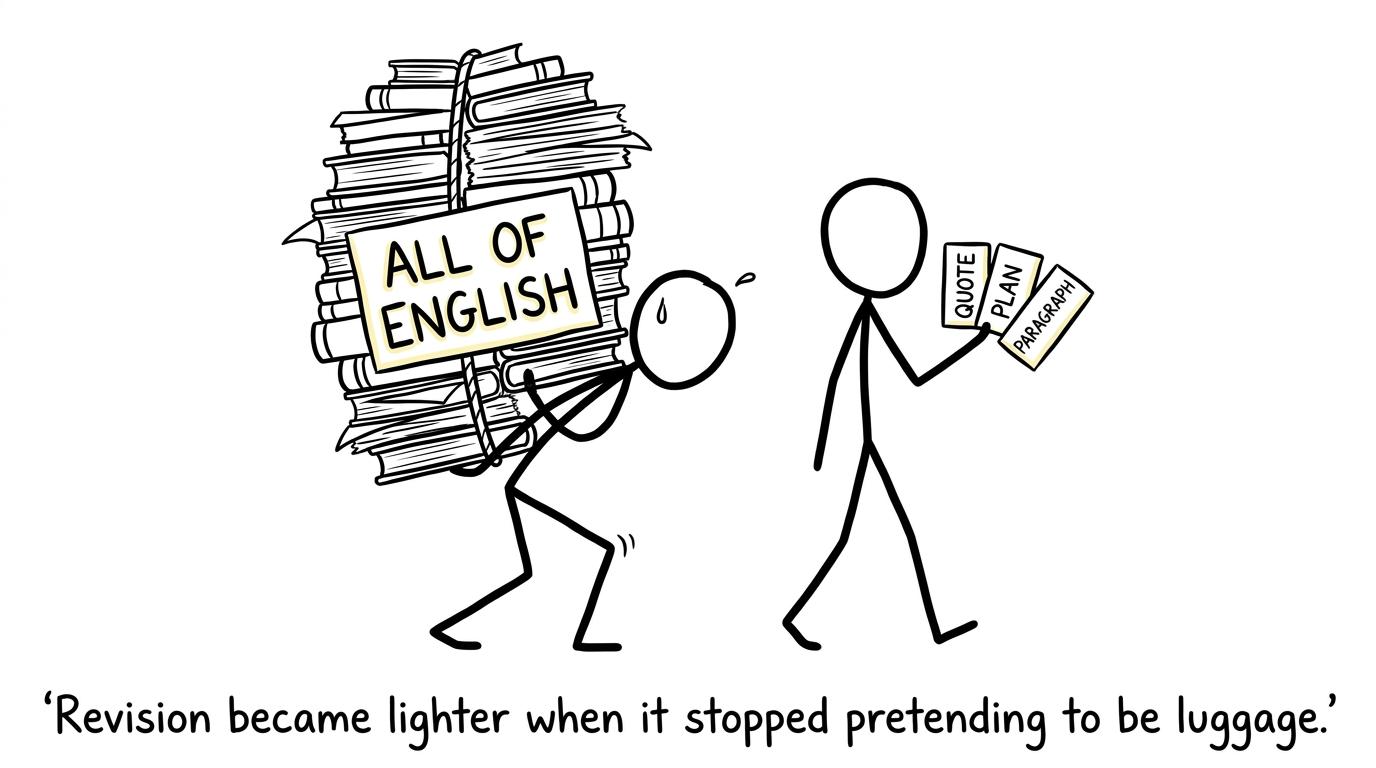 A student discovers that small revision tasks are easier to carry
Use small English tasks that produce something
Passive revision is tempting after work because it feels gentle. You can reread a novel chapter or watch an explanation without confronting what you can remember. Some rereading has value, but it should lead to an output.
Useful short outputs include:
- a quotation list written from memory;
- a theme map completed without the text open;
- a five-minute essay plan;
- one analytical paragraph;
- a Language question completed to a time limit;
- a corrected paragraph with one improvement explained;
- a list of recurring spelling or punctuation errors.
Spacing these tasks across several days is usually more manageable than saving all English revision for one long Sunday session. Return to the same material after a gap, attempt retrieval before opening notes and check accuracy afterwards.
Stop maths disappearing from the week
Students balancing English and work can accidentally treat maths as the subject that will be rescued later. Yet maths skills become less secure when practice vanishes for weeks.
Use the GCSE maths revision hub to select your exam board, tier and weak area. On working days, choose one revision lesson or a compact set of practice questions. On a free day, add a mini test or timed paper section.
A diagnostic approach prevents you revising only comfortable topics. The guide to finding your weakest GCSE topics shows how to turn lost marks into a focused list. You can then use Edexcel GCSE maths mini tests for shorter timed practice where appropriate.
When longer practice becomes realistic, select papers matching your board and tier. MathsGenie provides dedicated collections for Edexcel GCSE maths past papers, AQA GCSE maths past papers and OCR GCSE maths past papers, with mark schemes and worked solutions where available.
The balance is not equal time every day. It is ensuring that no important subject remains untouched for so long that restarting becomes difficult.
Speak to your employer before the pressure peaks
Do not wait until the night before an exam to mention your timetable. As soon as your exam dates and revision commitments are known, ask whether shifts can be made more predictable or reduced around important papers. A clear request is easier to consider than a vague statement that you are busy.
If you are below school leaving age, employment rules restrict the work children can do and the hours they may work. Rules can vary by age, nation and local council by-laws, and an employment permit may be required. Check current official government and local council guidance with a parent, carer or trusted adult rather than relying on a colleague's memory.
Whatever your age, tell a parent, carer, teacher, pastoral lead or manager if work is regularly damaging sleep, attendance, homework or wellbeing. A part-time job should fit around education, not quietly replace it.
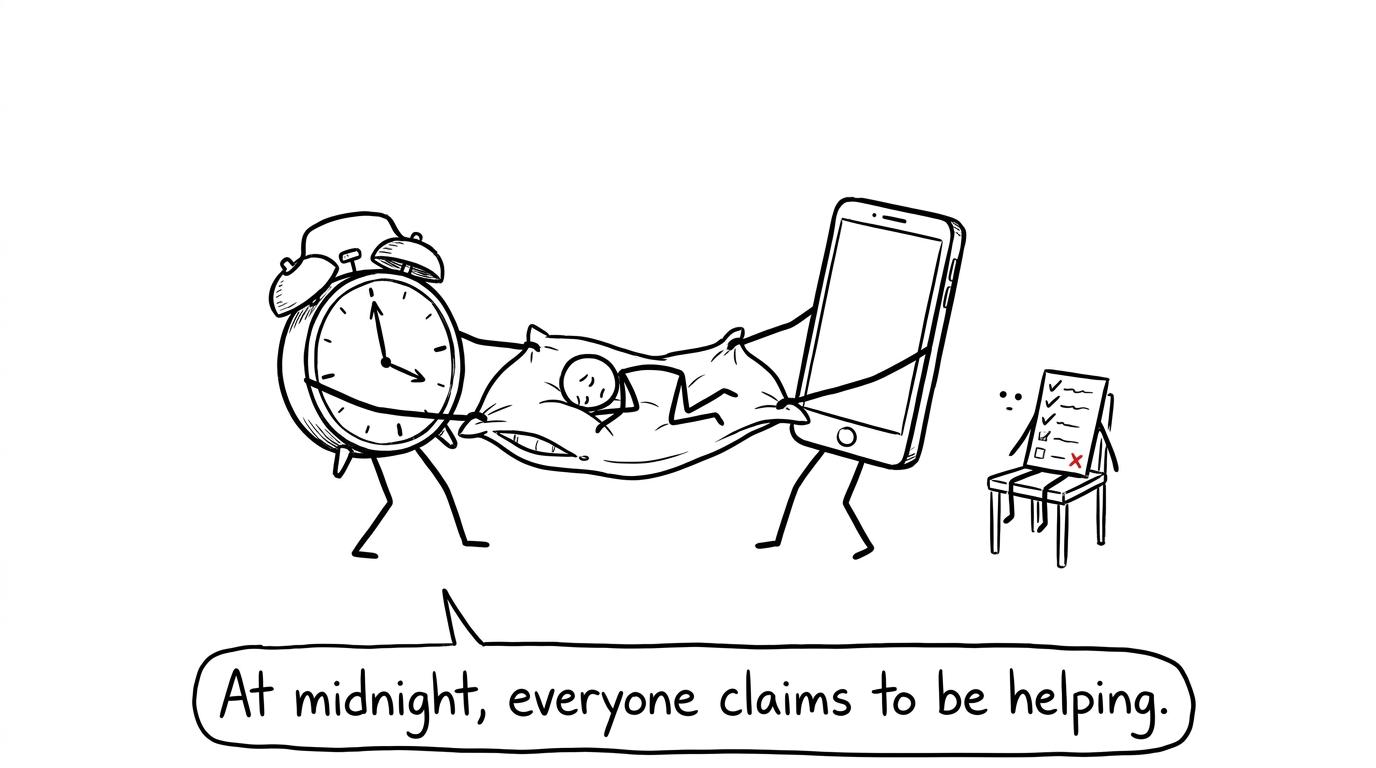 An alarm clock and phone compete to manage a student's midnight
Common mistakes when balancing work and revision
Planning every free minute
A timetable without meals, travel, rest or delays is already broken. Leave some space unassigned so one late shift does not destroy the whole week.
Treating Language and Literature as one subject
General reading will not automatically prepare you for every assessment objective. Schedule unseen analysis and writing for Language, then text knowledge and essay practice for Literature.
Saving difficult work for after a shift
Place demanding writing in your strongest available period. Use tired evenings for retrieval, correction and preparation.
Measuring progress only in hours
Two hours of distracted rereading may produce less than one focused paragraph followed by honest marking. Record completed outputs and repaired mistakes, not merely time spent at a desk.
Dropping maths until English feels finished
English revision is never completely “finished”. Keep a small maths baseline throughout the week so foundation or higher tier skills remain familiar.
Borrowing sleep to catch up
Late-night revision can become a debt paid during tomorrow's lessons. Set a stopping time. Move unfinished work to a named slot rather than extending the evening indefinitely.
A balanced routine can be small and still work
The students with the busiest weeks do not need grander plans. They need fewer moving parts: shifts entered first, tasks matched to energy, separate goals for Language and Literature, and a minimum maths routine that continues even when time is tight.
Start by planning the next seven days, not the rest of the year. Choose one English Language task, one Literature task and one weak maths topic. Then use MathsGenie to make the maths part easy to begin: open a free revision lesson, complete practice questions, check the mark scheme and use video solutions to repair mistakes. As exams approach, build towards mini tests, past papers and predicted papers.
You do not need to win every evening. You need a system that is still standing after a difficult shift and a clear next action when you return.