GCSE English Language and Literature Note Taking
GCSE English language and literature note taking that works: build concise, exam-ready notes you can retrieve, review and use under timed conditions.
A notebook can look full and still be almost useless. Pages of copied slides, highlighted quotations and careful headings may prove that you were busy, but they do not guarantee that you can recall an idea or shape it into an exam response.
Effective GCSE English language and literature note taking has a different purpose: to make later revision easier. Your notes should help you retrieve knowledge, connect evidence to interpretations and recognise what a question requires. If a page cannot support one of those jobs, it probably needs simplifying.
This matters when English is competing with maths, science and every other subject for your attention. The goal is not to create more revision. It is to create notes that reduce the work you will face later.
The useful-notes checklist
Before building a new system, remember what effective notes need to do:
- match the content and assessment objectives of your exam board
- separate English Language skills from English Literature knowledge
- reduce lessons and texts into manageable prompts
- make you recall information rather than merely reread it
- connect quotations or methods to meaning and context
- reveal gaps while there is still time to address them
- support timed planning and exam practice
A beautiful page may satisfy some of these conditions. A plain set of question cards may satisfy all of them. Usefulness matters more than appearance.
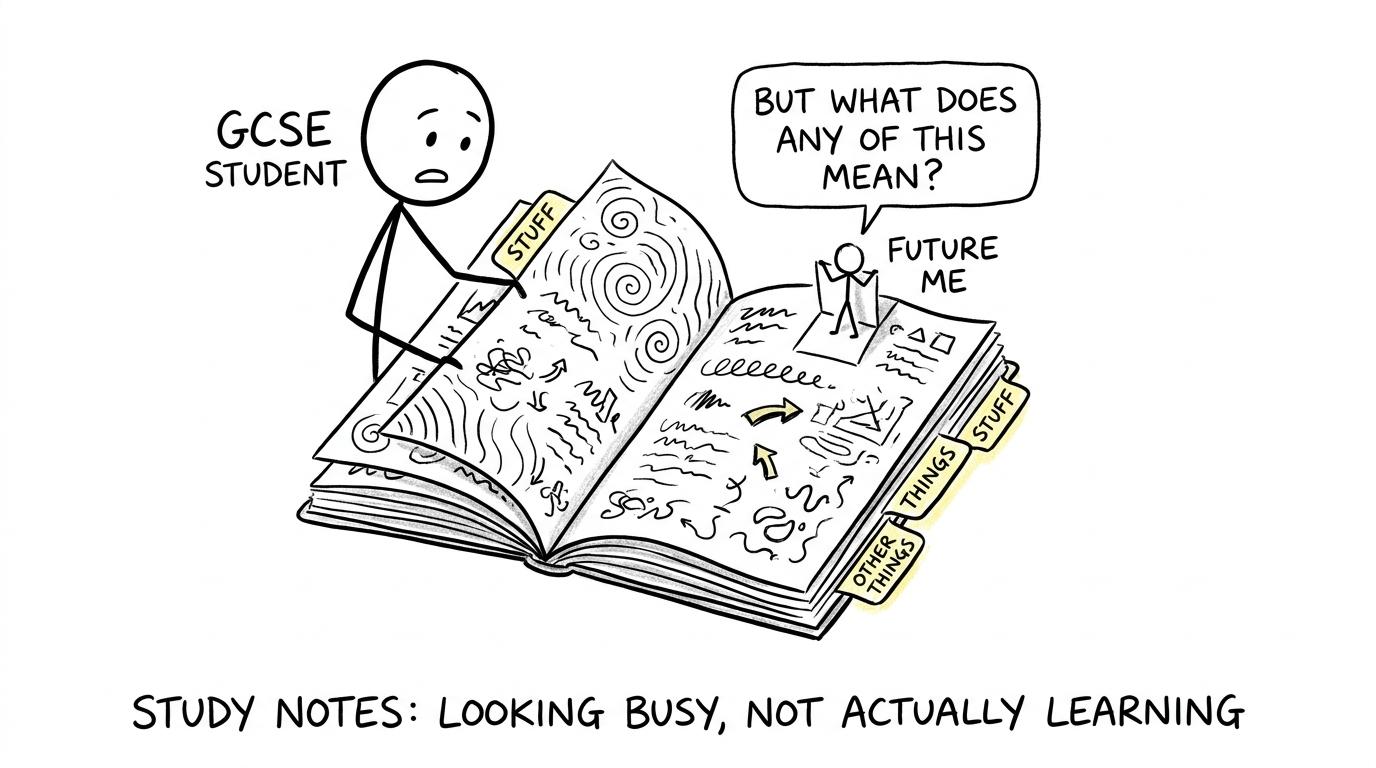 A student discovers that attractive notes do not automatically help future revision
Begin with the exam, not the notebook
GCSE English specifications vary across AQA, Edexcel, OCR and Eduqas. Text choices, paper structures and the wording of assessment objectives are not identical. Before organising notes, check your current specification, the texts selected by your school and recent official mark schemes.
Then work backwards from what the examination asks you to demonstrate.
Broadly, English Language rewards reading, analysis, comparison, evaluation and controlled writing. English Literature requires secure knowledge of set texts alongside analysis of language, form and structure, supported by relevant evidence. Context matters where the specification requires it, but it should illuminate the text rather than become a detached history essay.
This leads to a simple rule: do not take the same kind of notes for both subjects.
Notes for English Language
English Language is largely a skills-based subject. You cannot predict the unseen extracts, but you can prepare ways to approach them.
Useful Language notes might contain:
- a short checklist for reading each question
- common command words and what they require
- methods writers use to shape meaning
- paragraph structures that keep analysis focused
- reminders about comparison and evaluation
- planning prompts for descriptive, narrative or transactional writing
- personal error lists drawn from marked responses
Avoid collecting enormous lists of sophisticated words or techniques without knowing how to use them. Naming alliteration earns little by itself. The important question is what a choice suggests, how it affects the reader and why it suits that moment in the text.
Notes for English Literature
Literature notes need to preserve knowledge without turning each text into a second textbook. Organise them around ideas that can travel between questions:
- characters and relationships
- themes and conflicts
- changes across the text
- significant moments
- methods involving language, form and structure
- concise contextual knowledge
- short, flexible quotations
- alternative interpretations you genuinely understand
A quotation should never sit alone on a card. Pair it with a speaker or location, an idea, a method and a possible interpretation. That makes it usable rather than merely memorable.
Build notes in layers
One reason revision notes become overwhelming is that every detail receives equal status. Strong notes have layers, allowing you to move from the whole course to a single precise point.
The course map
Create one page listing every component you must revise. For Literature, include each set text, poetry collection and unseen element required by your specification. For Language, list the question types and writing tasks on each paper.
Mark each area as secure, developing or weak. This overview performs the same job as a revision planner: it turns a vague feeling of being behind into visible next actions.
Maths students can use the same principle with the GCSE maths revision topic list, where revision becomes easier once the course is divided into specific skills rather than treated as one enormous subject.
The one-page summary
Give each text, major theme or Language question type a single summary page. Limit the page deliberately. Include only material you would want available during a short review before practice.
For a Literature text, that might mean central themes, character journeys, structural turning points and a small quotation bank. For a Language question, it might mean the purpose of the task, a reading sequence, useful analytical prompts and mistakes found in your previous work.
The limit creates judgement. Copying records what a teacher said; selecting forces you to decide what matters.
Retrieval prompts
Turn the summary into questions. Put the prompt on one side of a card or digital note and the answer on the other. Questions should require thought:
- Which moments show this character changing?
- How does the setting contribute to tension?
- Which evidence could support two different themes?
- What does this command word require?
- Which error appears repeatedly in my writing?
Try to answer before checking. The temporary struggle is part of the process. Rereading can feel fluent because the information is in front of you; retrieval reveals whether it is available without help.
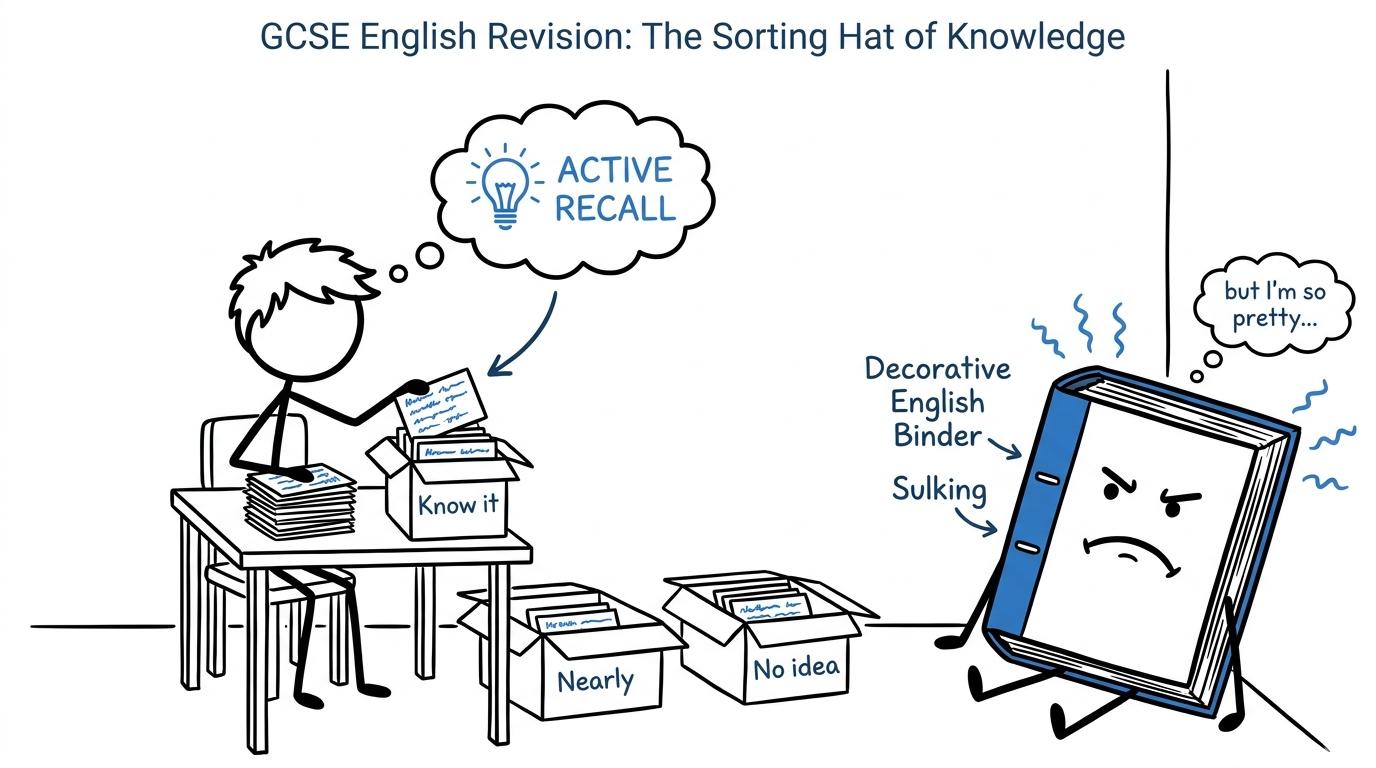 A student sorts revision prompts while an oversized decorative binder watches
Use quotations as flexible evidence
Students often assume that successful Literature revision means memorising the largest possible quotation bank. A smaller collection of short, accurately remembered evidence is usually easier to adapt.
Choose quotations that can support several themes, relationships or stages of a character's development. Record:
- who says it or where it appears
- the idea it may support
- one important word or structural feature
- a concise interpretation
- another section of the text to which it connects
Do not overload every quotation with five techniques and a fixed paragraph. Questions vary. Your notes should preserve flexibility rather than lock you into an answer prepared for a different task.
Use context selectively too. A contextual note is valuable when it explains a writer's choice, an audience's possible response or a tension within the work. It is less useful when it has no clear route back to the text.
Create an error log from real practice
The most personal revision resource is not a model answer. It is a record of what goes wrong in your own work.
After feedback or timed practice, note the precise issue and the correction. Useful categories include:
- misunderstood command words
- unsupported interpretations
- excessive retelling of the plot
- vague comments about reader effects
- missing comparison
- weak paragraph control
- inaccurate quotation recall
- punctuation or sentence-boundary errors
- poor use of time
Keep each entry brief and actionable. Instead of writing “analysis weak”, record “explain the effect of the chosen word before moving to another quotation”. Review the log immediately before your next response.
The same approach works in maths. When using Edexcel GCSE past papers, AQA GCSE past papers or OCR GCSE past papers, the mark scheme tells you where marks were lost; an error log tells you what to change next time.
Schedule review, not just note making
A note becomes valuable when you return to it. Build review into the system from the beginning.
After making notes, close them and write down what you can remember. Revisit weak prompts regularly, while allowing secure material to appear less often. Mix topics so that you must identify the right idea rather than repeating one comfortable routine.
A practical review session might include:
- recalling one theme without looking
- sorting quotation cards by character or idea
- planning a response to an unfamiliar question
- checking the plan against your notes
- completing one short timed section
- updating the error log
This principle transfers directly to maths revision. A video or summary can clarify a method, but independent questions show whether you can use it. MathsGenie's free GCSE revision resources combine explanations, practice questions and video solutions, while predicted GCSE maths papers can support timed practice closer to the examination period.
Keep English and maths revision distinct but connected
English and maths demand different knowledge, yet useful notes perform the same basic function in both subjects. They turn content into decisions you can make under pressure.
In English, a prompt might ask you to connect a quotation to a theme. In maths, it might ask you to identify a method from the wording of a problem. In both cases, simply recognising a completed solution is weaker than producing the next step independently.
If you are balancing GCSEs, use one revision planner for all subjects but choose subject-specific activities. “Revise English” and “revise maths” are too broad. “Recall five flexible quotations”, “plan one comparison” or “complete a mini test on a weak algebra topic” gives you a finish line.
Students moving towards sixth-form study can apply the same habits to A Level maths revision: concise summaries, independent recall, practice and careful review of errors remain more useful than passive copying.
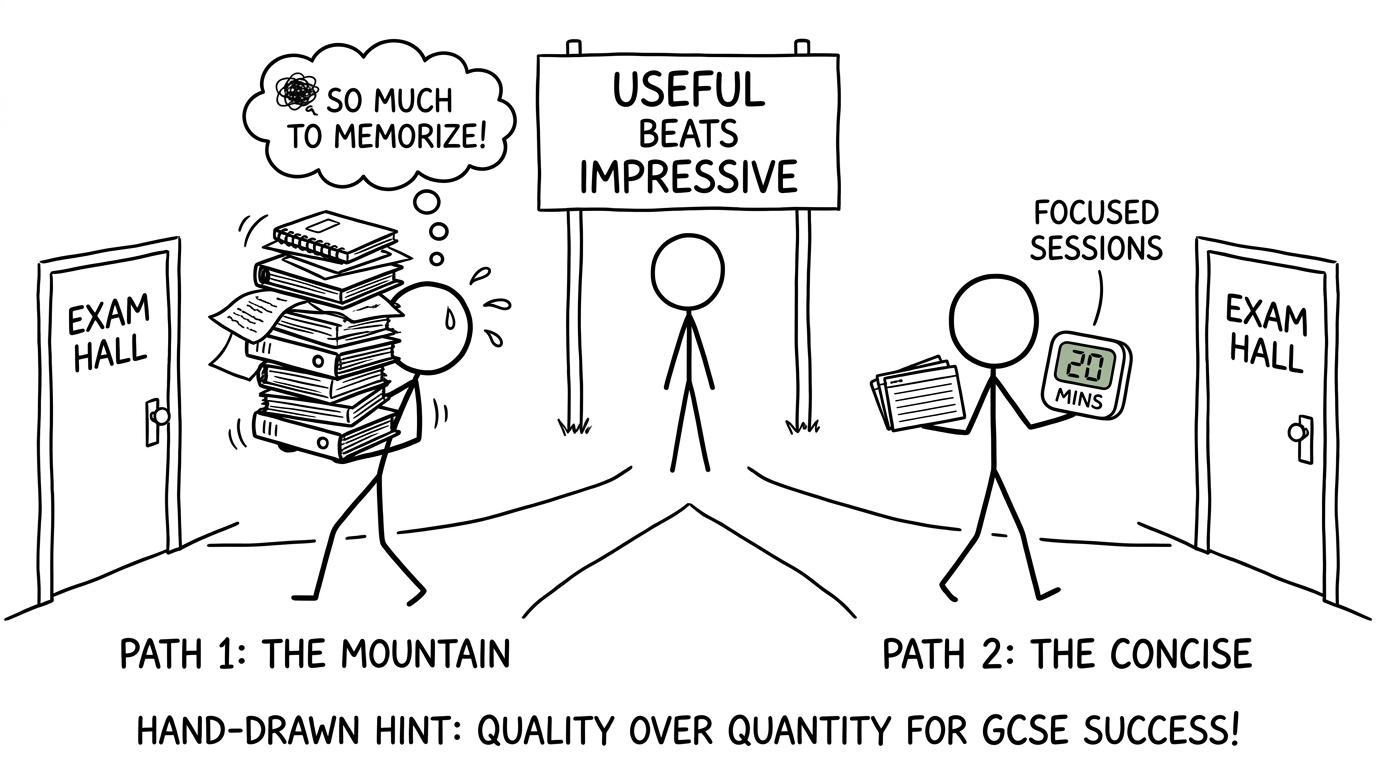 One student carries a mountain of notebooks while another chooses a few useful revision prompts
Common GCSE note-taking mistakes
Copying everything
Transcription feels safe because it removes the need to choose. Unfortunately, it also creates long notes that are difficult to review. Listen first, identify the central idea, then record it briefly in your own words.
Highlighting without a purpose
Colour should communicate something consistent, such as theme, evidence or an uncertainty to revisit. If most of the page is highlighted, nothing has been prioritised.
Writing analysis you do not understand
A complicated interpretation is not useful merely because it sounds impressive. Keep explanations clear enough that you could reproduce and adapt them under timed conditions.
Treating notes as the final stage
Notes are preparation for retrieval, planning and writing. If all your revision time is spent remaking them, you never test whether they work.
Ignoring the specification
Do not inherit an older student's folder and assume every detail matches your course. Confirm the exam board, current paper structure and set texts used by your school.
Avoiding weak topics
Students naturally polish notes on texts and skills they already enjoy. Let your course map and error log determine what comes next, even when the answer is uncomfortable.
Make every page earn its place
The best notes are rarely the longest. They are the ones you can question, compress, revisit and apply. Build a course map, separate Language skills from Literature knowledge, create flexible prompts and let practice expose what needs attention.
Then carry the same discipline into maths. Use MathsGenie to choose a focused revision lesson, answer the accompanying practice questions and check your reasoning with mark schemes or video solutions. Add past papers, predicted papers, mini tests and the revision planner when they serve a clear purpose.
Revision becomes less intimidating when every resource has a job. Make notes for the student who will need them later, not for the page that needs to look impressive today.