

GCSE English Grade Boundaries: Language vs Literature
GCSE English Language and Literature vs English Language grade boundaries explained: compare subjects fairly, understand yearly changes and set safer targets.
A grade boundary can look like a promise. Reach this mark, earn this grade. Yet the closer you look, the less fixed it becomes.
For students comparing GCSE English Language and Literature vs English Language grade boundaries, the useful answer is simple: neither subject has permanently more generous boundaries. In many exam series, English Literature has required a lower proportion of the available marks for some middle grades, but that pattern is not universal. At the highest grades it may narrow or reverse, and boundaries vary by exam board, specification and year.
The sensible approach is to compare the boundary for your exact qualification and target grade, then prepare to score safely above it.
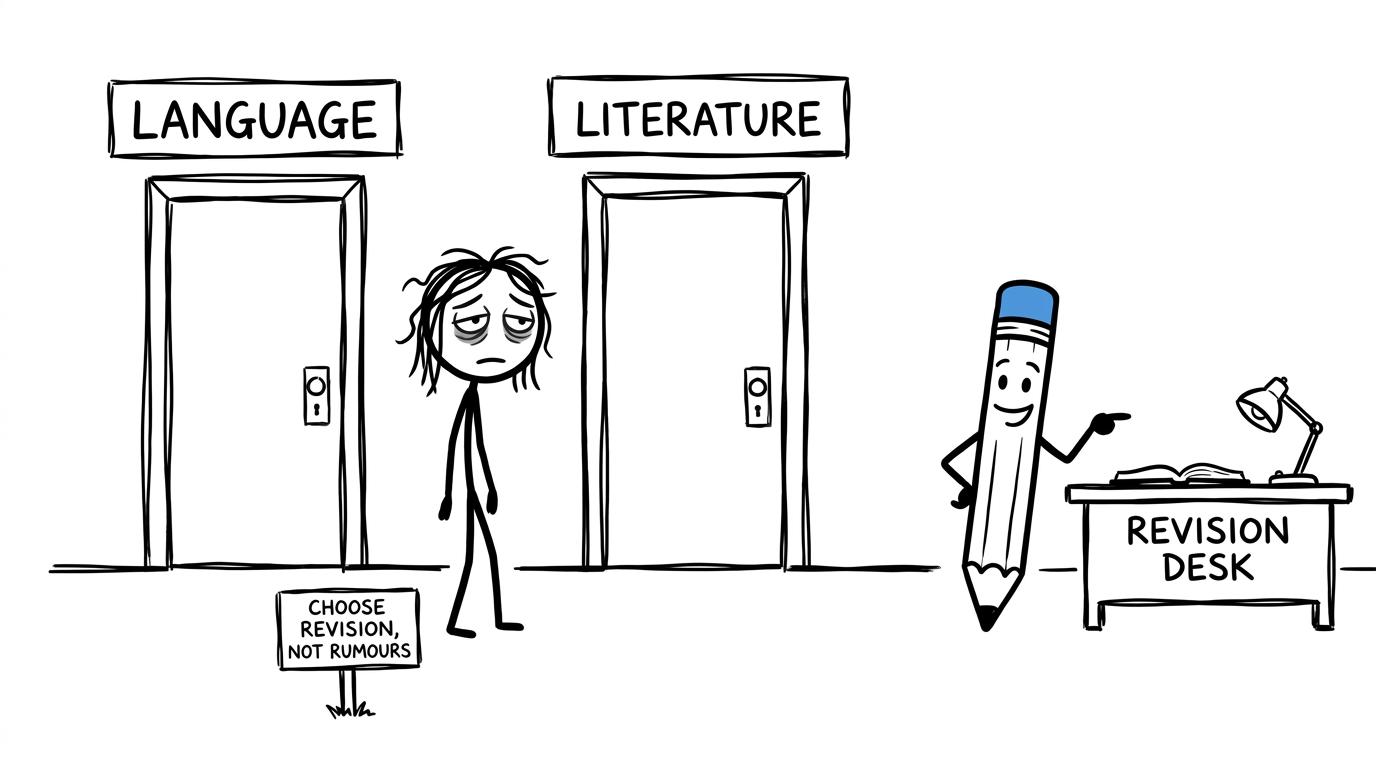 A student choosing revision over grade-boundary rumours
The quick grade-boundary checklist
Before deciding that one English GCSE is more generous, check:
- whether you mean two separate GCSEs or a combined qualification;
- your exam board: AQA, Edexcel, OCR or Eduqas;
- the exact specification code;
- the exam series and year;
- the total available raw marks;
- the boundary for your particular target grade;
- whether you are viewing an official boundary or an unofficial estimate.
Do not compare two raw marks unless both qualifications have the same maximum mark. Convert them into proportions first:
Boundary percentage=grade boundarymaximum available mark×100\text{Boundary percentage}=\frac{\text{grade boundary}}{\text{maximum available mark}}\times 100Boundary percentage=maximum available markgrade boundary×100Even then, a lower percentage does not automatically mean an easier qualification. Grade boundaries respond to how demanding the papers were and how students performed.
English Language and Literature are usually separate GCSEs
The wording causes much of the confusion. In England, GCSE English Language and GCSE English Literature are normally separate qualifications with separate papers, marks and final grades.
When someone says they are taking “English Language and Literature”, they often mean they are taking both GCSEs. There is not one shared boundary for the pair. English Language has its own grade boundaries, while English Literature has different boundaries.
Some qualifications elsewhere in the UK or under particular specifications may use a combined or double-award title. If that is what appears on your school timetable, use the specification and boundary document named by your school rather than assuming it follows an English AQA, Edexcel, OCR or Eduqas course.
English GCSEs are also not split into foundation and higher tiers. Unlike GCSE Maths, every candidate on a particular English specification is working towards the same grade range of 999 to 111.
Which grade boundaries tend to look more generous?
Across several exam series and major English exam boards, Literature boundaries have sometimes looked more generous around pass and middle grades because a smaller proportion of the total marks was required. That does not create a dependable rule.
The comparison can change at higher grades. A Literature boundary for grade 444 might be proportionally lower than the Language boundary in one series, while the difference at grade 777 is smaller. Grade 999 could produce another pattern entirely.
This happens because each grade boundary is set for a particular assessment. Examiners and awarding organisations consider the demand of the papers, evidence from marking and expected standards. Boundaries are not chosen in advance as permanent percentages.
So the honest verdict is:
- For grades around 444 or 555: Literature may sometimes have the lower proportional boundary.
- For grades around 777 to 999: the gap may shrink, disappear or reverse.
- Across different boards: no comparison is meaningful without checking maximum marks and specification details.
- Across different years: last year’s boundary is evidence, not a guarantee.
This is why “Which subject has the lower boundary?” is less useful than “What mark can I repeatedly achieve under timed conditions?”
Why a lower boundary does not mean an easier paper
Imagine two hurdles. One is lower because the track leading towards it is steeper. Looking only at the hurdle misses most of the challenge.
English Language assesses skills such as retrieving information, analysing writers’ methods, comparing texts and producing clear, controlled writing. The source material is normally unseen, so students must apply their skills to unfamiliar texts.
English Literature depends more heavily on secure knowledge of set texts, interpretation, relevant references and analysis of writers’ choices. Depending on the specification and paper, students may also need to respond to an unseen poem or another unfamiliar extract.
A demanding Literature paper can lead to a lower boundary because fewer candidates collected the same proportion of raw marks. That lower threshold compensates for the paper’s demand; it does not prove that earning the grade was easier.
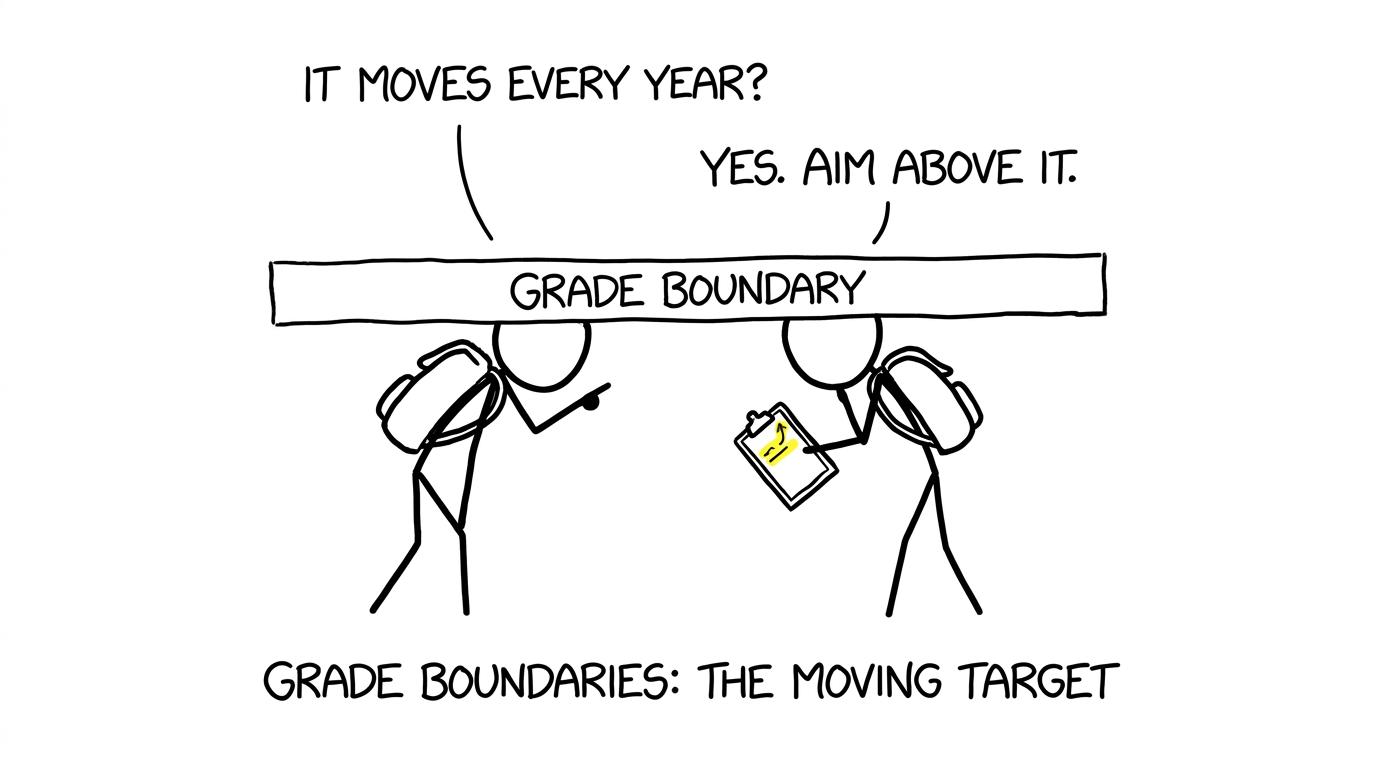 Students discover that the grade-boundary bar moves
Why grade boundaries change each year
Grade boundaries exist to preserve standards when paper difficulty varies. If one year’s paper is more demanding, candidates may need fewer raw marks to demonstrate the same standard. If it is more accessible, the boundary may rise.
The same principle matters in maths. A student using MathsGenie’s GCSE revision resources should not assume that a raw mark from one paper automatically represents the same grade on every other paper.
Boundaries can change because of:
- differences in question demand;
- changes in how accessible particular questions are;
- the balance of skills tested across the papers;
- evidence considered during the awarding process;
- differences between specifications and maximum marks.
They are published after papers have been marked and grades awarded. Any boundary circulating before that point is a prediction, not an official result.
What the comparison means for your target grade
Your target grade determines which comparison matters. There is little value in comparing grade 444 thresholds if you are aiming for grade 777.
If your target is grade 444
Treat the recent grade 444 boundaries as a rough baseline, not the finish line. English Language is particularly important because students in England who have not secured the required pass standard may need to continue with English after Year 111111, subject to the current post-161616 rules applying to them.
Build a margin above the recent boundaries. A mark exactly on an old threshold leaves no protection against a higher boundary, a difficult question or an avoidable loss of marks.
If your target is grade 555 or 666
Focus on consistency. At these grades, incomplete responses and weak time management often matter more than tiny differences between historical boundaries. Track whether each section is contributing reliably rather than depending on one strong answer to rescue the paper.
The same habit works in maths: use GCSE past papers, mark them honestly and identify topics that repeatedly reduce your total.
If your target is grade 777 to 999
A lower pass boundary tells you almost nothing about the top of the grade scale. Compare the grade 777, 888 or 999 boundary for your own specification and look at how close your timed-paper marks are to it.
At this level, precision matters. In English, that means developed analysis, a controlled argument and accurate written expression. In maths, it means preserving method marks and checking demanding multi-step questions. MathsGenie’s predicted papers can help maths students practise that sustained exam discipline, although no predicted paper can guarantee the content of a live examination.
A better revision strategy than chasing the lowest boundary
The most reassuring boundary is not the lowest one from the past. It is the distance between your current performance and the range of plausible boundaries.
Start by collecting several official papers from your specification. Complete them in timed conditions, use the relevant mark schemes and record your raw mark by section. One unusually high result can be luck; a pattern across several papers is more useful.
For maths preparation, MathsGenie places revision lessons and practice questions alongside videos and answers, making it easier to repair a weak topic before attempting another full paper. The GCSE exam-paper collection then tests whether that improvement survives exam conditions.
Keep English and maths records separate, but use the same questions after each paper:
- Where were marks lost?
- Was the problem knowledge, technique or timing?
- Which errors could have been prevented?
- Is the score safely above the relevant historical boundary?
- Can the result be repeated?
Students moving towards sixth form can apply the same system with MathsGenie’s A Level revision resources and A Level past papers. Qualifications change, but careful feedback remains valuable.
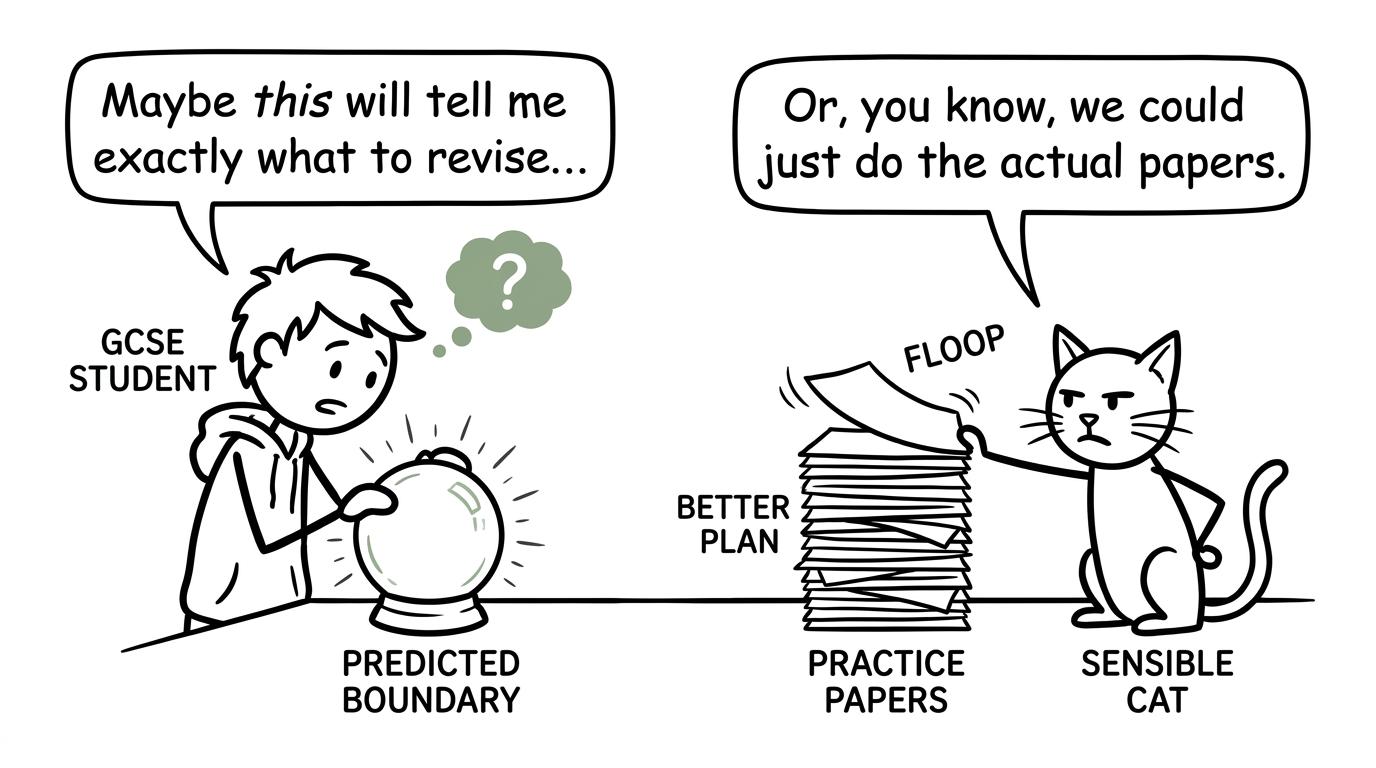 A crystal ball loses an argument with a stack of practice papers
Common mistakes when comparing English grade boundaries
Comparing raw marks with different totals
A boundary of 808080 marks means something different on a qualification worth 160160160 marks than on one worth 200200200 marks. Compare percentages, but remember that percentages still do not measure paper difficulty perfectly.
Using the wrong specification
An AQA boundary cannot estimate an Edexcel result. Even qualifications from the same board may have different specification codes. Check the document heading carefully.
Treating Language and Literature as one grade
Strong Literature performance does not alter the English Language boundary or compensate for a lower Language result. They are normally awarded separately.
Looking only at the pass boundary
A student targeting grade 888 needs the grade 888 boundary. Patterns at grade 444 may not continue at the top of the scale.
Revising to land exactly on an old boundary
Historical boundaries move. Aim for a secure margin and judge progress across several timed papers rather than one favourable result.
Trusting predicted boundaries as facts
Schools and teachers may estimate likely thresholds, but official boundaries are not known before awarding. Predictions should guide caution, not create certainty.
The boundary matters less than the buffer
The comparison between GCSE English Language and Literature grade boundaries has no permanent winner. Literature may show lower proportional thresholds for some grades and exam series, but the pattern varies by target grade, board and paper difficulty.
Your practical decision is clearer: identify the qualification you are taking, compare the correct boundary, practise under timed conditions and aim above the historical range.
Then bring the same discipline back to your maths exams. Start with MathsGenie’s free GCSE maths revision, strengthen weak topics with revision lessons, videos, mini tests and practice questions, and test your progress using past and predicted papers. Grade boundaries move. Secure knowledge travels with you.











