

GCSE English Language Group Chat Study Guide
GCSE English language group chat study tips that turn class messages into focused reading, writing and exam practice without banning every meme.
A class group chat can become useful or useless in seconds. Someone asks about a language technique; someone else posts a meme; then forty messages arrive without anybody answering the original question.
Effective GCSE English language group chat study needs a simple structure. Use the chat for short retrieval questions, paragraph feedback, timed planning and revision accountability. Keep social conversation separate, check advice against your exam board's specification and never allow shared messages to replace independent writing.
The goal is not to create a silent, joyless chat. It is to make useful revision easier to find than yesterday's jokes.
The quick group chat checklist
Before the next revision session, agree on these rules:
- Give the chat a clear purpose for each session.
- Set a start time, finish time and specific topic.
- Ask questions that require people to recall or apply knowledge.
- Share short plans or paragraphs rather than complete copied answers.
- Explain feedback instead of sending unexplained corrections.
- Label the relevant exam board and paper where necessary.
- Save valuable summaries in one organised document or pinned message.
- Mute the chat outside agreed revision periods.
- Move unrelated conversation to another chat.
A chat does not become a revision resource merely because students discuss an exam in it. It becomes useful when everyone knows what action to take.
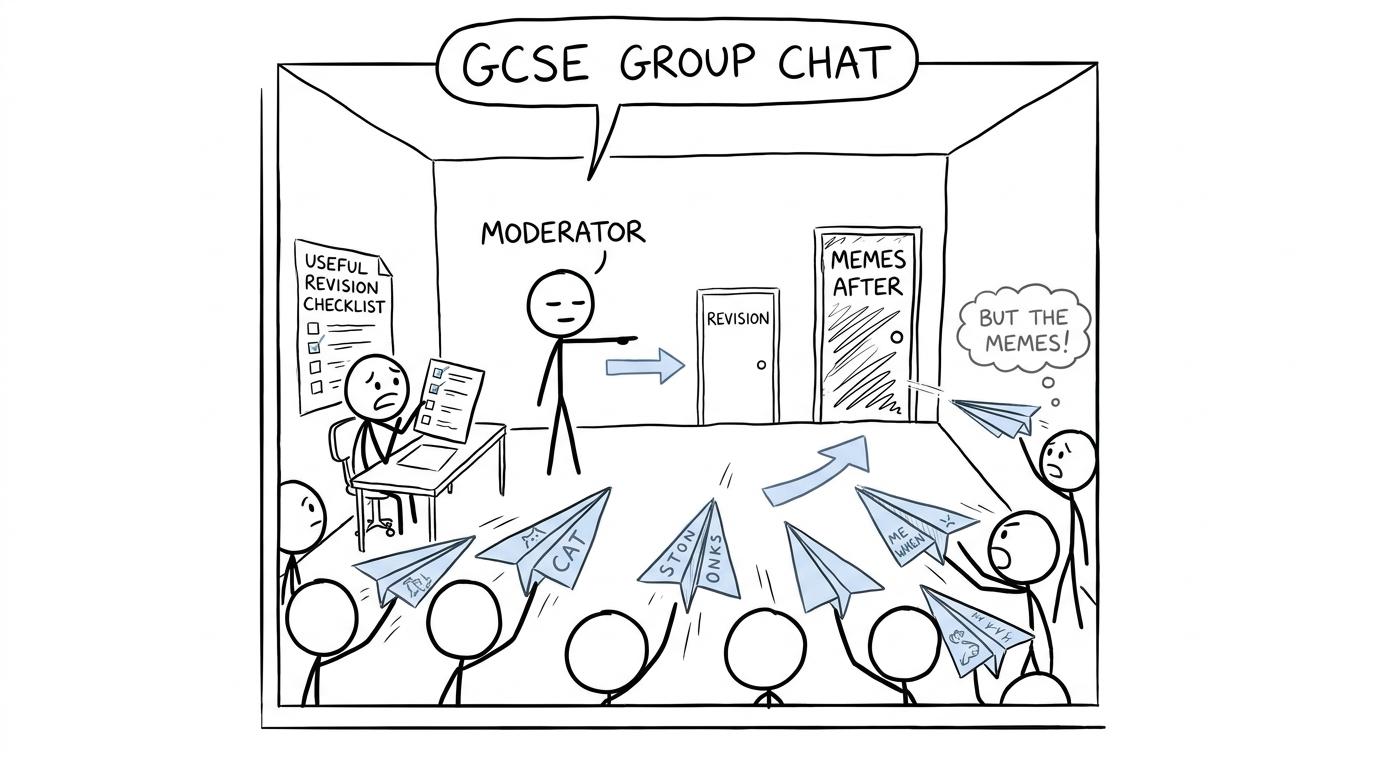 A chaotic class chat chooses between revision and memes
Give every session one job
The easiest way to lose an evening is to begin with the message, "What should we revise?" The discussion expands while the revision disappears.
Choose one narrow task before starting. A GCSE English Language chat session might focus on:
- identifying language methods in a short extract;
- comparing possible interpretations;
- planning a response to a writing prompt;
- improving topic sentences;
- checking punctuation choices;
- recalling the demands of a particular question;
- reviewing feedback from a recent assessment.
Keep exam-board labels visible. AQA, Edexcel, OCR and Eduqas do not organise every paper and question in the same way. Advice that is sensible for one assessment may be confusing when it is pasted into a conversation about another. Students should check their current specification, teacher guidance and official materials rather than trusting a confident message simply because it arrived first.
This principle transfers directly to maths revision. "Revise algebra" is too broad, while "complete a mini test on simultaneous equations and review each error" gives you a finish line. MathsGenie's GCSE maths revision resources organise topics by grade, helping a group choose a precise area rather than wandering through the whole course.
Use the chat to retrieve, not just reread
Copying a list of persuasive devices into the chat can look productive. Usually, however, only the sender has done much thinking.
Turn notes into prompts. One student can post a short question, allow everyone time to respond independently, and then reveal an agreed explanation. Useful prompts include:
- What is the writer trying to make the reader feel here?
- Which detail most strongly supports that interpretation?
- What is the effect of the change in sentence length?
- Which structural shift deserves analysis?
- What would make this opening more appropriate for its audience?
The important part is the pause before the answer. If one person immediately sends a polished response, everyone else can recognise it without having to recall or construct anything.
Rotate responsibility for writing prompts. This prevents one organised student from becoming an unpaid revision service and makes each member inspect the material closely enough to ask a worthwhile question.
Build a question-answer-explanation routine
A strong group chat can follow three stages:
Question
One student posts a focused question, a brief extract or a writing prompt. The source and relevant paper should be clear.
Answer
Everyone drafts independently before reading other replies. Answers can be short, but they should make a decision rather than echoing somebody else.
Explanation
The group compares reasoning. Ask why a quotation is relevant, how an interpretation is supported or what makes a sentence effective for the intended audience.
The explanation matters most. Correcting a label from "metaphor" to "personification" is less valuable if nobody explains what the writer's choice contributes to meaning, tone or perspective.
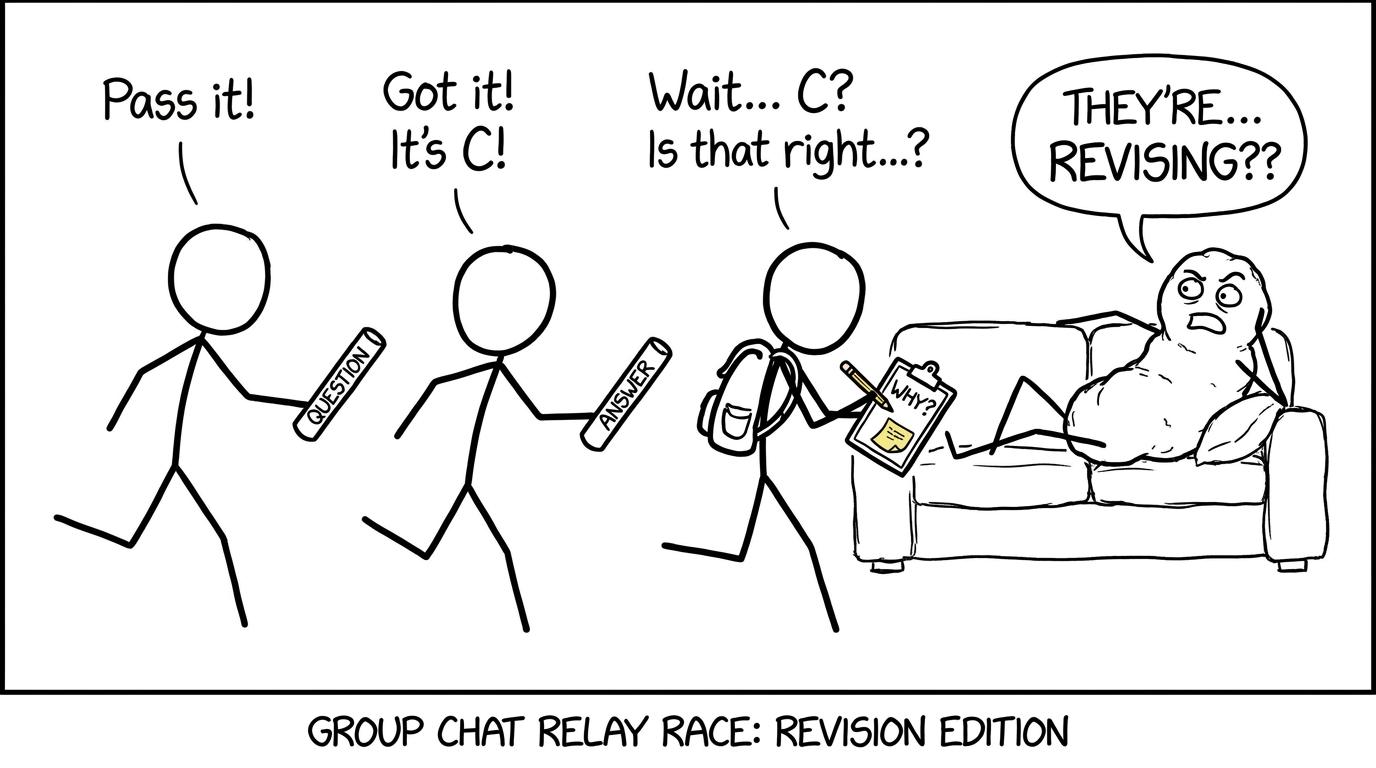 Students pass a question, answer and explanation baton
Maths revision benefits from the same habit. Posting only a final answer hides the method, while comparing reasoning exposes the step where an error began. Students can select questions from MathsGenie's GCSE practice materials, work alone first, and use the chat to discuss methods afterwards. The relevant video solutions and mark schemes can then settle uncertainty without turning the quickest typist into the group's authority.
Share work without creating a copying bank
Group feedback can help, but complete model responses are easy to copy without understanding. Share small pieces of work instead:
- a thesis or overview;
- one analytical paragraph;
- an opening for a writing task;
- a paragraph plan;
- two alternative sentences;
- a conclusion that needs tightening.
Ask for targeted feedback. "Is this good?" invites vague reassurance. Better questions include:
- Is my interpretation supported by the quotation?
- Have I analysed the writer's choice rather than paraphrased it?
- Does this paragraph answer the question throughout?
- Is the tone suitable for the stated audience?
- Where does my sentence become unclear?
Use a simple feedback pattern: identify one effective choice, identify one precise improvement, then explain the next action. The writer must make the edit. Friends should not silently rewrite the paragraph into language the original student could not reproduce under exam conditions.
Never share material from a live assessment when doing so would break school or exam rules. A group chat should support preparation, not compromise the integrity of assessed work.
Make timed practice social but independent
A group can create accountability without composing one collective answer. Post the task, agree on a short planning or writing period, and stop messaging until time is called. Afterwards, members can share plans, selected paragraphs or brief reflections.
This protects the most important part of exam preparation: producing an answer without prompts arriving from other people.
Try ending each timed session with three messages:
- what went well;
- what caused difficulty;
- what each person will practise next.
For maths, the equivalent is completing a paper independently before discussing errors. MathsGenie's GCSE past papers provide realistic paper practice, while GCSE predicted papers can add fresh preparation close to the exam period. Predicted papers are practice resources, not guarantees of which questions will appear.
Organise useful messages before they vanish
Chats are streams, not filing cabinets. Even an excellent explanation becomes difficult to retrieve after hundreds of new messages.
Nominate one member to collect the session's useful material in a shared revision log. Record:
- the topic covered;
- the questions attempted;
- common misunderstandings;
- links or resources checked;
- each person's next step.
Pin only messages that remain useful, such as the weekly timetable, exam-board details and the current revision focus. Avoid pinning every decent paragraph. A smaller, curated collection is easier to revisit.
For a wider revision routine, move tasks into a planner rather than relying on memory or notifications. MathsGenie's resources can form the maths part of that schedule: a revision lesson, practice questions, a mini test, and later an exam paper with a mark scheme. Students moving beyond GCSE can use the same workflow with the A Level maths revision hub.
Control notifications rather than letting them control you
A revision chat that interrupts every other subject is no longer helping. Agree on limited windows when members are expected to reply. Outside those periods, mute notifications and check the chat deliberately.
Create boundaries that are easy to follow:
- no pressure for immediate replies;
- no tagging the whole group for minor questions;
- no late-night revision demands;
- no reposting somebody's work outside the group;
- no personal criticism disguised as feedback.
Students should also follow school guidance on approved platforms, privacy and respectful communication. Do not add people without permission or share phone numbers, screenshots and personal information casually.
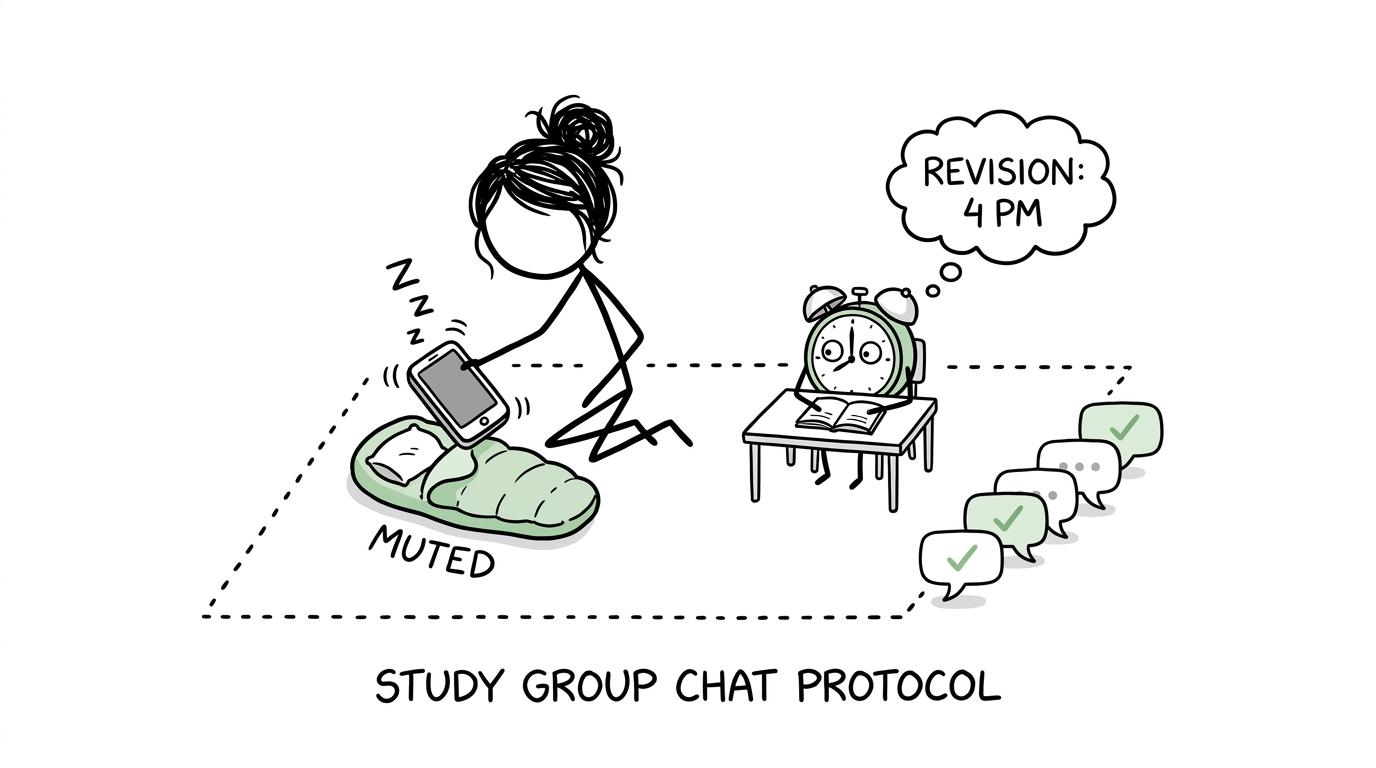 A student tucks noisy notifications into a muted sleeping bag
Common mistakes in group chat revision
Letting the fastest student answer everything
Speed is not the same as understanding. Ask members to wait before posting so everyone attempts the task independently.
Treating popularity as accuracy
Several approving reactions do not turn an incorrect claim into a correct one. Check disputed advice against the current specification, teacher guidance and official mark schemes. In maths, use the worked resources available through MathsGenie's free revision website rather than deciding by vote.
Revising labels without analysing effects
Naming a technique may be useful, but English Language responses usually need a relevant interpretation supported by evidence and explanation. Do not let terminology replace thought.
Sharing polished answers too early
A perfect paragraph can stop everyone else thinking. Share the question first, allow independent time, and compare responses afterwards.
Spending the session designing the session
Keep the format repeatable. One topic, a few prompts, independent work, discussion and a recorded next step are enough.
Using chat activity as proof of progress
A busy screen can disguise very little written practice. The evidence of revision is the plan produced, paragraph improved, misconception corrected or paper completed, not the number of messages sent.
Turn conversation into action
A useful class chat is not the one with the strictest moderator or the fewest memes. It is the one that repeatedly moves students from a prompt to independent thought, from an answer to an explanation, and from feedback to a better second attempt.
Start modestly. Choose one English Language topic, run one focused session and save only what deserves to be revisited. Then take the same discipline into maths: select a topic from MathsGenie's GCSE revision lessons, complete the practice questions, check the video solutions, use mini tests to revisit weak areas, and progress to past-paper practice with mark schemes.
The chat can provide company and accountability. The work still has to be yours. MathsGenie gives you the free revision lessons, predicted papers, practice questions and exam resources to make that independent work count.











