GCSE English Language and GCSE Literature Together?
GCSE English Language and GCSE English Literature together is normal. See what overlaps, what stays separate, and how to revise both alongside GCSE maths.
The timetable can make it look slightly unreasonable: English Language, English Literature and GCSE maths all demanding attention in the same exam season. But taking GCSE English Language and GCSE English Literature together is entirely realistic. In fact, it is the normal route for most students in England.
They are separate GCSE qualifications with separate exams and grades, but schools commonly teach them alongside each other. The useful truth is that some reading, analysis and writing skills transfer between them. The equally important truth is that they are not interchangeable. Literature requires knowledge of set texts, while Language tests your response to unseen material and your ability to write for different purposes.
The answer at a glance
- Yes, you can take both qualifications at the same time.
- Most schools enter students for both, although entry decisions depend on the school and individual circumstances.
- They produce two separate grades on the grades 999 to 111 scale.
- Neither GCSE is split into foundation and higher tier.
- Reading closely, analysing language and writing clearly help in both.
- Literature adds set-text knowledge, quotations, themes and context.
- Language adds unseen reading, creative or transactional writing and a spoken language endorsement.
- Exact papers, timings and question structures depend on your exam board and specification.
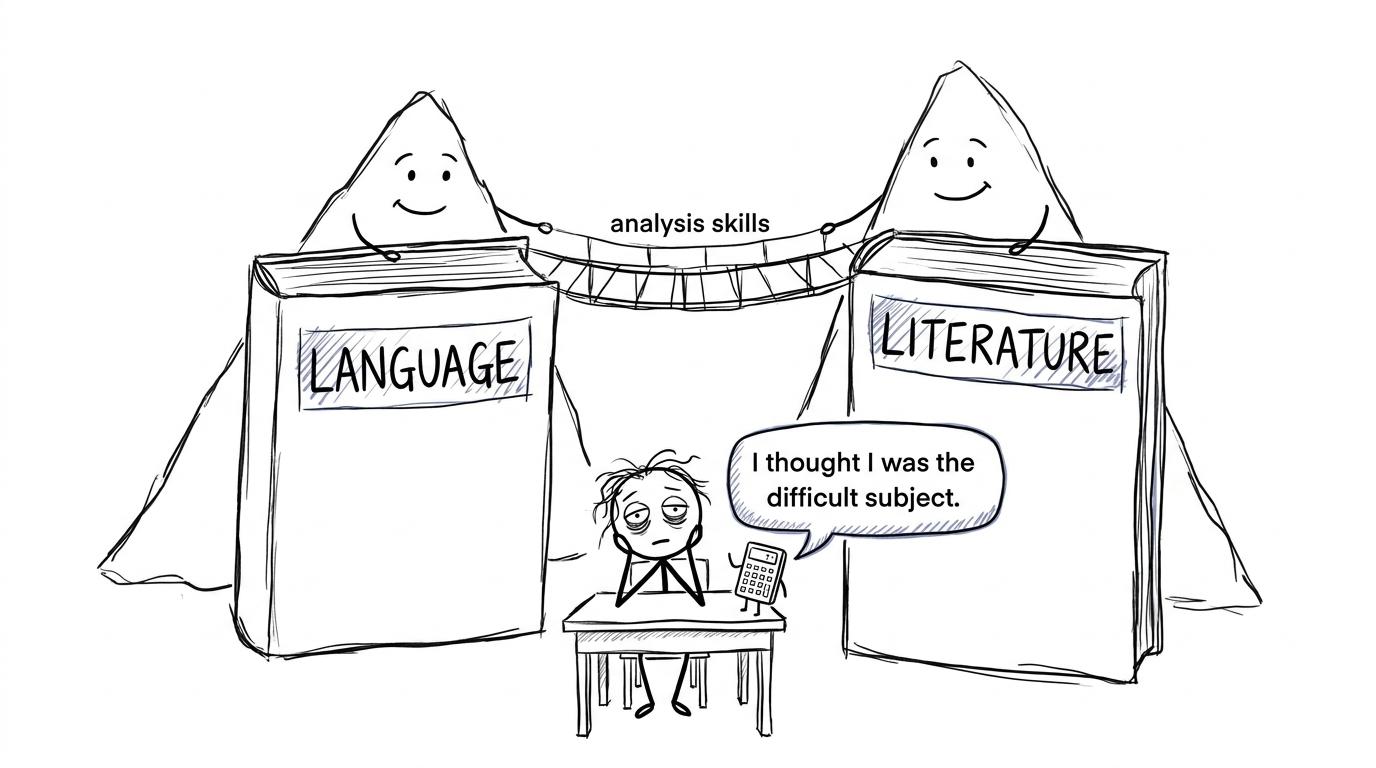 A student faces twin English book mountains while a calculator watches from the desk
Are English Language and English Literature separate GCSEs?
Yes. GCSE English Language and GCSE English Literature are separate qualifications. You receive a distinct grade for each, even when your school teaches them within the same English lessons.
English Language is concerned mainly with how communication works. You read unseen fiction and non-fiction, interpret ideas, analyse writers' methods and produce your own writing. The exact combination varies between AQA, Pearson Edexcel, OCR and Eduqas, so your exam board's current specification should be your final guide.
English Literature is built around literary works studied during the course. The national subject content includes Shakespeare, a nineteenth-century novel, poetry and modern prose or drama. You are assessed on your understanding, interpretation and analysis of those texts, with context relevant to particular questions and assessment objectives.
This distinction matters. A strong Literature student cannot assume that remembered quotations will carry an unseen Language paper. A strong Language student cannot walk into Literature relying only on general analytical skill. Shared ability helps, but each qualification has its own preparation.
Is it normal to take both at the same time?
Yes. Studying both concurrently is not an unusual double workload designed for a small group of students. It is how English is commonly organised at Key Stage 4.
Official qualification material reflects this relationship. AQA describes its English Language and English Literature specifications as co-teachable, while OCR identifies some overlap between its two qualifications. This does not mean every lesson serves both courses equally. It means schools can sensibly develop transferable skills while teaching the distinct content each GCSE requires.
Your school still controls its curriculum and exam entries. Some students may be entered for English Language only because of individual needs, available teaching time or a school's entry policy. If your timetable or options form is unclear, ask your English teacher or exams officer which qualifications and exam board you are following.
Do not infer your entry from the word “English” on a timetable. Confirm the full qualification titles.
How much overlap is there really?
The overlap is meaningful, but it is mostly about skills rather than content.
| Skill or content | English Language | English Literature |
|---|---|---|
| Close reading | Central | Central |
| Analysing vocabulary and structure | Central | Central |
| Supporting ideas with textual evidence | Central | Central |
| Comparing texts | Often assessed | Often assessed |
| Accurate, coherent writing | Central | Important |
| Responding to unseen texts | Central | Required in areas such as unseen poetry, depending on the specification |
| Set-text knowledge | Not the main focus | Essential |
| Memorising useful quotations | Usually unnecessary | Often helpful |
| Creative or transactional writing | Essential | Not normally assessed as its own task |
| Literary context | Usually not a separate focus | Relevant to specified assessment objectives |
The skills that transfer
Both qualifications reward attentive reading. You need to notice details, make a defensible interpretation and connect evidence to the question. Analysis of vocabulary, imagery, tone, form and structure can therefore support both courses.
Clear paragraphing also transfers. In either subject, an idea becomes stronger when it is specific, supported and explained rather than hidden beneath memorised terminology. Accurate spelling, punctuation and grammar matter too, although their precise weighting and placement vary by qualification.
The best shared revision focuses on the process: read the question carefully, select relevant evidence, explain its effect and keep returning to the task.
What does not transfer automatically
Literature carries a substantial content burden. You must know your school's chosen texts, understand characters and themes, and recall enough precise detail to construct an argument. Context should illuminate the text rather than become a detached history paragraph.
Language demands a different kind of flexibility. The extracts are unseen, so you cannot revise their content in advance. Instead, you practise reading unfamiliar material efficiently, recognising what each question requires and controlling your own writing under timed conditions.
That is why “I am revising English” is too vague. Decide whether the session is building a transferable skill, securing Literature knowledge or practising a Language task.
Can you manage both alongside GCSE maths?
Yes, but only if your plan recognises that the subjects need different kinds of practice.
Maths improves through repeated problem-solving, correction and retesting. English also benefits from practice, but the output may be a planned argument, an analysed extract, quotation recall or a timed paragraph. Giving every subject the same revision method is less efficient than giving each one the method it needs.
A manageable weekly pattern might include:
- one English Language reading session;
- one English Language writing or planning session;
- two short Literature recall and essay-planning sessions;
- several focused maths topic sessions;
- one timed maths section or mini test;
- protected catch-up and rest time.
Keep sessions specific. “Revise maths” and “revise English” invite delay because they contain too many possible actions. “Complete one probability mini test” or “plan one response on a Literature theme” gives you a visible finish line.
For maths, begin at the GCSE Maths revision hub, where you can select your exam board and work through revision lessons and practice questions. If you are following AQA, the AQA GCSE Maths revision hub keeps foundation and higher resources together.
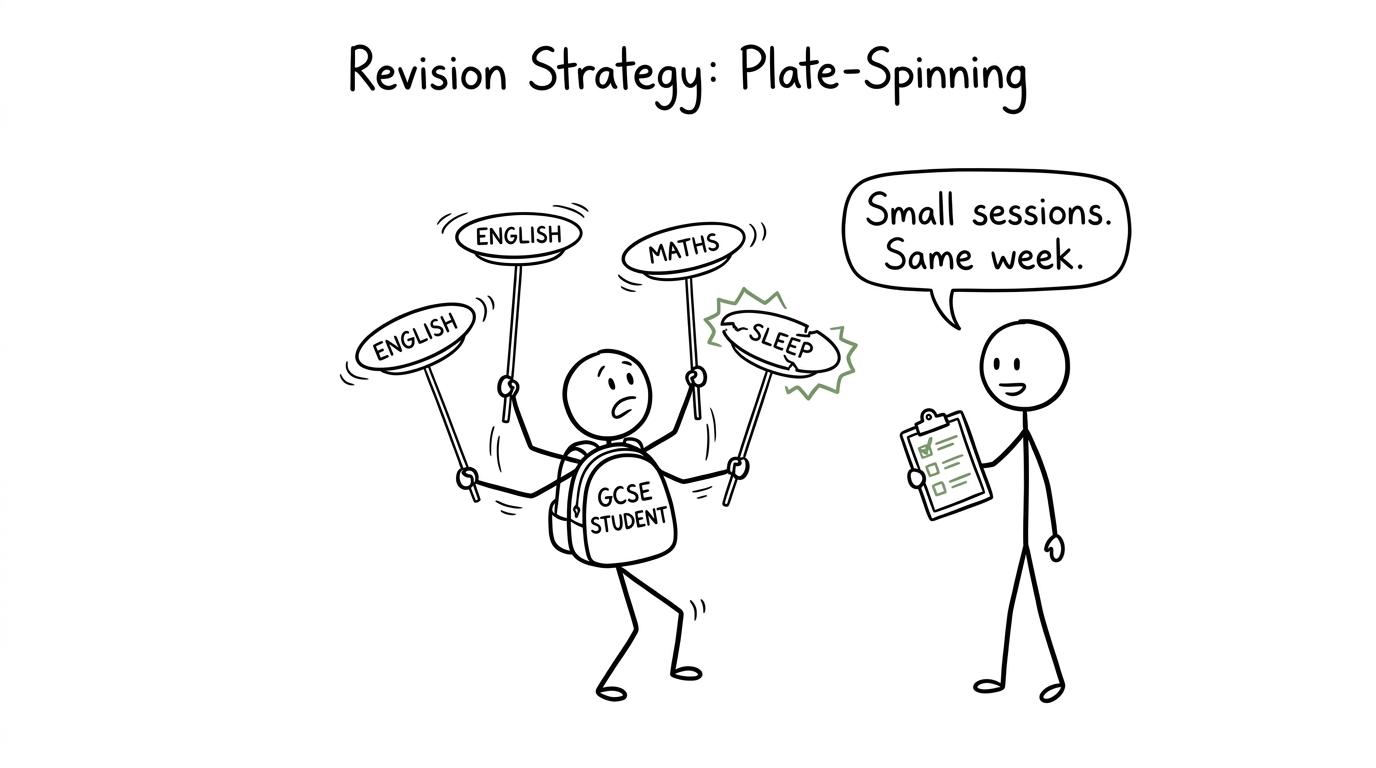 A student spins English, maths and sleep revision plates
A revision system that protects all three subjects
The danger is rarely taking both English GCSEs. It is allowing whichever exam feels most urgent to consume the entire week.
Start by placing fixed commitments and exam dates into a calendar. Then assign short, repeatable sessions. MathsGenie's guide to building a GCSE maths revision timetable can help you create a structure that leaves room for English rather than competing with it.
Use a simple cycle for each subject:
- Diagnose: identify the precise weakness.
- Learn: revisit the relevant method, text or question demand.
- Practise: produce an answer without copying a model.
- Mark: compare it with a mark scheme or teacher feedback.
- Fix: improve the response and return to the skill later.
In maths, short tests are particularly useful when English coursework or set-text revision has used most of your concentration. The Edexcel GCSE Maths mini tests provide focused practice without requiring a complete paper.
When you have more time, use MathsGenie's past-paper library and follow the guide to using GCSE past papers properly. A completed paper only becomes useful revision when you mark it, identify the cause of each lost mark and revisit the weak topic.
The same principle applies to English. Do not collect completed essays without studying the feedback. MathsGenie's guide to using GCSE mark schemes effectively explains how to turn marking criteria into a practical next action.
Common mistakes when taking both English GCSEs
Assuming the courses are almost identical
The shared analytical skills can hide the difference in content. Keep separate checklists for Language tasks and Literature texts, even if both sit inside one folder or revision planner.
Revising Literature only by rereading
Familiarity is not the same as recall. Close the book and retrieve themes, character developments, key moments and short quotations. Then practise selecting the material that answers a particular question.
Treating Language as impossible to revise
You cannot predict the unseen extracts, but you can practise the process. Work on reading speed, annotation, question selection, planning, comparison and timed writing. The unfamiliar content is precisely why a familiar method matters.
Using terminology without explaining anything
Naming a metaphor or sentence type does not complete the analysis. Explain what the choice suggests, how it shapes the reader's response and why it matters in relation to the question.
Neglecting maths because English feels larger
Literature can create a long visible to-do list: several texts, poetry and quotations. Maths weaknesses are often quieter until a mock exposes them. Maintain short maths sessions throughout the week, using revision lessons, practice questions and mini tests to stop topics fading.
Using predicted papers as predictions of certainty
Predicted papers provide fresh exam-style practice; they cannot guarantee what will appear. Use Edexcel GCSE Maths predicted papers after topic revision and alongside official past papers, not instead of them.
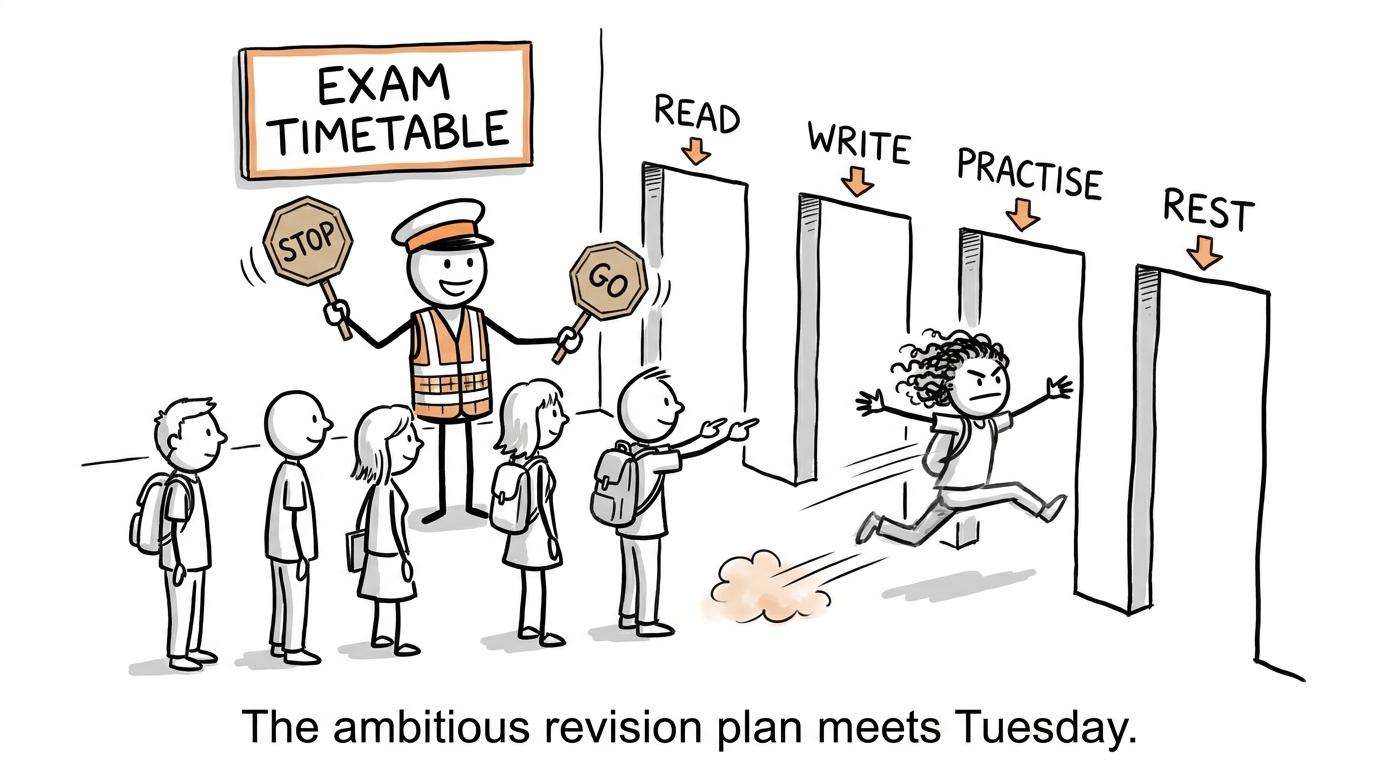 An ambitious student tries to sprint through every revision door at once
Two GCSEs, one manageable plan
Taking GCSE English Language and GCSE English Literature together is realistic because the qualifications share useful reading and writing skills and are commonly taught side by side. But success comes from respecting their differences: unseen analysis and purposeful writing for Language; secure textual knowledge and literary argument for Literature.
Then protect maths with the same calm discipline. Use the MathsGenie revision planner to give each subject a place, return to the GCSE Maths revision hub for free revision lessons and practice questions, and build towards mini tests, past papers and predicted papers. Mark your work carefully, use mark schemes and video solutions, and turn each mistake into the next small task.
You do not need to revise every subject every evening. You need a plan that brings each one back before it is forgotten.