

GCSE English Exam Conditions Practice at Home
GCSE English language and literature exam conditions practice: create a realistic timed session at home, manage distractions and review every paper.
A bedroom desk does not feel much like an exam hall. The chair is familiar, the kitchen is nearby and your phone is probably within reach. Yet effective GCSE English language and literature exam conditions practice depends less on the room than on the rules you create inside it.
The basic method is simple: use the correct paper, reproduce its official time limit, remove unauthorised help, work without pausing and review the result afterwards. Done properly, a home mock teaches more than subject knowledge. It reveals whether you can plan, write, think and recover while the clock keeps moving.
That skill matters in English, but it also transfers directly to GCSE maths. A student who learns to manage a demanding English Literature paper is also learning how to protect time, make decisions and stay composed during a long maths paper.
Your realistic practice checklist
Before starting, make sure you have:
- the correct exam board and qualification
- the exact paper or component
- the official duration from the current specification or paper cover
- a clean, previously unseen paper where possible
- only the materials permitted in the real examination
- a visible clock or silent timer
- a quiet desk with your phone out of reach
- any access arrangements confirmed by your school
- uninterrupted time for the paper and a separate review afterwards
Do not assume that all English papers follow the same format. AQA, Pearson Edexcel, OCR and Eduqas use different durations, question structures and mark totals. English Language and English Literature are also untiered, unlike foundation and higher tier GCSE maths.
Start with the exact paper you will sit
Realism begins before the timer starts. Confirm your exam board with your teacher, timetable or official specification, then identify whether you are practising English Language or English Literature and which paper it is.
For example, AQA English Language Paper 1 and Paper 2 each last 1 hour 45 minutes. AQA English Literature Paper 1 lasts 1 hour 45 minutes, while Paper 2 lasts 2 hours 15 minutes. OCR English Language uses two 2-hour written papers. Other boards and qualification versions differ, so these examples must not become a universal timing plan.
Check the current paper cover for:
- the full duration
- the total marks
- the questions or sections you must answer
- any choice of tasks
- whether source material is supplied
- the equipment and materials permitted
English Language examinations use unseen texts. Literature rules depend on the specification, but AQA Literature assessments, for example, are closed book. Do not keep a novel, anthology, quotation sheet or revision guide beside you unless it would genuinely be authorised for that paper.
The same discipline improves maths revision. Before a timed maths session, choose the right board, tier and calculator status through the MathsGenie GCSE maths revision hub, rather than completing a paper that does not match your entry.
Build an exam zone, not a perfect exam hall
You do not need rows of desks or an invigilator pacing behind you. You need a controlled space with fewer escape routes.
Clear the desk except for the paper, answer booklet or lined paper, permitted stationery and a transparent water bottle if you want one. Put your phone in another room or give it to someone at home. Switching it to silent is weaker because the possibility of checking it remains.
Tell the people around you when the session will finish. Close unnecessary browser tabs and disable notifications if your paper must be viewed digitally. Printing the paper is preferable when practical because it lets you annotate sources and reproduce the physical demands of the examination.
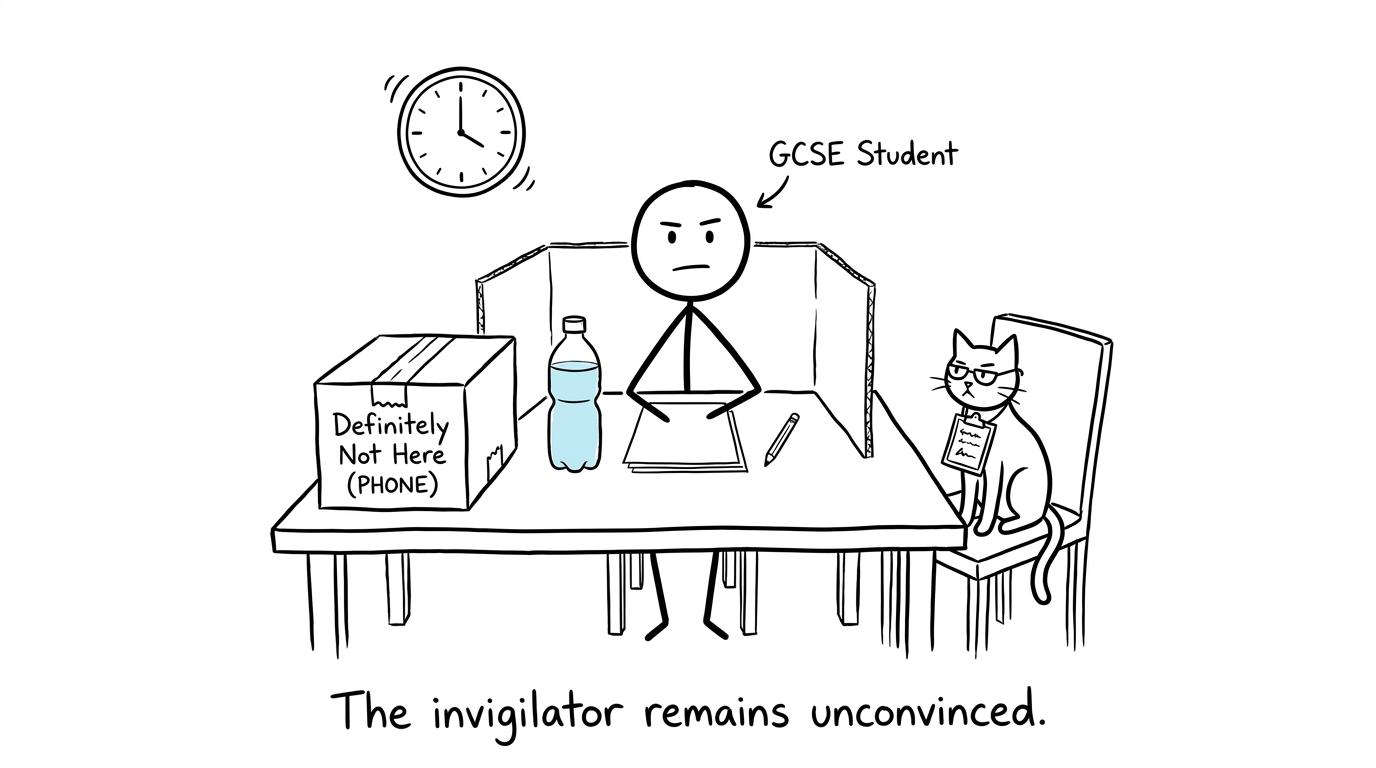 A GCSE student sits a home mock while a suspicious cat acts as the invigilator
Sit at a table rather than on a bed or sofa. The aim is not discomfort. It is to create a repeatable signal: when you sit here with this setup, you work until time is called.
A structured routine makes that easier. Maths students can use the free MathsGenie revision planner to place full papers among shorter revision sessions, rather than attempting exhausting mocks on consecutive evenings.
Follow real examination rules
A home practice paper is not an official examination, but it should imitate the important constraints.
Once you start:
- do not pause the clock
- do not search for quotations, vocabulary or interpretations
- do not ask someone for help
- do not listen to music or a podcast
- do not check messages
- do not restart because the opening answer felt weak
- stop writing when the allotted time ends
JCQ instructions require candidates in real examinations to receive the full published time and prohibit communication once they are in the examination room. You cannot reproduce formal invigilation at home, but you can reproduce silence, independence and the uninterrupted time limit.
If you have an approved access arrangement, such as extra time, supervised rest breaks or use of a word processor, practise using the arrangement confirmed by your school. Do not invent an allowance for yourself, but do not omit an authorised arrangement merely to make practice feel tougher. Realism means reproducing your actual conditions.
Plan your time before the paper begins
Do not create one generic English timing plan and use it everywhere. Start with guidance from your teacher or exam board, then adapt it using evidence from previous attempts.
Write a small timing checkpoint list before starting. It might identify when you should finish a section, begin an extended response and leave time to check. These are boundaries, not invitations to stare at the clock every minute.
A rough diagnostic can be found by dividing the available minutes by the marks:
rough minutes per mark=total available minutestotal marks\text{rough minutes per mark}=\frac{\text{total available minutes}}{\text{total marks}}rough minutes per mark=total markstotal available minutesThis is not a complete strategy. Reading an unseen source, planning an essay and checking technical accuracy all consume time without immediately producing marks. Different questions also demand different kinds of thinking. Use the calculation only as a warning against spending too long on a low-tariff task.
For English Language, protect time for the extended writing task and a final check of spelling, punctuation, sentence control and paragraphing. National subject requirements divide the written qualification between reading and writing, with technical accuracy carrying a meaningful share of the assessment.
For Literature, account for planning, textual references, analysis of language, form and structure, and relevant context. Avoid turning the first essay into a masterpiece at the expense of later sections.
Practise the uncomfortable middle
The first ten minutes of a mock often feel purposeful. The final ten feel urgent. The most useful training happens between them, when concentration dips and the paper stops feeling new.
When you become stuck, behave as you will need to behave in the real exam. Reread the command word, identify the precise focus, jot a brief plan or move on temporarily. Do not end the session to revise the topic. That converts an exam test into an open-book lesson and hides the problem you needed to discover.
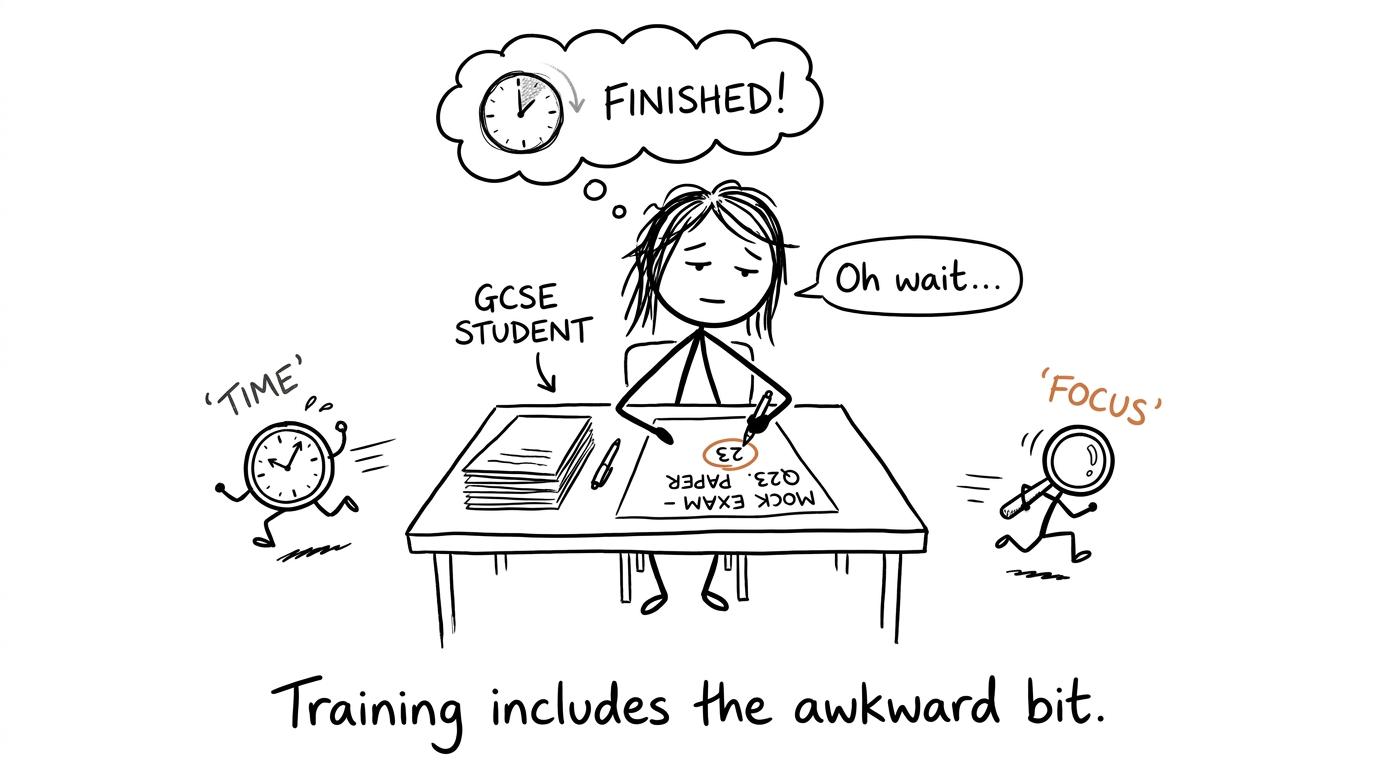 A student calmly continues while Time and Focus run in opposite directions
Full-paper stamina should be built gradually. Begin with a timed section if you have not completed one before, then progress to a complete paper. The GCSE one-month revision plan uses the same sensible progression for maths: targeted practice first, followed by increasingly realistic timed work.
Mark the paper after a proper break
Finishing the timer is only half the session. Take a short break, then review your work using the official mark scheme, examiner guidance where available and feedback from your teacher.
English responses are not always self-marked as cleanly as short maths questions. Mark schemes often describe levels of performance, so avoid awarding a mark merely because your answer mentions a feature. Ask whether the response actually explains its effect, develops an interpretation and uses evidence effectively.
Classify each problem under one of four headings:
- knowledge: you could not recall a quotation, theme or relevant idea
- analysis: you identified a technique but did not explore meaning or effect
- timing: an answer was rushed, incomplete or never attempted
- exam reading: you misread the source range, command word or task choice
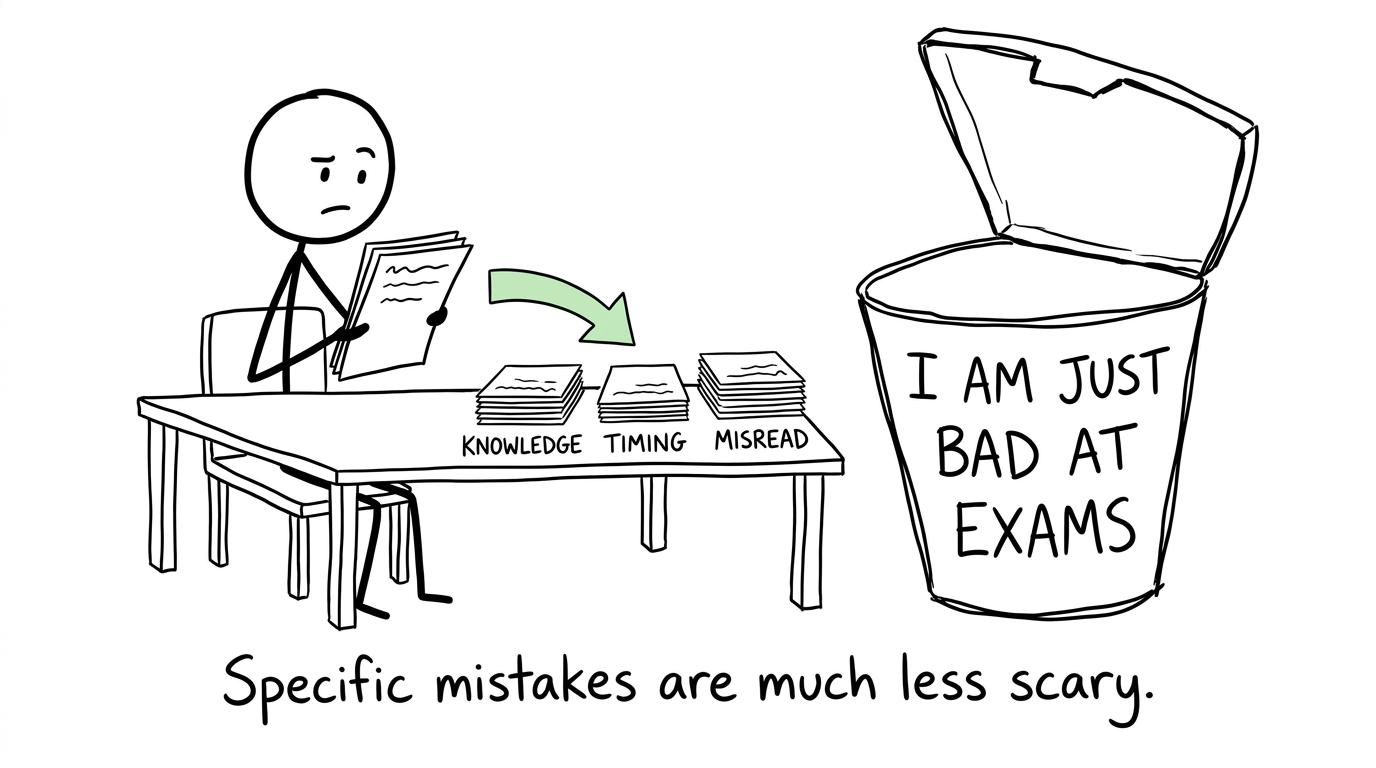 A student sorts specific errors while leaving the dramatic self-criticism bin empty
Specific errors are useful because they suggest specific repairs. Review approaches such as those in MathsGenie's guide to learning from GCSE mark schemes can help you turn a score into a practical revision list.
Common mistakes in home exam practice
Pausing whenever something interrupts you
A paused timer removes the pressure you are trying to train. Arrange the session carefully beforehand. If a genuine emergency interrupts it, record what happened and repeat the paper conditions with different material later.
Using a paper you already remember
A familiar question can test recall rather than exam performance. Save at least some unseen papers for full simulations. Previously attempted papers remain valuable for correction and technique practice, but label them honestly.
Checking notes for one small detail
One quotation search changes the conditions and conceals a recall gap. Put an asterisk beside the point you could not remember, continue unaided and investigate it afterwards.
Marking immediately while frustrated
A brief break creates enough distance to evaluate the response rather than defend it. Separate completion from review.
Completing full mocks too often
Full papers diagnose problems; focused revision repairs them. Alternate simulations with shorter sessions addressing the weaknesses revealed. Maths students can follow the rhythm in the GCSE maths revision timetable: practise, mark, repair and retest.
Treating one disappointing mark as a predicted grade
A single home paper is evidence, not a verdict. Paper difficulty, marking accuracy and current preparation all matter. Track repeated patterns across several attempts and ask your teacher to review extended responses.
Make exam conditions part of a wider revision cycle
A realistic mock should change what you do next. If weak quotation recall caused the problem, schedule retrieval practice. If the final response was unfinished, rehearse that section under a shorter limit. If concentration faded, build stamina with progressively longer blocks.
Avoid placing a punishing full paper on the night before an examination. MathsGenie's calm GCSE night-before plan explains the broader principle well: use a short, focused check, prepare your equipment and protect sleep rather than chasing one last score.
Turn home practice into calm exam behaviour
You cannot make your kitchen become an examination hall. You can make your behaviour consistent with one.
Choose the exact paper, use the correct time, remove help, work through uncertainty and stop when time is called. Then mark carefully and repair the problems the session exposes. That is what makes GCSE English language and literature exam conditions practice genuine rather than theatrical.
Carry the same habits into maths revision. Start with MathsGenie's free one-week GCSE revision plan, then use the revision lessons, practice questions, mini tests, past papers, predicted papers, mark schemes and video solutions to move from topic confidence to full exam readiness. The room may still be familiar. Your response to the clock will not be.










