

GCSE Engineering Revision Drop-In Sessions: Worth It?
GCSE engineering revision drop in sessions: learn when teacher support beats solo revision, how to prepare and how to use each session well before exams.
The difficult part of after-school revision is rarely deciding whether revision matters. It is deciding what deserves the next hour. GCSE engineering revision drop in sessions are usually worth attending when you need feedback, cannot resolve a specific problem or want help applying maths in an engineering context. They are less valuable when you arrive without a goal and simply watch someone else work.
The best approach is not drop-in sessions or independent revision. It is a deliberate combination: diagnose difficulties alone, take the stubborn ones to a teacher, then practise independently afterwards.
That matters because engineering questions often place familiar maths inside unfamiliar situations. Ratios become scale drawings. Area becomes material coverage. Volume becomes capacity. A session can help you recognise that connection, but only your own practice will make it reliable under exam conditions.
A quick decision checklist
Attend your school’s engineering revision session if you can answer yes to at least one of these questions:
- Do you have a precise question that notes or videos have not resolved?
- Are you repeatedly losing marks on the same skill?
- Do you need feedback on your method, units or written explanation?
- Are you unsure what an engineering question is asking you to calculate?
- Would a scheduled session stop you postponing revision?
Revise alone first if you mainly need to learn facts, complete straightforward practice or build fluency through repetition. Start with the GCSE Maths Revision Topics, where lessons are organised by grade and include videos, practice questions and answers.
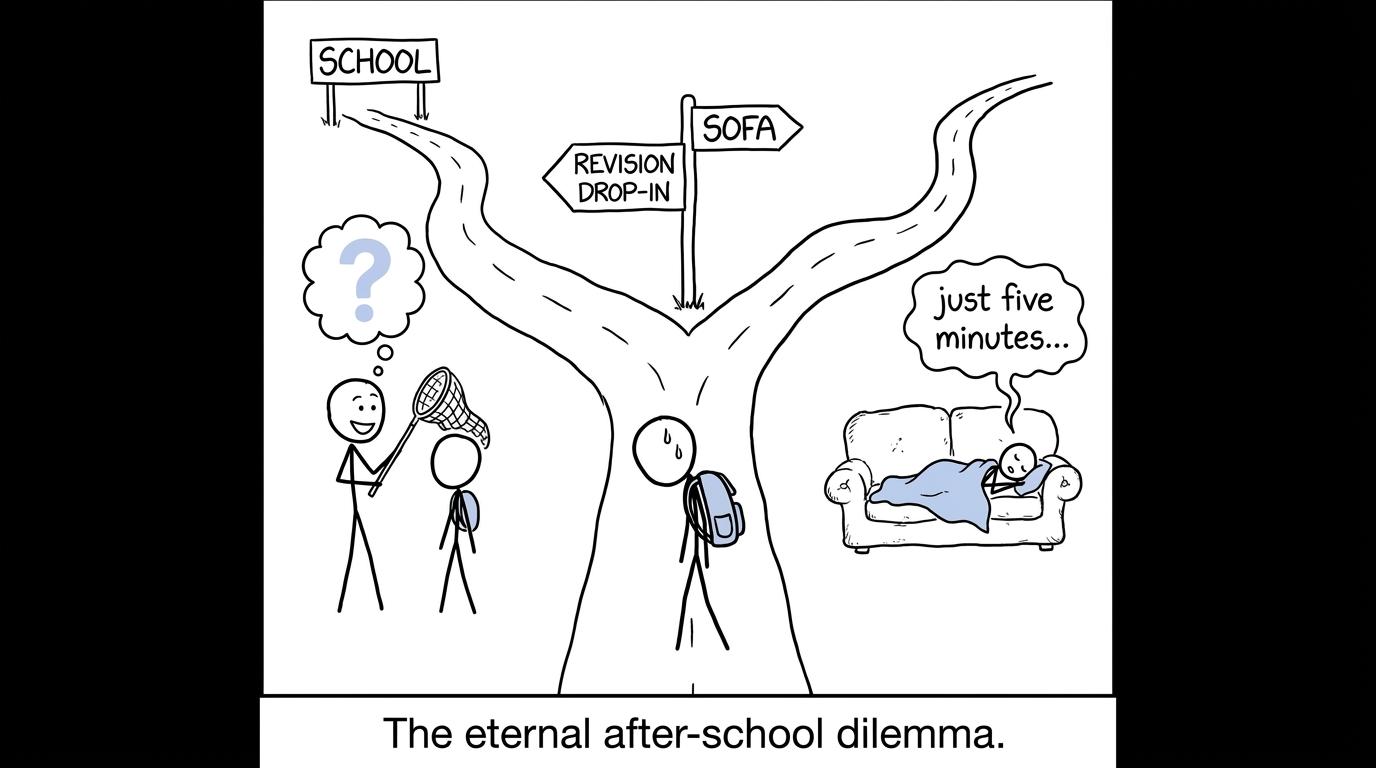 A student choosing between a revision drop-in and the tempting sofa
Why engineering revision sessions can be valuable
Engineering courses are not identical across UK schools. AQA offers a GCSE Engineering specification, while some schools use vocational engineering qualifications from other awarding organisations. Assessment structures, content and permitted resources can therefore differ. Check the exact qualification title and current specification used by your school rather than assuming advice for one course automatically applies to another.
Whatever the qualification, several benefits of a good drop-in session remain consistent.
You can uncover the real cause of an error
A wrong answer does not always mean you lack engineering knowledge. You may have selected the wrong dimensions, mixed units, rounded too early or misunderstood a command word.
When revising alone, it is easy to label all of these problems as “I cannot do this topic”. A teacher can often identify the narrower issue. That diagnosis saves time because you can practise the actual weakness rather than restarting an entire chapter.
For example, a calculation involving material mass might depend on understanding density through the relationship
density=massvolume.\text{density}=\frac{\text{mass}}{\text{volume}}.density=volumemass.The formula may not be the difficulty. The obstacle might be converting dimensions into consistent units before finding the volume. A drop-in gives you an opportunity to ask where your reasoning changed direction, rather than merely being shown the final answer.
Feedback is immediate and specific
Mark schemes are valuable, but they cannot inspect your thought process. A teacher can notice whether your diagram is unclear, your calculator entry is incorrect or your answer lacks a unit.
That immediacy is especially useful when a method contains several connected decisions. If you wait until much later to check it, the reason for each decision may be hard to remember.
Use the session to ask questions such as:
- “At which line does my method stop being valid?”
- “Would this earn method marks even though my final answer is wrong?”
- “Which unit should I use here, and why?”
- “What clue in the question tells me which calculation is needed?”
These questions produce more useful feedback than simply asking, “Is this right?”
Engineering language can be translated into maths
A common challenge is recognising the maths hidden inside a practical context. Engineering problems may involve tolerances, dimensions, scale, costs, rates, material properties, area or volume.
The underlying skills can be strengthened using MathsGenie’s lessons on ratio, percentages, area and volume. A teacher can then help you transfer those skills into the terminology and diagrams used by your engineering qualification.
This transfer is where drop-ins can outperform isolated revision. A video can teach a method clearly. A teacher who knows your course can explain why that method applies to the engineering question in front of you.
When revising alone is the better choice
Drop-ins are not automatically productive merely because a teacher is present. Some revision jobs are better completed independently.
You need repetition rather than explanation
Once you understand a method, improvement usually comes from retrieving it and applying it without prompts. Watching another explanation can feel productive while quietly delaying the practice you need.
Suppose you already know that percentage change is based on the original value:
percentage change=changeoriginal value×100.\text{percentage change}=\frac{\text{change}}{\text{original value}}\times 100.percentage change=original valuechange×100.If your difficulty is speed or accuracy, a set of independent questions is likely to help more than another general explanation. Complete the questions, mark them honestly and take only the unresolved errors to the next session.
The session is too general for your needs
A busy drop-in may cover whatever the largest group requests. That is sensible for the teacher, but it may not match your priorities.
If you need concentrated practice on scale, compound measures or geometric calculations, a quiet hour with targeted resources may produce more progress. The speed, distance and time lesson, for instance, can support calculations involving rates without requiring you to wait for the group to reach that topic.
You work passively in groups
Some students become observers during informal sessions. They copy a solution, recognise each step and leave believing the topic is secure. Recognition is not the same as recall.
A useful test is simple: after the explanation, close the notes and attempt a similar question without help. If you cannot choose the first step, the method is not yet secure.
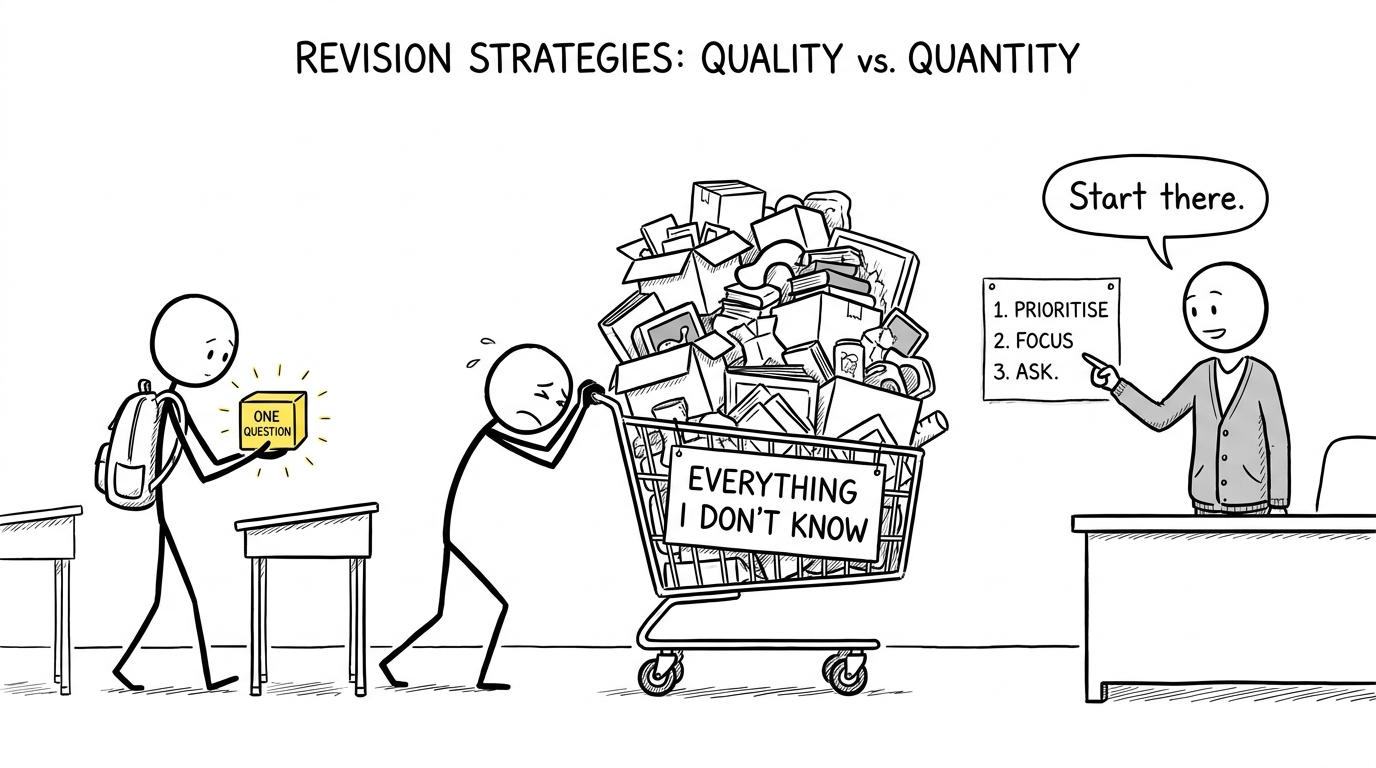 One prepared question arrives beside a trolley full of everything
How to make a revision drop-in worth attending
The value of a session is often decided before it begins. Preparation turns an open room into targeted support.
Arrive with evidence, not a vague topic
Bring attempted questions, marked work or a list of errors. Circle the exact line where you became uncertain. If you have not attempted the question, the teacher cannot easily tell whether the barrier is knowledge, interpretation or confidence.
A useful preparation routine is:
- attempt a short set of questions without notes;
- mark the work in a different colour;
- classify each error by topic or cause;
- choose the two most important questions;
- write down what you want the teacher to explain.
This also prevents one difficult question from consuming the entire session when a quick clarification would be enough.
Ask for the next step, not the whole solution
There is a large difference between receiving help and outsourcing the thinking. Ask for the smallest hint that allows you to continue.
If the teacher completes every line, the finished page may look excellent while telling you very little about what you can do independently. Asking for the next decision keeps the mental work with you.
Leave with an action
Before going home, record what you need to practise. That might be unit conversion, selecting a formula, interpreting a scale drawing or presenting calculations clearly.
Complete a short follow-up task within the next day if possible. The purpose is not to repeat the teacher’s exact solution, but to check whether you can apply the corrected idea alone.
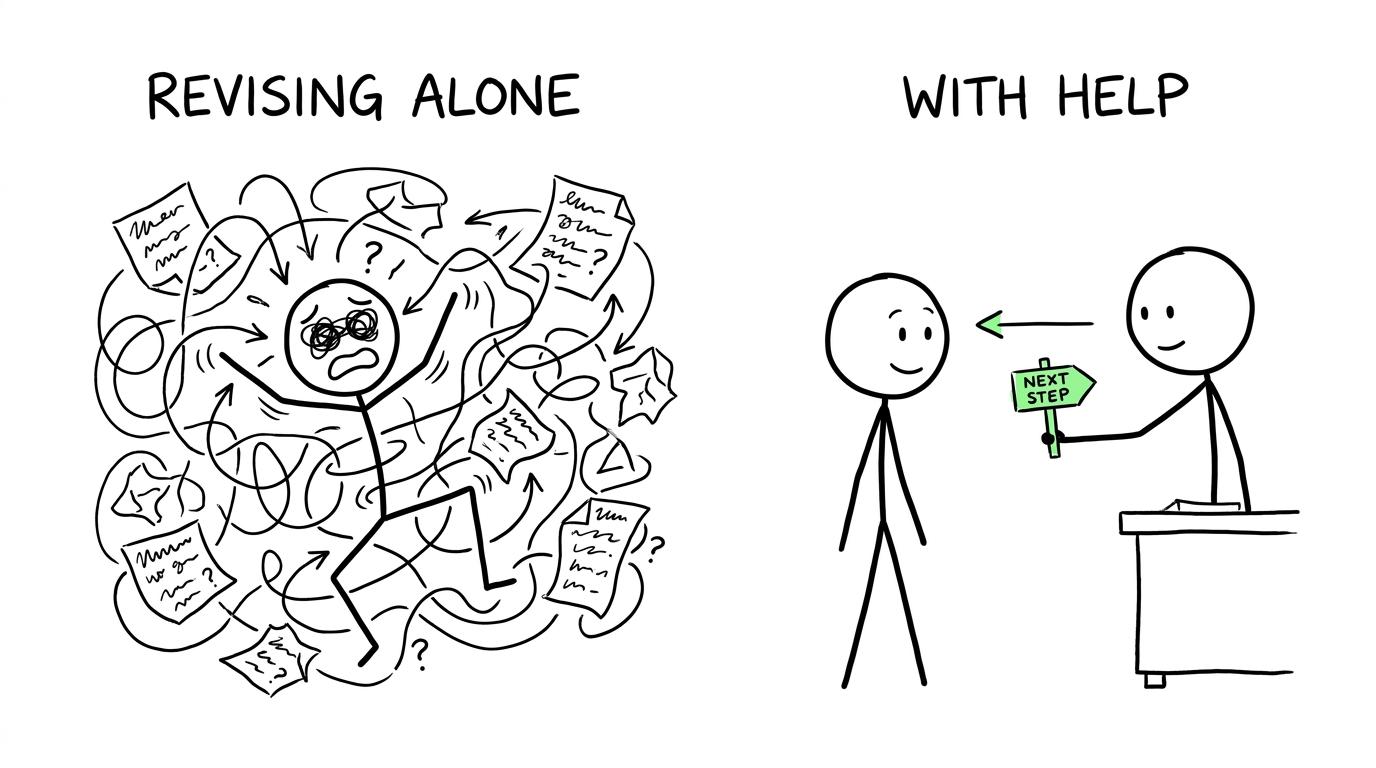 A teacher supplies a small next-step signpost beside a revision maze
The strongest strategy combines both methods
Think of independent revision as the engine and drop-in support as the steering. Practice creates fluency; feedback stops repeated mistakes from becoming habits.
A balanced weekly cycle could look like this:
- Review one engineering topic and identify its mathematical demands.
- Complete relevant questions independently under quiet conditions.
- Mark the work and keep an error log.
- Take persistent errors to the school drop-in.
- Redo similar questions without notes.
- Use an exam paper to test whether the skill transfers to a new context.
Maths Genie’s GCSE past papers help you practise the wider maths skills under timed conditions. Its predicted papers provide additional exam-style practice, but they should complement the current specification and official past papers rather than replace them.
Although an engineering calculation may be set in a different context, practising precise algebra, geometry, ratio and measures for GCSE maths can reduce the cognitive load. You spend less time recalling a basic method and more time deciding how the engineering information fits together.
Common mistakes with GCSE engineering revision drop-in sessions
Attending without attempting anything first
This makes it difficult to diagnose what you actually need. Even an incomplete attempt gives the teacher useful evidence.
Copying corrections without explaining them
After receiving help, write one sentence describing the cause of the error. “Wrong answer” is not a diagnosis; “converted one dimension but not the others” is.
Ignoring units and sensible accuracy
Engineering calculations depend on clear measurement. Keep units consistent, show them in the final answer and follow any instruction about rounding or significant figures. Avoid rounding intermediate values unless the question requires it.
Spending the whole session on comfortable work
Familiar questions feel reassuring, but revision should expose uncertainty. Begin with the topic most likely to cost marks, not the one that makes the page look busiest.
Treating attendance as proof of progress
Time spent in a classroom is an input, not an outcome. Judge the session by what you can do afterwards without support.
Using resources from the wrong qualification
Engineering course names can sound similar while specifications differ. Confirm your awarding organisation, qualification title and assessment requirements with your school. For the maths component of your preparation, use resources that match your foundation or higher tier and exam board where relevant.
Are the sessions worth your time?
Yes, when they solve a problem that independent revision cannot solve efficiently. A focused conversation can reveal a misconception, improve how you communicate a method and connect classroom maths with an engineering application.
But the session should sit inside a larger revision system. Prepare a question before attending. Ask for precise feedback. Then prove the learning through independent practice.
Start by using MathsGenie’s free GCSE revision lessons to identify and strengthen the maths behind your engineering work. Follow this with practice questions, mini tests, past papers, mark schemes, video solutions and predicted papers. Take the errors you still cannot resolve to your school drop-in; then return to MathsGenie and test whether the method is finally yours.










