

GCSE Engineering February Half-Term Revision Plan
GCSE engineering February half-term revision made manageable: follow a focused seven-day plan while protecting time for maths, rest and later practice.
February half-term can feel uncomfortably important. Engineering work is unfinished, maths topics are accumulating, and the summer exams are close enough to notice but too far away to feel urgent every day.
The best GCSE engineering February half term revision plan is not an attempt to finish everything. Use the break to identify weak areas, complete one clearly defined engineering priority and strengthen the maths that supports both engineering and your GCSE maths papers. Then leave with a plan you can continue after school returns.
Think like an engineer: inspect the system, locate the constraint and make a controlled improvement. Seven exhausting days are less valuable than a focused week followed by steady practice.
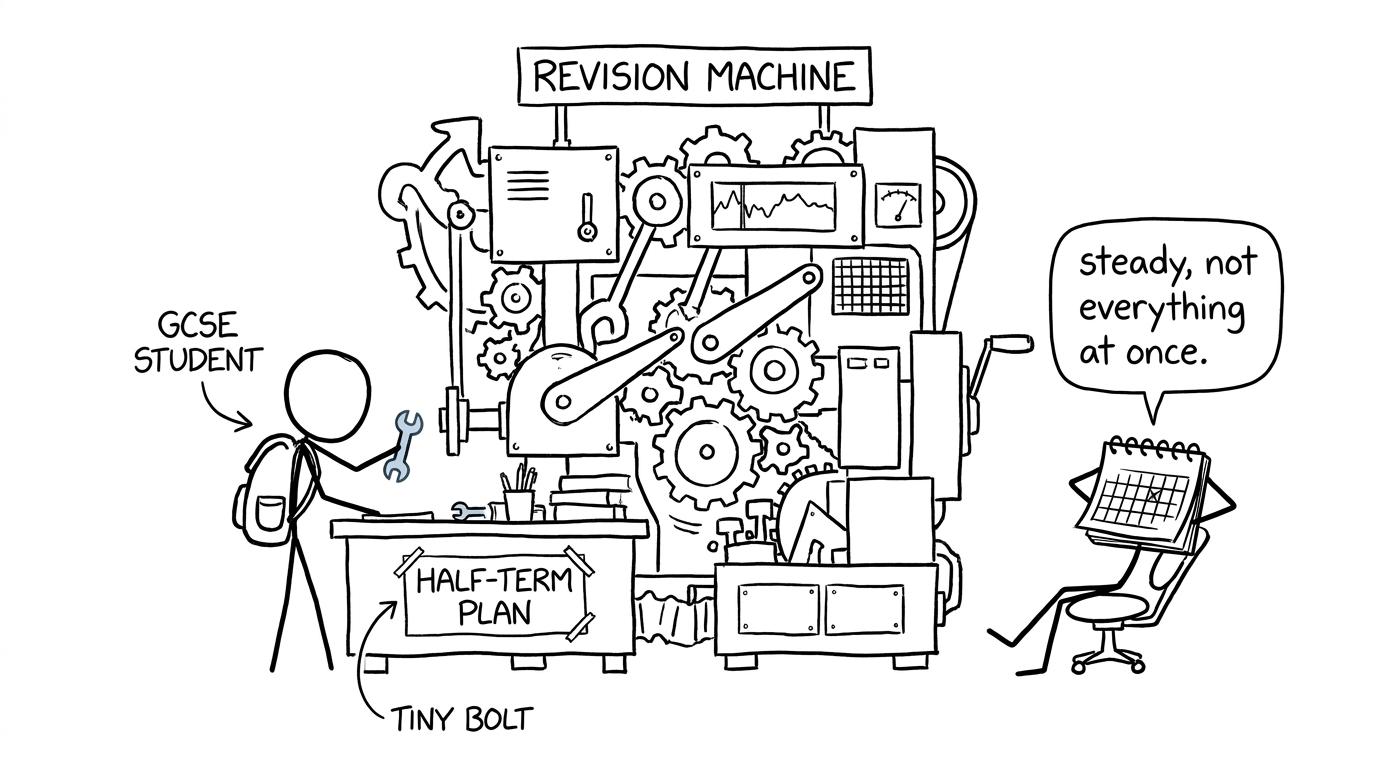 A student carefully adjusting an enormous half-term revision machine
Your half-term revision checklist
By the end of the break, aim to have:
- checked your school's current Engineering specification and assessment deadlines;
- identified three priority areas rather than carrying a vague list of everything;
- completed or improved one important piece of Engineering work;
- revised the maths topics most relevant to engineering contexts;
- answered practice questions and checked them against solutions or mark schemes;
- recorded mistakes that need another attempt;
- planned two or three short weekly sessions for the next half-term;
- protected time for sleep, exercise and an actual break.
Your qualification may be called Engineering, Engineering Design or another related technical award. Content and assessment arrangements vary between specifications, schools and exam boards, so use the documents and deadlines given by your teacher rather than assuming that another student's timetable applies to you.
Start with an engineering-style diagnostic
Revision often begins with choosing a chapter. A better starting point is evidence.
Collect your latest assessments, teacher feedback, practice questions and unfinished Engineering tasks. Sort what you find into three categories:
- Secure: you can explain or complete it without substantial help.
- Shaky: you recognise the method but make errors or forget details.
- Missing: you cannot yet begin confidently, or the work remains incomplete.
This turns anxiety into a finite set of decisions. If ratio is secure but tolerances are shaky, do not spend the morning answering comfortable ratio questions. If your design documentation needs a short, specific improvement, define that job instead of writing “do coursework” across an entire day.
Use the MathsGenie GCSE revision lessons to compare your maths knowledge with the topics required at your tier. The videos and practice questions make it easier to distinguish between something you genuinely understand and something that merely looks familiar.
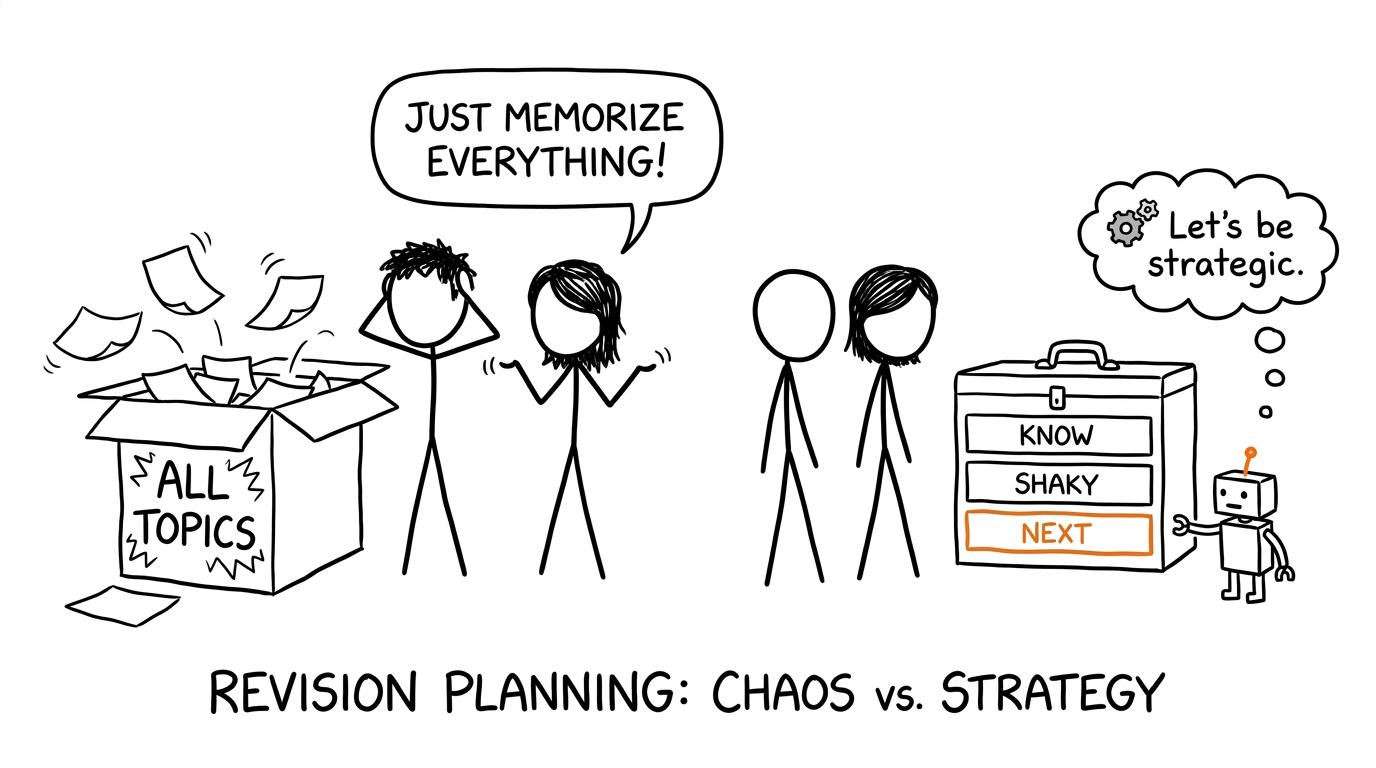 A chaotic revision toolbox beside a calm three-drawer priority system
Prioritise the maths used in engineering
Engineering contexts reward careful mathematical communication. A sensible half-term plan therefore includes the topics below, but your diagnostic should decide their order.
Units, measurement and accuracy
Engineering questions may involve lengths, areas, volumes, mass, time and compound measures. Practise converting units before substituting values into a formula. For length,
1 m=1000 mm1\text{ m}=1000\text{ mm}1 m=1000 mmbut area and volume conversion factors must also be squared or cubed:
1 m2=1,000,000 mm21\text{ m}^2=1{,}000{,}000\text{ mm}^21 m2=1,000,000 mm2 1 m3=1,000,000,000 mm31\text{ m}^3=1{,}000{,}000{,}000\text{ mm}^31 m3=1,000,000,000 mm3Accuracy also includes rounding, bounds and tolerance notation. If a permitted measurement is written as L±tL\pm tL±t, the acceptable interval runs from L−tL-tL−t to L+tL+tL+t. Check whether endpoints are included and preserve enough accuracy during intermediate calculations.
Ratio, proportion and scale
Ratio appears in scale drawings, material mixtures, gears and model dimensions. You should be able to simplify a ratio, divide an amount in a given ratio and apply a scale factor consistently.
The general relationship is:
actual length=drawing length×scale factor\text{actual length}=\text{drawing length}\times\text{scale factor}actual length=drawing length×scale factorArea changes by the square of a linear scale factor, while volume changes by its cube. That distinction is easily missed when a problem moves from a drawing to the amount of material required.
Percentages and efficiency
Percentage change, waste, profit, depreciation and efficiency can all appear in technical contexts. Keep the core relationships visible in your notes:
percentage change=changeoriginal amount×100%\text{percentage change}=\frac{\text{change}}{\text{original amount}}\times 100\%percentage change=original amountchange×100% efficiency=useful outputtotal input×100%\text{efficiency}=\frac{\text{useful output}}{\text{total input}}\times 100\%efficiency=total inputuseful output×100%Read the language carefully. A percentage increase is calculated from the original amount, while reverse-percentage questions require you to reconstruct that original value.
Geometry, graphs and formulae
Area, surface area, volume, Pythagoras' theorem and trigonometry are especially useful when interpreting components or designs. Foundation and higher-tier requirements differ, so match your practice to your entered tier and current exam-board specification.
You may also meet compound relationships such as
ρ=mV\rho=\frac{m}{V}ρ=Vmwhere density depends on mass and volume. The challenge is often not remembering a formula but rearranging it, selecting compatible units and communicating the answer appropriately.
Graphs can represent performance, cost, displacement or change over time. Revise how to interpret gradients, intercepts, scales and trends rather than treating a graph as decoration around the question.
A focused seven-day half-term plan
This framework is deliberately limited. Adjust the days around family plans, work, travel and the dates set by your school.
| Day | Main focus | Useful outcome |
|---|---|---|
| Monday | Diagnostic and organisation | Three priorities and a realistic timetable |
| Tuesday | Units, accuracy and scale | Practice completed and mistakes recorded |
| Wednesday | Engineering task or design documentation | One defined section improved |
| Thursday | Ratio, percentages and formulae | Weak methods revisited through questions |
| Friday | Geometry, measures and graphs | Mixed technical maths practice completed |
| Saturday | Timed maths paper section | Mark scheme used to identify lost marks |
| Sunday | Corrections and forward planning | Errors retried and next sessions scheduled |
A day does not need to contain hours of uninterrupted work. Two purposeful sessions can be enough. What matters is that every session has an output: questions marked, notes condensed, feedback acted upon or a defined piece of Engineering work completed.
For shorter checks, use MathsGenie mini tests. When you need broader exam practice, select an appropriate paper from the GCSE maths past papers.
Build revision sessions that produce evidence
A productive session has four stages:
Retrieve
Begin without notes. Write down the formulae, definitions or steps you remember. This exposes gaps that rereading can hide.
Repair
Use a short revision lesson or your class materials to correct those gaps. Keep this phase focused on the exact difficulty you found.
Practise
Answer questions without copying the model method. Include enough variety to test whether you can recognise when the method is needed.
Review
Mark the work and classify each error. Was it caused by misunderstood mathematics, an incorrect unit, premature rounding, calculator input or misreading the instruction?
A mark scheme is not simply a device for producing a score. It shows where credit is awarded. After marking, close the solution and retry incorrect questions later. Video solutions can then help you compare the structure of your method with a clear alternative.
Keep Engineering from consuming the whole break
Project-based work expands to fill the time available. A vague task such as “improve my folder” has no natural endpoint, so it can absorb every afternoon without producing the most important improvement.
Instead, define work by deliverable and time boundary. You might organise teacher feedback, improve selected annotations, check dimensions or complete a named section specified by your teacher. Stop when the planned deliverable is complete, then move to maths or rest.
This matters because February half-term is a checkpoint, not your final revision window. GCSE maths improves through repeated contact with topics. One intensive week cannot replace practice across the following months, particularly when methods need to be recalled under timed conditions.
If you are ready for exam-style rehearsal, MathsGenie predicted papers can complement revision. They should sit alongside topic practice and genuine past papers rather than replacing either.
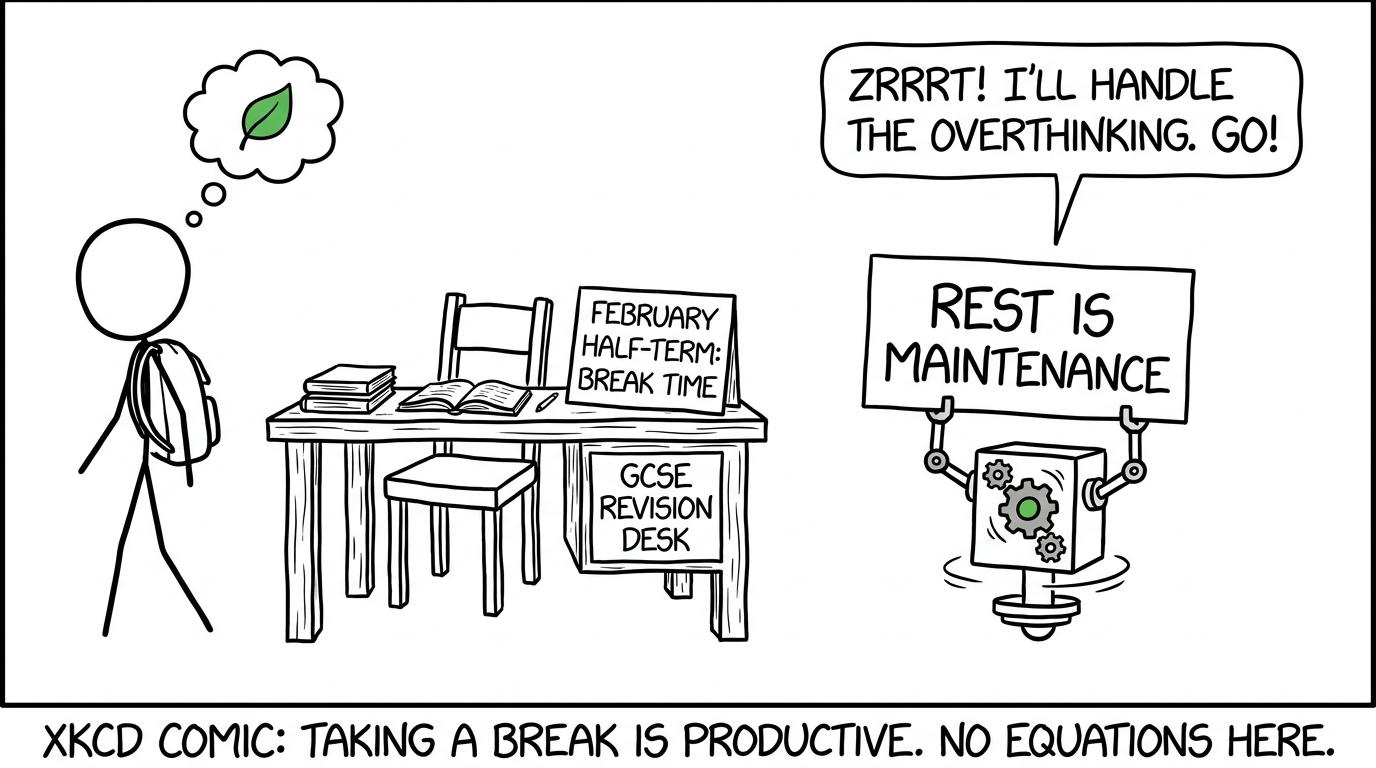 A revision robot explaining that rest is maintenance
Common mistakes during February revision
Planning every hour before diagnosing weaknesses
An attractive timetable is not necessarily a useful one. Decide what needs attention first, then allocate time.
Spending too long making notes
Notes can organise knowledge, but GCSE maths requires performance. Move quickly from reviewing a method to answering questions independently.
Ignoring units and presentation
A correct calculator value can still lead to lost marks if the unit, degree of accuracy or reasoning is missing. Treat communication as part of the mathematics.
Marking without correcting
Writing a score at the top of a page does not repair anything. Record the cause of each error and retry the question without looking at the solution.
Completing only favourite topics
Comfortable questions create motion without much improvement. Give the best part of your attention to topics categorised as shaky or missing.
Treating half-term as the final push
The break should create momentum, not exhaustion. Leave space for recovery and schedule the next review before school resumes.
What should happen after half-term?
Turn the week's error log into a modest continuing routine. Two short topic sessions and one mixed practice session each week will usually be more sustainable than waiting for another long holiday.
Return to incorrect questions after a delay. Add timed sections gradually. As exams approach, use full papers to practise selecting methods, managing time and maintaining accuracy across several topics. Keep Engineering deadlines visible, but separate project tasks from maths revision so that each has a clear purpose.
The MathsGenie free maths revision hub gives you a consistent place to continue: revision lessons when knowledge needs repairing, practice questions and mini tests when it needs strengthening, and past or predicted papers when it needs testing.
Make the week a beginning, not a rescue mission
Successful engineering rarely depends on one dramatic adjustment. It comes from checking, testing and improving a system before failure becomes expensive. Revision works in much the same way.
Use February half-term to reduce uncertainty. Choose a few high-value Engineering tasks, strengthen the maths beneath them and record what still needs attention. Then carry that information into a calmer weekly routine.
Start today with the MathsGenie GCSE revision resources, complete a focused set of practice questions and mark it honestly. From there, move towards mini tests, past papers and predicted papers. Half-term does not need to finish your revision. It needs to make the next step obvious.










