

GCSE Engineering Exam Conditions Practice at Home
GCSE engineering exam conditions practice: create a realistic timed session at home, control distractions and review your paper to improve future marks.
The first full paper at home often feels strangely unlike an exam. The kitchen clock is somewhere behind you, your phone is within reach, and pausing for a drink seems harmless. Yet realistic GCSE engineering exam conditions practice depends less on having an invigilator than on removing choices. Use an unseen paper, follow its exact time and equipment rules, work without help, and stop when time is called. Then mark it honestly.
That simple routine trains two things at once: your engineering knowledge and your ability to retrieve it under pressure. The second skill is easy to overlook. It is also one of the few parts of exam day that you can rehearse almost exactly at home.
Your realistic practice checklist
Before beginning, make sure you have:
- an unseen paper for your exact qualification and specification;
- checked the time, marks and permitted equipment on its front cover;
- a quiet desk cleared of notes, textbooks and unrelated devices;
- pens, pencils, ruler and any permitted calculator or drawing equipment;
- a visible clock or silent timer;
- told other people in the house when you must not be interrupted;
- placed the mark scheme somewhere inaccessible;
- planned time immediately afterwards, or later that day, for marking and reflection.
For AQA GCSE Engineering (8852)(8852)(8852), the current specification includes a written examination lasting 222 hours and worth 120120120 marks, alongside non-exam assessment. The paper includes different question styles, including shorter and extended responses. Always check the current specification, your paper's front cover and your teacher's instructions because arrangements can change and similarly named engineering qualifications may use different assessments.
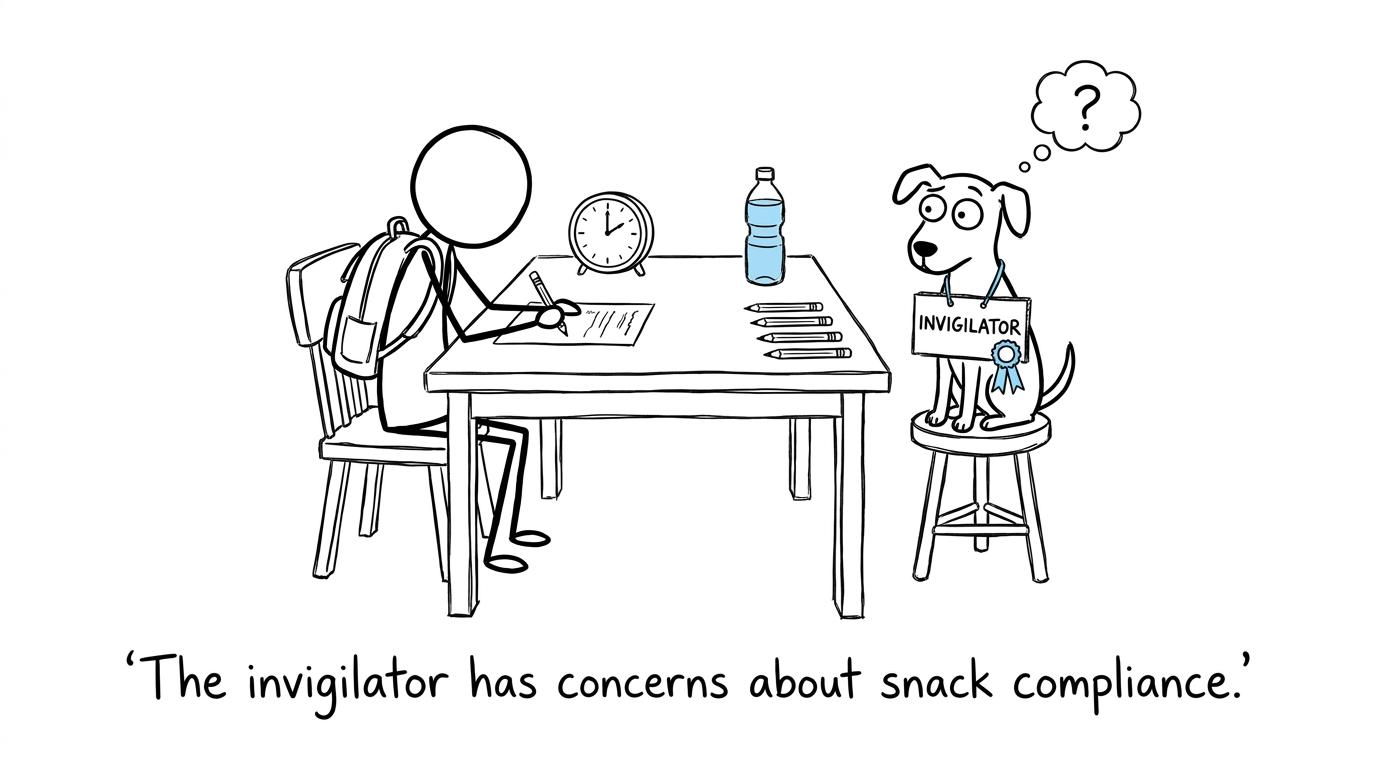 A pet takes its role as a home exam invigilator far too seriously
Choose a paper that will produce honest evidence
A familiar paper tests memory as much as engineering. You may recognise a diagram, remember an answer or anticipate the next topic. That can feel reassuring while giving you an inflated mark.
Choose a secure, previously unseen paper supplied appropriately by your school, or an unused past paper from your awarding body. Confirm whether you are taking GCSE Engineering or another engineering qualification before selecting it. Edexcel, AQA, OCR and Eduqas do not necessarily offer identically structured qualifications simply because their titles sound similar.
Maths remains an important part of technical problem-solving. Use MathsGenie's GCSE maths revision resources to strengthen weaknesses such as ratio, percentages, standard form, measurement, graphs, area and volume. For separate GCSE Maths rehearsal, the GCSE past papers collection provides useful practice with mark schemes and video solutions.
Do not open the mark scheme beforehand. If somebody at home can print or select the paper for you, ask them to keep its answers hidden. A realistic attempt begins with uncertainty.
Build a small exam hall at home
You do not need rows of desks. You need a controlled environment that prevents avoidable interruptions.
Clear the desk
Keep only the paper and permitted equipment in front of you. Remove revision cards, formula posters, smart watches, headphones and spare devices. If a formula or reference sheet is officially supplied with the paper, use that exact sheet rather than one you created yourself.
Your calculator should be the model you expect to use in the real assessment, with an appropriate examination mode where required. Check its battery and settings before the timed session, not during it.
Control noise and interruptions
Choose the quietest realistic period available. Tell family or housemates your finishing time and put a note on the door. Avoid music, even if you normally revise with it. The aim is not to make home revision unpleasant; it is to reduce the difference between practice and the assessment room.
If your home cannot become completely quiet, aim for predictable rather than perfect conditions. A library or supervised school revision room may be a better option for future sessions.
Protect your actual access arrangements
Realism does not mean denying yourself approved support. If you have an agreed access arrangement, such as supervised rest breaks, extra time, a reader or use of a word processor, practise according to the arrangement confirmed by your school.
For example, approved extra time changes the available duration proportionally. If the standard duration is TTT minutes and the approved allowance is p%p\%p%, the total time is:
Ttotal=T(1+p100)T_{\text{{total}}}=T\left(1+\frac{p}{100}\right)Ttotal=T(1+100p)Your school's special educational needs coordinator or examinations officer should confirm what applies. Do not assume that an arrangement used informally in lessons will automatically apply in a public examination.
Run the timed session without escape routes
Set one alarm for the end and keep a clock visible for checking progress. A phone is a poor timer because it also contains messages, search tools and notifications. If it must be used, switch on aeroplane mode, silence it and place it beyond reach.
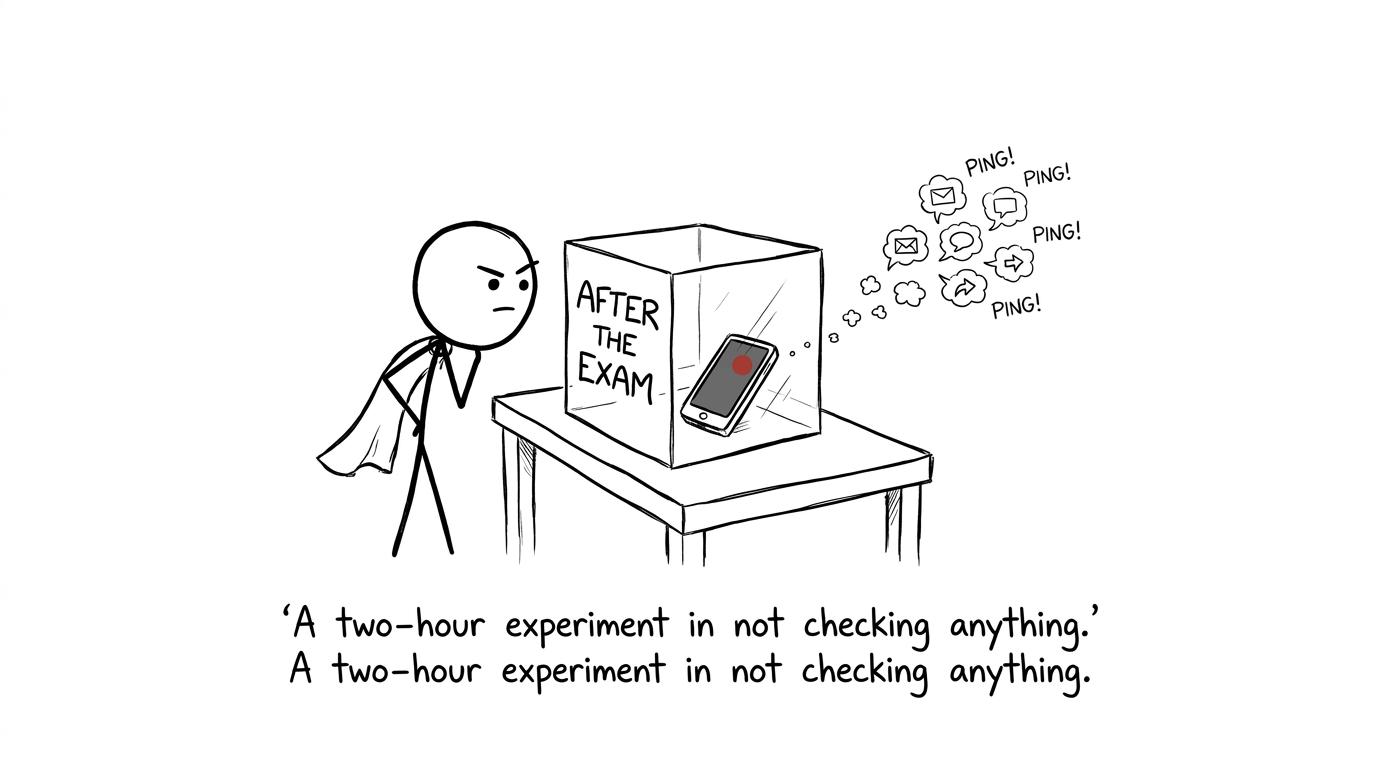 A student's phone waits dramatically outside the practice exam
Begin by reading the instructions on the front cover. Check whether all questions must be answered, what equipment is permitted and where answers should be written. Start the timer only when you are ready to reproduce the real beginning of the assessment.
During the paper:
- do not pause the timer for ordinary discomfort or difficult questions;
- do not search online, check notes or ask somebody for clarification;
- show calculations and units rather than recording unsupported answers;
- mark difficult questions lightly and return to them later;
- use sketches, labels and technical vocabulary where the question requires them;
- leave enough space for extended responses and plan them briefly where useful.
A rough pacing measure is minutes per mark:
minutes per mark=total available minutestotal marks\text{minutes per mark}=\frac{\text{total available minutes}}{\text{total marks}}minutes per mark=total markstotal available minutesFor a 222-hour, 120120120-mark paper, this produces an average of:
120120=1 minute per mark\frac{120}{120}=1 \text{ minute per mark}120120=1 minute per markThis is a guide, not a command. Reading, checking and extended writing alter the pace. Record the time at one or two planned checkpoints rather than watching the clock after every line.
When the alarm sounds, stop writing. Draw a line beneath the final answer if necessary. Finishing a half-completed response afterwards destroys the evidence you were trying to collect.
Rehearse the decisions engineering questions demand
Engineering assessments do not reward calculations alone. They can require knowledge of materials, manufacturing processes, systems, environmental considerations, design decisions and commercial production. Your timed practice should therefore test whether you can move between technical knowledge, quantitative reasoning and justified judgement.
When a calculation appears, read for:
- the required quantity;
- the data actually needed;
- consistent units;
- sensible accuracy;
- whether the result should be interpreted in context.
A formula is only useful when the quantities have compatible units. Likewise, an engineering recommendation needs evidence: a property, requirement, manufacturing constraint or consequence. Vague statements such as "it is better" rarely communicate enough technical reasoning.
If the maths is slowing down your engineering answers, return later to targeted free GCSE revision lessons. Topic practice repairs a skill; a full paper tests whether you can recognise and use that skill independently.
Mark the paper as evidence, not as a verdict
Take a short break before marking so that you are less tempted to defend what you meant. Use the official mark scheme for that exact paper and apply it consistently. Do not award a mark because an answer was "nearly there" unless the scheme permits it.
Record more than the total. Classify lost marks under four headings:
| Cause | What it may reveal | Next action |
|---|---|---|
| Knowledge | A fact, process or property was not secure | Revisit the relevant specification content |
| Application | Knowledge was not connected to the context | Practise explaining why a choice fits a requirement |
| Maths | A method, unit or calculation failed | Use focused MathsGenie questions and mini tests |
| Exam technique | The question was misread or time ran out | Rehearse command words and improve pacing |
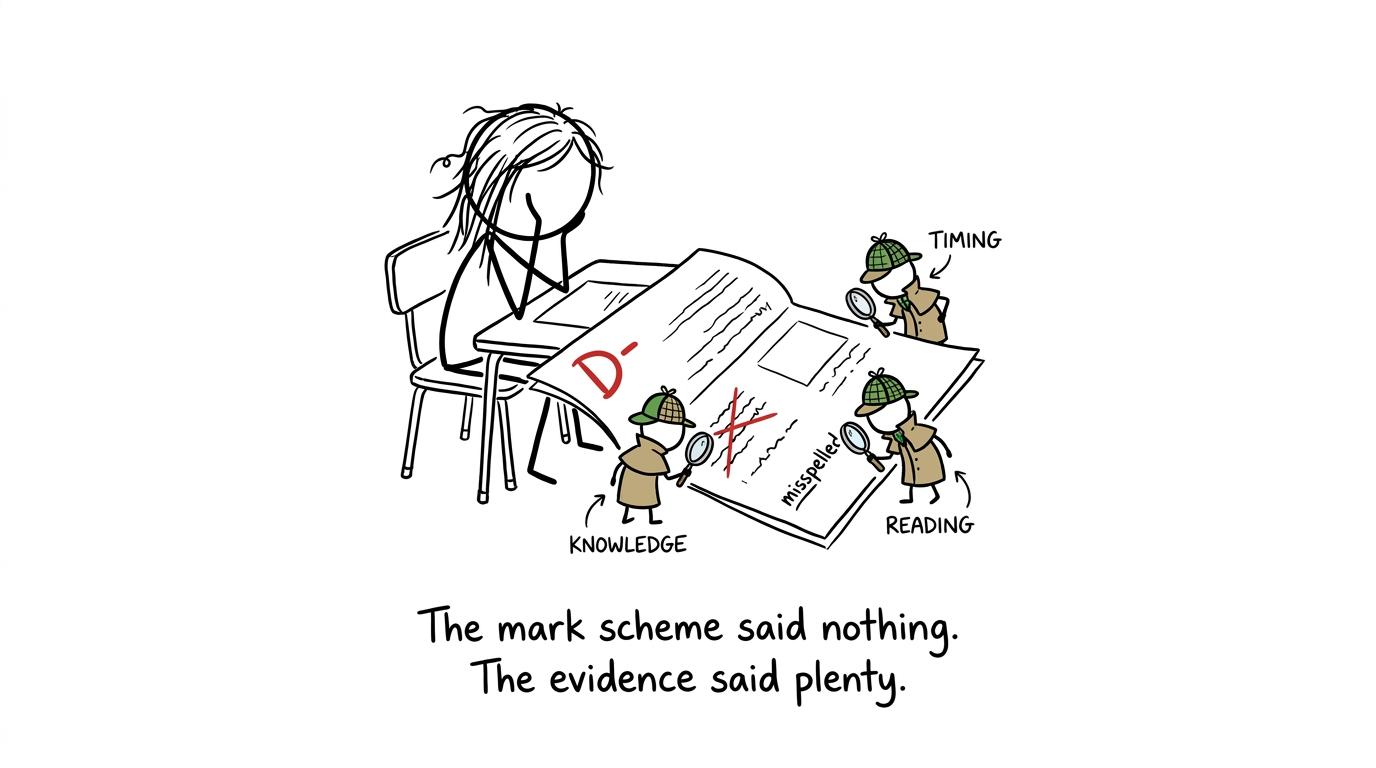 Three detectives investigate where the marks disappeared
Write a short correction beside each lost mark, but do not immediately repeat the entire paper. First repair the underlying gaps. MathsGenie's practice papers and mark schemes can support this cycle for GCSE Maths, while predicted maths papers offer further unfamiliar material nearer the examination period. Predicted papers are practice resources, not forecasts of the exact questions that will appear.
After several days, retry selected questions without looking at your corrections. Improvement is demonstrated by successful retrieval later, not by understanding the answer while it is visible.
Common mistakes in home exam practice
Making the session unrealistically comfortable
Music, snacks, messages and unlimited pauses make the paper easier than the real assessment. Keep permitted water available, but remove optional comforts that interrupt concentration.
Using a paper you partly remember
Recognition raises confidence without necessarily improving independent performance. Save at least one unseen paper for a complete rehearsal.
Ignoring the qualification's exact rules
Engineering qualifications and exam boards can differ. Do not copy timings, calculator rules or paper structures from a friend taking another course. Use your own specification and the current front cover.
Checking one answer during the test
One quick search changes the conditions and may reveal information useful elsewhere in the paper. Put a question mark beside the response and investigate only after time has ended.
Focusing only on the final mark
A mark tells you where you are. Error categories tell you what to do next. A lower-than-expected result can still be valuable if it identifies a precise weakness early enough to fix it.
Repeating full papers without targeted revision
Full papers diagnose; they do not automatically teach. Alternate timed attempts with revision lessons, short sets of practice questions and mini tests. The MathsGenie GCSE revision hub lets you select work by topic and grade, while the MathsGenie home page brings the wider free revision resources together.
Turn one rehearsal into a repeatable routine
A genuinely realistic session is simple: an unseen paper, exact rules, permitted equipment, uninterrupted timing and honest marking. Its value lies in repetition with reflection. Each attempt should reveal one or two priorities, and those priorities should shape the revision that follows.
Do not wait until the final week to discover that timing, calculator settings or extended responses are a problem. Schedule a full rehearsal, review the evidence, repair the gaps and then test yourself again. Use MathsGenie's free revision lessons, practice questions, mini tests, revision planning tools, past papers with worked support and predicted papers to build the mathematical fluency behind confident technical answers.
The goal is not to make every home session feel intimidating. It is to make the real exam feel familiar.










