

GCSE Engineering Exam Clash Same Week: Revision Plan
GCSE engineering exam clash same week? Balance Engineering, maths and other GCSE papers with a calm revision plan that protects time, sleep and marks.
When several exams appear on one week of your timetable, revision can start to feel like an argument between subjects. Engineering needs technical knowledge. Maths needs repeated practice. English, science and your other papers are making equally convincing claims on your time.
If you are searching for help with a GCSE engineering exam clash same week, the immediate answer is this: confirm whether you have a genuine timetable clash, then divide revision according to exam proximity, current weakness and available marks. Do not split every evening equally. Give the next exam the largest focused block while keeping later subjects warm through short retrieval sessions.
The aim is not to feel completely prepared for everything. It is to make the best decision available each day.
Your exam-week checklist
Before creating a detailed plan:
- Check the date, session, duration and paper code on your school timetable.
- Tell your exams officer immediately if two papers occupy the same session.
- List the topics that still cost you marks in each subject.
- Give the nearest exam a focused block, not the whole day.
- Maintain maths with short question-based sessions.
- Mark every practice task and record the next correction.
- Protect sleep, meals, travel time and equipment preparation.
- Review the plan after each exam rather than trying to predict the entire week perfectly.
MathsGenie's GCSE maths revision hub lets you choose your exam board and move directly between revision lessons, questions and papers. That matters during a crowded week because fewer decisions leave more attention for the work itself.
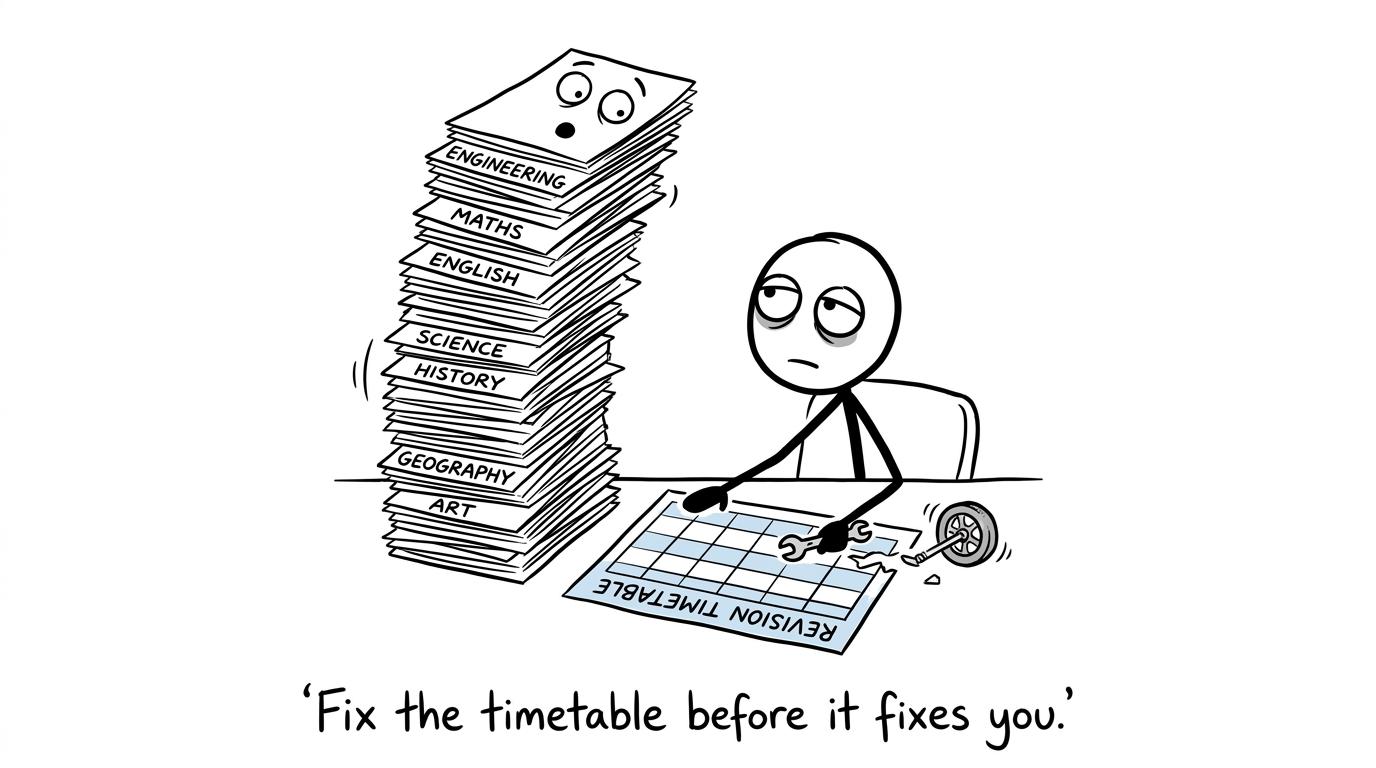 A student repairs a revision timetable while exam papers wait
First decide whether it is really an exam clash
Students often use “clash” to mean several exams in the same week. Officially, a timetable clash occurs when you are entered for two or more examinations at the same time on the same day.
Those are different problems.
If Engineering is on Monday and maths is on Wednesday, you have a demanding week but not an official timetable clash. You control the revision plan. If both papers are scheduled in the same session, your school or college must manage the arrangements under current Joint Council for Qualifications rules.
Depending on the combined duration, papers in one session may be taken consecutively with a supervised break, or your centre may move one paper to another session on the same day. More exceptional arrangements are possible for unusually heavy same-day timetables, but these are decisions for the exams officer and centre, not the student.
Do not try to solve a genuine clash yourself by choosing which exam to attend. Ask for the arrangements in writing and check:
- which paper you will sit first;
- where you must report;
- whether you will remain under supervision;
- what food, drink and revision materials are permitted;
- when your phone and other electronic devices must be handed in.
A same-week concentration of papers, by contrast, requires a revision strategy rather than an administrative solution.
Understand what your Engineering paper demands
The title “Engineering” can refer to different qualifications, so check your awarding organisation and specification. For AQA GCSE Engineering, the externally assessed written paper lasts 222 hours, carries 120120120 raw marks and contributes 60%60\%60% of the qualification. The non-exam assessment contributes the remaining 40%40\%40%.
The written assessment includes multiple-choice questions, short answers, calculations, practical contexts and extended responses. It assesses knowledge, application, analysis and evaluation. This means that simply rereading a materials booklet is unlikely to cover the full demand.
Sort your Engineering preparation into four categories:
- Recall: materials, properties, processes, components and terminology.
- Application: selecting an appropriate material or process for a stated context.
- Calculation: substituting values, rearranging relationships and handling units.
- Evaluation: comparing alternatives and justifying a decision using the requirements of the problem.
This classification makes a crowded week easier to manage. You can revise recall in a short session, but application and evaluation need questions. Calculations need a pen, not just a page of highlighted notes.
Split attention using urgency, weakness and value
Equal time feels fair. It is rarely sensible.
A paper taking place tomorrow normally deserves more attention than one taking place four days later. However, proximity is not the only factor. A weak topic that appears throughout a paper may deserve more time than a small isolated gap.
Use three questions for each planned block:
- Urgency: How soon is the exam?
- Weakness: Where am I currently losing marks?
- Value: Can this session realistically improve my performance?
You can then label tasks as high, medium or low priority. “Engineering calculations I repeatedly get wrong” might be high priority. “Rewrite neat notes on a topic I already know” is probably low priority.
A useful busy-evening structure is:
| Block | Purpose |
|---|---|
| 404040 to 505050 minutes | Nearest exam: weakest high-value area |
| 101010 minutes | Break away from the desk |
| 252525 to 353535 minutes | Second subject: active practice |
| 101010 to 151515 minutes | Retrieval for a later paper |
| Final 101010 minutes | Mark work, pack equipment and set tomorrow's first task |
These are adjustable blocks, not compulsory totals. If you receive extra time, have access arrangements or are exhausted after an exam, plan around your own working conditions.
The GCSE maths revision timetable guide provides a broader structure for organising topic work, timed practice and review without filling every free hour.
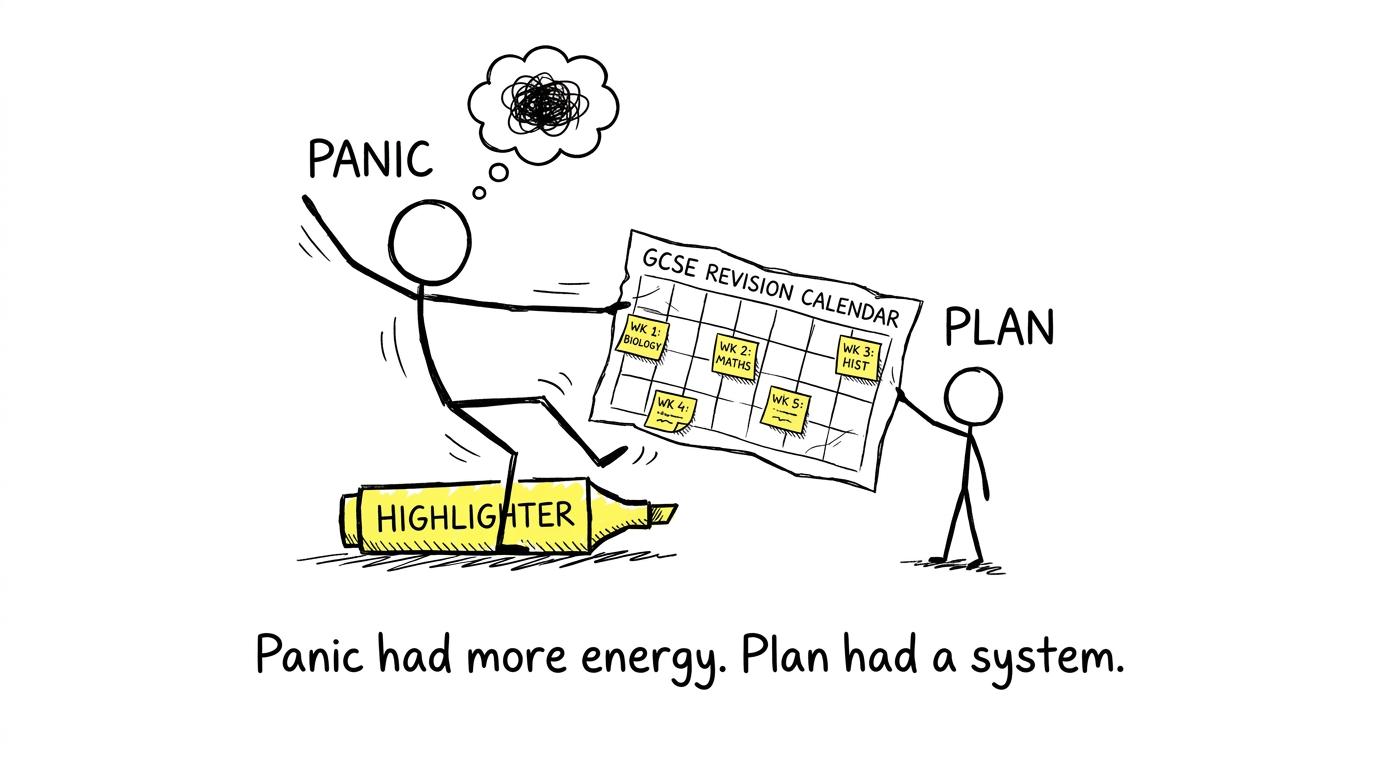 Plan defeats Panic in a revision-calendar tug of war
Keep maths warm while Engineering is urgent
Maths knowledge can feel familiar when you read a solution and disappear when you face a blank question. During an Engineering-heavy week, the answer is not necessarily a full maths paper every evening. It is a small amount of active contact.
Choose one of these maintenance tasks:
- complete a short mini test;
- answer several questions from one weak topic;
- redo questions previously answered incorrectly;
- complete a timed section rather than an entire paper;
- recall key methods, then check them against questions.
Engineering and GCSE maths also share useful habits. Both may require formula substitution, rearranging, scale, ratio, graphs, area, volume and compound measures. For example:
density=massvolume\text{density}=\frac{\text{mass}}{\text{volume}}density=volumemassand
pressure=forcearea.\text{pressure}=\frac{\text{force}}{\text{area}}.pressure=areaforce.The formula is only the beginning. Marks can also depend on consistent units, accurate substitution, sensible rounding and visible working. MathsGenie's speed and density revision guide is useful when compound measures are a shared weakness.
You can also review the GCSE formulae to remember, but check the formula sheet arrangements and permitted materials for your own exam series and specification. Do not assume that every relationship you use in class will be supplied.
Plan backwards through the same week
Start with fixed events: exams, travel, school sessions, meals and sleep. Revision must fit around reality rather than an imaginary week with unlimited energy.
Then work backwards from each paper.
Two or three days before Engineering
Focus on broad diagnosis. Attempt selected questions across the specification, mark them and identify a short repair list. Avoid creating a list so long that it becomes another source of anxiety.
Keep maths active with one focused topic session or a timed paper section. If your maths exam is also close, use the GCSE one-week maths revision plan to organise diagnosis, topic repair and paper practice.
The day before Engineering
Prioritise recall, familiar calculations, command words and a small number of previously corrected questions. This is not the best moment to begin a large untouched unit.
Stop heavy revision early enough to prepare your equipment and wind down. A late session that leaves you unable to concentrate for a 222-hour paper is a poor trade.
After the Engineering exam
Do not conduct a long post-mortem with friends or search for unofficial answers. The marks are no longer available, but the evening still is.
Eat, take a genuine break, then switch to the next paper. Start with a manageable task so that changing subjects does not require a burst of motivation. If maths is next, use a mini test or familiar topic questions before moving into a timed section.
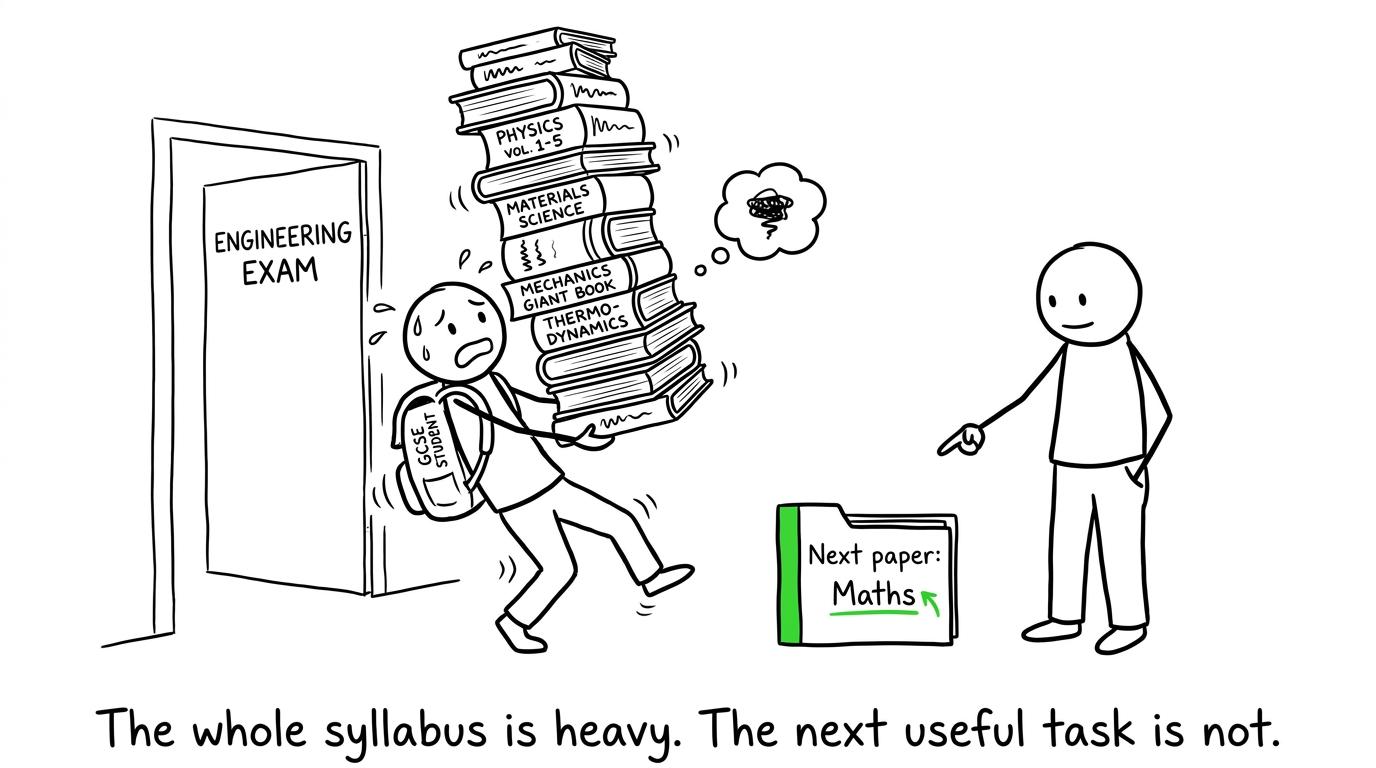 A student is reminded to carry only the folder for the next exam
Use papers without allowing them to consume the week
Past papers are valuable because they reveal gaps under exam-style wording. But a full paper plus careful marking can take a large part of an evening.
When several GCSEs land together, scale the task to the time available:
- use individual questions when repairing one method;
- use a short timed section for accuracy and pacing;
- use a full paper only when you have time to mark and review it;
- use predicted papers as fresh practice, not as a promise of what will appear.
For maths, choose papers matching your board and tier. MathsGenie's Edexcel GCSE maths past papers include mark schemes and worked solutions where available. If you need guidance on timing your paper practice across the revision period, read when to start GCSE past papers.
After marking, record the exact cause of each important error: missing knowledge, incorrect method, unit error, misreading, arithmetic or time pressure. “Bad at maths” is not a useful diagnosis. “Converted minutes incorrectly” gives you something you can repair.
Common mistakes during a crowded exam week
Dividing time equally between every subject
Equal blocks ignore exam order and personal weakness. Reassess priorities each evening.
Revising only the nearest paper
Urgent revision can crowd out everything else. Keep later subjects alive with brief retrieval or question practice.
Treating rereading as proof of readiness
Recognition is not the same as recall. Close the notes, answer a question, mark it and correct the method.
Completing papers without reviewing them
A paper identifies problems; the review changes them. If there is no time to mark a full paper properly, complete a smaller section.
Confusing a busy week with an official clash
Several exams in one week are not automatically a timetable clash. Two exams in the same session require immediate contact with your exams officer.
Sacrificing sleep to create extra hours
Revision quality falls when attention disappears. Set a finishing time, prepare your equipment and leave tomorrow's first task clearly written down.
Finish the week one useful task at a time
A packed exam week encourages dramatic plans: finish every topic, complete every paper, remove every weakness. Calm plans are smaller. They ask which marks remain reachable and what action will reach them.
Confirm genuine clashes with your exams officer. Prioritise Engineering according to its date and your gaps. Keep maths active through short, marked practice. After each paper, turn towards the next one.
Use MathsGenie's free GCSE maths resources as your base: choose your board and tier, revisit weak methods through revision lessons, practise with topic questions and mini tests, then build confidence with past papers, predicted papers, mark schemes and video solutions. Open one resource now and choose the first task your next exam actually needs.










