

Is a GCSE Economics Revision Timetable Worth It?
GCSE economics revision timetable worth it? Learn when a written plan helps, when flexible revision works, and how to build a realistic hybrid routine.
The timetable can become a comforting form of procrastination. Colours are chosen, boxes are ruled, and every evening until the exams appears to have a purpose. Then Tuesday arrives, homework takes longer than expected, and the whole plan begins to slide.
So, is a GCSE economics revision timetable worth it? Usually, yes, but only if it helps you decide what to practise, return to topics over time and respond to what you get wrong. A timetable does not improve grades by existing. The revision inside it does.
Flexible revision can work just as well, particularly for independent students who already choose useful tasks and monitor their progress. For most students, however, the strongest approach is a hybrid: a simple written framework with enough flexibility to change the details.
The short answer
A useful GCSE Economics revision plan should:
- divide the specification into manageable topics;
- revisit material rather than covering it once;
- include recall, application, calculations and extended responses;
- reserve time for past-paper practice;
- change when evidence shows that a topic needs more attention;
- fit alongside GCSE Maths and your other subjects;
- leave realistic space for rest, schoolwork and disrupted days.
If your timetable does those things, it is worth making. If it merely assigns the word “Economics” to several coloured boxes, it is not yet a revision plan.
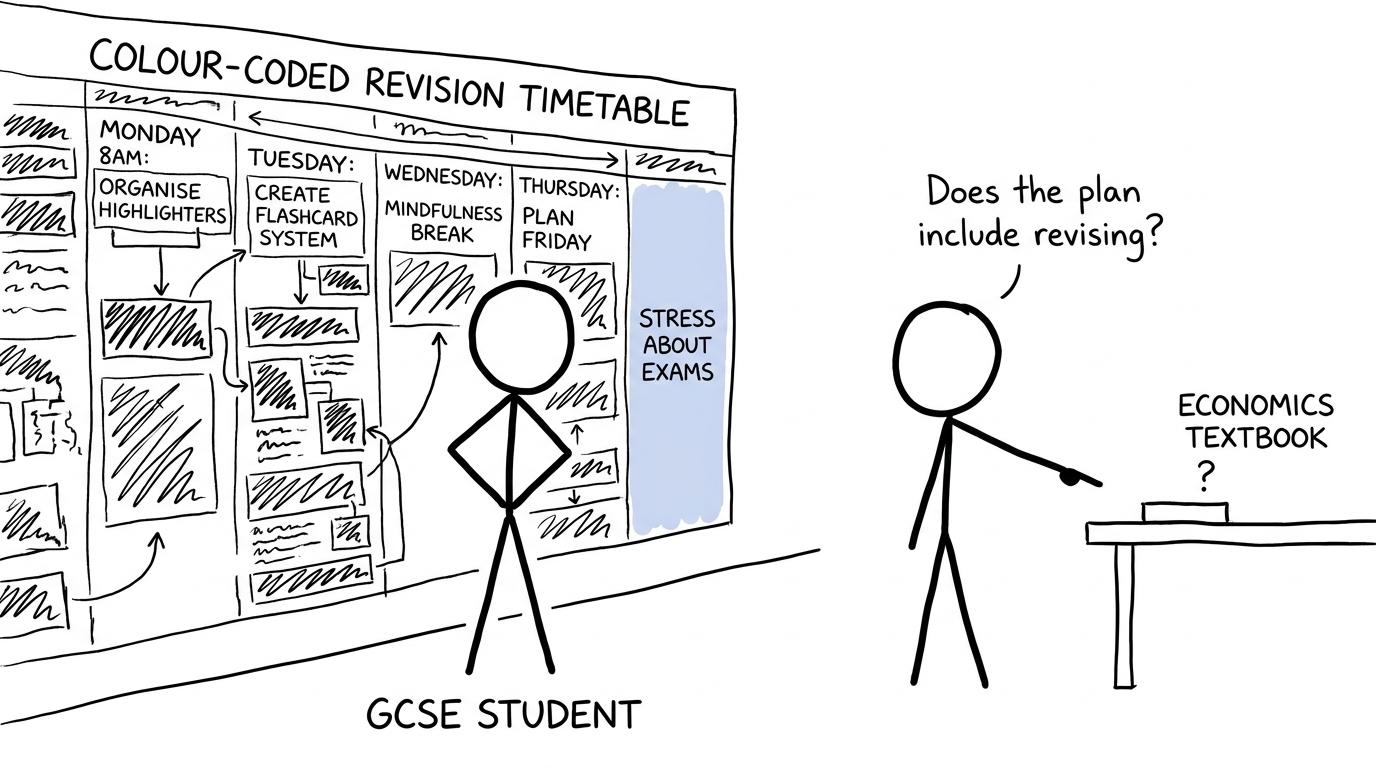 A student discovers that making a revision timetable is not the same as revising
What a written timetable can actually change
A timetable cannot guarantee an outcome. What it can change is behaviour.
Without a plan, revision is often driven by whatever feels urgent or comfortable. That may mean rereading a familiar chapter while avoiding market failure, exchange rates or an awkward extended-response question. A written plan makes those choices visible before tiredness or nerves begin negotiating with you.
Planning is also part of self-regulated learning: deciding what to do, monitoring how it went and adjusting the next step. The final part matters most. A timetable that is never updated assumes that the student who wrote it already knew exactly what their future self would need.
No student knows that. Practice reveals it.
It protects spacing
Learning tends to be more durable when a topic is revisited across separate sessions instead of being compressed into one long block. A timetable can deliberately bring demand and supply back next week, then return to it later through mixed questions or an exam paper.
This is different from writing “microeconomics” for an entire afternoon. Smaller, repeated encounters give you more opportunities to retrieve ideas after some forgetting has occurred.
It reduces daily decision-making
Revision requires effort before the first question is answered. You must choose a subject, locate a resource and decide whether to read, recall or practise. A written plan removes some of that friction.
The task should still be specific. “Revise Economics” leaves every decision untouched. “Recall causes of inflation, check gaps, then plan one evaluation response” gives the session a clear finish line.
It makes neglect harder to hide
Students naturally return to work that feels fluent. Unfortunately, familiarity can be mistaken for knowledge. A plan that includes every specification area makes it harder for weaker topics to disappear.
Use your own exam board’s current specification as the master checklist because topic organisation and assessment requirements can differ. Your class materials should also guide the terminology, diagrams and response structures expected in your course.
Can flexible revision work just as well?
Yes. A rigid timetable is not the only serious way to revise.
Flexible revision can be effective when “flexible” means responsive rather than random. A student might keep a weekly list of priority outcomes, choose the next task according to recent mistakes and record what has been completed. The exact evening may change, but the important work still happens.
Flexible revision is most likely to work when you can:
- begin without waiting to feel motivated;
- cover the full specification rather than favourite topics;
- revisit knowledge after a delay;
- practise under exam conditions;
- keep an accurate record of errors;
- balance Economics with Maths and other GCSE subjects.
If those habits are not yet reliable, a light timetable provides useful structure. It is not a judgement on your discipline. It is simply a way to make the next action easier.
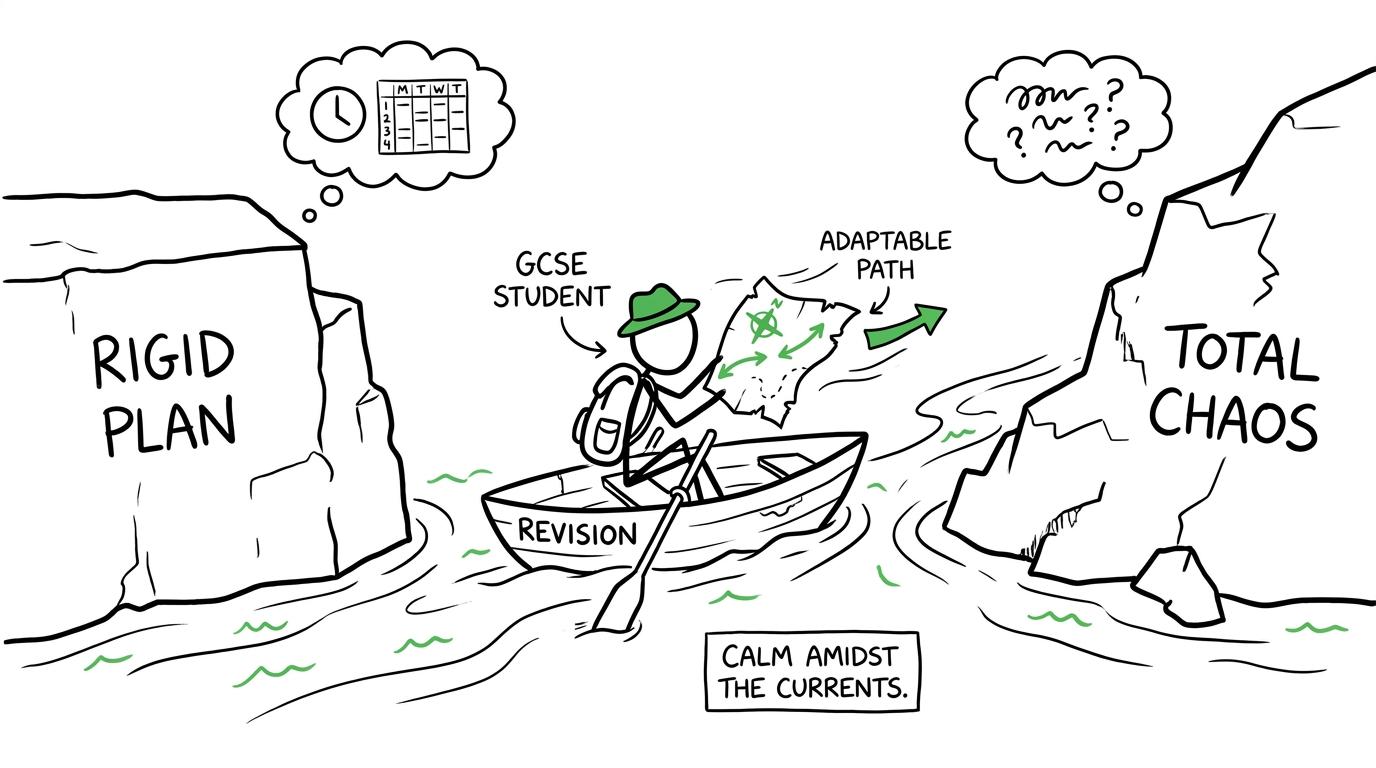 A revision boat navigates between a rigid plan and total chaos
The hybrid timetable is usually the better answer
Rigid plans break because real weeks contain homework, illness, family commitments and topics that take longer than expected. Completely open plans fail for the opposite reason: nothing has a protected place.
A hybrid timetable fixes the broad structure while allowing the task to change.
You might protect several subject sessions across the week but choose each Economics task from a live priority list. One session may focus on knowledge retrieval, another on application and analysis, and another on timed exam practice. If a paper exposes weak data interpretation, that weakness moves up the list.
The timetable becomes a budget for attention, not a prediction of a perfect future.
Plan outputs rather than minutes
Time matters, but time alone is a poor measure of revision. A student can spend an hour copying notes without checking whether anything can be recalled.
Give each session an observable output, such as:
- answer retrieval questions without notes;
- draw and explain specified economic diagrams;
- complete calculation and data-response questions;
- plan an extended answer using a clear analytical chain;
- mark a response and record the reason for each lost mark.
Economics rewards more than remembered definitions. You need to select knowledge, apply it to context, build analysis and make supported judgements. Your plan should therefore rotate between these demands rather than treating all revision as note-making.
Use a weekly review
At the end of the week, ask three questions:
- What can I now recall without support?
- Which errors are recurring?
- What deserves another session next week?
Then move tasks. Do not preserve an outdated timetable simply because it looks orderly. The written plan should follow the evidence produced by your work.
How to balance Economics with GCSE Maths
Economics includes quantitative information, percentages, ratios, averages, graphs and interpretation of data. Those skills also appear in GCSE Maths, so revision in one subject can expose a useful target in the other.
If percentage change is slowing down an Economics data question, use MathsGenie’s GCSE Maths revision resources to repair the underlying skill. You can also revisit percentage revision, ratio practice and averages revision where these match the gap you have identified.
Keep the subjects distinct, however. Knowing how to calculate a figure is not the same as explaining its economic significance. In Economics, always return to the context: what the value suggests, who may be affected and what limitations could weaken the conclusion.
A balanced weekly plan should reflect need rather than dividing time equally. If Maths is your earliest exam or your weakest subject, it may temporarily receive more sessions. MathsGenie’s topic-based materials, practice questions and video solutions make it easier to assign a precise task instead of writing the vague instruction “do Maths”.
Build the timetable backwards from evidence
Begin with the dates and requirements supplied by your school and exam board. Next, list the topics that must be covered. Then use recent class assessments, homework, teacher feedback and practice papers to sort them into broad priorities.
Avoid creating a false numerical science around this. A simple red, amber and green judgement can work, provided it is based on performance rather than confidence alone. A topic that feels difficult may be improving; a familiar topic may still produce errors under timed conditions.
Leave buffer space each week. When a session is missed, move the important task into that space instead of squeezing two sessions into the next evening. If the buffer is unused, it can become rest, mixed retrieval or extra exam practice.
As exams approach, increase the proportion of work that resembles the final assessment. For Maths, that means using the relevant Edexcel GCSE Maths past papers, AQA GCSE Maths past papers or OCR GCSE Maths past papers. Mark schemes and video solutions help turn each paper into information for the next plan.
MathsGenie’s GCSE predicted papers can provide further practice, but no predicted paper can tell you exactly what will appear. Use predicted papers to practise broad specification content and exam technique, not to narrow your revision to guessed topics.
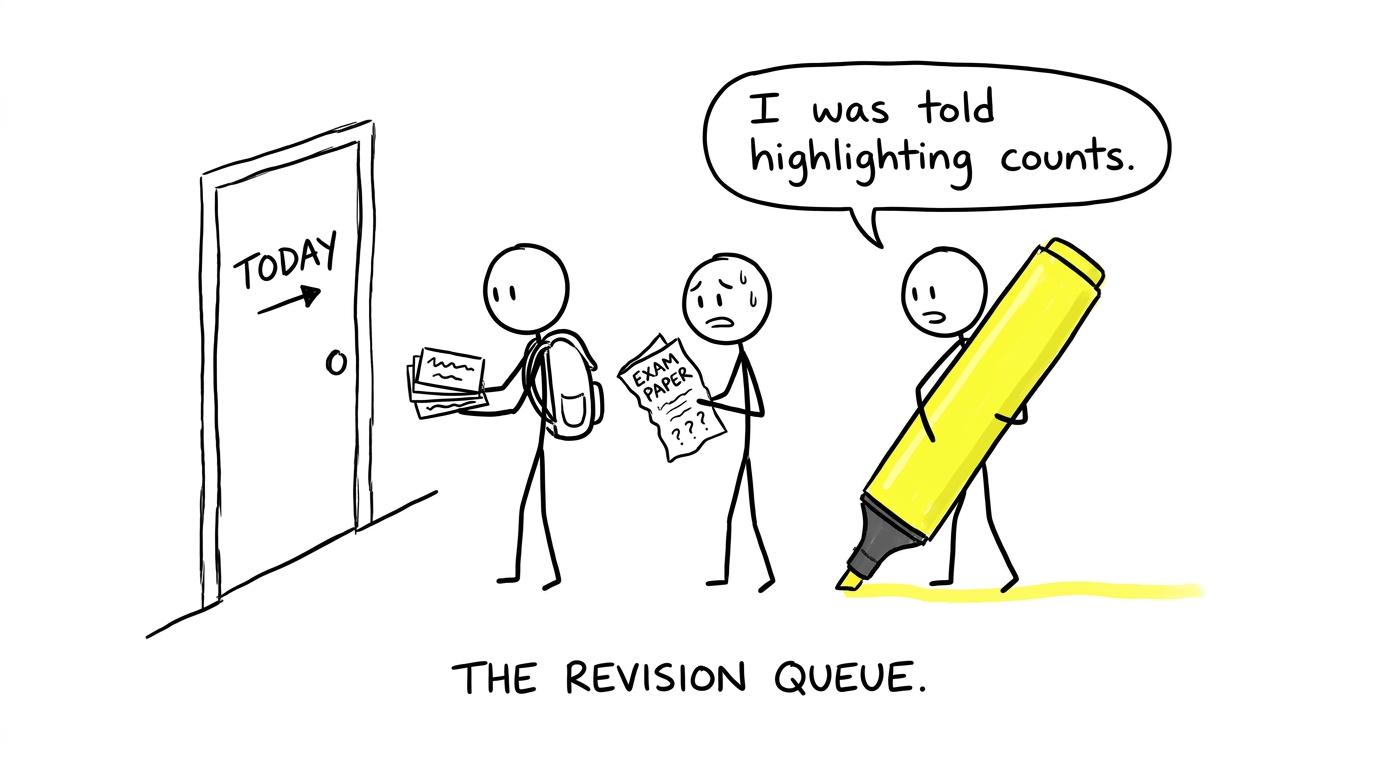 Revision tasks queue while an enormous highlighter claims to be useful
Common timetable mistakes
Spending longer designing than using it
A clear plan does not need complicated software, perfect handwriting or elaborate colour coding. If design becomes the main activity, reduce the timetable to subjects, tasks and a completion box.
Scheduling every available hour
A plan with no space for meals, travel, homework, rest or delays is already inaccurate. Overplanning creates a cycle in which one missed task makes the entire week feel lost.
Writing subjects instead of actions
“Economics” and “Maths” are labels, not instructions. Name the topic, resource and output. The easier it is to begin, the less motivation the session requires.
Treating completion as mastery
A tick proves that you attempted a task. It does not prove that you can retrieve the knowledge or use it in an unfamiliar question. Recheck topics through closed-book recall, mixed practice and later exam questions.
Refusing to change the plan
A timetable is a hypothesis about what will help. Marked work supplies better evidence. Move sessions when your errors show that the original priorities were wrong.
Using passive revision for every session
Reading and highlighting can help you become familiar with material, but familiarity is not enough. Include retrieval, explanation, application, timed responses and careful marking.
Make the plan useful, not impressive
A GCSE Economics revision timetable is worth making when it leads to spaced, specific and responsive practice. Flexible revision can be equally effective when it has the same ingredients. The important distinction is not written versus unwritten. It is deliberate versus accidental.
Start with a modest weekly framework. Give each session a clear output, keep a flexible priority list and review your evidence at the end of the week. When Maths needs attention, use MathsGenie’s free revision lessons, mini tests, practice questions and video solutions to target the exact gap. Then build towards past papers, mark schemes and predicted papers as your exams approach.
Start your free GCSE Maths revision on MathsGenie, and create a timetable that earns its place by helping you do the next useful piece of work.











