GCSE Economics Results Day Questions Answered
GCSE economics results day questions answered clearly: grades, boundaries, marking reviews and sensible next steps for students and parents in 2026.
Results day compresses two years of lessons, revision and exams into a few seconds. That can make every mark feel heavier than it really is. The short answer to most GCSE economics results day questions is simple: collect the facts, speak to your school and avoid making a rushed decision.
For the June 2026 series, GCSE results are released to students on Thursday 20 August. If an Economics result seems wrong, your school can help you access the marked script or request a review. Marks can rise, remain unchanged or fall, so evidence matters.
Your results-day checklist
Before worrying about individual marks:
- Confirm your exam board and qualification details.
- Record your grade and component marks, if provided.
- Check whether the grade meets your sixth-form or college requirements.
- Ask your Economics teacher about any unexpected result.
- Contact the exams officer promptly if you are considering a review.
- Keep post-results deadlines in mind.
You can also visit the GCSE Economics revision hub to find resources for AQA and OCR.
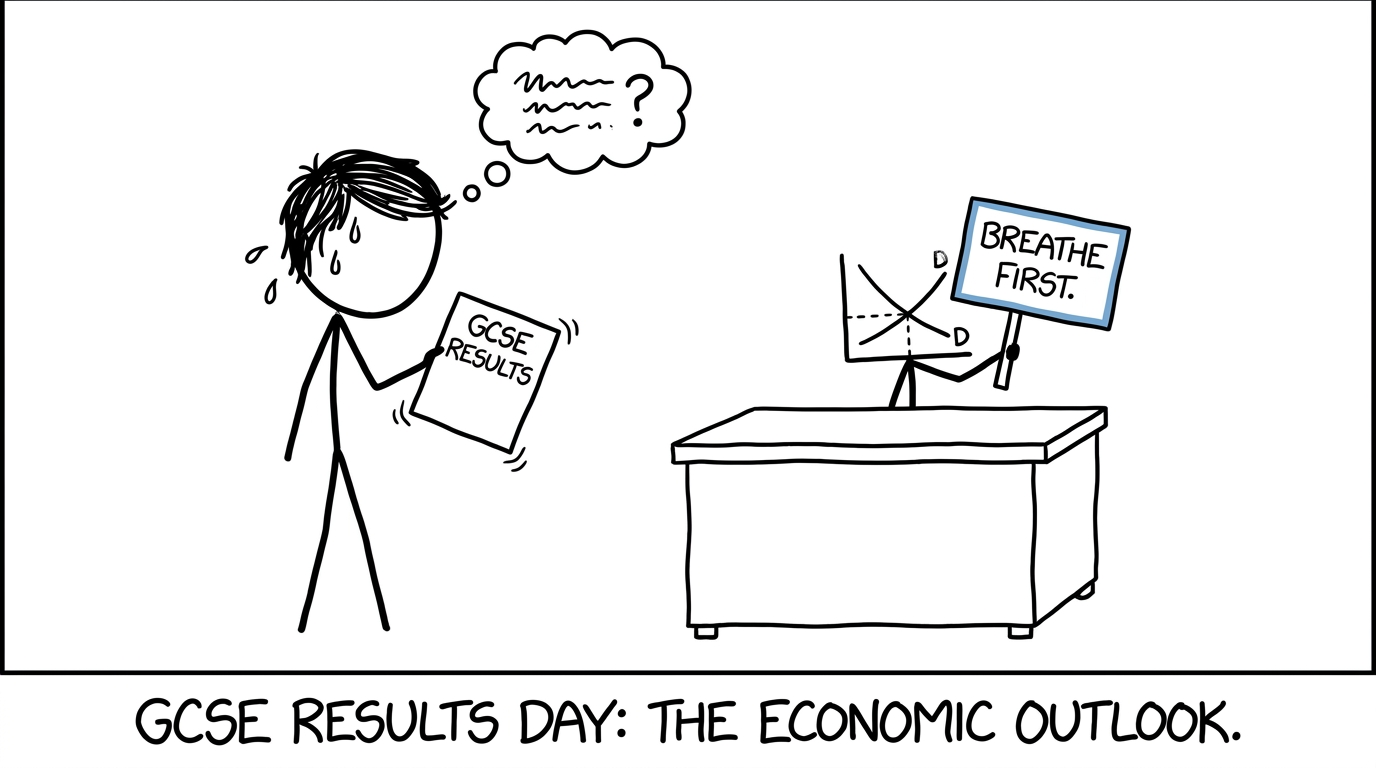 A nervous student is reminded to breathe before opening an Economics results envelope
When is GCSE Economics results day in 2026?
GCSE results for the June 2026 examination series are released to candidates on Thursday 20 August 2026. Your school decides when and how you can collect them, so check its arrangements in advance.
If you cannot attend, ask whether results can be accessed online or collected by an authorised person. Schools normally require prior permission and identification rather than accepting an informal request on the morning.
What information will my results show?
Your results statement should show the subject, exam board and final grade on the 999 to 111 scale. It may also include your overall mark or component marks, although the exact presentation varies between centres and awarding organisations.
AQA and OCR GCSE Economics are linear qualifications. Under their current specifications, the final result comes from two externally assessed papers, each contributing 50%50\%50% of the qualification. This means one disappointing paper does not automatically determine the whole result.
How are GCSE Economics grades calculated?
Your marks from the assessed components are combined to create a total qualification mark. The exam board then applies that examination series' grade boundaries.
For the current AQA and OCR specifications, the two papers are each marked out of 808080, giving a total of:
80+80=16080 + 80 = 16080+80=160However, boundaries can change between series because papers vary in difficulty. Last year's boundary can provide context, but it cannot prove what this year's boundary should be. The official boundary published for your board and series is the one that matters.
What should I do if my grade is lower than expected?
First, separate surprise from evidence. A result below a mock grade can be disappointing, but it does not by itself show that marking was incorrect.
Ask your teacher or exams officer for:
- your total and component marks;
- the relevant grade boundary;
- advice based on your performance across the papers;
- information about accessing your marked scripts;
- your school's deadline and charges for post-results services.
A marked script can help a teacher judge whether the mark scheme appears to have been applied correctly. This is usually more useful than deciding solely because you are one or two marks below a boundary.
Can I ask for a GCSE Economics paper to be remarked?
The formal service is called a review of marking, not simply a remark. A reviewer checks whether the original examiner applied the mark scheme correctly. It is not automatically a completely fresh assessment of every judgement.
Most students must make the request through their school or college, and written consent is required because the mark and grade can go down, stay unchanged or go up. Private candidates should contact the centre through which they entered or follow their awarding organisation's instructions.
For the June 2026 series, the awarding-body deadline for standard reviews of results is 24 September 2026. Schools often set earlier internal deadlines, so speak to the exams office quickly. Fees and arrangements depend on the board and centre.
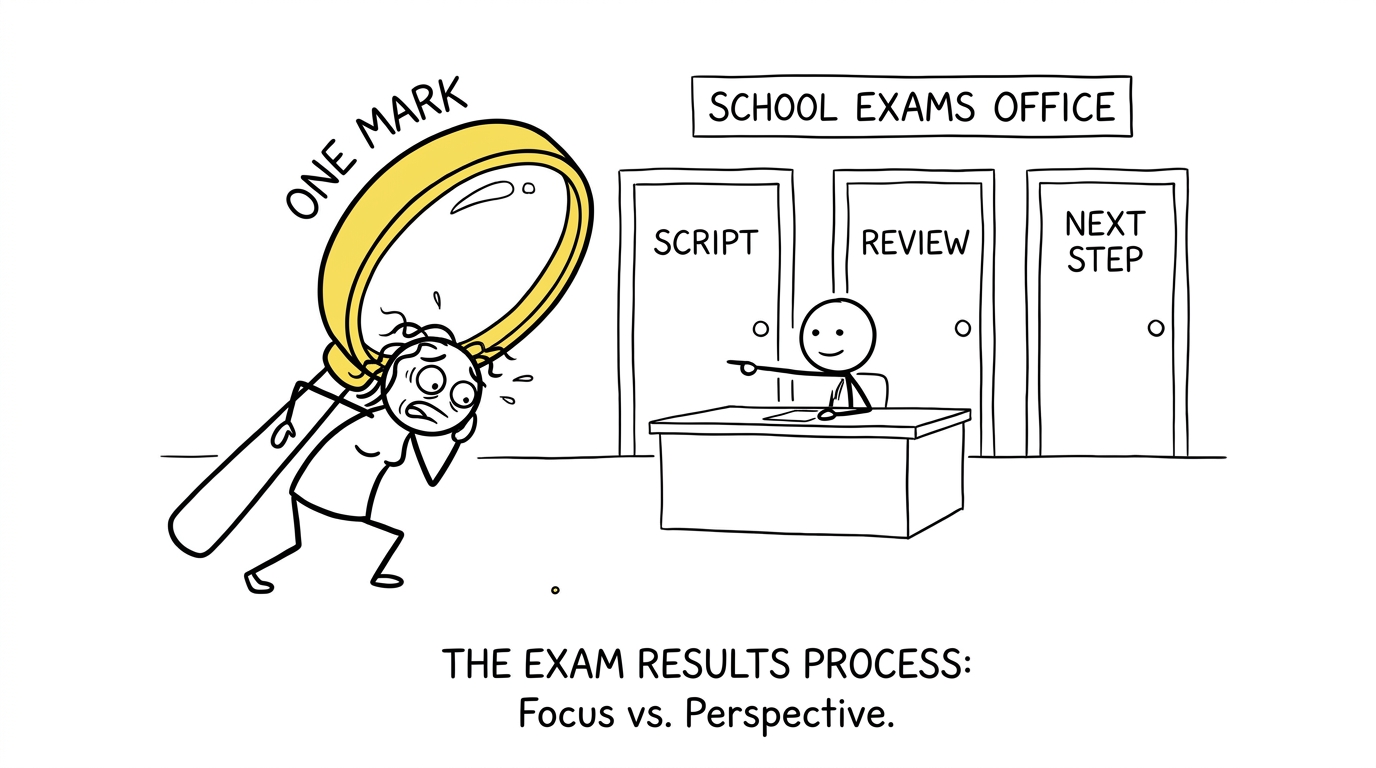 A parent brings an enormous one-mark magnifying glass to a calm exams office
What is the difference between a clerical re-check and a review?
A clerical re-check looks for administrative problems. It checks matters such as whether every part was marked, marks were totalled correctly and the result was recorded accurately.
A review of marking considers whether the mark scheme was applied properly. Access to scripts is different again: it gives the centre a copy of the marked work, helping your teacher decide whether a review has a reasonable basis.
If your concern is about the quality of a written Economics response, script access and teacher advice may be especially valuable. Extended answers involve examiner judgement, but a review only changes marks when an error is identified.
What if my sixth-form place depends on the result?
Contact the sixth form or college immediately. Explain the result calmly and ask whether there is flexibility, an alternative course or another condition you can meet. Do not assume that missing a stated grade means the conversation is over.
At the same time, speak to your school's exams officer if you have credible grounds for a review. GCSE post-results arrangements are not identical to the priority services used for some Level 3 progression decisions, so ask the centre exactly what is available and how long it may take.
Is it worth appealing my Economics result?
An appeal normally follows a completed clerical re-check or review of marking. It is not the first step simply because you disagree with the grade.
Your school can consider an appeal where it believes a marking or procedural error remains. Under the 2026 JCQ process, appeals generally need to be submitted within 303030 calendar days of the post-results outcome. Ask the exams officer about the precise route and centre deadline.
The sensible sequence is evidence first, review where justified, then appeal only if a valid concern remains.
How can I prepare if I need Economics again?
Turn the result into a diagnosis rather than a label. Identify whether marks were lost through knowledge, application, quantitative skills, analysis, evaluation or exam timing.
MathsGenie provides AQA GCSE Economics revision resources, AQA Economics past papers and OCR GCSE Economics papers and resources. Use the relevant specification rather than mixing boards.
For data interpretation, percentages and graphs, the GCSE Maths revision area can strengthen the quantitative skills that Economics assessments require. The guide to using GCSE past papers properly also explains how to mark, diagnose and retest rather than merely completing paper after paper.
Common results-day mistakes
The most common mistakes happen when emotion moves faster than information:
- comparing raw marks from different exam series;
- assuming proximity to a boundary guarantees an increase;
- requesting a review without understanding that marks can fall;
- missing the school's earlier internal deadline;
- contacting the exam board directly when the centre must act;
- treating one grade as a complete judgement of future ability;
- revising from materials for the wrong exam board.
Take the next step calmly
A GCSE Economics grade is important, but results day is a decision point rather than a final verdict. Confirm the details, seek informed advice and use post-results services only when the evidence supports them.
If further preparation is needed, begin with the free MathsGenie GCSE Economics resources. Revision lessons, practice questions, past papers, predicted papers, mini tests and mark schemes can turn an uncertain result into a clear plan for what comes next.