

GCSE Economics Resit: Your Results Day Plan
GCSE Economics resit preparation made manageable with a milestone plan covering exam entry, topic revision, quantitative skills and past papers.
Results Day can make one number feel larger than it is. Yet a grade is a snapshot, not a verdict. If you are considering a GCSE Economics resit, your first steps are practical: speak to your school or an approved exam centre, confirm your exam board and next available series, then use your marked performance to build a focused revision plan.
Do not assume Economics can be retaken in November. Current AQA and OCR timetables place GCSE Economics in the summer series, while November GCSE entries are more limited. Your school or centre should confirm the applicable arrangements, entry deadline and fee before you begin planning.
Your resit checklist
During the first week after Results Day:
- Ask whether a review of marking should be considered before entering a resit.
- Obtain your component marks and, where available, access to your scripts.
- Confirm whether you studied AQA GCSE Economics 813681368136 or OCR GCSE Economics J205J205J205.
- Find an approved centre willing to enter you.
- Check the entry deadline, cost and examination dates directly with that centre.
- Create a weekly timetable covering knowledge, quantitative skills and exam technique.
- Start an error log based on evidence rather than guesswork.
The GCSE Economics revision hub is a useful starting point for free lessons, revision guides, flashcards, worksheets and examination resources.
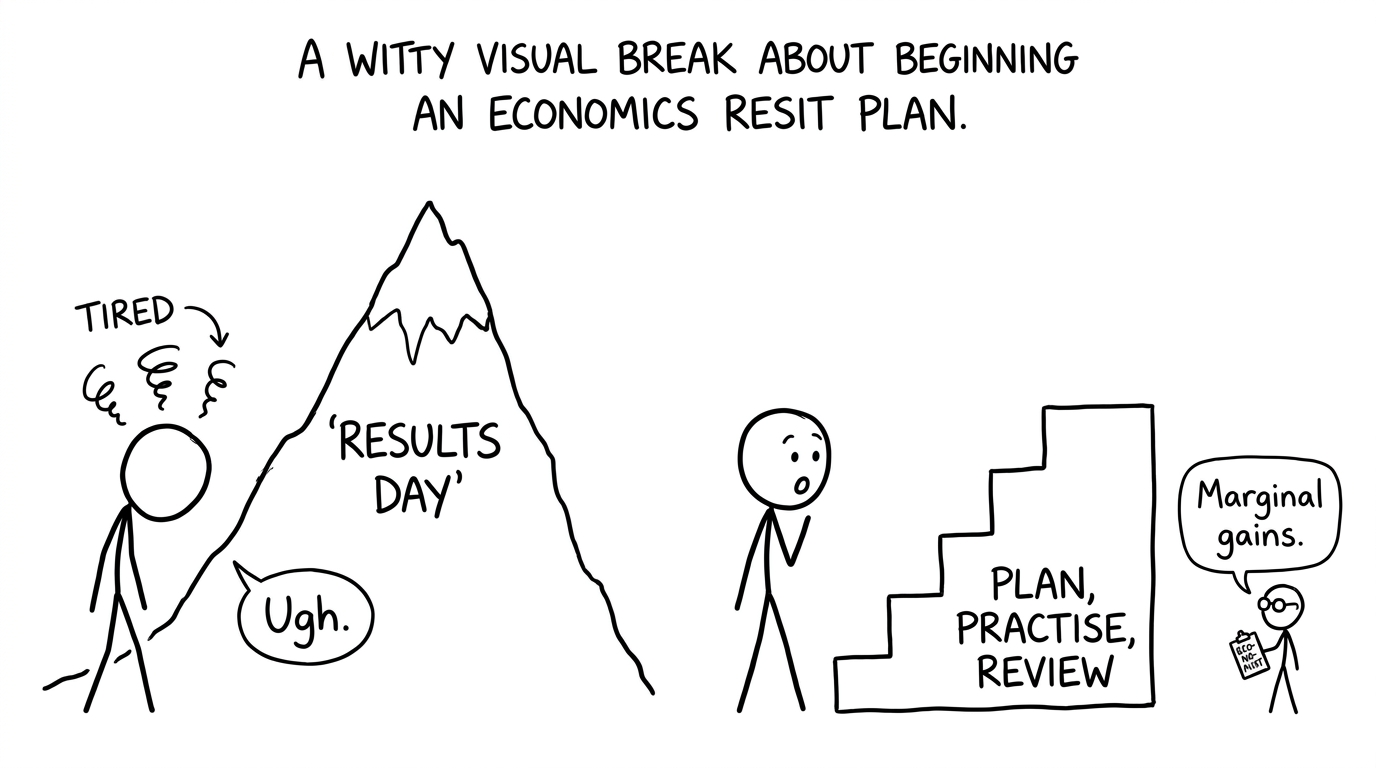 A student discovering that Results Day is a mountain with a staircase labelled Plan, Practise and Review
Milestone one: diagnose what cost you marks
Resitting GCSE Economics should not mean repeating your previous revision more intensely. It should mean finding where that revision failed.
Separate lost marks into four categories:
- Knowledge: definitions or concepts were missing.
- Application: answers did not use the business, market or economy in the question.
- Analysis: chains of cause and effect were incomplete.
- Evaluation: conclusions lacked balance, evidence or a supported judgement.
These categories reflect the assessment objectives used across GCSE Economics specifications. AQA and OCR both weight knowledge, application and analysis or evaluation substantially, so memorising definitions alone cannot secure the strongest grades.
Complete one paper without notes, mark it strictly and record why every mark was lost. A statement such as “lost six marks on inflation” is too broad. “Defined inflation correctly but did not explain its effect on real incomes” gives you something to repair.
Use the correct board page: AQA GCSE Economics revision or OCR GCSE Economics revision.
Milestone two: rebuild the specification
Spend the next phase turning your specification into a traffic-light checklist. Mark each topic green, amber or red only after testing yourself.
For microeconomics, this may include scarcity, opportunity cost, demand, supply, price determination, competition, labour markets and market failure. Macroeconomic revision may cover economic growth, inflation, unemployment, government policy, international trade and globalisation. Exact organisation and terminology vary between boards, so follow your own specification rather than a generic online checklist.
A productive session has three parts:
- Retrieve key ideas without notes.
- Answer focused questions or complete a worksheet.
- Mark your work and write one correction.
Reading can create familiarity. Retrieval reveals whether the knowledge is actually available when the paper is closed.
Milestone three: secure quantitative skills
Economics is not a maths qualification, but numerical fluency matters. Both AQA and OCR specifications require at least 10%10\%10% of the total marks to assess quantitative skills. These include percentages, percentage change, averages, revenue, costs, profit, income, graphs and economic data.
Keep the core relationships available for recall:
Percentage change=new value−original valueoriginal value×100\text{Percentage change}=\frac{\text{new value}-\text{original value}}{\text{original value}}\times 100Percentage change=original valuenew value−original value×100 Profit=total revenue−total cost\text{Profit}=\text{total revenue}-\text{total cost}Profit=total revenue−total costYou also need to interpret what a result means economically. A correct calculation without a relevant conclusion may not answer the whole question.
If these skills are weak, use MathsGenie's percentage change revision resources and averages revision resources. Although organised for Edexcel GCSE Maths, the underlying numerical skills transfer directly to Economics data questions.
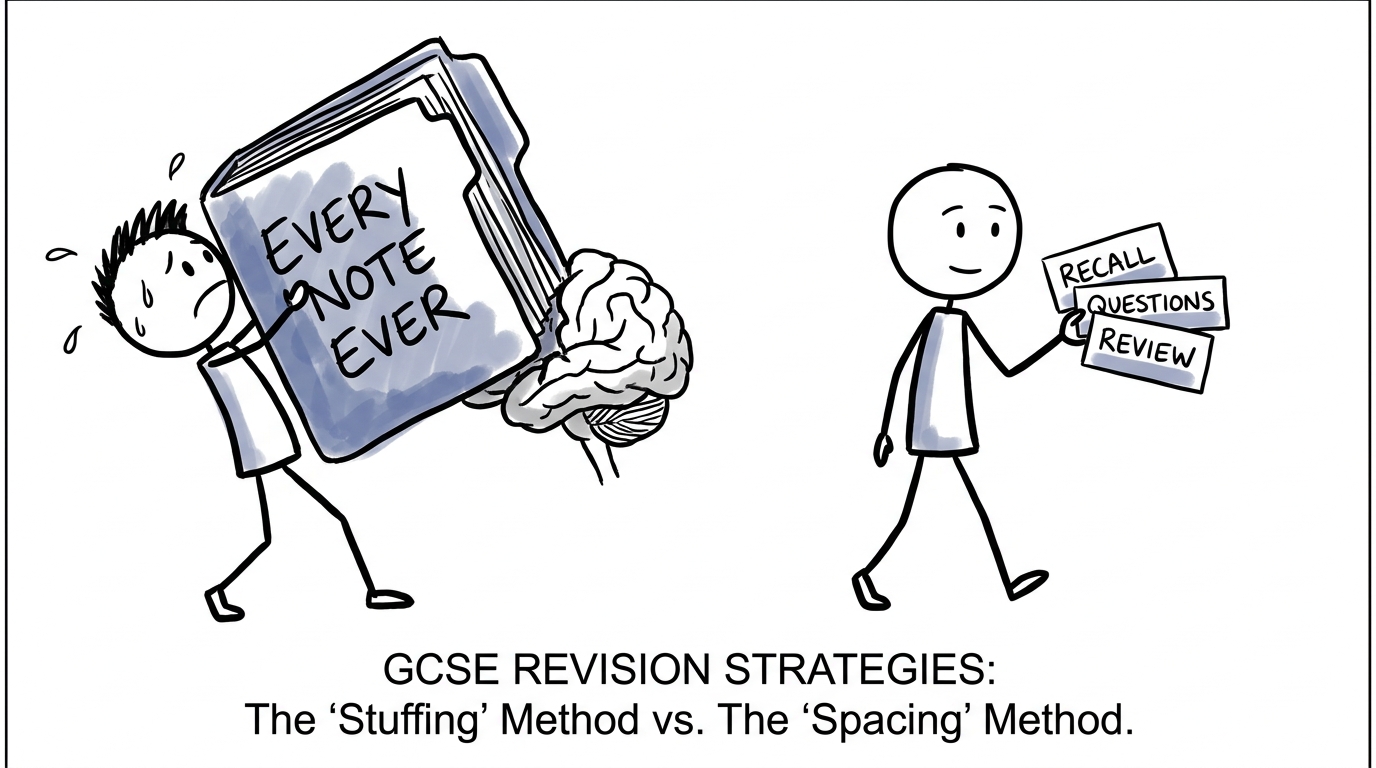 A student replacing an enormous folder of notes with three manageable revision cards
Milestone four: train extended responses
A longer Economics answer is not a memory dump. It is an argument built for a specific context.
Before writing, identify the command word, economic issue, context and number of marks. Then build connected reasoning: make a claim, apply it to the information given, explain the consequence and continue the chain where appropriate. For evaluation, consider conditions, affected groups, short-run and long-run effects, and the evidence supporting your final judgement.
Use mark schemes to understand acceptable reasoning, not to memorise model paragraphs. Examiners reward answers to the question that was asked. Practise planning responses briefly before writing them under timed conditions.
Milestone five: move into timed papers
In the final phase of your GCSE Economics retake revision, shift from isolated topics to complete papers.
AQA uses two papers worth 808080 marks each, with 111 hour 454545 minutes available for each. OCR also uses two 808080-mark papers, each lasting 111 hour 303030 minutes. Check your current specification and centre timetable before relying on any timings.
Use a weekly cycle:
- Sit a paper or substantial section under timed conditions.
- Mark it on the same day.
- Update your error log.
- Revise the two weakest areas.
- Answer fresh questions on those areas.
- Re-test them later without notes.
You can begin with AQA GCSE Economics past papers. OCR students can access papers and mark schemes through the OCR GCSE Economics resource page.
Common GCSE Economics resit mistakes
Revising before confirming the board
AQA and OCR cover overlapping economic ideas, but their paper structures differ. Confirm the qualification code before choosing resources.
Assuming the retake is in November
Economics is ordinarily examined in the summer series. Ask your centre for the next available sitting rather than building a plan around an assumed date.
Copying notes instead of producing answers
Neat notes can feel productive while concealing weak recall. Close the book, answer questions and then check what was missing.
Ignoring calculations and graphs
Quantitative skills form an explicit part of GCSE Economics. Practise calculations, data interpretation and accurate graph work throughout the plan.
Completing papers without reviewing them
A past paper becomes useful after it is marked. The improvement comes from identifying lost marks, correcting the cause and testing the same skill again.
Make the next attempt different
A resit works best when it becomes a controlled project rather than a reaction to Results Day. Confirm the administrative details, diagnose the previous attempt, rebuild weak topics and gradually move towards timed papers.
Start today with the MathsGenie GCSE Economics hub. Choose your exam board, use the free revision lessons and worksheets to repair gaps, then practise with past papers, mark schemes, predicted papers and mini tests. One result began the process. A better system can shape what happens next.











