

GCSE Economics Remark: When to Request One
GCSE economics remark guidance: learn how reviews of marking work, when to request one, grade risks, deadlines and the evidence to check first.
Results day can shrink two years of work into one uncomfortable question: what if the mark is wrong? If you are considering a GCSE economics remark, speak to your school’s exams officer quickly, check how far your total is from the next grade boundary and, where possible, ask a teacher to inspect your scripts. A review may be sensible when there is credible evidence of a marking error. It is not a reliable way to gain a few hopeful marks.
The official term is a review of marking, not a re-mark. Your mark can rise, remain unchanged or fall, so the decision should be based on evidence rather than disappointment alone.
Your results-day decision checklist
Before requesting a review, check each of these points:
- Confirm your exam board, component marks and overall mark.
- Compare the total with the correct boundary for your exam series.
- Ask how many marks are needed for the next grade.
- Find out whether your school can obtain your scripts.
- Ask an Economics teacher to identify possible marking errors.
- Consider which paper is most likely to contain missed credit.
- Check your school’s internal deadline and the current exam-board fee.
- Understand that your mark and grade can go down.
- Give written consent only when you understand the risk.
Start with MathsGenie’s AQA GCSE Economics grade boundaries, or use the wider GCSE grade boundaries hub if you need to confirm your board and subject.
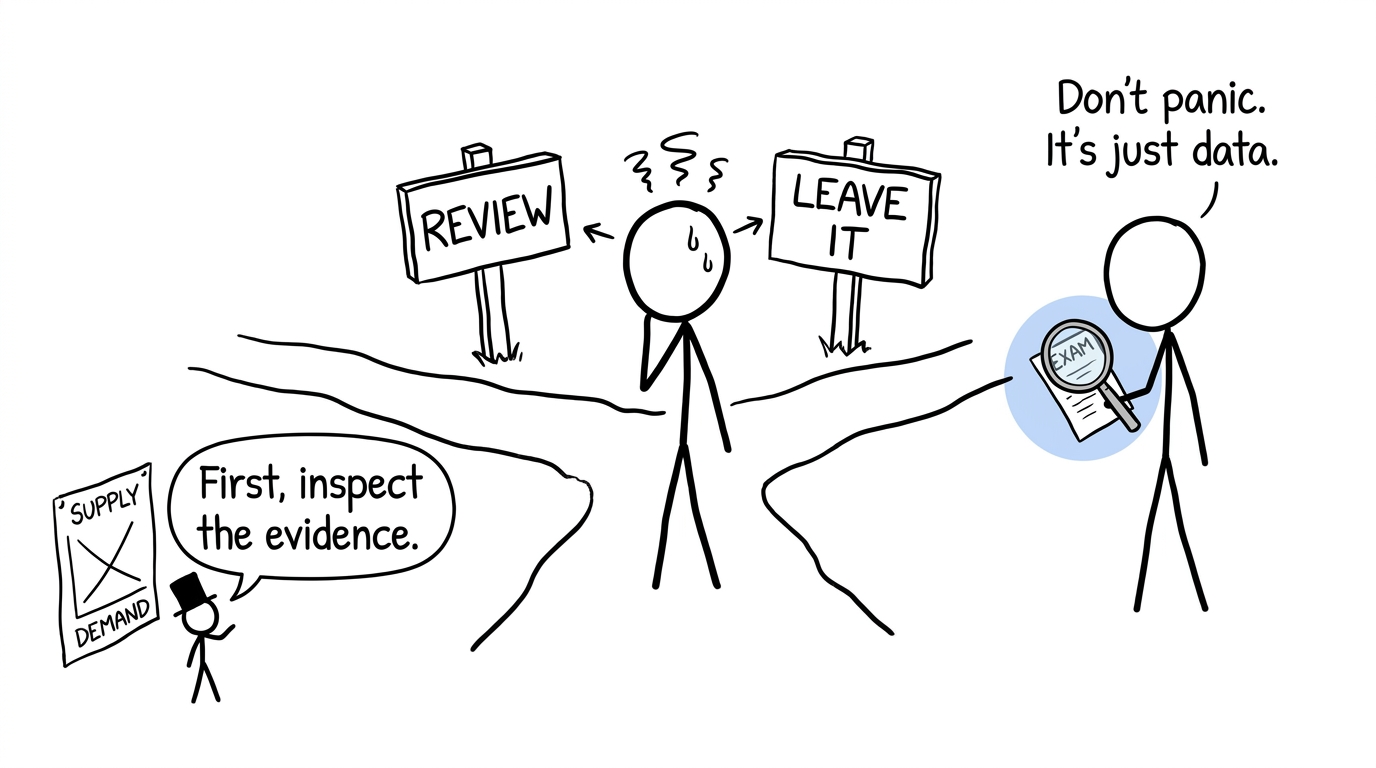 A student deciding whether to request a review of marking
How the GCSE Economics re-mark process works
Ask your school for the mark breakdown
Schools and colleges normally submit post-results requests for students. Private candidates may be able to approach their exam board directly, depending on their entry arrangements.
Ask the exams officer for your total and individual paper marks. For AQA GCSE Economics, Paper 1 and Paper 2 are each worth 808080 marks and contribute 50%50\%50% of the qualification, producing a total out of 160160160. You can confirm the assessment structure on the AQA GCSE Economics revision page.
Being one mark below a boundary does not prove that one mark was missed. It simply tells you how much the outcome would need to change.
Request access to your scripts
A script can turn a vague feeling into a decision grounded in evidence. Your teacher can compare your responses with the mark scheme and look for:
- an answer or page that appears unmarked;
- incorrect addition or recording of marks;
- valid economic analysis that may not have received reasonable credit;
- an extended response where the level awarded appears inconsistent with the answer;
- correct use of data, chains of reasoning or evaluation that may have been overlooked.
Economics contains both objective questions and responses requiring academic judgement. A reviewer does not simply give the answer a fresh mark because another examiner might have been slightly more generous. They check whether the original mark could reasonably have been awarded and correct identified marking errors.
Reviewing past AQA GCSE Economics papers and mark schemes can help you understand why two plausible answers do not automatically deserve identical credit.
Choose the right post-results service
A clerical re-check checks matters such as whether every response was marked and whether marks were totalled and recorded correctly.
A review of marking checks whether the mark scheme was applied correctly. A clerical check is included where it has not already been completed.
For summer 2026, JCQ’s published deadline for standard post-results requests is 24 September 2026. Schools usually set earlier internal deadlines, so do not wait until the JCQ date. Standard reviews are normally completed within 202020 calendar days of the exam board receiving the request. GCSE priority availability varies by board; government guidance states that Pearson currently offers a priority GCSE service, while all boards offer priority reviews for AS and A Level.
Fees are set by individual exam boards and schools differ in how they pass them on. Ask your exams officer for the current cost and refund policy rather than relying on figures from a previous year.
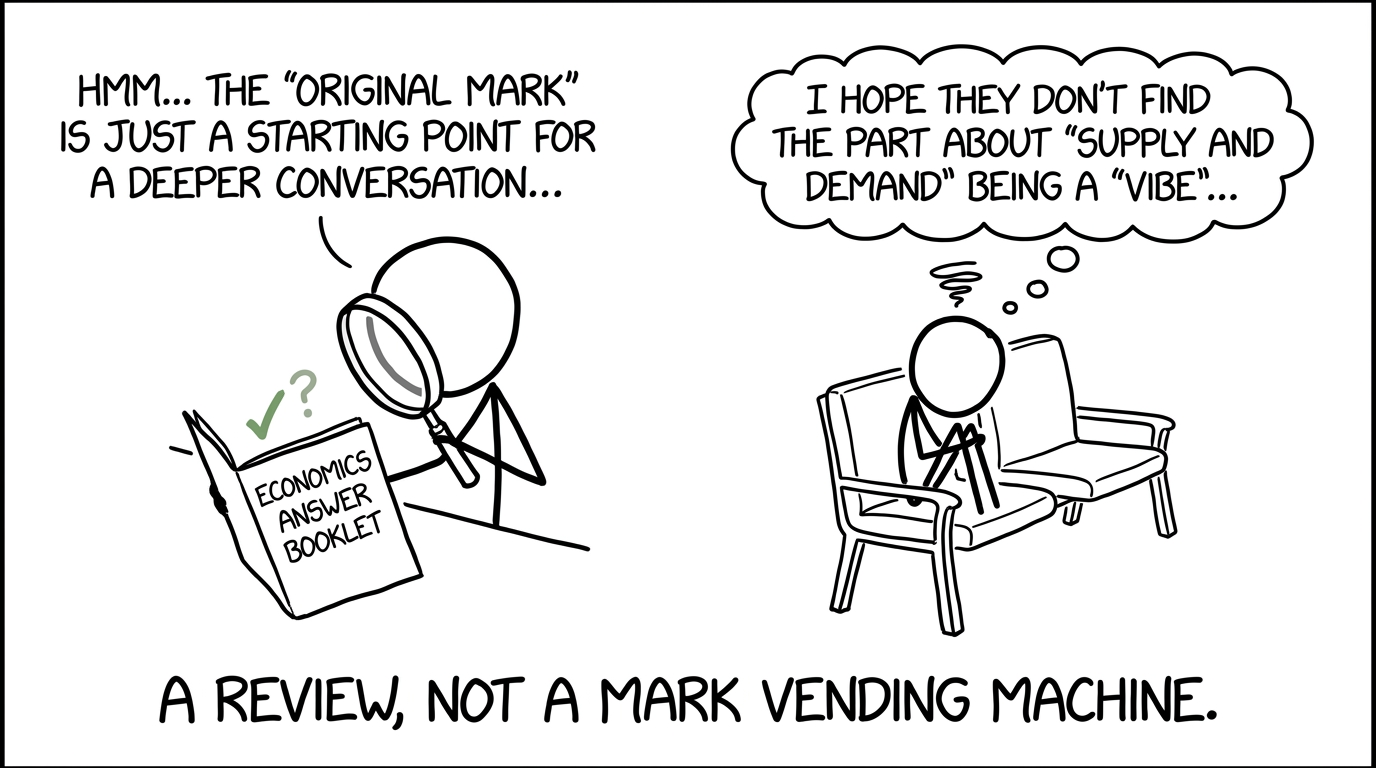 An examiner detective reviewing an Economics answer booklet
When requesting a review makes sense
A request is stronger when several factors align:
- your mark is close enough to the next boundary for an identified correction to matter;
- a teacher has inspected the script and found a defensible concern;
- the disputed credit is concentrated in one paper;
- the grade affects a sixth-form, college or subject-entry requirement;
- you accept the possibility that the result could fall.
Subject-specific judgement matters. Longer Economics answers often reward application, analysis and evaluation through levels-based marking. A teacher should examine the quality of the reasoning against the published descriptors, not merely conclude that the response “sounds good”.
Students taking OCR can use the OCR GCSE Economics revision hub to confirm course content and revisit the Economics calculations revision guide when interpreting where calculation marks were awarded.
When leaving the grade unchanged may be wiser
A review may not be worthwhile when the only reason is that your result feels lower than expected, the script closely matches the mark scheme, or you would need a large movement without identifiable errors.
Predicted grades and mock results are useful context, but they are not evidence that the live paper was marked incorrectly. The relevant evidence is what you wrote and whether the published marking criteria were applied reasonably.
Common mistakes when appealing a GCSE Economics grade
- Treating a review as a guaranteed second chance. The outcome can be higher, unchanged or lower.
- Requesting every paper automatically. Evidence may point towards one component only, and fees commonly apply per component.
- Looking only at the boundary. Proximity tells you what change is needed, not whether an error exists.
- Missing the school deadline. Your centre needs time to obtain consent and submit the request.
- Confusing a review with an appeal. An appeal normally follows a completed review and challenges whether the exam board applied its procedures or marking-error rules correctly.
- Ignoring written consent. JCQ requires consent after results are published because marks and grades can fall.
What happens after the outcome?
Your school will tell you whether the mark was raised, confirmed or lowered. If the centre believes the review itself was handled incorrectly, it can consider an appeal under the exam board’s procedures. An appeal is not simply another attempt to secure a more generous academic judgement.
Whatever the outcome, use it as evidence for what comes next. If you are continuing with Economics or preparing for GCSE maths, organise your practice through the MathsGenie revision planner. MathsGenie brings together free revision lessons, practice questions, past papers, predicted papers, mini tests, mark schemes and video solutions so that uncertainty becomes a clear next step.
Begin by checking the GCSE Economics grade boundaries, then contact your exams officer before your school’s deadline. A calm, evidence-led decision is far more useful than either blind optimism or immediate defeat.











