

GCSE Economics Half-Term Revision That Gets Done
GCSE economics half term revision made manageable: build a focused plan, practise exam skills, fix weak areas and still enjoy a proper break this week.
Half-term revision often begins with an ambitious timetable and ends with unopened notes beside a half-finished snack. The problem is rarely laziness. Usually, the task is simply too vague: “revise economics” gives you no clear place to begin and no satisfying moment when you can stop.
Effective GCSE economics half term revision is smaller and more deliberate. Choose a few weak areas, complete short closed-book sessions, answer genuine exam questions, and use the mark scheme to decide what to fix next. You do not need to surrender the whole holiday. You need several focused sessions with clear boundaries.
Your half-term revision checklist
A realistic plan should include:
- your exam board specification or topic list
- a quick audit of strong and weak topics
- between 444 and 666 focused revision sessions
- retrieval practice without notes
- exam questions and mark schemes
- at least one timed section
- planned rest and a definite finishing time
Economics also involves quantitative skills, including percentages, ratios, averages and interpreting graphs. If those calculations slow you down, use the free GCSE maths revision resources on MathsGenie alongside your economics materials.
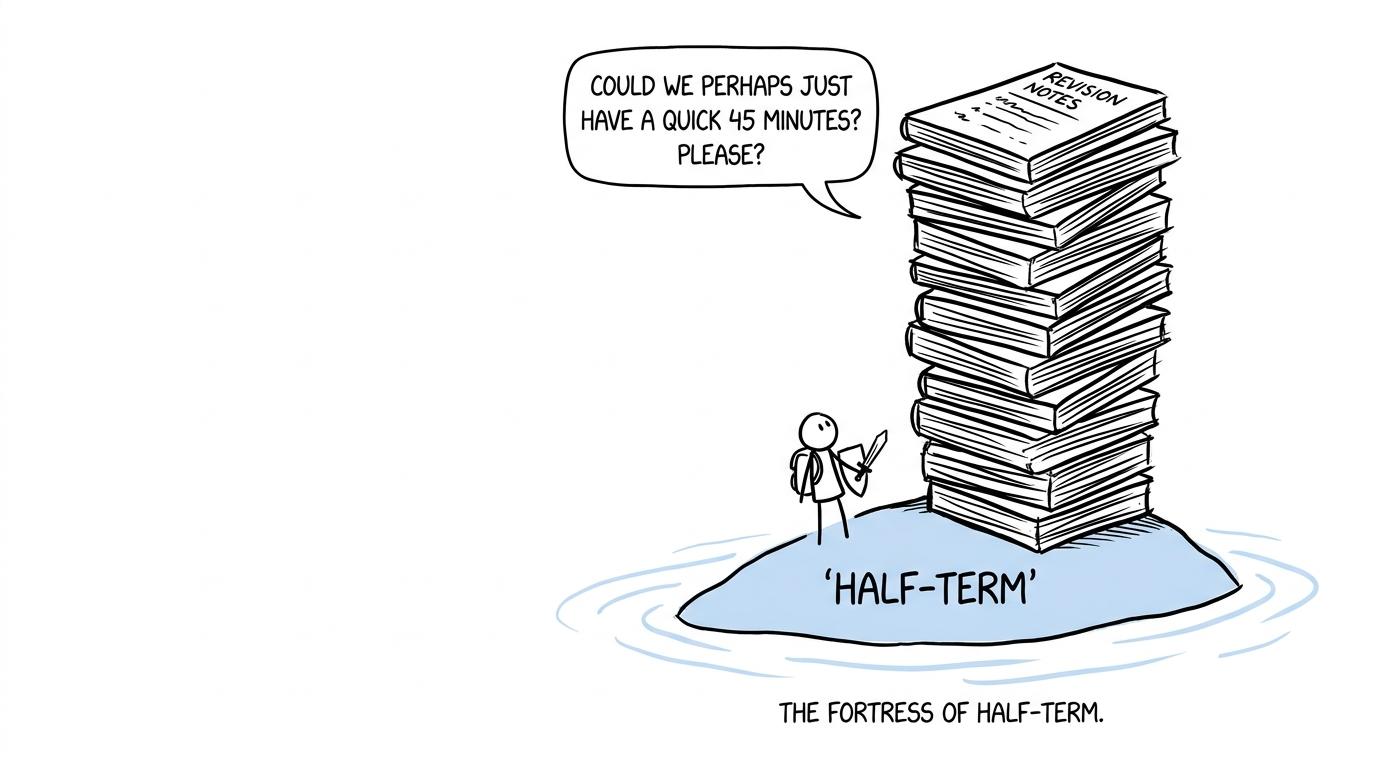 A revision pile negotiates for a small part of half-term
Start with an audit, not a timetable
A timetable feels productive because it creates order. But order is only useful when it is aimed at the right work.
Before scheduling anything, list the content required by your own AQA, Pearson Edexcel or OCR specification. Do not revise from a generic online checklist without comparing it with the specification used by your school. Topic wording and assessment structures differ between exam boards.
Sort each topic into three groups:
| Category | What it means | Your next action |
|---|---|---|
| Secure | You can explain it and answer questions without support | Brief retrieval later in the week |
| Uncertain | You recognise it but cannot explain it precisely | Review, recall and practise |
| Weak | You avoid it or repeatedly lose marks on it | Make it a priority session |
Be honest rather than dramatic. One forgotten definition does not make an entire unit weak. Equally, recognising a diagram is not the same as being able to analyse what it shows.
Select no more than 333 priority areas for the week. A short list creates movement. A list of every chapter creates guilt.
Build a plan that protects the break
Revision expands to fill whatever time you give it. If the plan says “economics on Tuesday”, the task can hang over the entire day. Give it a start, a finish and a measurable outcome instead.
A balanced half-term might contain 555 sessions of around 454545 to 606060 minutes. The precise arrangement should reflect your school timetable, other subjects and existing commitments.
| Session | Main purpose | Evidence of completion |
|---|---|---|
| First | Audit knowledge and choose priorities | A completed red, amber and green topic list |
| Second | Repair the weakest content area | A closed-book summary and corrected questions |
| Third | Practise data and quantitative skills | Marked calculations and graph questions |
| Fourth | Develop written exam responses | Answers checked against a mark scheme |
| Fifth | Complete a timed section and review it | An error list for the next revision cycle |
The important word is “evidence”. “Read chapter five” describes an activity. “Answer six questions and correct every error” describes an outcome.
Leave free days. Rest is not a reward for finishing an impossible plan; it is part of a sustainable one. When a session ends, close the materials and return to your break without carrying revision around mentally.
Use a repeatable revision session
Every session should have a simple rhythm. This removes the daily decision about how to revise.
Recall before reviewing
Spend the opening 555 to 101010 minutes writing what you remember without notes. You might recall definitions, label a diagram from memory, outline a chain of reasoning or list arguments on both sides of a policy.
Only then open your notes. The gaps become visible because you have tested your memory rather than your ability to recognise familiar words.
Repair one specific weakness
Review only what the recall attempt exposed. Rewrite an imprecise definition, reconstruct a missing link in an explanation, or check why a diagram shifts in a particular direction.
Avoid copying whole pages. A useful note changes what you can produce later without support.
Apply the knowledge
Complete questions on the same area. Economics rewards more than remembered content: you must select relevant knowledge, apply it to the context, develop analysis and, where required, reach a supported judgement.
Mark the work while your reasoning is still fresh. Treat the mark scheme as feedback, not a verdict. Record why marks were lost and write the correction you would make next time.
This answer-mark-fix cycle is also central to effective maths revision. MathsGenie organises skills by grade, from grade 111 revision topics and grade 222 revision topics through to more demanding grade 555 revision topics.
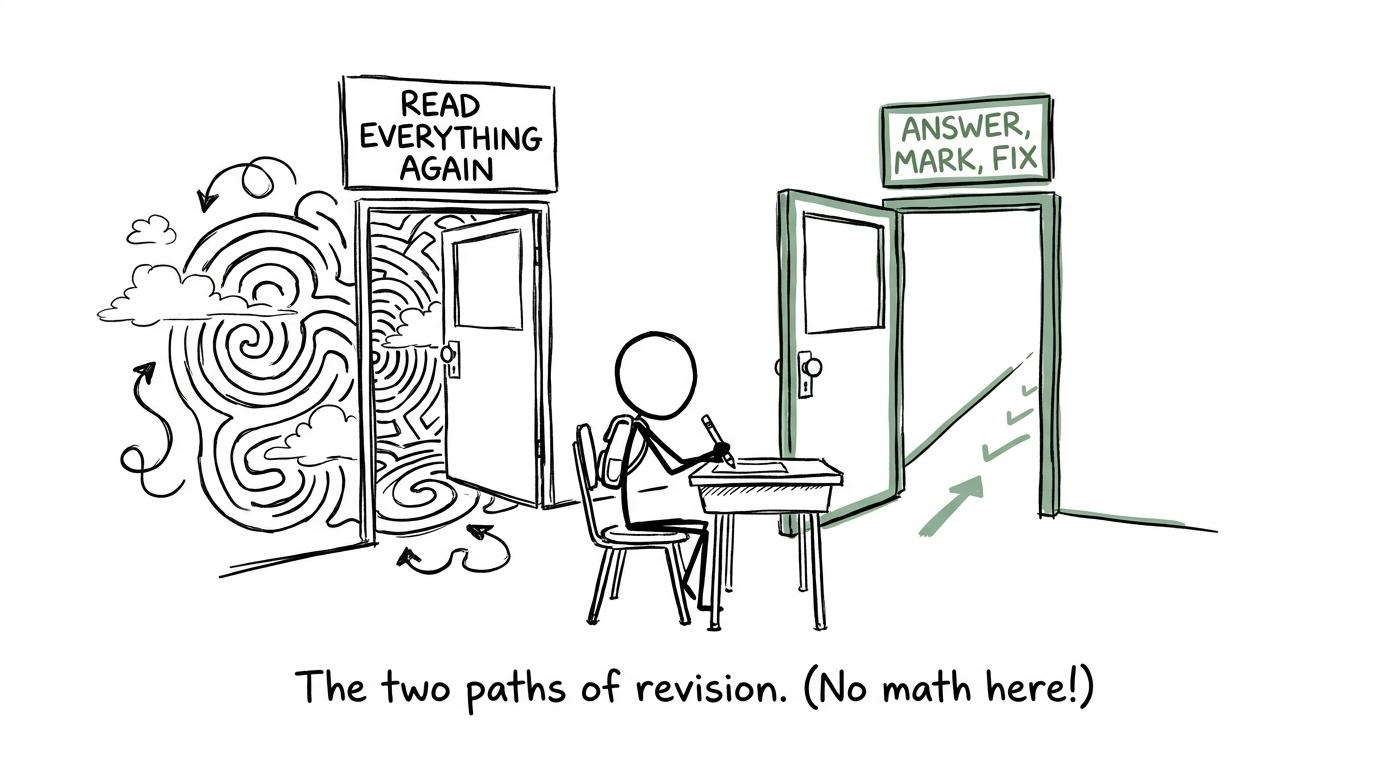 A student chooses the clear answer, mark and fix path
Divide economics into knowledge and exam skills
Economics revision becomes clearer when you separate what you know from what you can do with it.
Knowledge you can retrieve
This includes key terms, causes, consequences, diagrams, assumptions and relationships between economic ideas. Definitions must be precise enough to distinguish closely related concepts.
Do not create hundreds of flashcards automatically. Use cards selectively for material that benefits from short, repeated retrieval. More complex chains of reasoning are often better practised through plans, diagrams and exam responses.
Application to context
An answer should use the information provided rather than remaining generic. Before writing, identify relevant figures, market features, stakeholders or circumstances in the question. Then connect them to your economic reasoning.
Quoting the context without explaining its relevance is not enough. Ask: why does this detail change the likely effect?
Analysis and evaluation
Analysis develops a logical chain. Each sentence should make the next one easier to understand. Useful prompts include “this causes”, “therefore” and “as a result”, but the connection must be economically valid.
Evaluation is not a final sentence beginning with “however”. Consider the size of an effect, the time period, assumptions, affected groups and the conditions under which a conclusion might change. A judgement should follow from the analysis already presented.
Keep quantitative economics accurate
Economics papers can require calculations and interpretation of numerical information. Common foundations include fractions, percentages, ratios, averages and percentage change.
The percentage-change relationship is:
Percentage change=new value−original valueoriginal value×100\text{Percentage change} = \frac{\text{new value} - \text{original value}}{\text{original value}} \times 100Percentage change=original valuenew value−original value×100Revise the meaning as well as the procedure. Check whether the question asks for a change, a percentage of an amount or a percentage-point difference. These are not interchangeable.
Graphs require similar care. Read the title, axes, units and scale before interpreting movement. Explain what the data supports without claiming more than it shows. An association between two variables does not by itself prove that one caused the other.
If the arithmetic is the obstacle, revisit grade 333 maths skills and grade 444 maths revision. Strengthening the underlying calculation often releases marks across several subjects.
Make exam practice diagnostic
Completing a paper is useful only if it changes what you do afterwards. Begin with individual questions or sections while repairing weaknesses. Later, introduce timed practice to rehearse selection, pacing and writing under pressure.
After marking, classify each lost mark:
- knowledge gap: the required idea was missing
- application gap: the response did not use the context
- reasoning gap: the chain was incomplete or unsupported
- evaluation gap: the judgement lacked conditions or balance
- question-reading gap: the command word or data was misread
- time-management gap: the answer was unfinished or disproportionate
This turns a disappointing mark into a useful diagnosis. If calculations are repeatedly costing marks, MathsGenie's GCSE maths past papers provide further practice with mark schemes and video solutions. Nearer the exam, GCSE predicted papers can provide additional maths practice, but they should complement rather than replace past papers and full specification coverage.
What to do when motivation disappears
Do not wait to feel motivated. Reduce the starting cost.
Place the required paper, notes and pen on the desk before the session. Put your phone beyond reach. Set a timer for 101010 minutes and begin with one retrieval task. Once started, you can continue to the planned stopping point. If concentration remains poor, complete the minimum useful action, perhaps marking yesterday's questions, and restart properly at the next scheduled session.
Avoid extending a missed session into the evening as punishment. Move the highest-priority task and discard something less important. A plan should respond to reality rather than collapse because Wednesday went wrong.
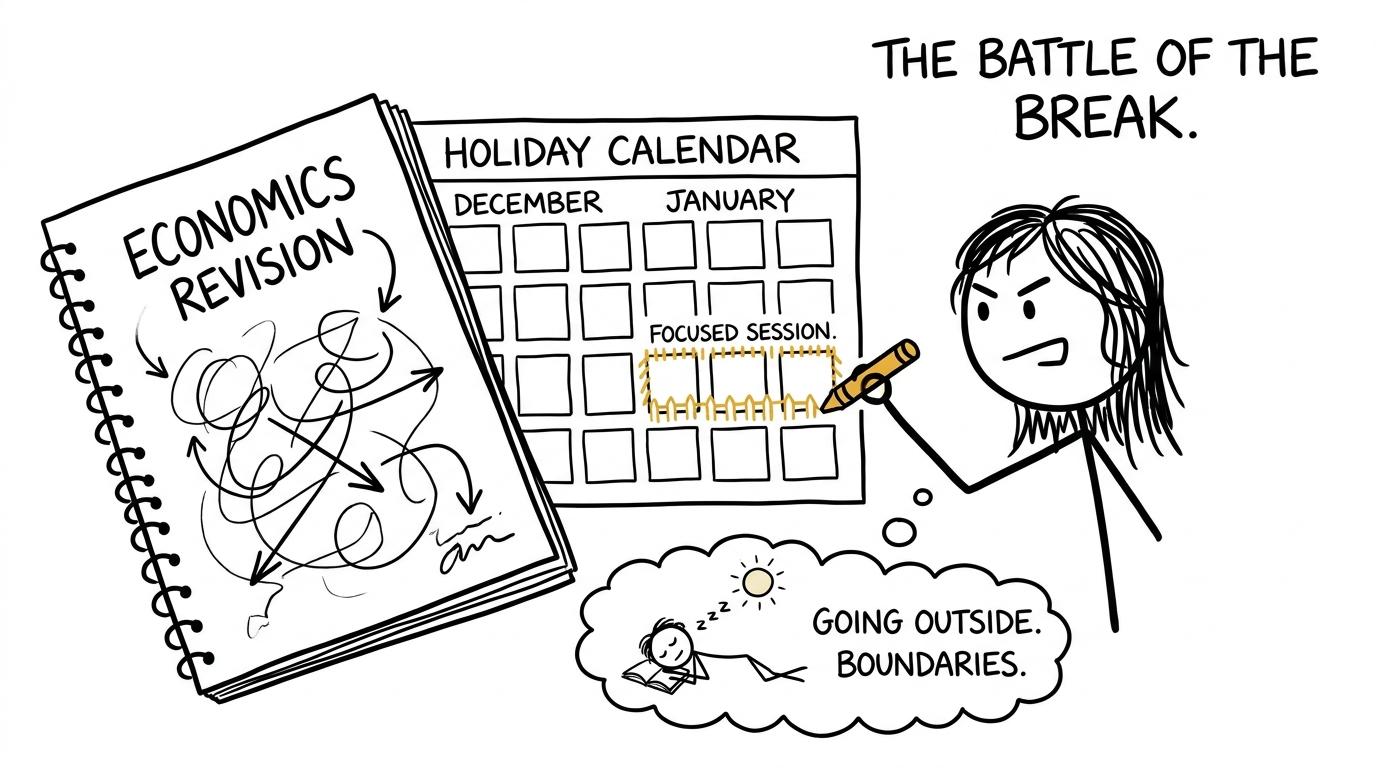 A student fences revision into a few sessions and keeps the holiday
Common half-term revision mistakes
Planning every hour
An overfilled timetable is fragile. One delay can make the whole week feel lost. Schedule focused blocks and leave space between them.
Reading instead of retrieving
Highlighting and rereading can make content feel familiar without making it recallable. Close the book and produce an answer before checking.
Avoiding difficult questions
Repeatedly completing comfortable tasks protects confidence but does not repair weaknesses. Spend most of your limited time where marks are currently being lost.
Writing essays without marking them
Unmarked practice can repeat the same problem. Use your exam board's mark schemes, indicative content and teacher guidance to understand what stronger responses require.
Ignoring command words
A calculation, explanation, analysis and evaluation demand different forms of response. Pause before writing and identify exactly what the question asks you to do.
Sacrificing the entire break
Long, unfocused days create fatigue without guaranteeing useful output. Revision should have boundaries. A completed 505050-minute session is better than a day spent feeling that you ought to begin.
Finish half-term with a smaller next step
The purpose of half-term is not to become perfect at economics. It is to return to school knowing more clearly what you understand, what still needs work and what action comes next.
On the final day, look at your corrections and choose the first task for the following week. That small decision preserves momentum without turning the holiday into an endless revision season.
For the mathematical skills supporting economics and your GCSE maths exams, make MathsGenie your next stop. Choose a targeted GCSE revision lesson, complete the practice questions or mini tests, and then use past papers, predicted papers, mark schemes and video solutions to close the gap between recognition and confident performance. Start with one session. Finish it properly. Then enjoy the part of half-term you deliberately protected.











