

GCSE Economics Grade and Sixth Form Entry
GCSE economics grade sixth form entry explained: learn when your result matters, what admissions teams prioritise and how to strengthen your application.
A single grade can feel strangely powerful when you are waiting for GCSE results. You may be wondering whether one disappointing result can quietly close a door before you reach it.
The GCSE economics grade sixth form entry question has a reassuring short answer: most sixth forms and colleges consider your overall GCSE profile alongside their general and subject-specific requirements. Your Economics grade may matter if you want to take A Level Economics, particularly where the provider names a required grade. However, GCSE Maths and English grades, your wider results and the precise course criteria often carry more weight.
Every institution sets its own entry requirements, so its current prospectus or admissions page is the final authority. Do not rely on a friend's offer, an old screenshot or a requirement published for a previous admissions year.
The quick admissions checklist
Before worrying about your Economics result, check these five things:
- the provider's general entry threshold for its sixth form or college programmes;
- the subject-specific requirement for A Level Economics;
- any separate GCSE Maths or English Language requirement;
- whether applicants who did not study GCSE Economics can still apply;
- what happens if a result is one grade below the published requirement.
That final question should go directly to the admissions team. Some decisions depend on capacity, the complete grade profile and the provider's published policy. There is no universal national rule guaranteeing flexibility.
 A student choosing between several GCSE keys at an admissions door
How much does your GCSE Economics grade actually matter?
Its weight usually sits on a spectrum rather than operating as a simple pass-or-fail switch.
It matters most when Economics has a named requirement
If a sixth form states that A Level Economics applicants need a particular GCSE Economics grade, your result is directly relevant. Meeting the requirement gives the admissions team clear evidence that you have handled concepts such as markets, policy choices, data and extended written evaluation.
Read the wording carefully. A prospectus might describe a firm requirement, a recommended grade or an alternative involving GCSE Maths or another essay-based subject. Those phrases are not interchangeable.
If your chosen institution requires grade 666, for example, grade 555 does not automatically mean rejection, but nor should you assume the difference will be ignored. Ask the institution how it applies the stated criterion.
It matters less when GCSE Economics was not available
Economics is not offered as a GCSE by every school. Consequently, many A Level courses are designed to accept students who have never studied the subject before. Where that is the case, admissions teams commonly look for evidence elsewhere in your results.
Your GCSE Maths result can indicate confidence with numerical information. English Language and essay-based subjects can indicate that you can explain, analyse and evaluate. The exact combination varies, which is why the current course page matters more than general advice online.
A lower Economics grade may therefore be only one part of the picture. It is rarely sensible to treat it as though it exists in isolation.
Your overall GCSE profile can carry substantial weight
Sixth forms often publish a general entry rule as well as requirements for individual subjects. An applicant may need a particular number of GCSEs within stated grade ranges before subject choices are considered.
This means an excellent Economics grade cannot necessarily compensate for missing the general threshold. The reverse can also be true: a strong overall profile may support your application when the Economics grade is less impressive, although it cannot be assumed to override a firm subject requirement.
Think of admissions as a set of gates. The overall GCSE threshold may be the first gate; the course requirement may be the second. Your Economics result is important only to the extent described by that institution's rules.
Why GCSE Maths may matter for A Level Economics
Economics combines written reasoning with quantitative interpretation. Students may need to understand percentages, ratios, averages, index numbers, graphs and changes in economic variables. They must also decide what the numbers do, and do not, prove.
That is why some providers specify a GCSE Maths grade for Economics, either instead of or alongside a GCSE Economics requirement. A strong Maths result can reassure a department that you are prepared for the quantitative side of the course.
If Maths is part of your offer, begin with the Maths Genie GCSE revision programme. Its topics are organised by grade, helping you identify the skills most likely to move your result rather than revising everything with equal intensity.
Graphs deserve particular attention. An Economics student does not merely draw a line; they interpret movement, compare rates and connect evidence to an argument. Algebra, proportional reasoning and percentages also support the manipulation of economic data.
This does not mean A Level Economics is simply another maths course. Clear writing, evaluation and subject knowledge remain essential. It means that stronger numerical foundations leave more attention available for the economic reasoning itself.
What if your Economics grade is lower than expected?
First, separate disappointment from information. A grade below your target tells you something about one assessment outcome. It does not, by itself, tell you the admissions decision.
Take these steps:
- compare the result with the exact wording of your offer;
- check whether the requirement concerns Economics, Maths, English or your overall profile;
- contact admissions promptly if you have narrowly missed a condition;
- ask whether another subject combination or course level is available;
- speak to your school about reviewing the marked paper if there is a specific reason to question the result.
Avoid promising yourself that an exception will be made. Equally, avoid rejecting yourself before the sixth form has considered the application. Admissions decisions belong to the institution, not to the most pessimistic interpretation circulating in a group chat.
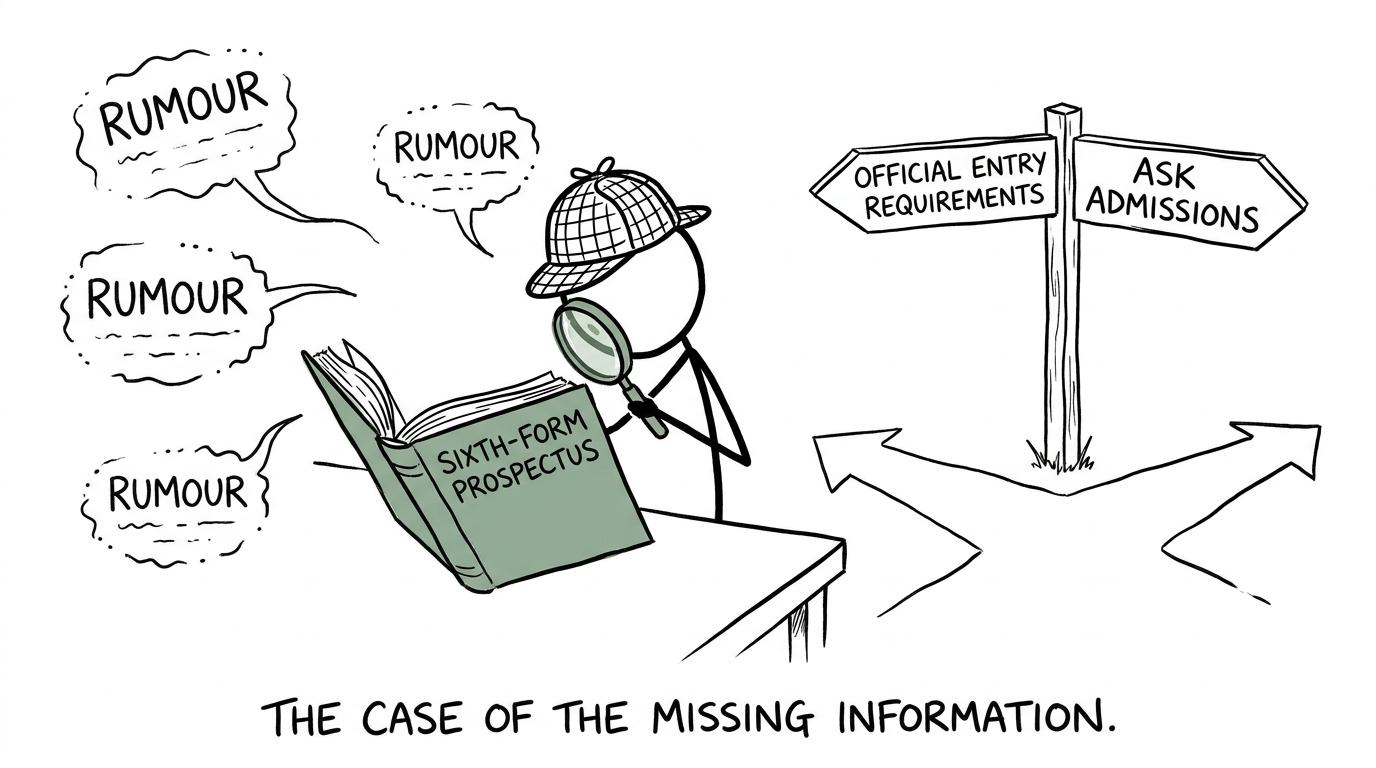 A student detective choosing official requirements over rumours
Should you prioritise Economics or Maths revision?
The sensible answer depends on your entry conditions. Revision works best when it follows consequences rather than anxiety.
If A Level Economics requires a particular Maths grade, improving Maths may protect more of your options. Maths is also commonly relevant to other post-161616 routes, so progress there can have broad value. If your preferred provider explicitly requires a GCSE Economics grade that is currently at risk, Economics deserves targeted time too.
Create three categories:
- Essential: grades explicitly required for entry or your chosen subjects;
- Important: subjects affecting your overall GCSE profile;
- Maintain: subjects currently secure but still needing regular retrieval practice.
This is prioritisation, not permission to abandon a subject. Moving every revision hour towards the grade that frightens you most can create a new problem elsewhere.
MathsGenie's GCSE exam papers and mark schemes help you test whether revision survives contact with a full paper. The GCSE predicted papers offer further exam-style practice, while video solutions help reveal whether a lost mark came from missing knowledge, an inaccurate method or poor presentation.
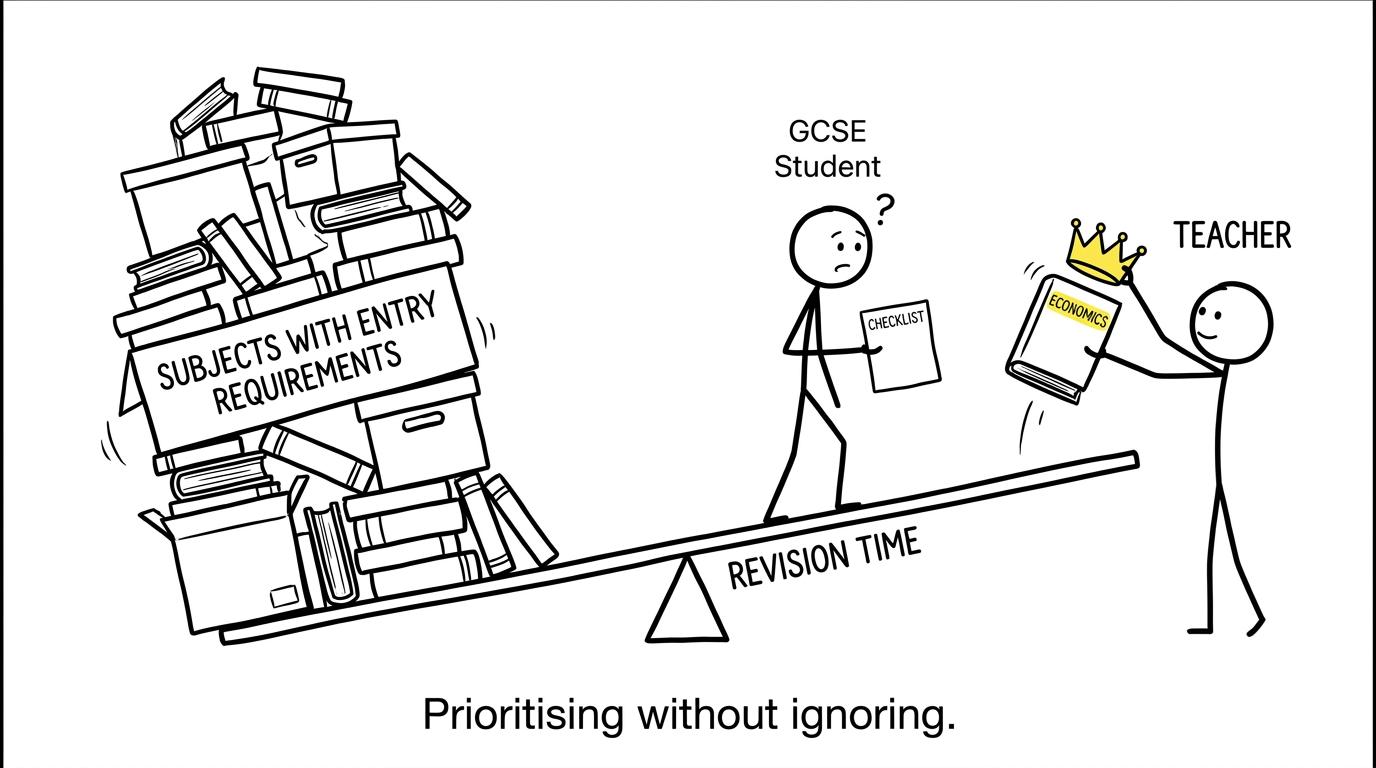 A student balancing revision priorities while an Economics textbook wears a crown
Building evidence that you are ready for sixth form
Grades are central because they are standardised evidence, but readiness is also visible in how you respond before results day.
For Maths, avoid mistaking recognition for mastery. Watching a solution can make a method feel familiar without proving that you can reproduce it independently. Use this cycle:
- review a focused revision lesson;
- answer practice questions without notes;
- mark the work carefully;
- record the reason for each lost mark;
- return to the same skill after a gap;
- finish with timed paper practice.
MathsGenie's free GCSE maths resources bring revision lessons, practice questions, mini tests, mark schemes and video explanations into one routine. If you are already looking beyond GCSE, the A Level Maths revision resources also show how much more independent post-161616 learning becomes.
The goal is not to perform readiness for an admissions form. It is to become ready: able to retrieve knowledge, work accurately under time pressure and learn from a mark scheme rather than merely count marks.
Common mistakes when judging sixth form entry
Assuming every provider uses the same grades
Entry requirements can differ between school sixth forms, sixth-form colleges and further education colleges. They can also change between admissions cycles. Always check each provider separately.
Treating a recommended grade as a guaranteed rule
A recommendation may signal the level at which students are expected to cope, but its admissions status depends on the institution's wording. Conversely, a clearly stated minimum should not be treated as optional.
Focusing only on GCSE Economics
For A Level Economics, Maths, English and the overall GCSE profile may be just as important or more important. Read the complete entry section, not only the subject title.
Assuming a high Economics grade guarantees a place
Meeting academic criteria does not necessarily guarantee admission. Providers may also be constrained by course capacity and their published admissions arrangements.
Revising from solutions instead of answering questions
Understanding someone else's method is not the same as producing it under exam conditions. Use GCSE past papers to practise selecting methods independently and interpreting mark schemes accurately.
Make the grade part of a wider plan
Your GCSE Economics grade can matter for sixth form entry, particularly when you are applying for A Level Economics and the provider names it as a condition. Yet it is usually considered alongside subject-specific Maths or English criteria, the general entry threshold and your wider GCSE profile.
The next action is simple: open the current prospectus for every sixth form or college on your list and write down the requirements exactly. If anything is unclear, ask admissions rather than guessing.
Then turn the answer into a revision plan. Use Maths Genie GCSE revision for focused lessons and practice questions, followed by predicted GCSE maths papers, past papers, mark schemes and video solutions. A requirement feels less intimidating once it becomes a series of skills you can practise today.











