GCSE Economics Exam Board Differences Explained
GCSE economics exam board differences explained: compare AQA and OCR, paper formats, content, difficulty and the smartest way to revise for your course.
A rumour can travel quickly through a GCSE classroom: one exam board is easier, another is harsher, and somebody at another school has somehow been given the better course. Yet the truth about GCSE economics exam board differences is less dramatic and more useful.
For the current GCSE Economics qualifications in England, most students encounter AQA or OCR. Their papers differ in length, organisation and question style, but neither board is reliably easier. Both must assess nationally defined subject content and assessment objectives. The best board for you is therefore the one you have been taught for, and the one whose specification, command words and mark schemes you understand.
This guide explains what genuinely changes between boards, whether those differences affect difficulty, and how to prepare without wasting revision time.
GCSE Economics exam board checklist
Before comparing courses, establish exactly what you are sitting:
- Find the exam board and qualification code on your school timetable or course documents.
- Download the current specification from the board's official website.
- Check the titles, duration and content of both papers.
- Identify the command words used in longer questions.
- Practise with papers and mark schemes from your board.
- Confirm arrangements with your teacher if any information appears inconsistent.
This matters because Pearson Edexcel offers an International GCSE in Economics, but that is not the same qualification as a domestic GCSE in England. Eduqas does not currently offer the standard GCSE Economics course either. A student who says they are doing “Edexcel Economics” may therefore be taking an International GCSE or referring imprecisely to another qualification.
Qualification availability can change, so always trust your current entry code rather than an old revision guide or an online discussion.
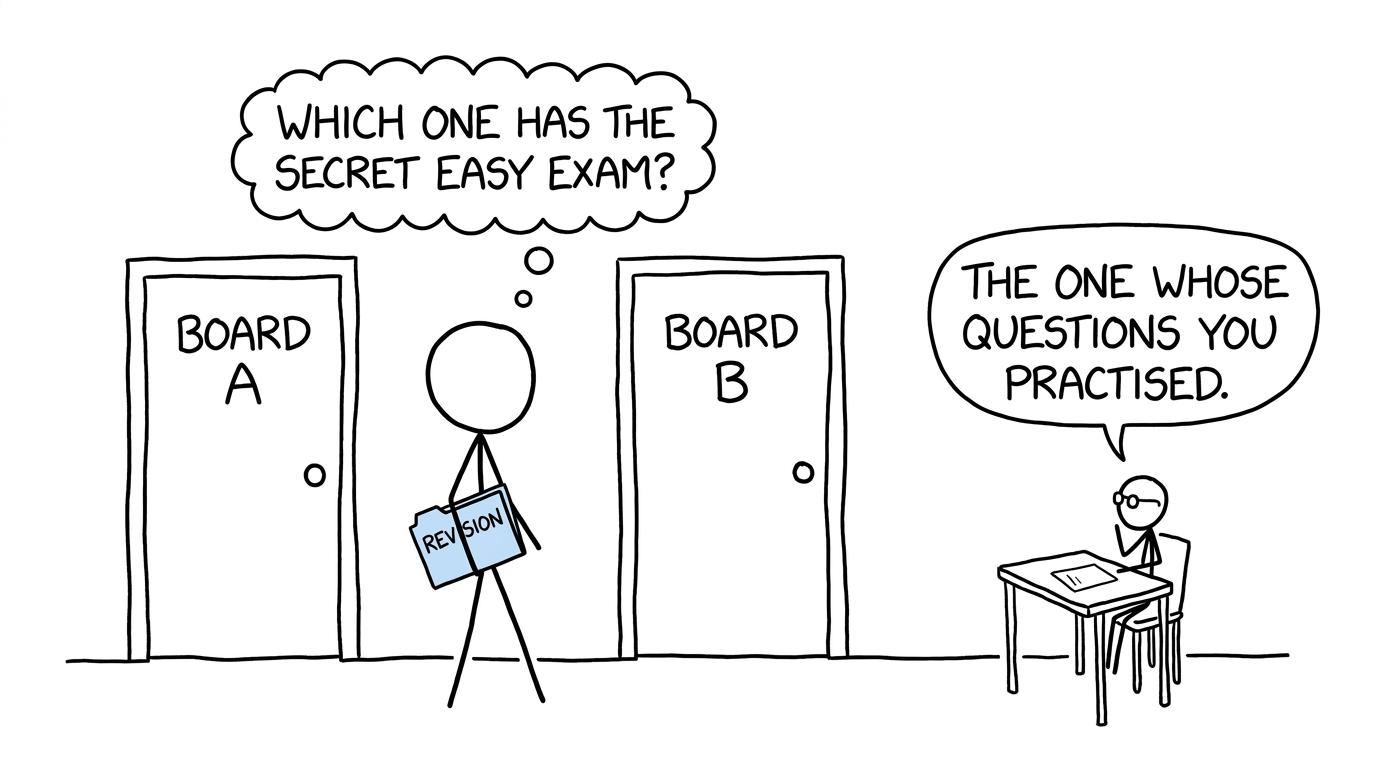 A student searches for the secret easy exam board
AQA and OCR GCSE Economics compared
The broad economic ideas overlap considerably. Both boards cover markets, firms, government policy, national economic performance and the international economy. The clearest differences are found in how this knowledge is divided between papers.
| Feature | AQA GCSE Economics | OCR GCSE Economics |
|---|---|---|
| Qualification code | 813681368136 | J205205205 |
| Number of papers | 222 | 222 |
| Duration | 111 hour 454545 minutes each | 111 hour 303030 minutes each |
| Marks | 808080 per paper | 808080 per paper |
| Weighting | 50%50\%50% per paper | 50%50\%50% per paper |
| Broad organisation | How Markets Work; How the Economy Works | Introduction to Economics; National and International Economics |
| Assessment | Linear, with both papers taken at the end of the course | Linear, with both papers taken at the end of the course |
| Tiers | No foundation or higher tier | No foundation or higher tier |
AQA Paper 111 concentrates on economic foundations and markets. This includes resource allocation, price determination, production, costs, revenue, profit, competition and market failure. Paper 222 moves towards the national economy, government objectives and policies, international trade, globalisation, money and financial markets.
OCR Paper 111 introduces the main economic groups, factors of production, markets and money. Paper 222 focuses on economic objectives, government policy, international trade and the global economy.
The content is not identical, and topics may be grouped or framed differently. That is why a paper from another board can be useful for additional thinking but should not replace your own board's materials.
Does one GCSE Economics exam board make the exam easier?
Not in a dependable sense.
One paper may feel friendlier to a particular student. Someone who writes quickly might prefer a paper with more time for extended responses. Another student may feel comfortable with OCR's wording after seeing it repeatedly in lessons. These are differences in familiarity and personal fit, not proof that one board awards easier grades.
GCSE qualifications are regulated so that boards assess comparable standards. Exam boards also use awarding processes and grade boundaries to account for the demand of a particular paper. Boundaries are not fixed promises made years in advance; they are set after the evidence from that examination series has been considered.
That does not mean every AQA and OCR paper will feel exactly equal. An individual paper can play more strongly to your preferred topics, and unexpected wording can make a familiar idea seem difficult. But there is no sound revision strategy built around the belief that one board always produces easier exams.
The practical conclusion is reassuring: your result depends far more on accurate knowledge, application, analysis, evaluation and exam technique than on the logo printed on the front.
Where the differences can affect your experience
Paper timing and writing pace
AQA allows 105105105 minutes for 808080 marks, while OCR allows 909090 minutes for 808080 marks. It is tempting to divide the time mechanically by the marks, but not every mark demands the same kind of work. Reading source material, interpreting data and planning an extended answer all consume time.
Use complete timed papers to discover whether your pace is realistic. If you always run out of time, the answer is not simply to write faster. You may need to make shorter plans, answer the precise command word or stop repeating an argument once it has earned its marks.
The organisation of topics
A board's paper structure affects how you schedule revision. With AQA, markets and the wider economy are clearly separated across the two papers. OCR uses a different thematic division.
Build your checklist from the specification rather than from broad headings such as “microeconomics” and “macroeconomics”. Broad labels can hide a small specification point that has never reached your revision list.
Question wording and mark schemes
Boards can express similar demands through different house styles. Words such as identify, explain, analyse, evaluate and justify do different jobs. The mark scheme also reveals whether an extended response rewards linked reasoning, evidence from the context, balanced judgement or a combination of these.
This is where board-specific practice matters most. Knowing economics is essential, but an examination also tests whether you can communicate that knowledge in the requested form.
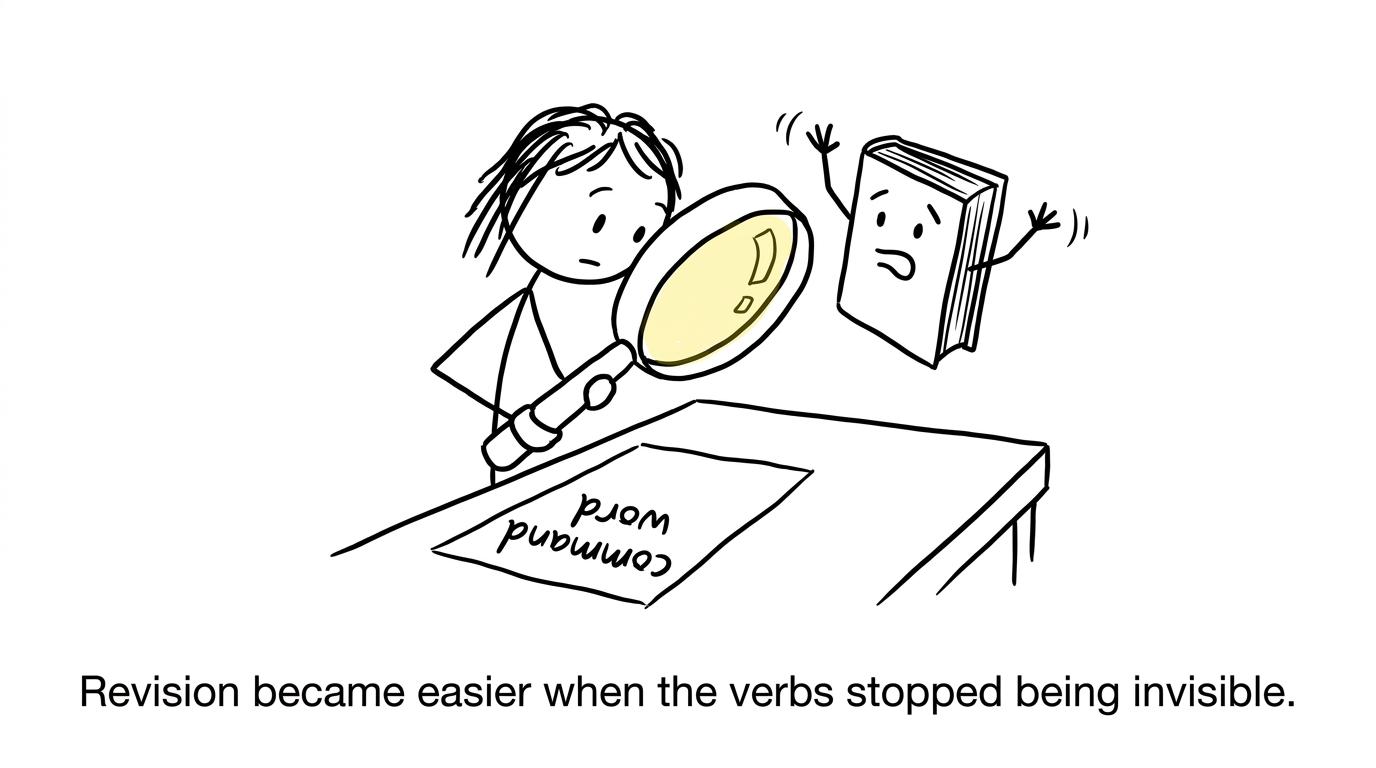 A student finally notices the command word
The maths inside GCSE Economics
Economics is an essay-based subject with a quantitative side. Students may need to work with percentages, ratios, averages, tables, index numbers and graphs. They must also interpret changes rather than merely calculate them.
A percentage change is found using:
percentage change=new value−original valueoriginal value×100\text{percentage change}=\frac{\text{new value}-\text{original value}}{\text{original value}}\times 100percentage change=original valuenew value−original value×100The calculation is only part of an economics answer. You may then need to explain what the change means for consumers, firms, workers or government objectives.
If the arithmetic feels less secure than the economics, use the free GCSE maths revision lessons on MathsGenie to repair the underlying skill. Topic videos, practice questions and solutions make it easier to isolate weaknesses before they cost marks in a data-response question.
You can also use GCSE maths exam papers to practise extracting information under time pressure. Although these are maths papers rather than Economics papers, the habits transfer: read units, show working, estimate whether an answer is reasonable and avoid rounding too early.
How to revise for your actual exam board
Begin with the specification
Treat the specification as the boundary of the course. Turn each content statement into a question you could answer without notes. Mark topics as secure, developing or unstarted, then revise the gaps rather than repeatedly reviewing your favourite chapter.
This is the same disciplined approach behind MathsGenie's grade-based GCSE revision resources. A long course becomes less intimidating when it is converted into small, visible tasks.
Use past papers as diagnostic tools
Do not save every paper for the final week. Complete individual questions while learning, then reserve some full papers for timed practice. Mark your answers carefully and record why marks were lost.
A useful error log separates problems into categories:
- missing economic knowledge;
- weak use of the source or data;
- incorrect interpretation of a command word;
- unsupported chains of reasoning;
- an evaluation without a final judgement;
- inaccurate calculation or graph reading;
- poor timing.
Maths students can apply the same process through MathsGenie's GCSE past-paper collection, which provides papers alongside mark schemes and video solutions. The important habit is comparison: what did the mark scheme reward that your response did not yet show?
Alternate knowledge with retrieval
Reading can create a comforting sense of recognition. Exams require recall. After reviewing a topic, close the notes and reconstruct the key definitions, diagram logic, causes, consequences and possible evaluation points.
Then answer a board-specific question. Revision should move repeatedly between knowing an idea and using it.
Build a realistic revision timetable
A sensible plan includes economics content, written practice and quantitative skills. It also leaves enough time to review mistakes. MathsGenie's free revision planning tools can help organise GCSE maths alongside other subjects, preventing one demanding course from absorbing every available evening.
Students continuing with maths after GCSE can explore the A Level maths revision hub and A Level past papers. Strong percentages, graphs and statistical interpretation remain valuable well beyond one examination series.
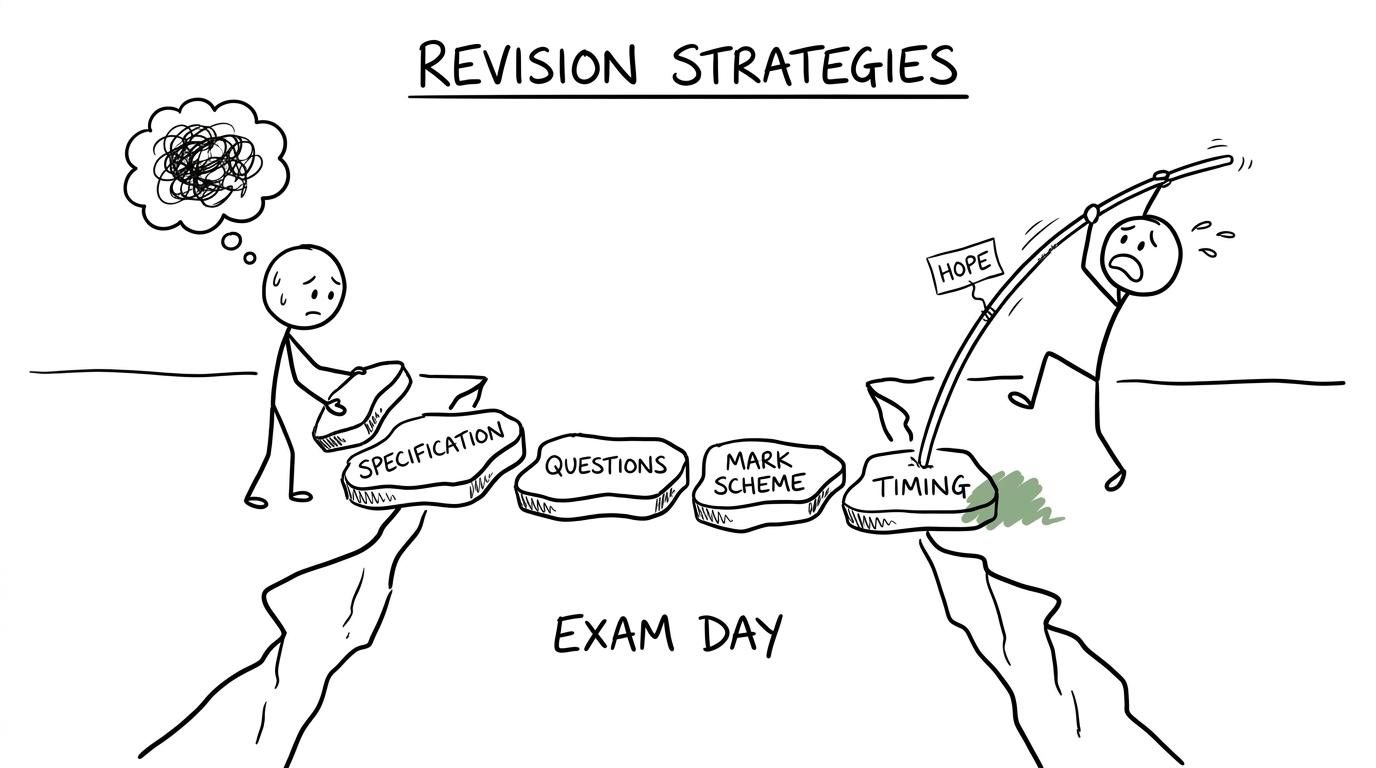 A revision bridge built from specification, questions and mark schemes
Common mistakes when comparing exam boards
Revising from the wrong specification
A polished video or textbook is not automatically relevant. Check the board, qualification and current specification before committing time to it. This is particularly important when International GCSE and domestic GCSE resources appear in the same search results.
Assuming a longer paper must be easier
More minutes do not guarantee easier questions or more generous marking. Paper design, reading demands and response length all matter. Practise under the timing printed on your own paper.
Using another board's mark scheme as a template
Cross-board questions can broaden your understanding, but terminology and marking approaches may differ. Learn your own board's expectations first.
Memorising model essays
A memorised response often answers a question that was not asked. Build flexible chains of reasoning instead: make a relevant claim, explain the mechanism, apply it to the context and evaluate the conditions affecting the conclusion.
Blaming the board instead of diagnosing the error
“The paper was strange” feels easier than identifying a weak definition or incomplete judgement. But only the second explanation improves your next answer. Revision advances when vague frustration becomes a specific action.
The exam board matters, but not in the way rumours suggest
Your board matters because it determines the specification, paper structure, wording and materials you should practise. It does not provide a dependable shortcut to an easier grade.
Find your qualification code. Learn the exact content. Practise the board's questions under its timing, and use its mark schemes to sharpen your reasoning. Then strengthen the quantitative foundation with MathsGenie's free maths revision, including lessons, mini tests, practice questions, past papers, mark schemes and video solutions. Near the maths examination series, MathsGenie predicted papers can add focused practice for your GCSE maths preparation.
The name on an exam paper is beyond your control. Familiarity, precision and the quality of your practice are not.