GCSE Economics and GCSE Business Together?
GCSE economics and GCSE business together: find out if schools allow both, where content overlaps, how workloads differ, and whether both suit you.
Choosing GCSE options can feel like being asked to predict the interests of your future self. Economics sounds useful. Business sounds practical. Then someone tells you they are "basically the same", while someone else insists they are completely different.
The short answer is that taking GCSE economics and GCSE business together is realistic, and they are separate qualifications. However, your school decides which subjects it offers and how its option blocks work. Even when both courses are available, timetable clashes or school-specific option rules may prevent the combination.
There is genuine overlap, particularly around markets, costs, revenue, profit and business growth. But the viewpoint changes. Business examines decisions inside organisations; economics looks more broadly at how consumers, firms, governments and economies respond to incentives and scarcity.
The quick decision checklist
Before selecting both subjects, check:
- whether your school actually offers both GCSEs;
- whether they appear in different option blocks;
- which exam board and specification your school follows;
- how much written analysis and extended evaluation each course requires;
- whether taking both would reduce the breadth of your other options;
- whether you are interested in both perspectives, rather than simply expecting an easy second qualification;
- how the workload will sit beside English, science and GCSE maths revision.
The most important step is practical: ask your options lead or subject teachers whether you can be entered for both. National specifications define the qualifications, but individual schools build the timetable.
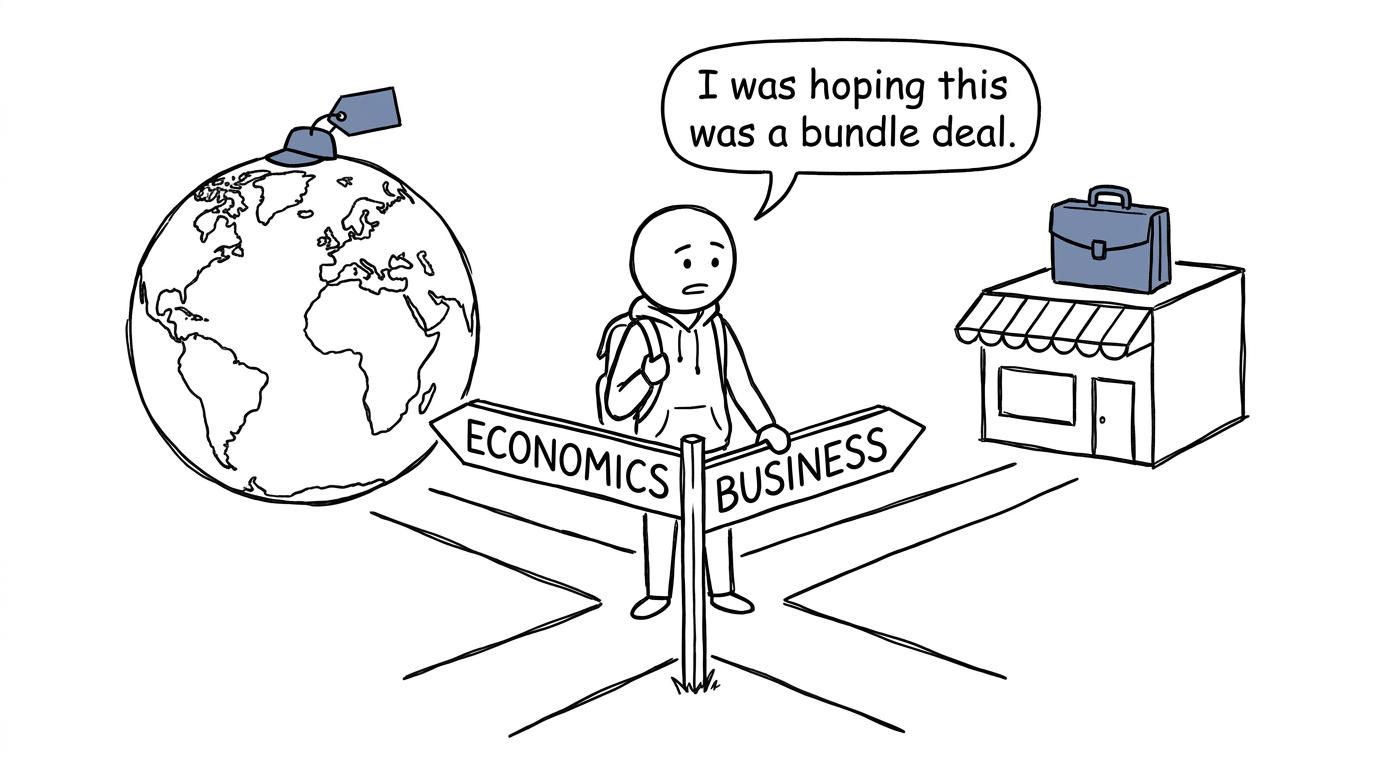 A student attempts to take the economics and business paths at once
Can you take GCSE Economics and GCSE Business at the same time?
Yes, in principle. GCSE Economics and GCSE Business are distinct subjects with their own specifications, examinations and grades. There is no universal rule saying that a student cannot study both.
In practice, availability is the real constraint. Not every school offers GCSE Economics, and a school that offers both subjects might place them in the same option block. Some schools may also encourage students to maintain a broader subject mix rather than choosing two related qualifications.
You should therefore confirm four details with your school:
- Entry: Will the school permit you to select both?
- Timetabling: Are the lessons scheduled in separate blocks?
- Specification: Are you following AQA, OCR, Edexcel or another approved course?
- Progression: Do the subjects fit your intended sixth-form choices?
AQA and OCR currently provide GCSE Economics specifications in England. GCSE Business is available through several exam boards, including AQA, Pearson Edexcel and OCR. Course structures and question styles differ, so use the specification named by your school rather than assuming that every GCSE has the same content.
How much overlap is there really?
The overlap is meaningful but limited. It can make some ideas more familiar, yet it does not turn two GCSEs into one course repeated twice.
Topics you may meet in both subjects
Depending on the specifications, both courses may address:
- demand, supply and markets;
- competition between firms;
- costs, revenue and profit;
- productivity and business growth;
- interest rates and exchange rates;
- employment and wages;
- government decisions affecting businesses;
- interpreting tables, charts and numerical data.
The mathematical language can also overlap. You may need to understand percentages, percentage change, averages, ratios and graphs. Strengthening these through MathsGenie's percentages revision, averages resources and ratio practice supports maths itself while making numerical evidence in both subjects easier to interpret.
The central difference is scale
Business usually starts with an organisation. It asks why an entrepreneur chose a particular product, how a firm could improve cash flow, whether a marketing decision is sensible or how recruitment might affect performance.
Economics usually begins with allocation and incentives. It asks why prices change, how markets distribute scarce resources, why unemployment or inflation matters, and how government policy affects households and firms.
Consider profit as a shared concept. Both subjects may use the relationship
profit=total revenue−total costs.\text{profit} = \text{total revenue} - \text{total costs}.profit=total revenue−total costs.In Business, that figure might support a judgement about a firm's strategy. In Economics, profit may help explain incentives, competition, market entry or how producers allocate resources. The calculation is familiar; the argument built around it is different.
That distinction matters. Memorising the same definition may help in both classrooms, but high-mark responses depend on applying it to the correct context.
What is distinctive about GCSE Business?
GCSE Business is concerned with how organisations begin, operate and make decisions. Exact content varies, but specifications commonly include areas such as:
- enterprise and entrepreneurship;
- business ownership and aims;
- marketing and market research;
- operations and production;
- finance, including costs and cash flow;
- human resources;
- growth, competition and external influences.
Questions frequently place you inside a business context. You may be given information about a firm and asked to explain, analyse or evaluate a decision. Good answers connect subject knowledge to the details supplied rather than offering generic advantages and disadvantages.
The subject is not simply common sense. A believable opinion earns little unless it uses accurate terminology, follows a logical chain and reaches a supported judgement.
What is distinctive about GCSE Economics?
Economics examines choices made because wants are greater than the resources available. It moves from individuals and markets towards national and international issues.
Depending on the exam board, topics can include:
- scarcity and opportunity cost;
- demand, supply and price determination;
- competition and market failure;
- labour and financial markets;
- economic growth, inflation and unemployment;
- fiscal, monetary and supply-side policies;
- international trade, exchange rates and globalisation.
Economics asks you to think in connected consequences. A policy may help one group but create a cost for another. A short-term benefit may carry a long-term risk. Evaluation means recognising these conditions and deciding which effect is most significant in the stated situation.
Official specifications also include quantitative skills. For example, OCR states that a minimum proportion of the marks in its GCSE Economics qualification assesses quantitative skills at the required level. This does not make Economics another maths GCSE, but comfort with data provides a clear advantage.
How demanding is taking both subjects?
The main challenge is not the number of calculations. It is the combined volume of terminology, context-dependent reasoning and extended writing.
Both courses can require you to:
- learn precise definitions;
- interpret unfamiliar source material;
- distinguish between causes and consequences;
- apply ideas to a named context;
- construct balanced chains of reasoning;
- make justified conclusions under timed conditions.
Overlap can reduce the time needed to understand certain foundations. It does not remove the need to learn separate specifications or practise different exam questions.
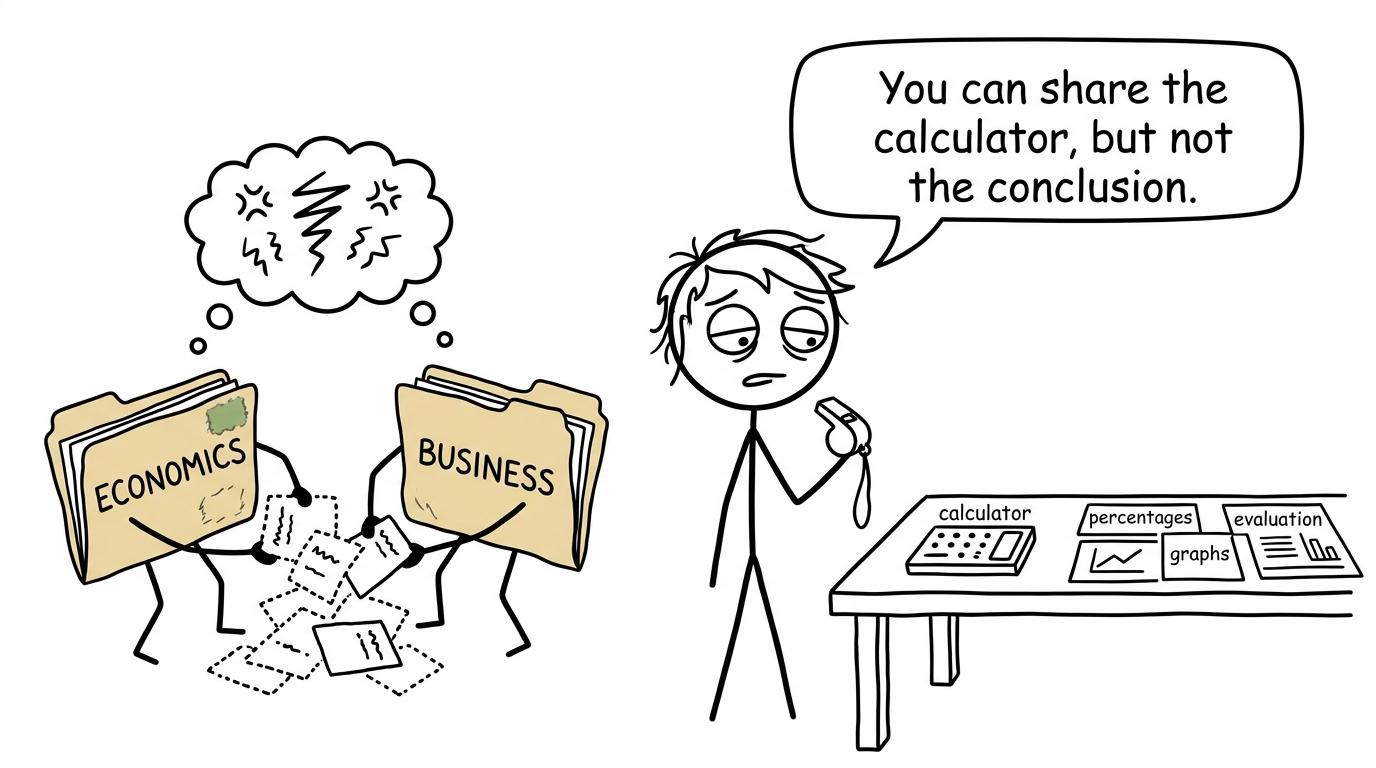 Economics and business negotiate over shared revision skills
A realistic workload test is to look at the assessment material before choosing. Ask each department for its specification and a recent paper. Notice the amount of reading, writing and evaluation required. Then consider how that fits alongside regular GCSE maths past-paper practice and your other subjects.
How maths supports both GCSEs
Neither subject should be chosen as a substitute for maths revision. However, several GCSE maths skills transfer directly:
- calculating and interpreting percentages;
- understanding percentage change;
- comparing values using ratios;
- reading line graphs, bar charts and tables;
- interpreting trends without claiming that correlation proves causation;
- calculating means and totals;
- rearranging straightforward formulae;
- checking whether an answer is reasonable.
Economics often uses data to describe changes across an economy, while Business may use figures to assess performance or compare decisions. In both cases, calculation is only one stage. You must explain what the result means in context.
MathsGenie's real-life graphs revision can strengthen graph interpretation, while the site's topic-based lessons help you identify gaps before they become expensive mistakes in an examination. When formal assessments approach, GCSE predicted papers provide focused maths preparation alongside your subject-specific revision.
Who is the combination best suited to?
Taking both may suit you if you:
- are genuinely curious about firms and the wider economy;
- enjoy explaining why decisions produce different consequences;
- can manage two content-heavy, examination-based courses;
- are comfortable reading case studies and writing evaluated conclusions;
- may consider Economics, Business, Politics, Geography or related subjects later.
It may be less suitable if you are choosing both only because you assume the content will be identical. It is also worth pausing if the combination prevents you from taking another subject you value, such as a language, creative subject or humanities option.
No single GCSE combination guarantees admission to a particular A Level or career. Sixth forms set their own entry requirements, which may include minimum grades in GCSE maths or English. Check the published requirements of the institutions you might realistically attend.
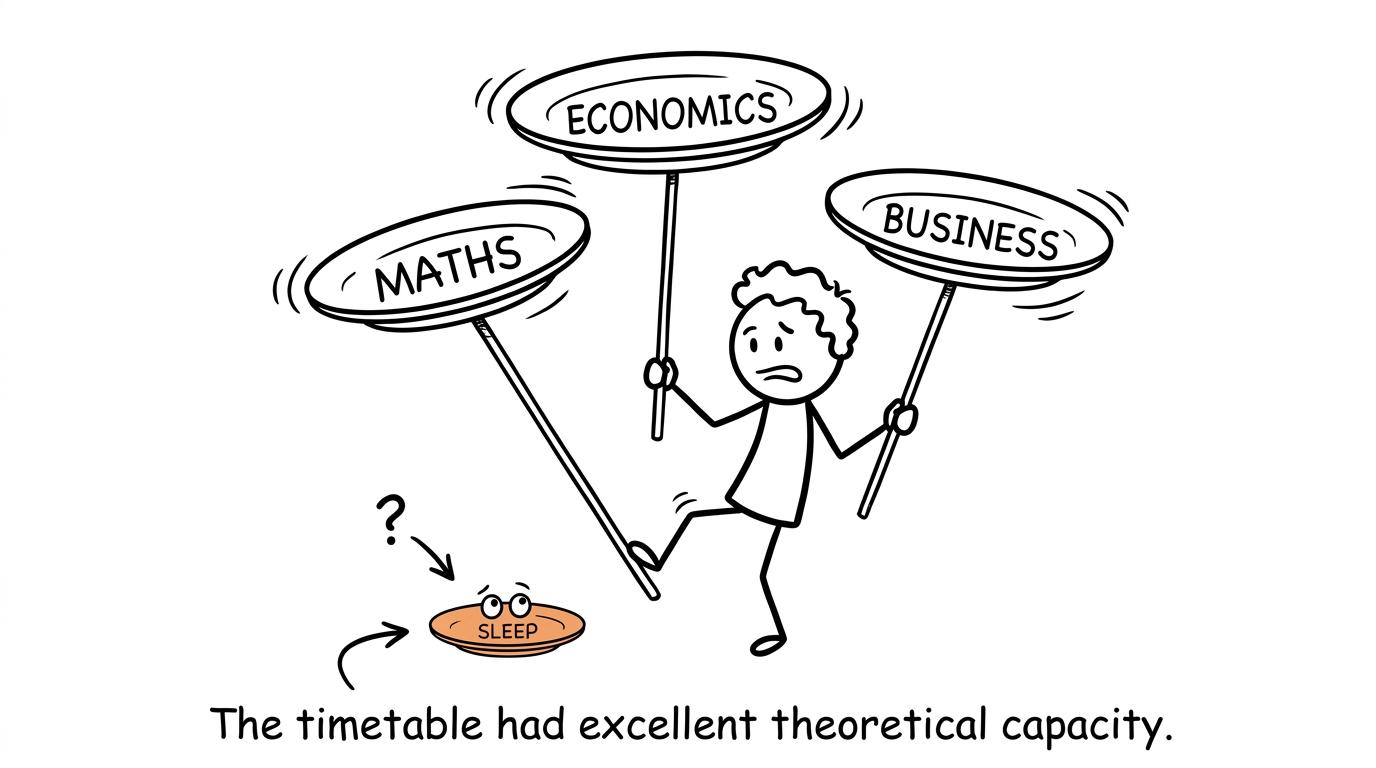 A student balances maths, economics, business and sleep
Common mistakes when choosing both
Assuming one course will revise the other automatically
Shared vocabulary can create false confidence. Keep separate specification checklists and practise the question style required by each exam board.
Ignoring the timetable
A combination can be academically valid but logistically impossible. Confirm the option blocks before building plans around both subjects.
Underestimating extended writing
Knowing a definition is not the same as analysing a case. Look at mark schemes and examiner materials so you understand how knowledge, application, analysis and evaluation are rewarded.
Neglecting maths because the calculations look simple
Errors with percentages, averages or graphs can cost marks in several subjects. Use MathsGenie's free GCSE resources to practise weak topics little and often.
Choosing for an imagined career requirement
Business and Economics can be useful preparation, but GCSE choices rarely determine an entire career. Interest, balance and the likelihood that you will engage consistently are better guides than a vague belief that a subject is compulsory.
Make the choice based on the work, not the label
Taking GCSE Economics and GCSE Business together is possible and can be a coherent choice. Their shared ideas give you useful connections, but their questions point in different directions: Business focuses more closely on organisations and decisions, while Economics examines markets, governments and the wider economy.
First confirm what your school permits. Then compare the specifications, inspect the papers and be honest about the total writing and revision load. If both subjects still interest you after seeing the actual work, the overlap can become an advantage rather than a reason to avoid the combination.
Whatever options you choose, protect the subject every student must continue: maths. Build a steady routine with MathsGenie's free revision lessons, video solutions, practice questions and mini tests. Use past papers and mark schemes to test progress, then add predicted papers as your examinations approach. A sensible options decision matters, but the habits you build afterwards matter more.