

GCSE Economics Access Arrangements Guide
GCSE economics access arrangements explained: extra time, evidence, school requests and a practical approval timeline for students and families.
A student can understand every economic concept on the specification and still struggle to show it under standard exam conditions. Slow processing, dyslexia, anxiety, a physical disability or another substantial difficulty may turn the clock into an extra obstacle.
GCSE economics access arrangements are adjustments designed to remove that disadvantage without making the assessment easier. They may include extra time, supervised rest breaks, assistive technology, modified papers or support from a reader or scribe. You cannot normally apply to an exam board yourself: speak to your school's special educational needs co-ordinator (SENCO), learning support team or exams officer as early as possible.
The same process can affect your other GCSEs, including maths. Arrangements are based on your needs, evidence and normal way of working, so they may not be identical in every subject.
GCSE economics access arrangements at a glance
Your practical checklist is:
- tell a teacher, SENCO or exams officer what happens when you work under timed conditions;
- ask which evidence the school needs and who will collect it;
- complete any assessment arranged by the school;
- use the proposed support regularly in lessons, tests and mock exams;
- confirm which arrangements have been approved for Economics and your other subjects;
- practise full papers under the approved conditions;
- check the exam-day details, including your room, equipment and start time.
Schools must follow the Joint Council for Qualifications (JCQ) regulations applying to that academic year. Exact administrative deadlines can change, and requests involving modified papers often have earlier deadlines. Your centre's own deadline may therefore be well before the published exam-board deadline.
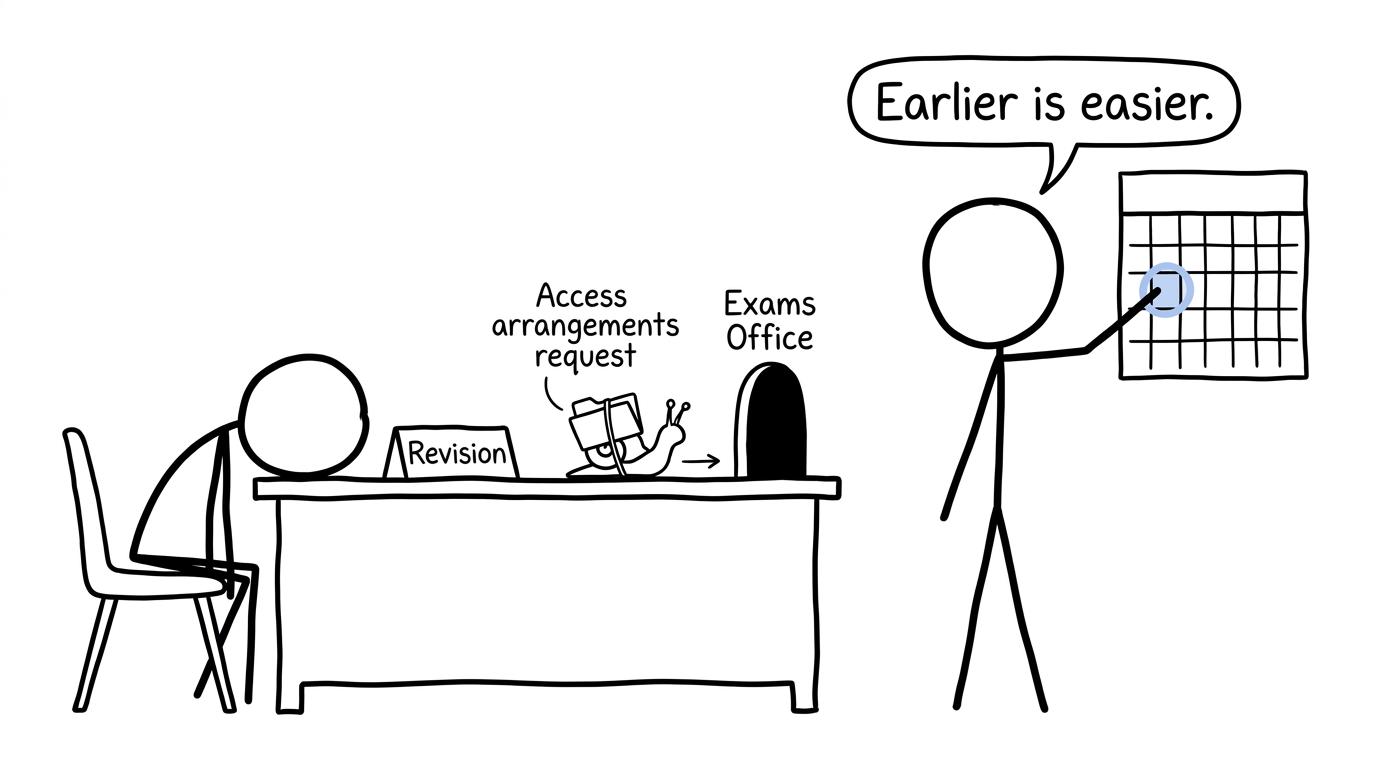 A student watches an access arrangements folder move slowly towards the exams office while a teacher advises starting early
What access arrangements are designed to do
Access arrangements provide a fair route into an assessment. They do not change the knowledge, application, analysis or evaluation being assessed, and they do not reduce the grade boundaries.
The core principle is reasonable adjustment. Under equality law, an exam centre must consider reasonable steps to avoid placing a disabled candidate at a substantial disadvantage. JCQ rules then govern how particular arrangements are evidenced, approved and delivered in GCSE examinations.
An arrangement is not awarded simply because it would feel helpful. The centre must establish a genuine need and, where required, show that the support reflects the student's normal way of working. That might mean it is already used in lessons, internal assessments and mock exams.
A diagnosis can be relevant evidence, but it does not automatically guarantee a particular arrangement. Equally, students should not assume that help is unavailable merely because they do not have a named diagnosis. The school must consider the complete picture and apply the current regulations.
How extra time works in GCSE Economics
Extra time is among the best-known arrangements. An allowance of 25%25\%25% is common, but it is not automatic or appropriate for everyone. A larger allowance has stricter evidence requirements, while some students benefit more from supervised rest breaks than from a longer working period.
In GCSE Economics, extra time may provide room to:
- process unfamiliar data and source material;
- organise longer written responses;
- move between calculations and economic analysis;
- check that conclusions answer the question asked;
- manage a recognised difficulty that materially slows working speed.
It is still the same Economics paper. The questions and mark scheme do not become easier, and the extra period should not be viewed as spare checking time awarded for general exam nerves.
Students should practise using the allowance intelligently. A longer exam can be tiring, and spending all the additional time on an early question may create the same rushed finish. When preparing for maths alongside Economics, GCSE Maths revision lessons can help you strengthen individual topics before you attempt timed papers.
Other arrangements you may be offered
The correct adjustment depends on the barrier rather than the subject label. Possible arrangements include the following.
Supervised rest breaks
During a supervised rest break, the candidate stops working and remains under supervision. The break is not usually counted as working time. This can be more suitable than extra time where fatigue, pain, concentration difficulties or a medical condition means the student needs genuine pauses.
The invigilator controls the procedure. You cannot continue reading or planning an answer during the stopped period.
A word processor
A word processor may be appropriate where typing is the student's established way of working and there is a substantial need. It is not granted merely because typed answers look neater or because handwriting becomes untidy when a student rushes.
The device must be prepared in line with exam rules. Functions such as internet access and stored files are restricted, and spelling or grammar tools may be disabled where required. A student using a word processor should be comfortable saving, numbering and printing responses before the real examination.
A reader or computer reader
A reader or approved computer reader may help an eligible candidate access written material. What can be read, repeated or explained is controlled by the assessment rules. The support cannot interpret an Economics question, define a technical term or guide the student towards an answer.
Because permissions can depend on what a qualification is assessing, your exams officer must confirm how the arrangement applies to each paper.
A scribe or speech recognition technology
A scribe records dictated answers under strict rules. The candidate remains responsible for the content and must communicate what should be written. Speech recognition may sometimes provide an alternative where it is established and permitted.
This support needs rehearsal. Dictating a developed economic argument is a distinct skill, particularly when the answer contains specialist vocabulary, diagrams or calculations.
Modified papers and practical adjustments
Some candidates need enlarged print, Braille, modified language papers or other accessible formats. These requests often need to be made particularly early because the paper must be produced in the correct format.
Other adjustments can include appropriate seating, a smaller room, coloured overlays or separate invigilation within the centre. A separate room is not automatically attached to extra time; the centre considers the candidate's needs and how the examination can be securely supervised.
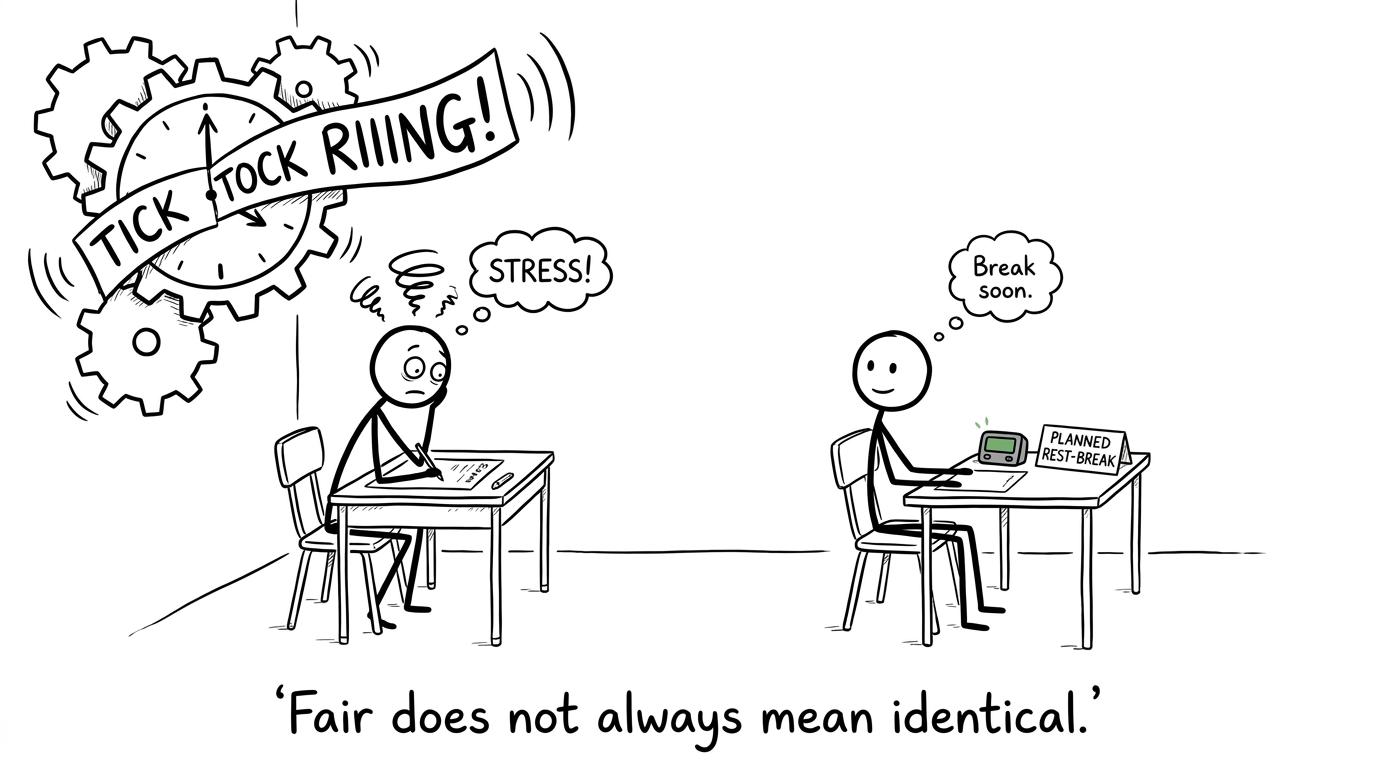 Two exam candidates illustrate that fair conditions need not be identical
How to request access arrangements
Begin with a direct conversation. Explain the barrier in practical terms rather than trying to prescribe the solution yourself. For example, tell the SENCO if you repeatedly fail to finish timed responses despite knowing the content, lose significant working time because of a medical condition, or cannot comfortably produce sustained handwriting.
The usual process is:
- Initial discussion: the SENCO, learning support team or exams officer reviews your concerns and existing school information.
- Evidence gathering: teachers may supply observations, marked work, test records or details of support already used.
- Assessment where required: an appropriately qualified assessor may complete standardised assessments for arrangements that require them.
- Centre decision and application: the school determines what is justified, records the evidence and uses the relevant online system where JCQ requires an application.
- Student confirmation: the centre should explain what has been approved and how it will operate.
- Implementation: the arrangement is used in mock and final examinations under proper supervision.
Parents and carers can raise concerns and provide medical or specialist information, but the school or college remains responsible for the examination application. Private reports do not bypass the centre's duty to establish need and normal way of working.
A sensible approval timeline
Do not wait for the final exam timetable. A practical timeline begins well before the summer series.
During Year 10
Raise persistent difficulties and begin using appropriate classroom support. This gives the school time to understand the barrier and establish a genuine normal way of working.
Early in Year 11
Ask whether evidence or an assessment is outstanding. Confirm that Economics is included in the discussion, especially if extended writing or source material creates a different barrier from maths.
Before the mock exams
Use the intended arrangements in formal mock conditions wherever possible. Mocks help the centre observe whether the support is suitable and give you a realistic opportunity to practise with it.
For maths preparation, attempt GCSE past papers using exactly the timing and breaks your school has authorised. Students building foundational knowledge can also organise practice through the Grade 4 GCSE revision resources, while those working towards more demanding higher-tier content can use the Grade 7 revision resources.
Before the centre's application deadline
Supply requested evidence promptly and ask for written confirmation of the outcome. The school's internal deadline may be earlier than the JCQ or awarding-body deadline because staff need time to assess evidence, make applications and resolve queries.
Always ask the exams officer for the dates applying to your examination series. Do not rely on a deadline copied from a previous academic year.
Before the first examination
Check the room, equipment, rest-break procedure and permitted support. If something appears wrong, tell the exams officer before the paper begins rather than trying to solve it silently during the examination.
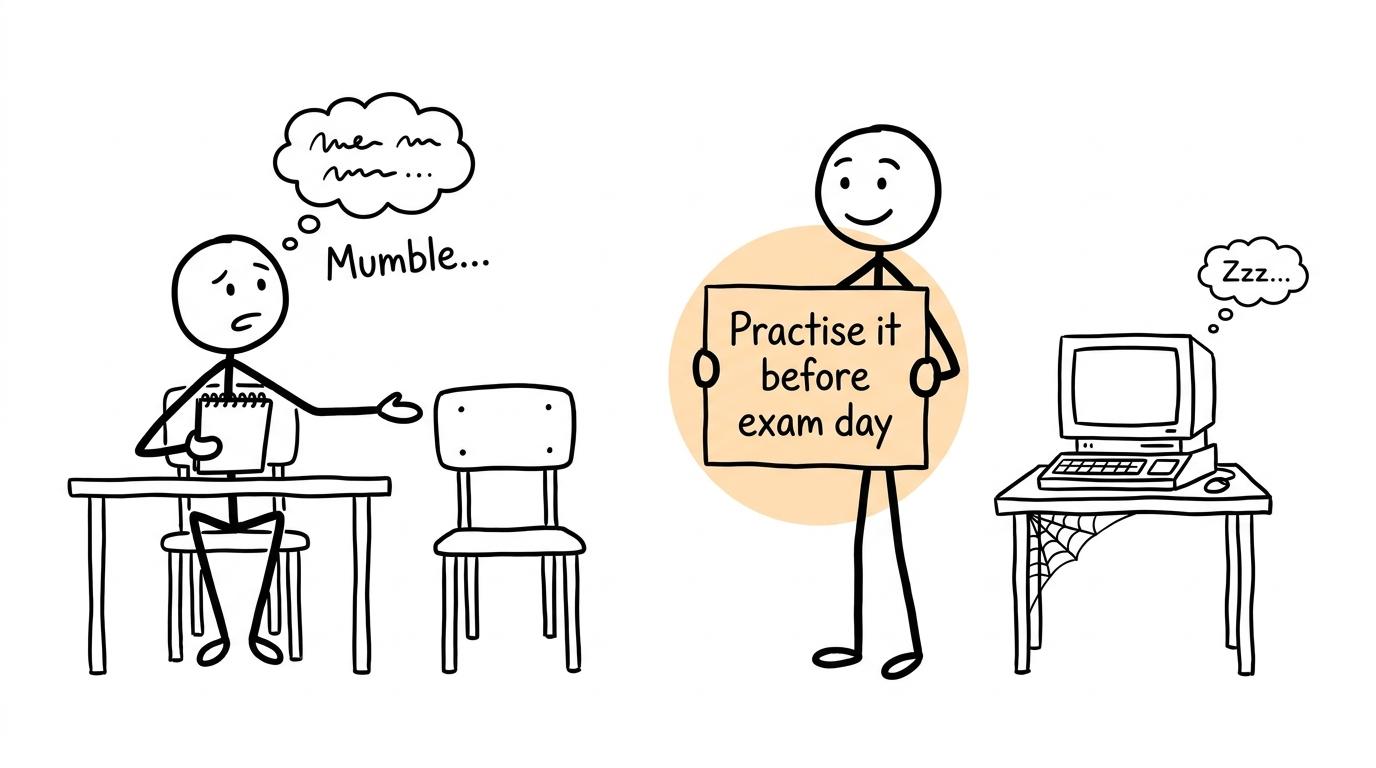 A student rehearses an approved exam arrangement before the real examination
What if your needs change late?
A temporary illness, injury or unexpected deterioration may arise after the usual application period. Contact the school immediately. The exams officer can decide what emergency or temporary provision is permitted and what evidence is needed.
This is different from special consideration, which concerns adverse circumstances affecting a candidate at or near the time of an assessment. Access arrangements normally remove an ongoing barrier before or during the paper; special consideration is considered after an event has affected performance. Neither process guarantees a grade increase.
Common mistakes to avoid
Waiting until the examination week
Evidence, assessments, applications, rooms and trained staff can take time to organise. Early disclosure gives the centre a fair chance to help.
Assuming a diagnosis automatically means extra time
The arrangement must match the demonstrated barrier and satisfy current JCQ rules. The appropriate answer might instead be rest breaks, assistive technology or another adjustment.
Treating the support as an exam-day experiment
An unfamiliar word processor, scribe or break procedure can create new pressure. Use approved arrangements during mocks and timed practice.
Expecting identical support in every subject
The underlying need may remain the same, but an arrangement can operate differently where a paper assesses a particular skill. Confirm the position for Economics, maths and every other qualification.
Revising only with untimed questions
Access arrangements remove disadvantage; they do not replace secure subject knowledge or exam technique. Combine focused lessons with timed MathsGenie predicted papers, then use the mark schemes and video solutions to identify what needs attention.
Make the arrangement part of your preparation
The quiet purpose of an access arrangement is not to give you an advantage. It is to let the exam measure the knowledge you have actually built.
Speak to your SENCO or exams officer early, provide evidence promptly and learn exactly how your approved support works. Then make it ordinary. Use it in mocks. Use it in timed revision. Know where the breaks fit and how you will manage the paper.
MathsGenie can support the revision side of that plan with free lessons, practice questions, mini tests, mark schemes, video solutions, past papers and predicted papers. Start with the complete GCSE Maths revision hub, choose the topics that need work, and practise under the conditions you will have on exam day. Fair access creates the opportunity; careful revision helps you use it.











