

GCSE Drama Revision Book Reviews: Buying Guide
GCSE drama revision book reviews help you look beyond star ratings. Check the exam board, set text, edition, questions and mark-scheme support before buying.
Buying a revision guide can feel like buying certainty. The cover promises complete preparation, the reviews sound reassuring, and the book looks easier to manage than a folder full of notes. But GCSE drama revision book reviews are only useful if you know what the reviewer has actually checked.
The short answer is yes: review the book before buying it. Look beyond its star rating and confirm that it matches your exam board, current specification, set text, prescribed edition and assessment format. Then inspect whether it contains realistic questions, useful answer guidance and enough practical detail to improve your own responses.
This matters especially when you are balancing Drama with GCSE Maths. Every unnecessary purchase consumes money, attention and revision time. A good guide should remove decisions. A poorly matched one quietly creates more of them.
Your pre-purchase checklist
Before ordering a GCSE Drama revision guide, check:
- your exam board: AQA, Edexcel, OCR or Eduqas
- the exact qualification and specification
- your school’s chosen set text
- whether a particular edition of that text is prescribed
- the publication or revision date of the guide
- whether it covers the written examination, practical components or both
- whether its questions reflect the current paper structure
- whether answer guidance explains how marks are earned
- whether it supports acting, directing and design perspectives where required
- whether the sample pages are clear enough for you to use independently
If any of those details are missing from the product description, do not assume the book is suitable. Ask your teacher or the publisher before buying.
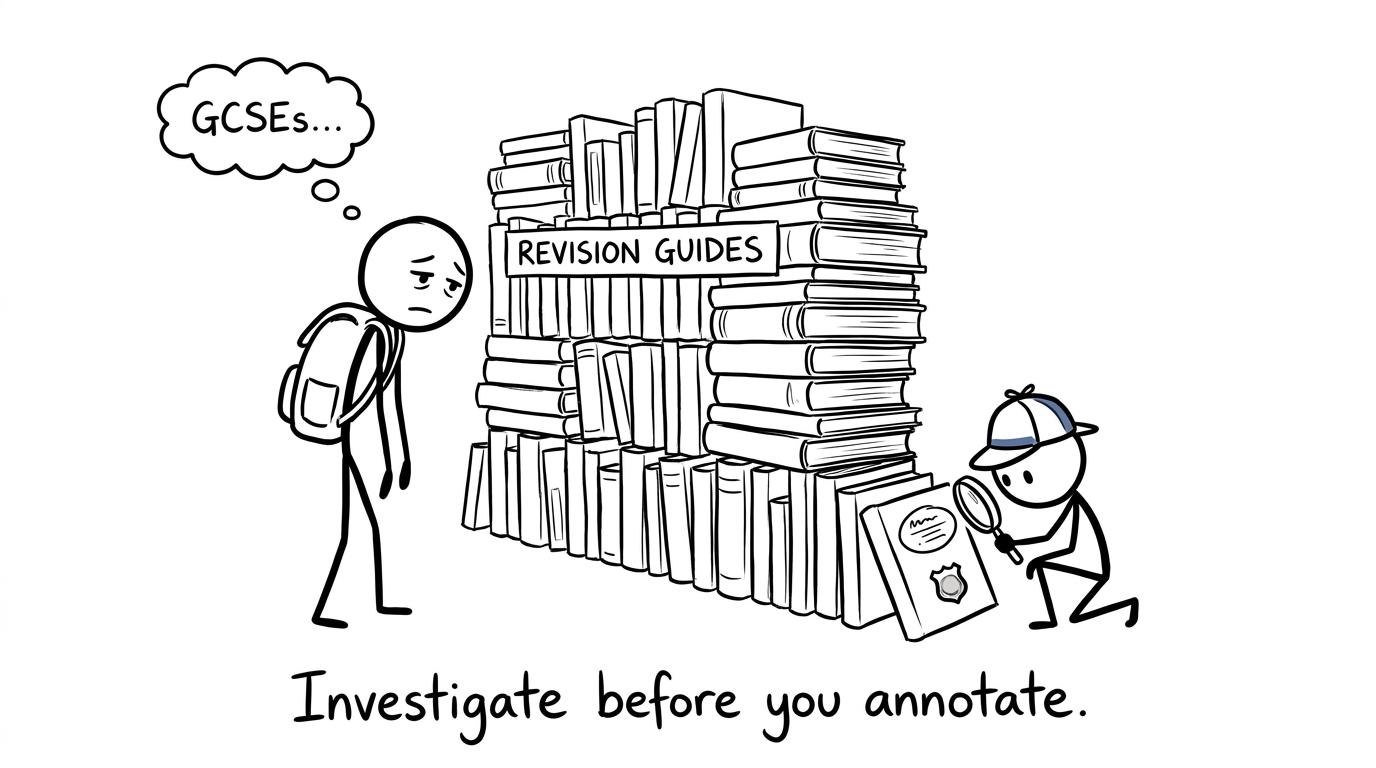 A student and detective inspect revision guides rather than trusting the covers
Why star ratings are not enough
A star rating answers a broad question: did previous buyers like the book? You need the answer to a narrower one: will this book prepare me for my particular examination?
Reviews may praise fast delivery, attractive colours or concise notes. Those features can be welcome, but they do not establish specification accuracy. A reviewer taking AQA may recommend a guide that is unsuitable for an OCR student. Someone studying Blood Brothers may have little to say about the quality of its coverage of another set text. An older review may also refer to a previous text list or assessment arrangement.
Read reviews for evidence rather than enthusiasm. Useful comments identify the exam board, set text, edition and specific parts of the guide used. They may discuss whether the questions resemble examination questions, whether terminology is explained accurately or whether suggested responses are sufficiently analytical.
Treat vague claims such as “everything you need” cautiously. In revision, completeness is not a feeling. It is a match between the resource and the specification.
Check the exam board and specification first
GCSE Drama is not assessed identically across every board. Current official specifications show meaningful differences in paper structure, text access and set-text choices.
For example, AQA’s written component is open book and includes theatre terminology, a set-play section and live theatre analysis. OCR’s written paper is closed book: students cannot access their studied performance text in the examination. Edexcel provides an unseen extract from the chosen performance text in its written paper, while Eduqas assesses its set text and live theatre review through its Interpreting Theatre component.
These are not small editorial details. They determine what useful revision looks like.
A book designed around quotation retrieval may be less helpful if your examination tests practical interpretation in a different way. Likewise, a general Drama guide may explain terminology well but provide too little preparation for your board’s extended responses.
Check the qualification code on a recent school document, mock paper or specification. Do not rely only on a familiar exam-board logo: publishers may sell several editions with nearly identical covers.
This is the same habit that protects maths revision. The GCSE Maths revision hub begins with the exam board because Edexcel, AQA, OCR and Eduqas organise their papers differently, even where much of the underlying content overlaps. MathsGenie’s guide to GCSE Maths topics by exam board and tier shows why checking the precise route matters before choosing resources.
Confirm the set text and prescribed edition
A guide can match your board and still be the wrong book.
Schools select particular set texts from the choices allowed by their exam board. Some boards also prescribe specific editions. AQA states that prescribed editions are used for its set plays, while OCR publishes the editions used to set questions. Eduqas similarly identifies editions for its examined texts.
The title alone may therefore be insufficient. Adaptations, pagination, stage directions and editorial material can differ. Before buying, compare the guide’s title, playwright or adapter, publisher and ISBN with the details supplied by your teacher.
Also check the year in which the guide was published or last updated. Exam boards can revise specifications and replace set texts. OCR, for instance, has announced changes affecting set texts for future assessment. A second-hand guide may still contain valuable dramatic concepts, but that does not make it a reliable map of your current exam.
A sensible check takes a few minutes:
- open your exam board’s current specification
- find the set-text and assessment sections
- compare them with the guide’s contents page
- ask your teacher if the editions do not match exactly
That small pause is usually cheaper than discovering the mismatch halfway through revision.
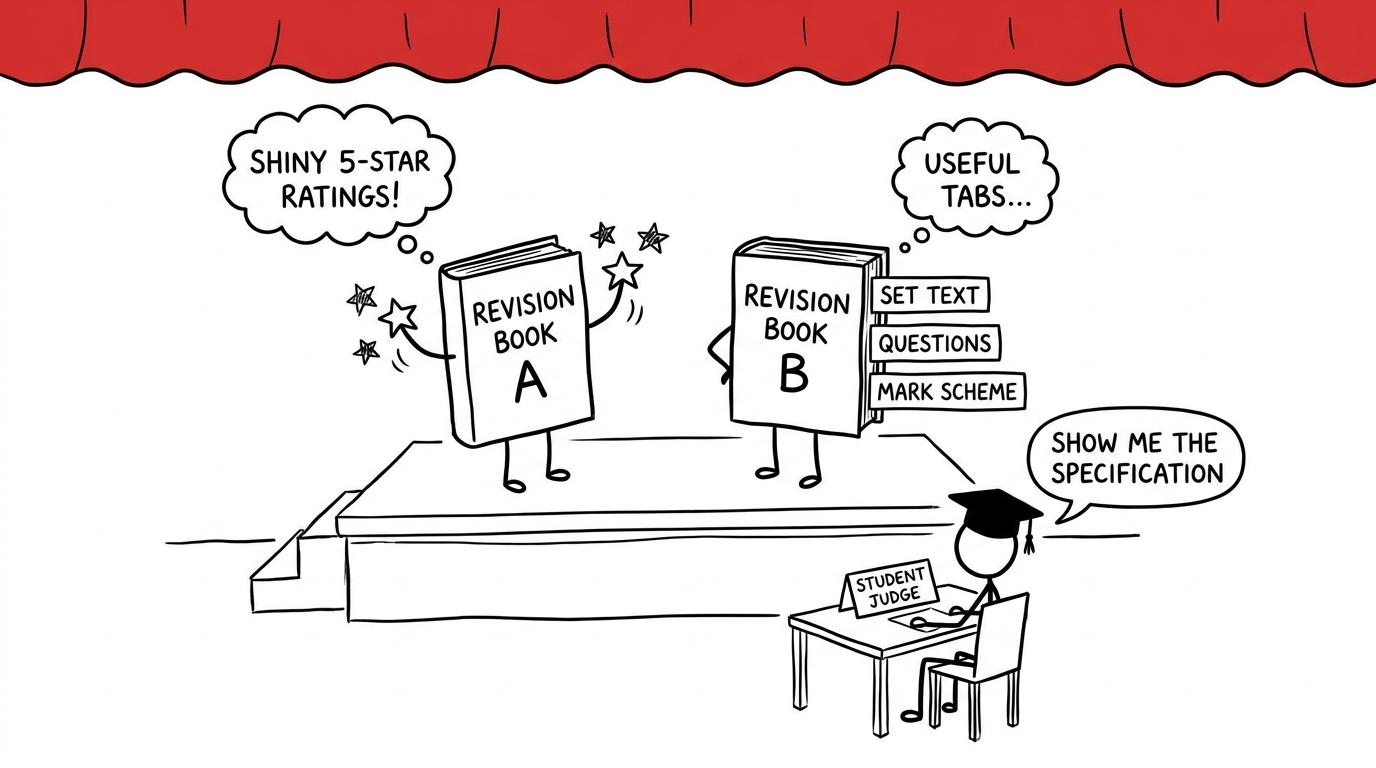 Revision books audition while a student asks to see the specification
Inspect what the guide actually teaches
A useful Drama revision book should do more than retell the plot. Plot summaries can refresh memory, but examinations reward understanding of drama as performance.
Look for coverage of:
- character motivation and relationships
- social, historical and theatrical context where relevant
- vocal and physical performance choices
- staging, proxemics and interaction
- direction and interpretation
- lighting, sound, costume, set and props
- dramatic form, structure and conventions
- live theatre analysis and evaluation
- accurate subject terminology
The balance should match your specification. If your assessment asks you to write as a performer, director or designer, the guide should model how those perspectives differ. A design choice should be connected to its intended effect, not merely listed. A performance choice should be precise enough to imagine on stage.
Sample pages are more informative than a polished cover. Read one explanation and ask: could I use this to improve a response without a teacher beside me? If the page is mostly decoration, compressed plot or unexplained terminology, it may not support independent revision.
Judge the quality of questions and answer support
Revision becomes effective when it requires retrieval, application and correction. Reading highlighted notes can feel productive while revealing very little about what you can produce under examination conditions.
Before buying, find out whether the guide contains:
- questions written in the style of your board
- a realistic range of short and extended tasks
- space or guidance for planning responses
- indicative content or model material
- commentary explaining why an answer earns marks
- references to assessment objectives where useful
An answer section that supplies only a polished final response has limited value. Better support identifies the features that make the response successful: precise theatrical detail, a justified interpretation, relevant evidence and analysis of audience effect.
This principle transfers directly to maths. On MathsGenie, Edexcel GCSE Maths past papers sit alongside mark schemes and solutions so that an attempt can become a diagnosis. The guide on when to start GCSE past papers explains why attempting, marking and repairing gaps is more valuable than passively collecting resources.
A Drama guide should support a comparable loop: recall, plan, write, check and improve.
Decide whether the book fits your revision system
The best book is not necessarily the longest one. It is the one you will use for a clear purpose.
If your teacher already provides detailed set-text notes, you may need a question workbook rather than another summary guide. If terminology is your weak point, concise explanations and retrieval prompts may matter more than model essays. If you struggle to structure extended answers, look for planning frameworks and annotated responses.
Consider the rest of your timetable too. GCSE students preparing for maths exams need resources that reduce switching costs. A Drama guide should make short, focused sessions possible rather than demanding that you read it from beginning to end.
You could assign each resource a job:
- class notes for your teacher’s interpretation
- the play text for evidence and stage directions
- a revision guide for organised recall
- official-style questions for application
- mark schemes or teacher feedback for correction
For maths, the same structure is available through free MathsGenie revision lessons and practice questions, shorter Foundation mini tests, full past papers and GCSE predicted papers. A revision planner can then give each resource a specific place instead of letting one subject absorb the entire evening.
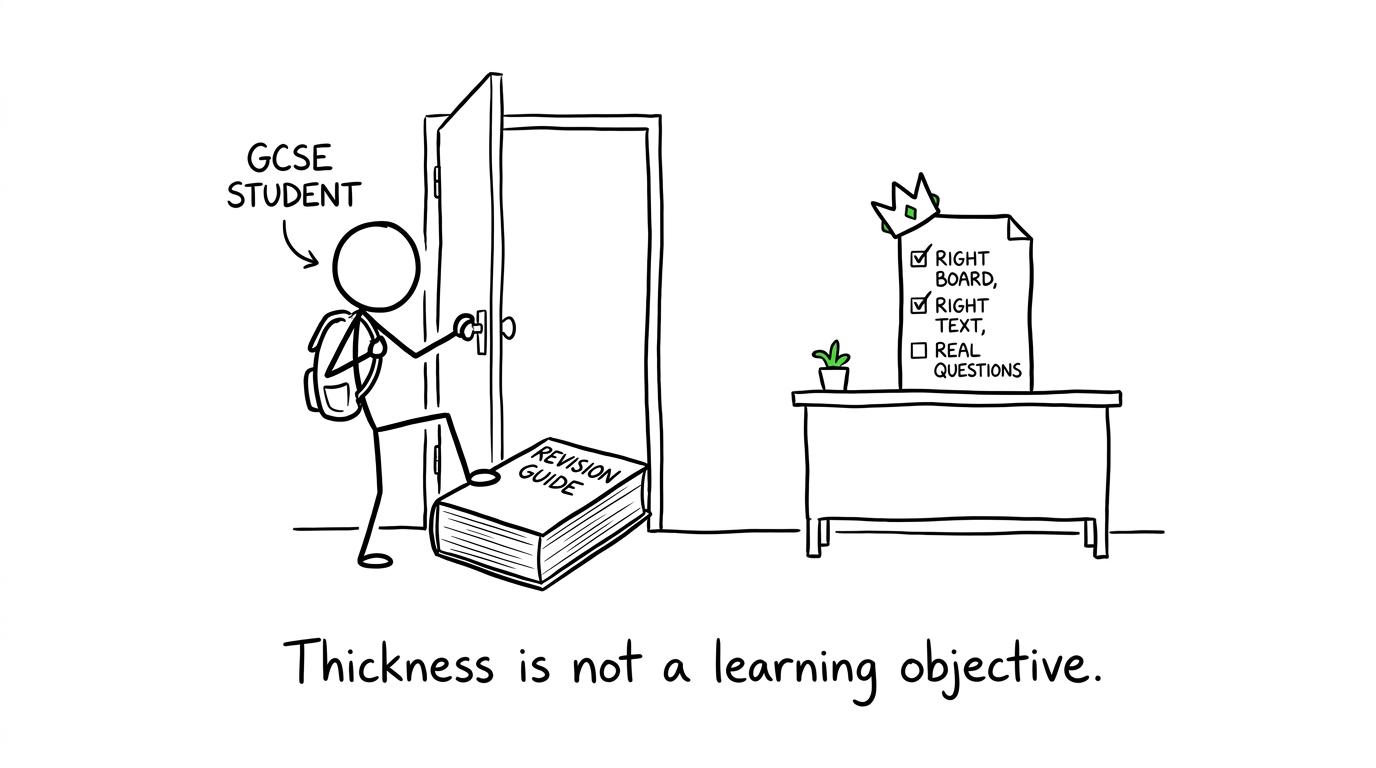 A slim checklist defeats an enormous revision guide in a contest of usefulness
Common mistakes when choosing a Drama revision guide
Buying by title alone
A book labelled “GCSE Drama” may cover the wrong board, set text or assessment route. Match the full details, not just the subject.
Trusting old reviews without checking dates
An honest review can still describe an outdated edition. Compare the review date, book edition and current specification.
Choosing the thickest guide
Page count does not measure usefulness. Dense content can become another task to manage. Prioritise accurate coverage, clear explanations and worthwhile practice.
Looking only for model answers
Model responses can help, but copying their phrasing does not build flexible understanding. Look for annotations, planning guidance and opportunities to produce your own interpretations.
Ignoring your teacher’s advice
Your teacher knows the text, production choices and assessment route followed by your class. Confirm compatibility before spending money, especially when buying second-hand.
Letting resource shopping replace revision
Comparing books can become a comfortable form of delay. Set a decision deadline. Once a suitable resource is chosen, use it actively and return attention to the subjects that need practice.
Make the purchase earn its place
The real question is not whether a GCSE Drama revision book has excellent reviews. It is whether the book fits your board, current specification, set text, prescribed edition, weaknesses and revision routine.
Check those details before buying. Then use the guide to retrieve knowledge, plan responses and correct weaknesses rather than simply rereading summaries.
And when Drama revision is finished for the day, let MathsGenie remove the next set of decisions. Start with the free GCSE Maths revision area, choose a lesson and practise the matching questions. Build towards past papers, mini tests and predicted papers, then use mark schemes and video solutions to understand every lost mark. The goal is not to own more revision material. It is to make each resource lead to a better next action.










