

GCSE Drama Note Taking You'll Actually Use
GCSE drama note taking made practical: create concise set-text, rehearsal and live-theatre notes you can retrieve, test and use under exam pressure.
A full exercise book can create a comforting illusion: I wrote everything down, so I must know it. Then revision begins, the pages blur together, and finding one useful detail about a performer’s vocal delivery takes longer than remembering the performance itself.
Effective GCSE drama note taking solves that problem. Your notes should help you retrieve precise details, explain theatrical choices and make supported judgements. They are not a transcript of every lesson. They are a compact set of prompts built for future answers.
This guide shows you how to organise notes for set texts, practical work and live theatre while turning them into active revision. If you are balancing Drama with GCSE maths, the same principle applies in both subjects: notes explain; retrieval and practice reveal what you can actually use.
The quick GCSE Drama note-taking checklist
Before keeping any page, ask whether it does at least one useful job:
- identifies a specific performance, direction or design choice;
- records where the choice happens;
- explains the intended meaning or artistic intention;
- describes its effect on the audience;
- connects the detail to character, context, theme or dramatic structure;
- creates a question you can answer later without looking;
- records feedback and the action you took because of it.
If a note does none of these things, it may look organised without helping you revise.
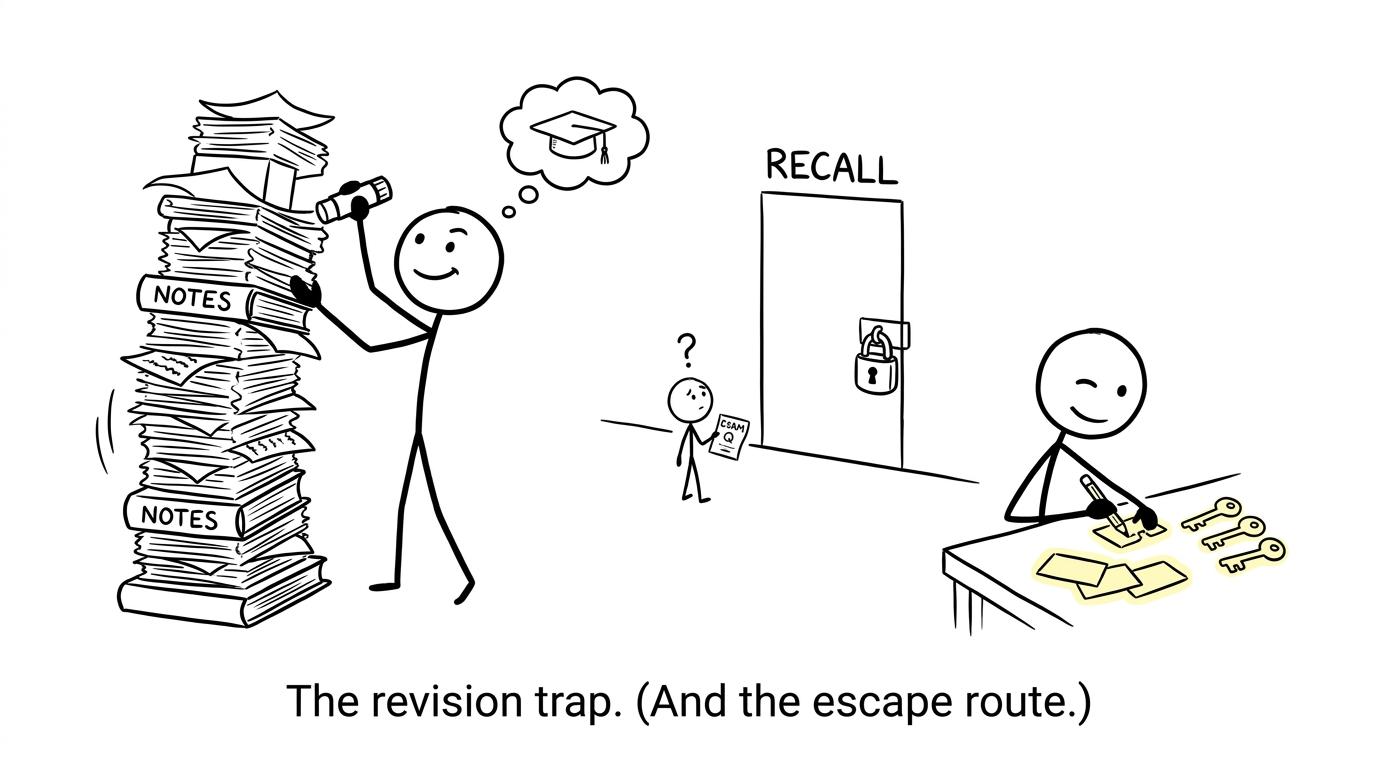 A student turns useful note cards into keys while an enormous tower of notes cannot open the recall door
Start with what GCSE Drama actually assesses
Across GCSE Drama specifications, students are expected to create and develop ideas, apply theatrical skills, demonstrate knowledge and understanding, and analyse and evaluate work. The exact component names, written-paper structure and permitted materials vary between AQA, Edexcel, OCR and Eduqas, so confirm your board and current specification with your teacher.
That variation matters. AQA’s written component, for example, covers theatre knowledge, a set play and live theatre. Edexcel’s current specification allows authenticated live-theatre evaluation notes of up to 500500500 words, subject to its rules. This is not a general allowance for every board or every section.
Never assume that your classroom notebook can enter the examination. Treat exam access as a separate rules question and check the latest instructions for your board. Your everyday notes should still be useful even if they remain outside the exam room.
A sensible filing system uses four sections:
- Set text: character, relationships, context, key moments and performance possibilities.
- Live theatre: precise observed choices, effects and judgements.
- Practical development: intentions, experiments, feedback and refinements.
- Vocabulary and theatre makers: terminology you can apply accurately rather than merely define.
This structure reflects the work you need to perform later. It also prevents a lighting observation from disappearing between several pages of plot summary.
Build notes from moments, not whole lessons
The most useful unit of Drama revision is usually a moment. A moment might be an entrance, pause, lighting transition, shift in status, use of stage space or change in vocal delivery.
For each important moment, capture five elements:
- Location: act, scene, line, rehearsal stage or recognisable point in the production.
- Choice: what the actor, director or designer did.
- Detail: how the choice was realised precisely.
- Meaning: what it communicated about character, relationship, atmosphere or theme.
- Effect and judgement: how the audience may have responded and how successfully the choice worked.
Specificity is what makes a note reusable. “The acting was powerful” offers almost nothing. A record of a sudden reduction in volume, sustained eye contact and a long pause gives you observable evidence that can support analysis.
Do not try to write a polished paragraph during every discussion or rehearsal. Capture short, accurate fragments first. Add meaning and evaluation while the event is still fresh. This separates observation from interpretation and reduces the temptation to replace evidence with vague praise.
Make set-text notes practical
A play is not only literature on a page. GCSE Drama asks you to think about how meaning is created in performance, so your notes should preserve practical possibilities.
Give each major character a performance profile
Record the character’s objective, obstacles, relationships and changes across the play. Then attach playable choices:
- vocal qualities such as pace, pitch, volume, tone and emphasis;
- physical qualities such as posture, gesture, facial expression and gait;
- proxemics, levels and use of stage space;
- reactions and moments of stillness;
- relevant costume, lighting, sound or set possibilities.
Avoid listing every technique the character could possibly use. Select choices that communicate a clear interpretation and connect them to precise moments.
Track change rather than collecting isolated facts
Examiners may ask you to consider an extract while drawing on understanding of the wider play. A character timeline is therefore more valuable than several disconnected pages.
Divide the text into turning points. At each one, note what changes, why it changes and how an actor or designer could make that development visible. This helps you discuss dramatic structure rather than treating every scene as independent.
Separate context from decoration
Context earns its place when it changes an interpretation, performance decision or audience understanding. Avoid copying a playwright biography unless a detail genuinely helps explain the work.
Ask: What would I perform, direct or design differently because I know this? If there is no answer, the contextual note probably needs refining.
Capture live theatre before memory edits it
A production feels vivid as you leave the theatre. A month later, memory often retains the general atmosphere while losing the precise evidence needed for analysis.
As soon as your teacher permits, record:
- the production title, venue and date;
- the staging configuration and relationship with the audience;
- key performers and characters;
- memorable vocal and physical choices;
- significant lighting, sound, costume and set details;
- several moments where performance and design worked together;
- your judgement of what succeeded, supported by a reason.
Do not attempt to preserve the entire production. Build a bank of adaptable moments across performance and design. The strongest note contains enough sensory and spatial detail to reconstruct what happened without becoming a miniature review.
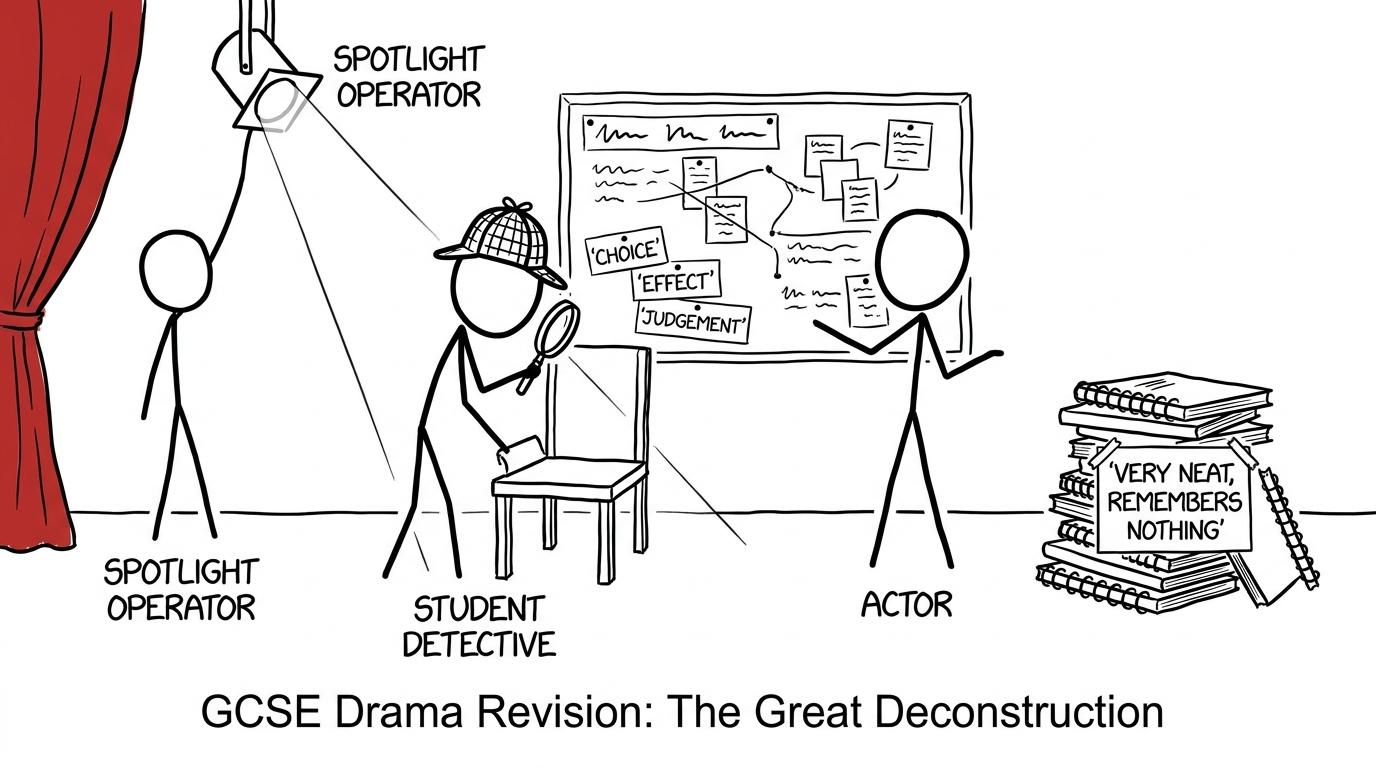 A student detective collects theatre clues labelled choice, effect and judgement while decorative notebooks sit unused
Afterwards, compress your observations. Keep fuller notes as an archive, then create a short retrieval sheet containing only the strongest moments. If your exam board permits notes in a particular assessment, follow its current word limit, authentication process and content rules exactly.
Turn rehearsal notes into evidence of development
Practical notes often fail because they describe activity rather than development: “We rehearsed the opening” records time spent, not learning.
Use a simple reflection chain:
- Intention: what did the group want the audience to understand or feel?
- Experiment: which performance or design choice was tested?
- Evidence: what happened in rehearsal or performance?
- Feedback: what specific issue or strength was identified?
- Refinement: what changed as a result?
- Evaluation: did the alteration communicate the intention more successfully?
Write this close to the rehearsal, but do not manufacture detail you cannot remember. A brief, honest record is more useful than an elaborate reconstruction written weeks later.
Keep your individual contribution visible too. Collaborative work matters, but your portfolio or log may need to show your own decisions, responses and evaluation according to your board’s requirements.
Convert every page into active revision
Research on learning distinguishes active retrieval from passive re-reading. Trying to recall knowledge, checking it and correcting errors can strengthen later access to that knowledge. Spacing reviews across different days is generally more useful than relying on one long encounter, although there is no single perfect timetable for every student or topic.
Make each Drama page testable:
- cover the detail and reconstruct the moment from its heading;
- turn headings into questions;
- sketch the stage space from memory, then check it;
- explain one design choice aloud without notes;
- choose a character moment and recall linked vocal, physical and spatial choices;
- draft a quick judgement, then inspect whether you supplied evidence.
Schedule short returns to the material rather than rewriting it. One possible rhythm is an initial check the next day, another later that week and a further review the following week. Adjust the intervals according to what you forget.
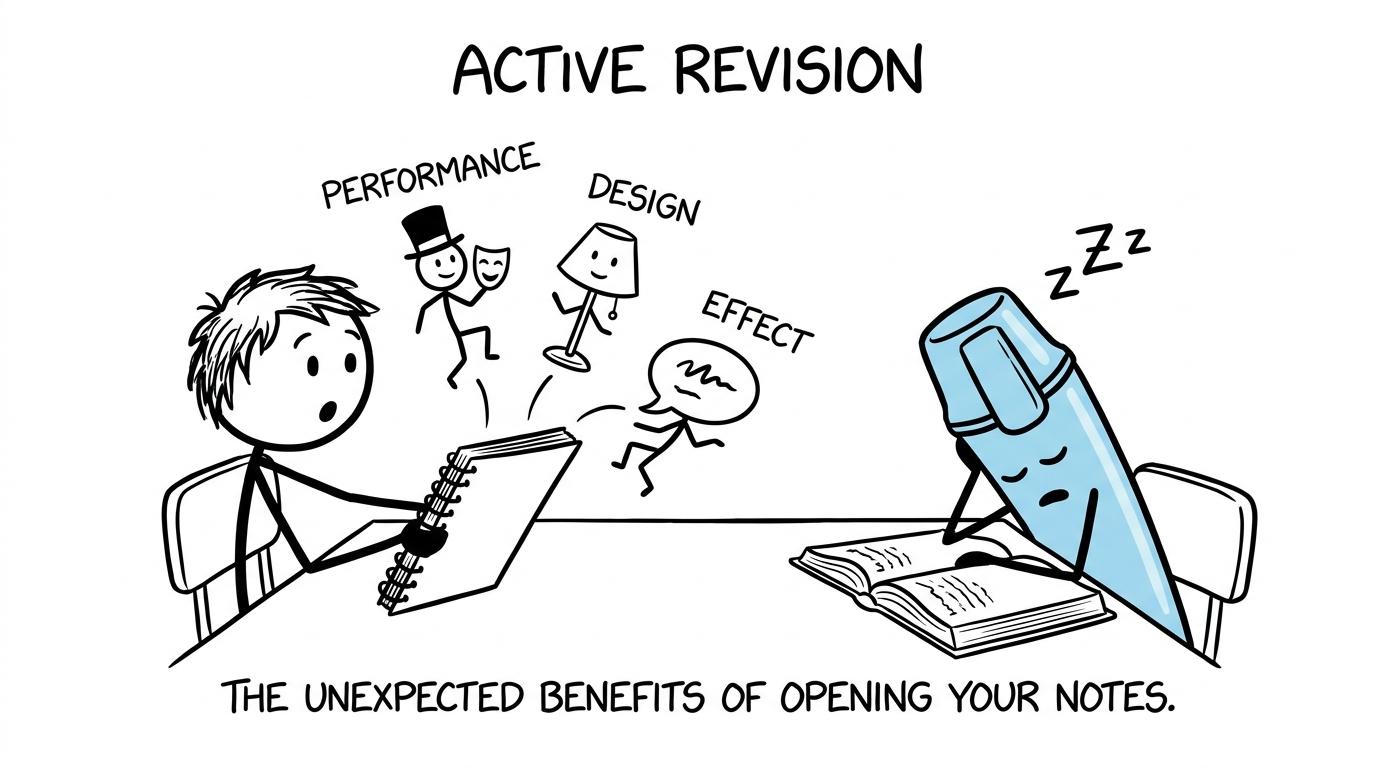 Performance, design and audience effect jump from a useful notebook while an exhausted highlighter sleeps
The same active process is valuable when Drama competes with maths revision. MathsGenie’s guide to stopping forgotten GCSE content explains how recall, checking and spaced revisits can replace passive re-reading.
Use a two-layer notebook system
One notebook cannot serve every purpose equally well. Class notes need room for exploration; revision notes need compression.
Use two layers:
- Archive layer: scripts, lesson notes, rehearsal records, teacher feedback and detailed live-theatre observations.
- Retrieval layer: concise character maps, moment cards, vocabulary prompts, feedback actions and self-test questions.
The archive protects detail. The retrieval layer makes that detail accessible under pressure.
Once a week, spend a short session moving only the most useful information from the archive into the retrieval layer. Do not copy everything. Selection is part of learning because it forces you to decide what evidence is precise, flexible and relevant.
This mirrors the error-log approach used in MathsGenie’s guide to finding your weakest GCSE topics. The purpose of a revision record is not to preserve every task. It is to identify the next useful action.
Common GCSE Drama note-taking mistakes
Copying the board word for word
Transcription can keep your pen moving while leaving your thinking still. Record the central idea, then add a performance implication or retrieval question.
Highlighting without a purpose
If every line is coloured, no line has priority. Give each colour a stable function, such as performance, design, context or audience effect, and use it sparingly.
Writing plot summary instead of theatrical analysis
Knowing what happens matters, but Drama answers also require understanding of how theatre makers communicate meaning. Attach performance, direction or design choices to important plot moments.
Using vague evaluation
Words such as “effective”, “dramatic” and “engaging” need evidence. State the precise choice, identify its impact and explain why it supported the interpretation.
Ignoring feedback after recording it
A page of teacher comments is not improvement. Translate each useful comment into an action, such as adding spatial detail, using more precise terminology or supporting judgements with observed evidence.
Making beautiful summaries you never test
Presentation can reduce friction, but appearance is not recall. Close the notebook and attempt a question. If you cannot retrieve the material, the page needs prompts and practice, not another border.
Keep Drama and maths revision working together
Students rarely revise one subject in isolation. A practical system should reduce decisions across the week.
Use a revision planner to alternate compact Drama retrieval sessions with focused maths practice. For maths, begin at the GCSE Maths revision hub, choose the correct board and tier, and move from a revision lesson into questions. AQA students can use AQA GCSE Maths past papers, while OCR students can work from the OCR GCSE Maths revision hub.
The principle remains consistent: attempt, check, record the weakness and return to it. MathsGenie’s guides to using past papers properly and using mark schemes as a revision coach show how to convert completed work into better future performance.
Notes should lead somewhere
Good notes are not the finished product. They are stage directions for your future self.
Build them around precise moments. Connect choices to meaning and audience response. Record practical development, compress the strongest evidence, then practise retrieving it without support. That is how a notebook stops being proof that you attended lessons and becomes a tool you can genuinely use.
For the maths side of your GCSE timetable, let MathsGenie remove the search for your next task. Use free revision lessons and practice questions to repair weak topics, mini tests to check recall, then progress to past papers and predicted papers. Mark with the available mark schemes and use video solutions to understand the steps you missed.
Open the MathsGenie GCSE Maths revision hub, choose one focused task, and make your next set of notes answer a simple question: What will I do differently when I review this?











