

GCSE Drama Grade Sixth Form Entry: Does It Matter?
GCSE drama grade sixth form entry explained: learn when Drama matters, why Maths often carries more weight, and how to check your chosen course requirements.
The worry often arrives after a mock result. One grade looks lower than the others, and suddenly it seems capable of deciding your entire future.
For most students, the gcse drama grade sixth form entry answer is reassuring: sixth forms and colleges usually place limited weight on Drama unless you want to study Drama, Theatre Studies or a related performing arts course. Your grade can still contribute to an overall GCSE threshold, but Maths, English and the subjects connected to your chosen course commonly matter more.
The important word is usually. Every provider sets its own admissions policy, so the course guide for the year you intend to enter is the final authority.
The short answer
Your GCSE Drama grade is most likely to matter when:
- you want to take A Level Drama and Theatre Studies;
- you are applying for a performing arts qualification;
- it is needed as one of the GCSEs meeting the provider's overall grade threshold;
- the sixth form calculates an average or admissions score across several subjects;
- the course is oversubscribed and the published policy considers your wider GCSE profile.
It is less likely to carry significant weight when:
- Drama is unrelated to your intended subjects;
- you already meet the overall entry threshold through other GCSEs;
- you satisfy the required Maths, English and subject-specific grades;
- the provider assesses performing arts applicants through an audition or portfolio instead.
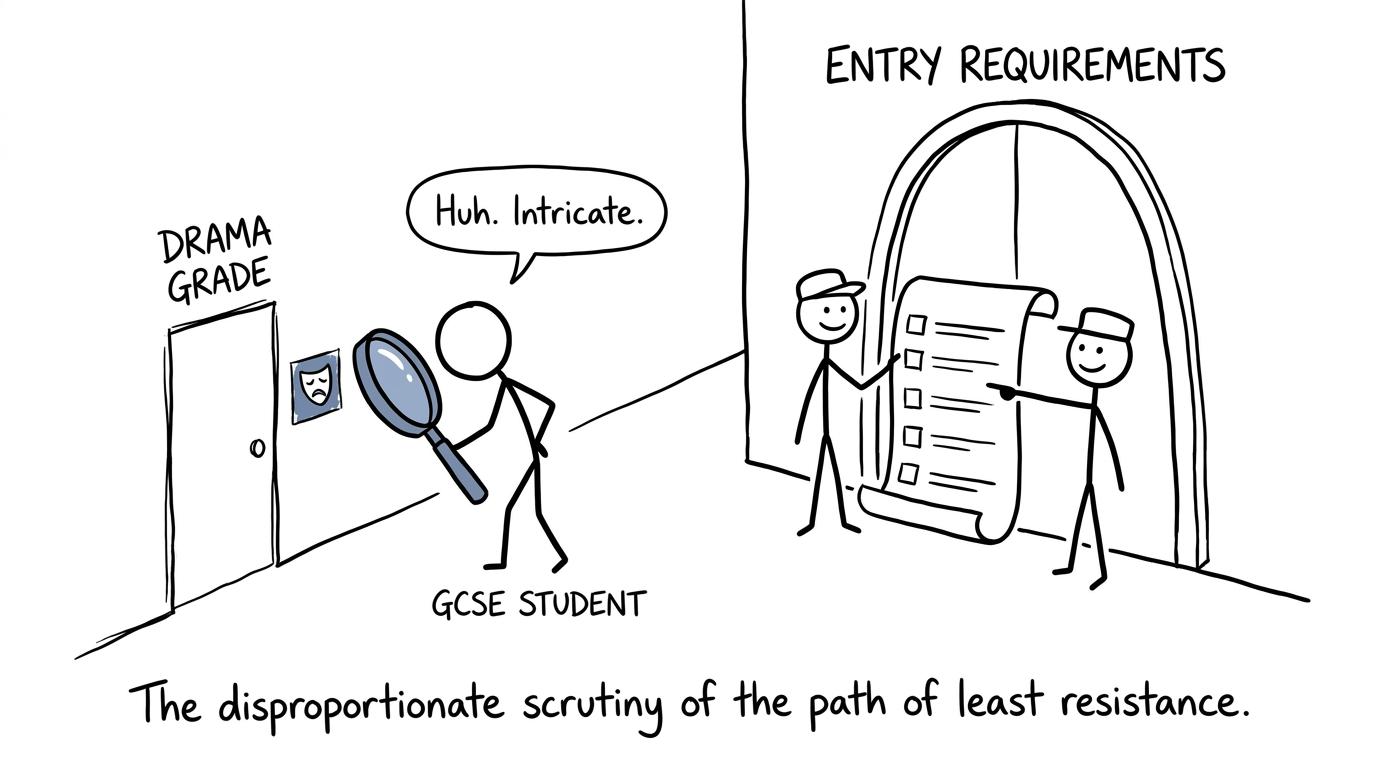 A student overlooks the large entry-requirements checklist while inspecting one Drama grade
How sixth forms and colleges assess GCSE results
Admissions decisions are rarely based on one isolated grade. Providers normally look through several layers of requirements.
General entry requirements
A sixth form may require a certain number of GCSEs within a stated grade range. For example, its published policy might ask applicants to hold five GCSEs at grade 444, grade 555 or above, sometimes including a specified number of grades at 666 or higher.
These thresholds vary considerably. Some providers calculate an average from a student's best results, while others simply count how many qualifications meet the required standard.
Drama may count towards this overall total if it is an accepted GCSE. In that situation, the provider is not necessarily giving Drama special importance. It is treating the result as one part of your broader academic profile.
Maths and English requirements
Maths and English appear frequently in general admissions criteria. In England, there is also a government funding condition requiring eligible students on relevant post-161616 programmes who have not achieved grade 444 or above in GCSE Maths or English to continue studying the subject they still need. The exact arrangements differ outside England.
That is one reason a Maths result can affect both course access and your post-161616 timetable more directly than an unrelated Drama result.
If Maths is one of your priorities, begin with the GCSE Maths revision hub. It brings together revision lessons, questions and board-specific resources for foundation and higher tier.
Subject-specific requirements
The next layer concerns the subjects you plan to take. A provider can set requirements above its general threshold.
A Level Maths, for instance, frequently requires a stronger GCSE Maths grade than the minimum needed for sixth-form admission. Current published policies show that requirements such as grade 666 or 777 are common, although the exact grade is set locally. Further Maths may demand an even higher result.
Science, Economics, Psychology and Computer Science courses may also specify particular Maths, English or Science grades. Check each subject separately rather than assuming that meeting the general entry requirement guarantees every course choice.
The GCSE Maths topics by exam board and tier guide can help you confirm what to revise for Edexcel, AQA, OCR or Eduqas.
When your GCSE Drama grade carries real weight
You want to study A Level Drama
This is the clearest case. Some sixth forms currently ask for a particular grade in GCSE Drama, often alongside an English requirement. Others state that the Drama requirement applies only if you studied the subject at GCSE.
There are also providers that accept applicants without GCSE Drama. They may use an audition, evidence of performance experience, an English grade or a discussion with the department to judge suitability.
So a lower Drama grade does not create one universal outcome. It creates a question to ask:
What does this particular provider require for this particular course in my year of entry?
Read the current course page and admissions policy. If the wording is unclear, contact the admissions team before choosing courses or abandoning an application.
You are applying for performing arts
Vocational performing arts courses can assess practical potential differently from traditional A Levels. An audition, interview, portfolio or evidence of theatre experience may form part of the process.
That does not make the GCSE grade irrelevant. It means the grade is one piece of evidence rather than automatically the deciding factor. Follow the provider's published instructions carefully, including any audition deadlines.
Drama is needed for your overall GCSE total
Suppose a college requires a set number of GCSEs at or above a particular grade. If your other results already satisfy that threshold, Drama may add little to the decision. If Drama is one of the results you need to reach the total, it matters more.
This is why the same grade can have different consequences for two applicants. The grade has not changed. Its role within the entry criteria has.
The provider uses an average score
Some selective or oversubscribed sixth forms calculate an admissions score across a specified number of GCSEs. In such a system, a Drama result may contribute to the average if the policy includes it.
Do not calculate your own score using assumptions. Check which qualifications count, how many results are included and whether English and Maths must form part of the calculation.
When Drama is unlikely to decide the outcome
If you intend to study Maths, Physics and Computer Science, admissions staff are more likely to focus on the grades named in those course requirements. A grade in Drama may still be visible and may count towards the general threshold, but it is not normally evidence of whether you are ready for A Level Maths.
Similarly, one weaker result does not automatically cancel an otherwise suitable application. Providers commonly consider whether you have met both the overall criteria and the requirements for your chosen subjects. Competitive admissions and oversubscription rules can be stricter, so the written policy remains important.
Conditional offers may initially use predicted grades, but places and course choices are commonly checked against achieved results after GCSE results day. Treat predicted grades as planning information, not a substitute for the final entry conditions.
Why Maths deserves careful attention
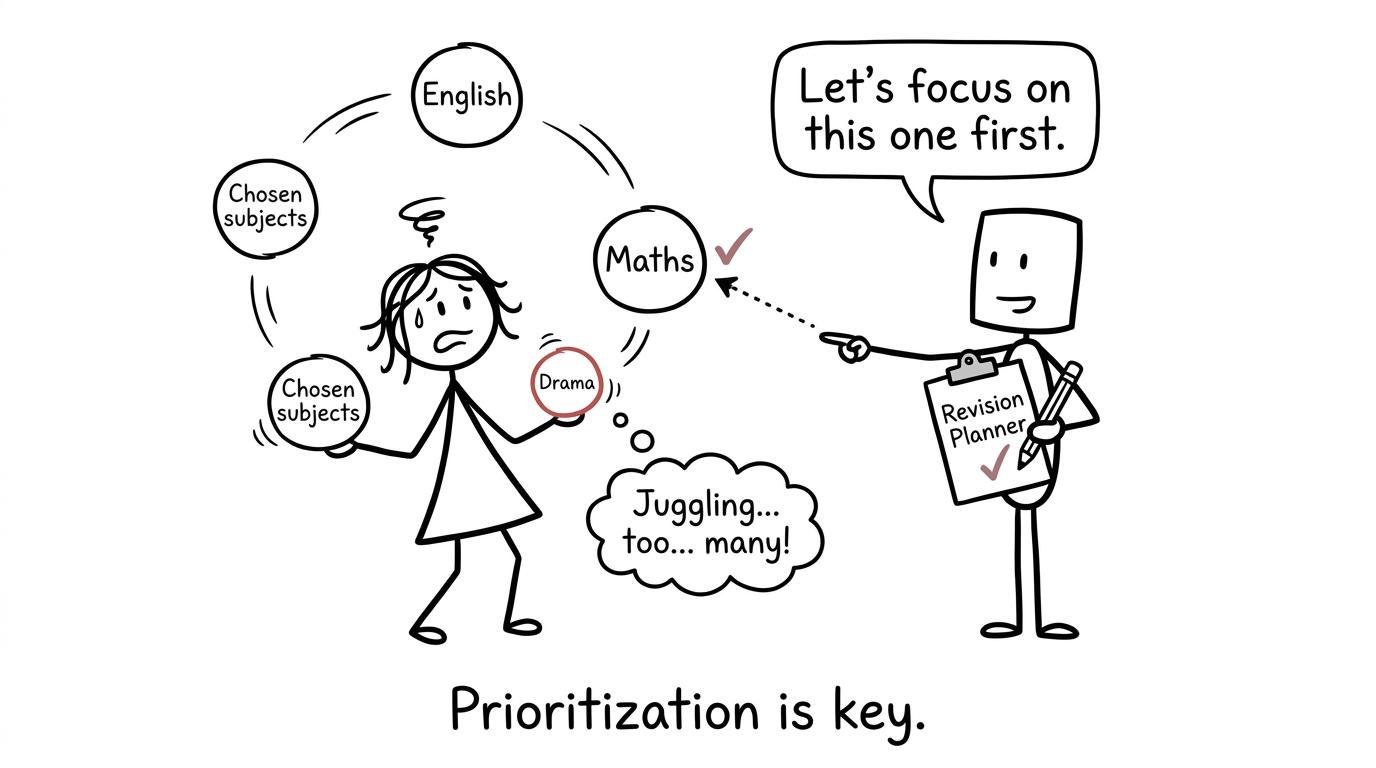 A student juggles Maths, English, chosen subjects and Drama while a planner suggests one priority at a time
This is not an argument that Drama is unimportant. Creative subjects develop valuable performance, collaboration, interpretation and communication skills. It is an argument about admissions leverage.
Maths often sits in more than one part of the decision:
- the provider's general entry criteria;
- the requirements for A Level Maths or Further Maths;
- entry requirements for some science and numerical subjects;
- continued post-161616 study requirements in England if grade 444 has not yet been achieved.
Your best response is not to panic about every subject equally. It is to identify the grades that unlock your intended route, then allocate revision time accordingly.
Use the one-month GCSE Maths revision plan if you need a manageable weekly structure. If you are unsure where marks are disappearing, the guide to finding your weakest GCSE topics turns paper results into a focused repair list.
A practical application checklist
Check the provider, not a rumour
For every sixth form or college on your list, record:
- its general GCSE entry threshold;
- the required Maths and English grades;
- the requirement for each intended subject;
- whether Drama is included in an average or GCSE count;
- whether an audition, portfolio or interview is required;
- what happens if a result falls narrowly below the stated grade;
- which year's admissions policy you are reading.
Policies can change between entry years. Advice from an older sibling may have been accurate for them and still be wrong for you.
Build a sensible range of choices
Apply to routes whose published requirements match your likely grades, while keeping an alternative course combination available. An ambitious choice can be reasonable, but it should not be your only plan.
If A Level Maths is part of that plan, practise with resources matching your board. MathsGenie provides AQA GCSE Maths past papers, an OCR GCSE Maths revision hub and Edexcel GCSE Maths mini tests.
Ask early when circumstances are unusual
Contact the provider if you did not take Drama but want to study it, experienced documented mitigating circumstances, need to clarify an audition route or cannot tell whether your qualification counts towards the total.
Ask a precise question and keep the reply. Admissions teams can explain their own policy more reliably than online speculation.
Common mistakes to avoid
Assuming every sixth form uses the same grades
There is no single national entry threshold for every A Level provider. Compare the current criteria for each institution and course.
Treating a grade 444 as automatic entry everywhere
Grade 444 is significant in the GCSE grading system and in England's post-161616 Maths and English funding condition, but a provider may set higher general or subject-specific requirements.
Focusing on Drama while ignoring the chosen subjects
If you want A Level Maths, the GCSE Maths requirement is likely to be far more important than an unrelated Drama grade. Direct revision towards the conditions that unlock your course.
Assuming a predicted offer is unconditional
An application may be discussed using predicted grades, but achieved GCSE results can determine whether you meet the final course conditions.
Doing papers without learning from them
A paper only helps when it changes your next revision session. Read about when to start GCSE past papers, mark each attempt carefully and repair the topics that cost marks. Nearer the exams, Edexcel predicted papers can add realistic timed practice for students on that specification.
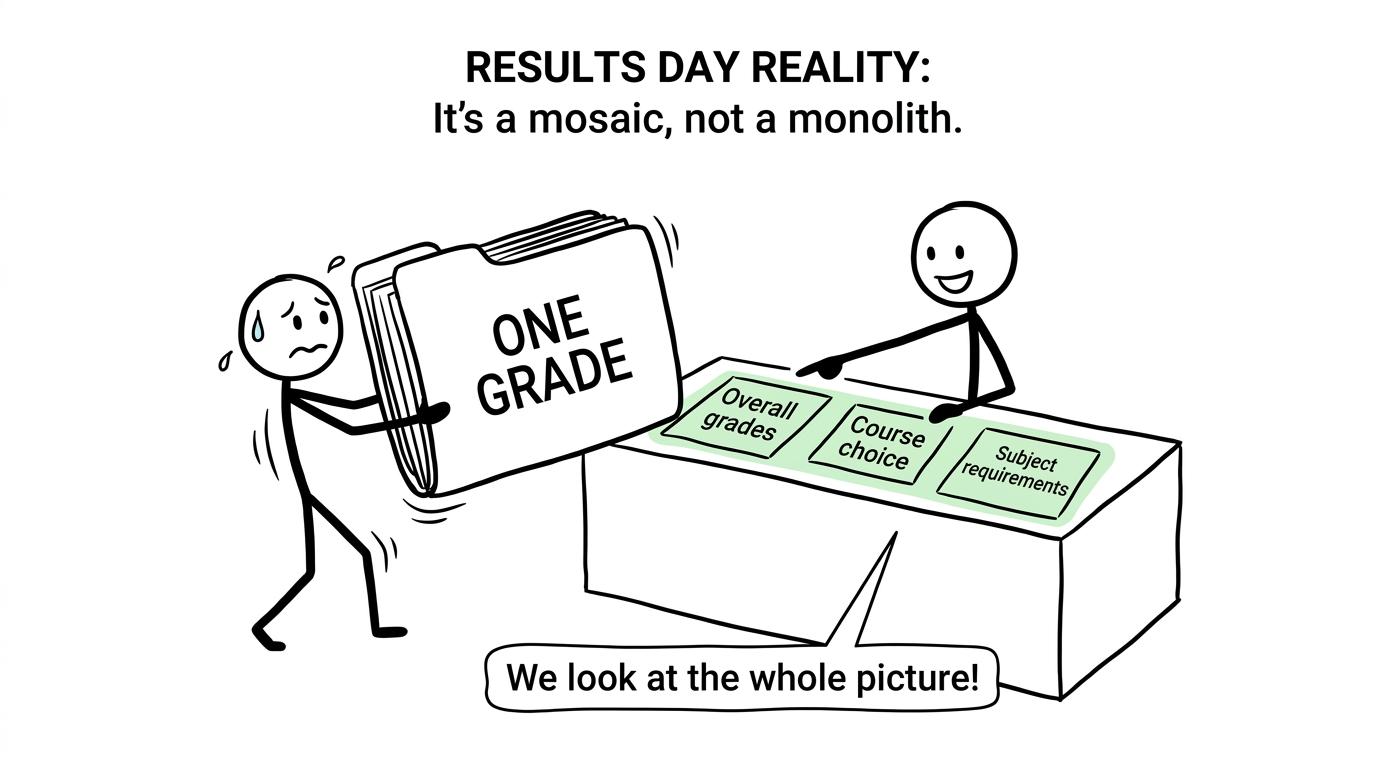 On results day, an admissions adviser shows that one grade is only part of the wider picture
One grade is evidence, not your whole future
Your GCSE Drama result can matter, especially for Drama, Theatre Studies, performing arts or an overall GCSE threshold. But for most unrelated A Level choices, it carries less weight than the provider's general conditions and the grades attached directly to your chosen subjects.
Make the decision smaller. Check each policy. Highlight the essential grades. Ask when something is unclear. Then spend your revision time where it can open the most doors.
For Maths, start with MathsGenie's free GCSE revision lessons and practice questions, then move into mini tests, past papers and predicted papers. Use the mark schemes and video solutions to turn each lost mark into a specific next step. The goal is not to make every result feel equally frightening. It is to understand which results matter for your route, and improve the ones still within your control.











