

GCSE D&T Revision: Silence or Background Noise?
GCSE design and technology revision silence or noise? Explore the evidence, match sound to each task and discover which setting supports recall best.
Revision can look productive while very little is sticking. The playlist is running, your notes are open and an hour passes pleasantly. Then you close the book and struggle to recall what you read.
So, for GCSE design and technology revision, silence or noise, which is better? The most useful answer is straightforward: use silence for demanding reading, memorising, calculations and exam questions. Music with lyrics is particularly likely to interfere. Quiet instrumental music or steady background sound may make routine tasks feel easier, but the evidence does not show a reliable learning advantage.
This matters for maths students too. Design and Technology includes calculations, graphs, dimensions, ratios and material quantities, while maths revision demands the same careful attention. The right sound environment depends less on your favourite genre and more on what your brain is being asked to do.
The short revision checklist
Use this as your starting point:
- Choose silence for learning technical vocabulary, reading explanations and recalling facts.
- Avoid music with lyrics during language-heavy or memory-heavy work.
- Keep any instrumental sound quiet, predictable and familiar.
- Do past papers in silence to reproduce exam conditions.
- Treat white noise as a personal experiment, not a proven revision shortcut.
- Test your recall afterwards rather than judging the session by how enjoyable it felt.
- Keep your phone out of reach so choosing music does not become choosing notifications.
The aim is not to create a perfectly silent life. It is to stop sound from competing with the knowledge you need to retrieve.
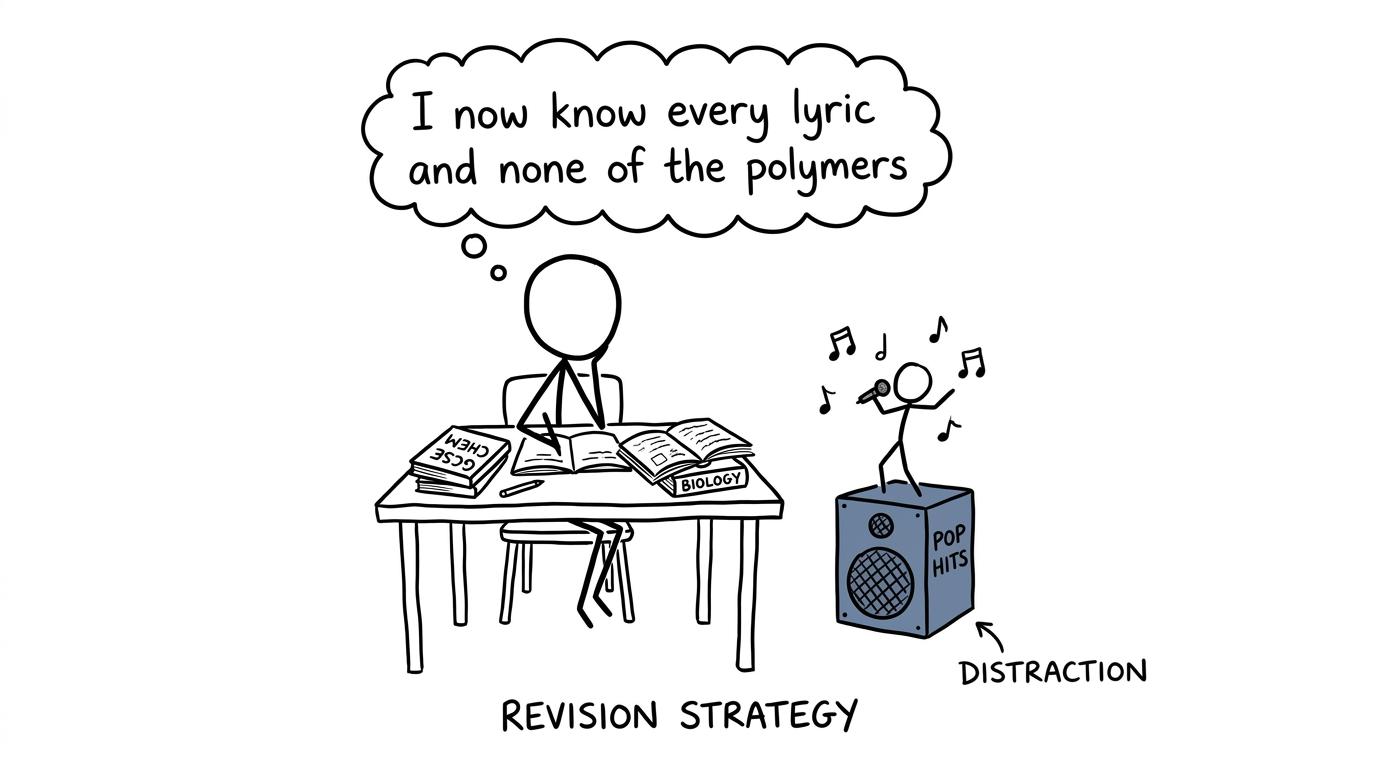 A student remembers every lyric but none of the polymers
What the evidence actually says about silence and noise
Research into background music and cognitive performance is not perfectly uniform. Different studies use different tasks, music, sound levels and participants. Much of the evidence also comes from adults rather than GCSE pupils, and very little examines Design and Technology revision specifically. Any universal claim that one soundtrack will transform everybody's grades should therefore be treated cautiously.
Even so, several patterns are reasonably consistent.
A systematic review covering ninety-five articles and more than one hundred and fifty experiments found that background music tended to be unhelpful for memory and language tasks. Music containing lyrics was generally more disruptive than instrumental music. Difficult tasks were also more vulnerable to interference than easy ones.
A controlled study published in 202320232023 compared silence, instrumental lo-fi music and music with lyrics across verbal memory, visual memory, reading comprehension and arithmetic. Performance was generally strongest in silence, between the two extremes with instrumental music, and weakest with lyrics. Instrumental music did not produce a credible overall improvement over silence.
More recent research into reading comprehension has similarly found that pop music with lyrics can reduce performance. Official education research reviews also recognise that ambient classroom noise may hinder concentration, particularly when irrelevant speech makes language harder to process.
The careful conclusion is not that all sound is always harmful. It is this:
Background sound provides no dependable academic boost, while lyrics and intelligible speech create a genuine risk of distraction.
That makes silence the safest default for serious revision. Instrumental music can remain an option when it helps you begin or persist, provided your later recall proves that it is not costing you accuracy.
Why Design and Technology revision is especially vulnerable
GCSE Design and Technology is not one type of thinking. In a single session, you might read about manufacturing processes, remember material properties, analyse a product, interpret a graph and calculate a quantity.
These activities place different demands on attention.
Reading and technical vocabulary
When you read about polymers, timbers, electronic systems or production methods, your brain is processing language. Song lyrics and nearby conversations use some of the same limited attention. You may continue moving your eyes across the page without building a clear memory of it.
Use silence when:
- learning definitions;
- comparing properties and processes;
- reading revision guides;
- planning an extended response;
- checking command words and mark schemes.
The GCSE Design and Technology revision hub brings together board-specific resources for AQA, Edexcel, Eduqas, OCR and WJEC. Open the correct board first, then remove competing speech before tackling its content.
Calculations and graphical information
Design and Technology papers can assess mathematical understanding in context. For example, the current AQA specification states that at least 15%15\%15% of its written examination assesses maths and at least 10%10\%10% assesses science. Exact assessment arrangements differ by board, so always check the specification you are taking.
Calculating areas, interpreting data, using ratios and working with dimensions all require you to hold intermediate information in mind. A sudden lyric, advert or change of track can interrupt that chain.
Silence is therefore the sensible choice for calculations. If the mathematical part of the subject is your weak point, use the free GCSE Maths revision hub to rebuild the relevant skills through lessons, questions and solutions.
Sketching and organising familiar notes
Not every task is equally demanding. Quiet instrumental music may be harmless while you organise completed notes, label an existing sketch or prepare materials for a later session. It can also mask unpredictable household sounds.
But there is an important distinction: feeling calmer is not the same as learning more. Once the task changes from organising information to understanding or retrieving it, lower the volume or switch the sound off.
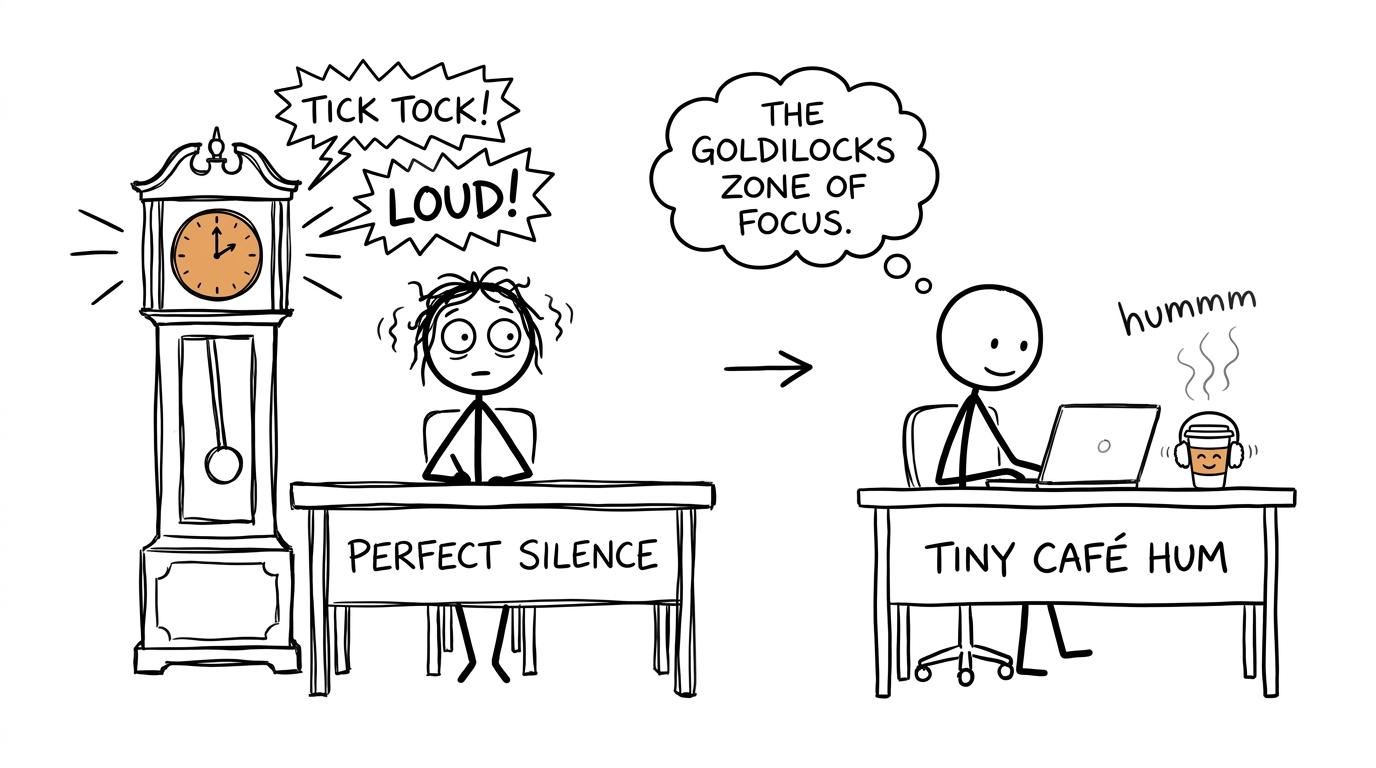 Two students discover that perfect silence and a tiny café hum create different distractions
Match the sound environment to the revision task
| Revision task | Best starting environment | Reason |
|---|---|---|
| Learning technical terms | Silence | Protects verbal memory from competing words |
| Reading a specification section | Silence | Supports sustained comprehension |
| Completing calculations | Silence | Reduces interruptions to multi-step thinking |
| Answering past-paper questions | Silence | Matches normal exam conditions |
| Marking with a mark scheme | Silence | Helps you notice precise wording and missed details |
| Organising familiar notes | Quiet instrumental sound may be acceptable | The cognitive demand is usually lower |
| Sketching an already-developed idea | Quiet instrumental sound may be acceptable | Sound may support persistence without adding language |
| Working near unpredictable conversation | Ear defenders or steady neutral sound | Masking speech may be better than hearing every word |
This is a starting framework, not a personality test. The only convincing personal evidence is performance.
Run a fair test on your own revision
Students often choose music according to mood: “I concentrated well” or “that session went quickly”. Those feelings matter because revision must be sustainable, but they do not tell you what you retained.
Instead, compare two similar sessions:
- Choose two topics of roughly equal difficulty.
- Revise one in silence and one with your usual background sound.
- Keep the duration and revision method the same.
- After each session, close the materials and write what you can recall.
- Answer a short set of questions without notes.
- Mark both attempts strictly.
- Repeat the comparison on another day before deciding.
Do not switch playlists halfway through or test silence on the hardest chapter and music on the easiest. You are trying to compare conditions, not confirm a preference.
MathsGenie's guide to finding your weakest GCSE topics shows how marks can turn vague impressions into useful evidence. The same principle works here: judge a sound environment by recall, accuracy and completed questions.
Separate learning conditions from exam conditions
Background music may help some students sit down and start. An examination, however, will not come with a carefully selected playlist.
As your exam approaches, practise retrieving knowledge in silence. Complete timed sections without headphones, notifications or mid-question pauses. This builds familiarity with the conditions in which the knowledge must eventually appear.
The transition can be gradual:
- Early revision: use quiet instrumental sound only for lower-demand tasks if it helps you begin.
- Topic practice: move towards silence for retrieval and calculations.
- Timed sections: work in silence with only permitted equipment.
- Full papers: reproduce exam conditions as closely as practical.
The MathsGenie guide to starting GCSE past papers explains why paper practice should develop in stages. For shorter sessions, the twenty-minute GCSE revision routine provides a useful pattern of recall, questions and feedback.
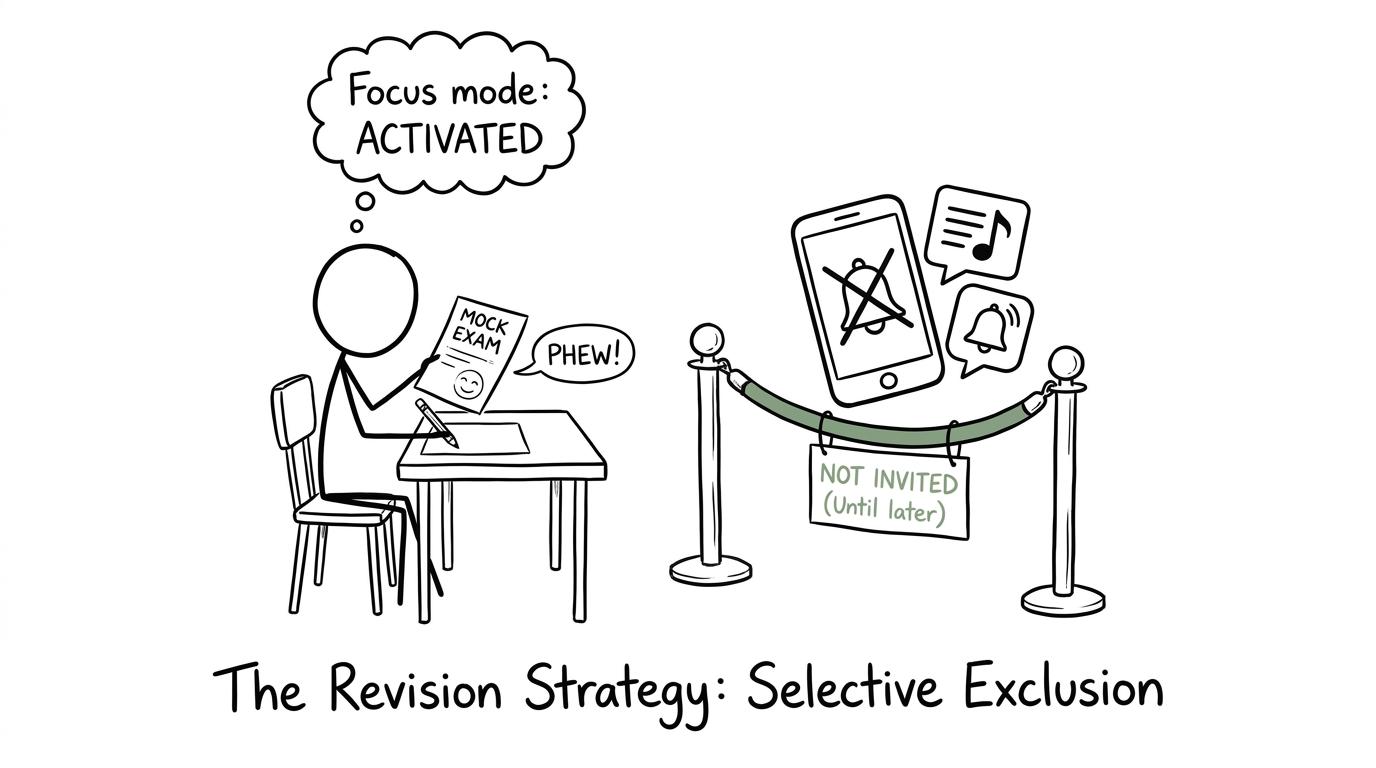 A mock examination keeps phones, playlists and notifications behind a velvet rope
What about white noise, brown noise and café sounds?
These sounds do not contain lyrics, so they are less likely to compete directly with reading than a song or nearby conversation. They may also mask unpredictable noises. That can make a difficult environment feel more stable.
However, there is not strong evidence that white or brown noise generally improves GCSE learning. Research involving pupils with ADHD has sometimes found reductions in off-task behaviour, but that does not automatically mean improved accuracy or task completion. Individual needs vary, and students with hearing, sensory or attention needs may benefit from guidance tailored by their school or an appropriate professional.
If neutral noise helps, keep it quiet and constant. It should disappear into the background. If you are adjusting it, noticing changes or wondering what will play next, it is no longer neutral.
Common mistakes when choosing revision sound
Assuming enjoyable revision must be effective
Music can improve mood while weakening recall. Always finish with closed-book retrieval or questions.
Using songs with familiar lyrics
Familiarity does not make words invisible. In fact, a favourite chorus may capture attention automatically.
Spending revision time managing a playlist
Searching, skipping and replying to notifications fragments attention. Choose the environment before the session and leave the phone elsewhere.
Using noise for every type of task
A soundtrack that feels harmless while drawing may interfere when you start reading technical explanations. Reassess whenever the task changes.
Never practising in exam conditions
Comfort matters during early revision, but retrieval must eventually survive silence and time pressure. The GCSE maths night-before plan also explains why calm, focused preparation is better than a final distracted marathon.
Treating silence as the revision method
A quiet room cannot rescue passive rereading. Effective revision still requires recall, exam questions and honest marking. If progress has stalled, use the structured advice in GCSE maths revision when you are stuck at a pass grade to build a repeatable learn, practise and review cycle.
Choose evidence over revision folklore
For demanding GCSE Design and Technology revision, silence is the best default. It is especially valuable for technical reading, memory, calculations, extended responses and past-paper practice. Lyrics and audible conversations are the clearest risks. Quiet instrumental or neutral sound may be reasonable for routine work, but it should earn its place through better recall, not merely a nicer atmosphere.
Start with the free MathsGenie Design and Technology resources, choose your exam board and complete a focused session in silence. Then test what remained. For the calculations that cross into maths, use MathsGenie's revision lessons, practice questions, mini tests, mark schemes and video solutions before moving to past papers and predicted papers.
The best revision environment is not the one that looks most productive. It is the one in which the right answer is still available when the room finally goes quiet.











