

GCSE Design and Technology: How Many Practice Papers?
GCSE design and technology how many practice papers? Aim for 4-6 timed sittings, spaced out with careful marking, targeted revision and error repair.
The first full practice paper often feels uncomfortable. The clock moves faster than expected, familiar facts become harder to retrieve, and a calculation that looked simple in class suddenly consumes five minutes. That discomfort is useful, but only if you respond to it properly.
If you are searching gcse design and technology how many practice papers, the realistic answer is: aim for 444-666 complete timed sittings before the written examination. Three carefully reviewed papers can still be worthwhile if time is short. More than 666-888 full papers rarely adds much unless each sitting exposes new weaknesses that you then repair.
The number is not a rule issued by an exam board. It is a practical target that balances exam stamina, coverage and feedback without allowing paper practice to consume all your revision time.
Your practice paper checklist
A strong plan should include:
- one early paper to diagnose knowledge and timing gaps;
- two or three middle-stage papers separated by targeted revision;
- one or two final papers in strict exam conditions;
- marking with the correct paper-specific mark scheme;
- an error log covering knowledge, calculations, command words and timing;
- short practice sessions between full sittings;
- at least one paper from your own exam board and specification.
The important pattern is not simply paper, paper, paper. It is:
paper, mark, diagnose, repair, retest.
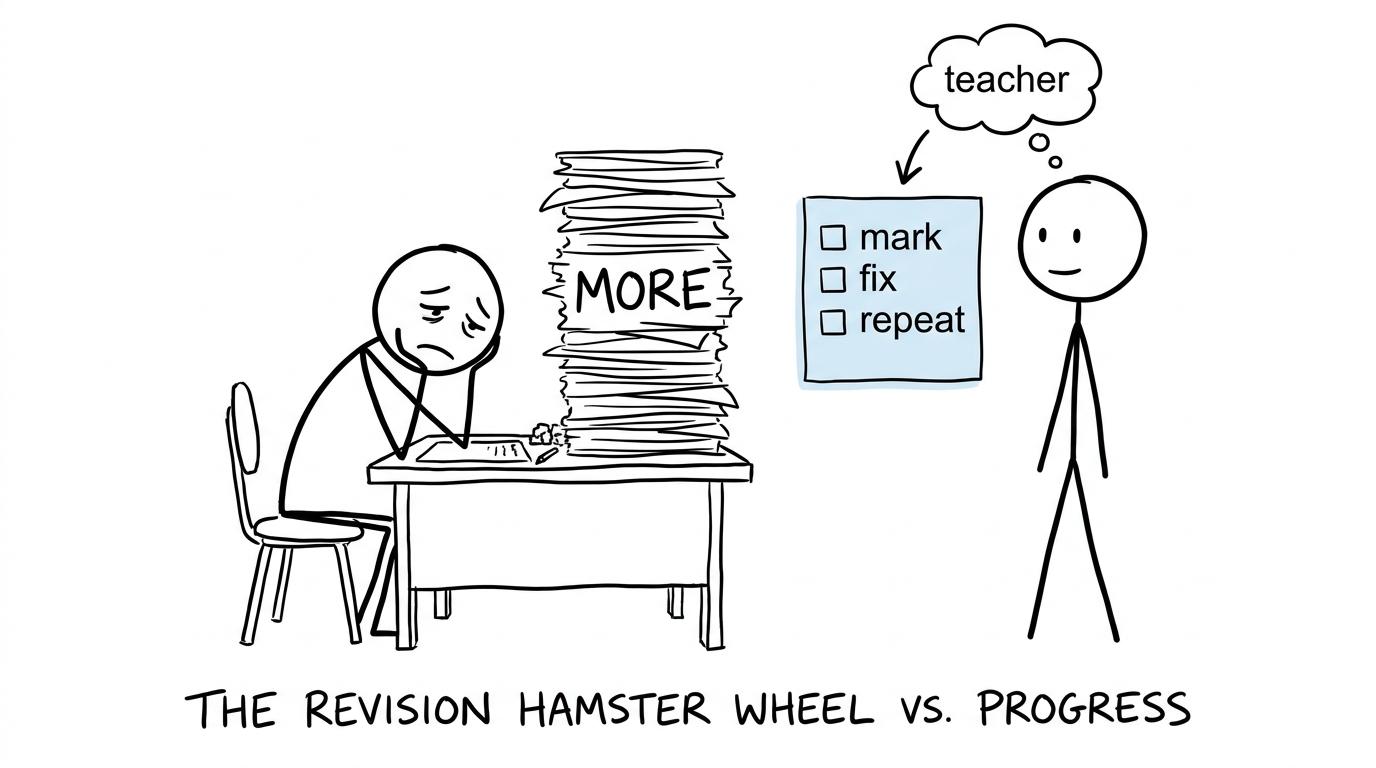 A student chooses careful review over an endless stack of papers
Why 444-666 timed papers is a sensible target
A full Design and Technology paper tests several things at once. You need technical knowledge, accurate calculations, interpretation of unfamiliar contexts, clear written analysis and enough stamina to keep making sensible decisions near the end.
One paper can reveal a problem, but it cannot show whether the problem is persistent. A second checks whether your first round of revision worked. Later papers help make timing and question selection more consistent.
The value of each sitting tends to change:
- Paper 111 establishes a baseline.
- Paper 222 checks whether you corrected the obvious gaps.
- Papers 333 and 444 build control over timing, calculations and extended responses.
- Papers 555 and 666 rehearse the complete performance under realistic conditions.
Educational research supports the broader principles behind this approach: retrieval is generally more useful than passive rereading, and practice spread across separate sessions supports longer-term retention better than the same work crowded into one block. It does not establish a universal perfect number of Design and Technology papers. That is why 444-666 should be treated as a planning range, not a promise.
Match practice to your exam board
Use papers that reflect the specification you are actually taking. GCSE Design and Technology is not divided into foundation and higher tiers, and the written examination contributes 50%50\%50% of the qualification under current Ofqual requirements. The other 50%50\%50% comes from non-exam assessment.
For AQA, OCR and Eduqas, the written paper is currently 222 hours and worth 100100100 marks. Pearson Edexcel's written examination is 111 hour 454545 minutes and also worth 100100100 marks. Structures and specialist material sections differ, so always check the front cover and current specification for your board.
At least 15%15\%15% of the written examination marks must reward mathematical skills used within a Design and Technology context. This is important: revising facts about materials will not, by itself, prepare you for every mark available.
Your full sittings should therefore use the correct:
- time limit;
- calculator and equipment rules;
- section structure;
- specialist material category where applicable;
- mark scheme from the same series.
Papers from another board can provide extra questions, but they should not replace realistic practice with your own board.
Space the papers so that learning can happen
Six papers completed over one weekend are not equivalent to six papers spread across several weeks. The first arrangement mostly measures fatigue. The second gives you time to change.
If you have six or more weeks, begin with one full timed paper every seven to ten days. Use the days between sittings for focused revision and shorter question sets. During the final two or three weeks, you might increase to one paper each week, provided you still have time to mark and repair it.
If you have only two weeks, do not force six sittings into the calendar. Two or three complete papers, plus timed sections addressing specific weaknesses, will usually be more useful than a rushed marathon.
Maths students can use the same phased approach described in when to start GCSE past papers: diagnose first, build performance through targeted work, then use full papers for realistic rehearsal.
What to do after every timed sitting
The score is the least interesting part of your first few papers. It tells you where you are, but not what to do next.
Mark the paper while your decisions are still fresh. For each lost mark, identify one main cause:
- knowledge; you did not know the material, process or principle;
- application: you knew the fact but could not use it in the context;
- mathematics: the formula, substitution, units or calculation failed;
- communication: the response lacked explanation, comparison or justification;
- timing: you knew enough but did not reach or complete the question;
- reading: you missed a command word, scale, unit or restriction.
Then choose the three most expensive weaknesses. Repair those before attempting another complete paper. A useful error log finishes each entry with a specific action, such as reviewing unit conversion, practising evaluation paragraphs or revisiting material properties.
MathsGenie's guide to using GCSE mark schemes effectively explains the same feedback principle: classify the lost mark, rebuild the response and return to the skill later. Mark schemes are not merely score sheets. They reveal what a rewarded response actually contains.
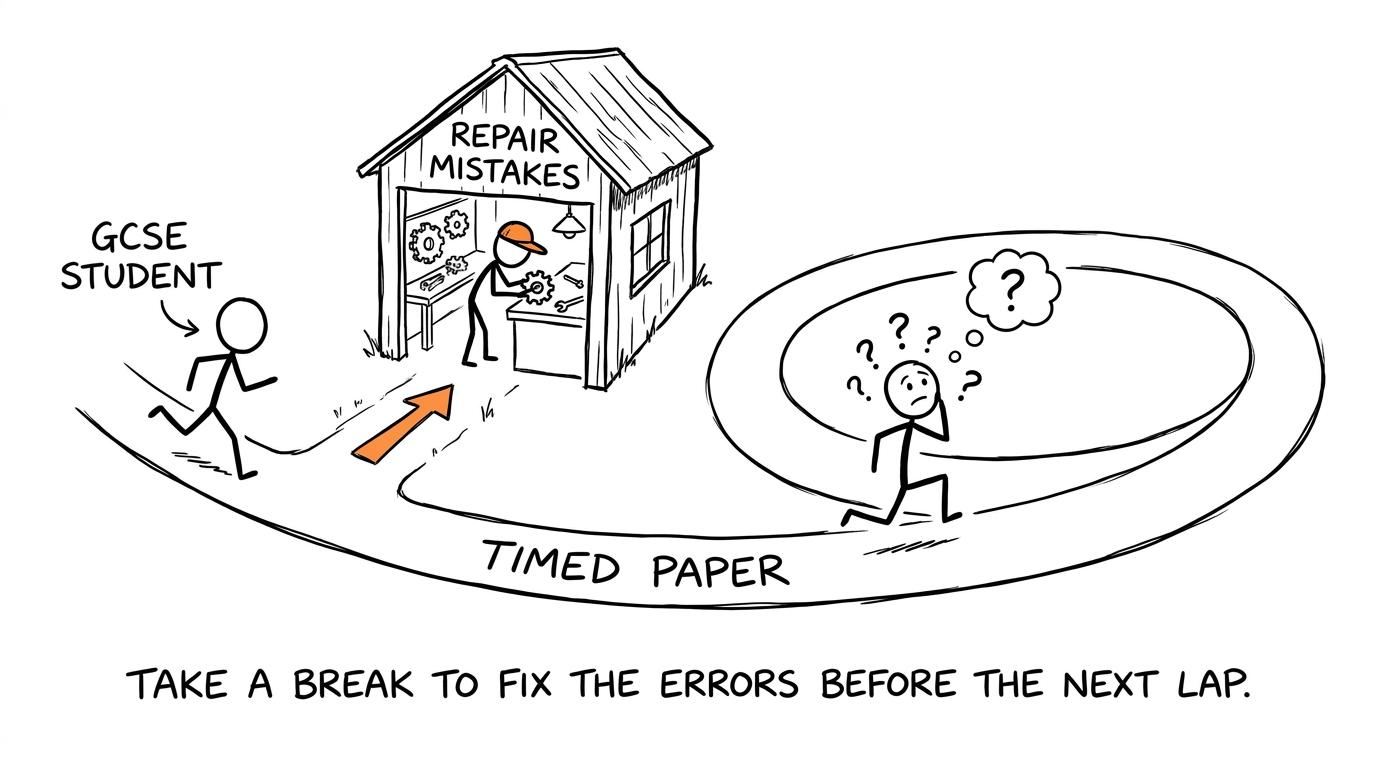 One student repairs mistakes while another keeps running paper laps
Use MathsGenie for the mathematical marks
MathsGenie is a maths revision website rather than a Design and Technology paper bank. Its value here is precise: it can help you repair the mathematical skills that D&T questions place inside practical contexts.
Common demands may include percentages, ratio, scale, unit conversion, area, volume, graphs and numerical comparison. The exact content and level of demand depend on the question and specification, so let your marked papers decide what to revise.
Start at the GCSE Maths revision hub, where you can choose your exam board and access revision lessons, worksheets, practice questions, mark schemes, videos and flashcards. Particularly relevant starting points include:
- Conversions and Units revision for changing measurements and checking final units;
- Area and Perimeter revision for questions involving dimensions and material use;
- the GCSE Maths topics by board and tier guide for locating wider skills such as ratio, percentages, scale drawings and volume.
Although D&T itself is untiered, your MathsGenie practice should match the level of maths you need to strengthen. Learn the method through a revision lesson, complete focused questions, check the solution, and then return to a D&T question where the skill appears in context.
When more practice papers stop helping
Another full sitting is useful when it answers a question you still need answered: Can you now finish on time? Have calculation errors reduced? Can you sustain extended responses? Do unfamiliar contexts still derail you?
More papers stop helping when:
- you repeatedly make the same mistakes without revising them;
- you mark only the final answers and ignore the reasoning;
- tiredness makes the sitting unrealistic;
- you have begun remembering answers from recently completed papers;
- full papers are replacing revision of known gaps;
- your scores and timing are stable, but you continue from anxiety rather than need.
At that point, switch to targeted sections, recall practice and correction work. You may gain more from twenty focused minutes on units or technical processes than from another two-hour performance containing only a few relevant questions.
This is also why predicted papers should be used carefully. In maths, GCSE predicted papers can add fresh exam-style practice after topic revision, but they are not forecasts that remove the need for broad specification coverage. The same principle applies to every subject: freshness is useful; guessing is not a revision strategy.
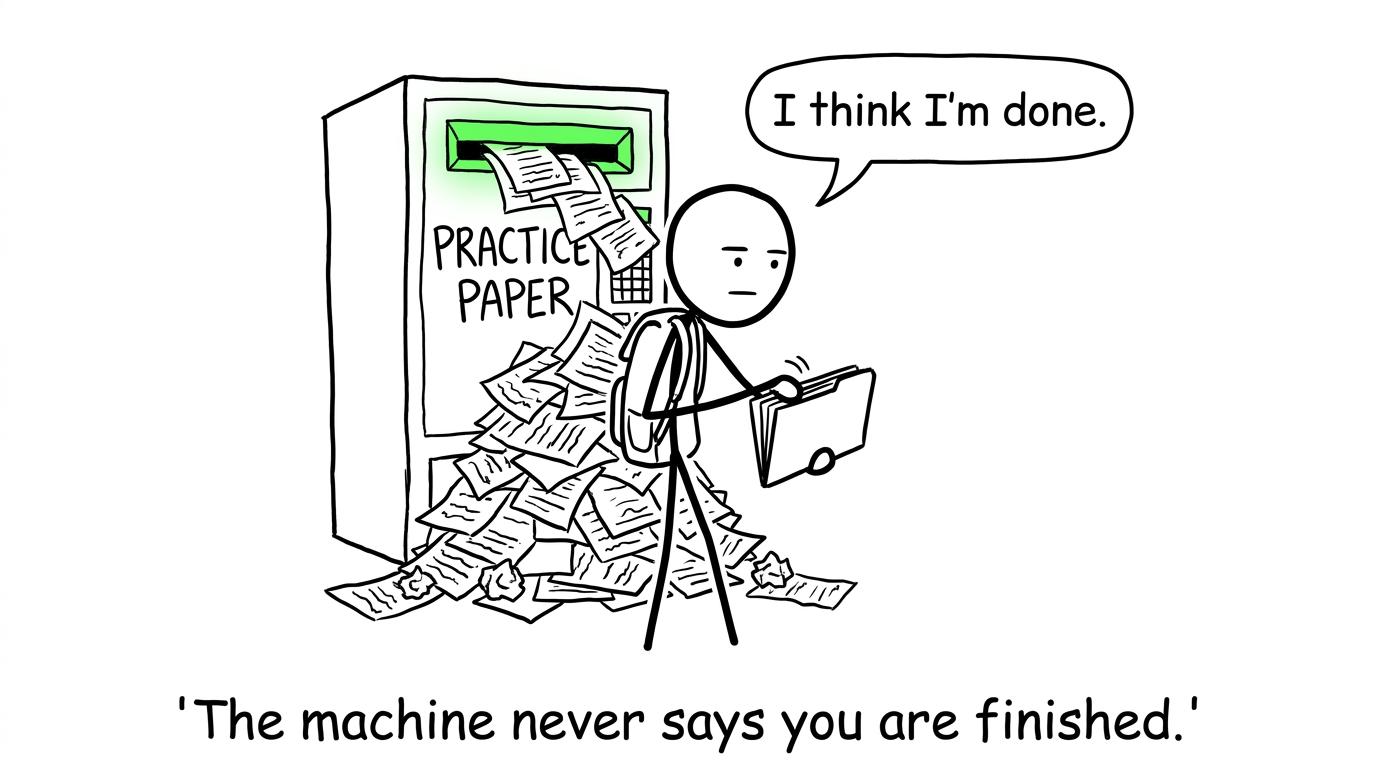 A practice paper machine keeps printing after the student is finished
Common mistakes with timed paper revision
Counting papers instead of improvements
Completing eight papers is not automatically better than completing four. Count repaired weaknesses, not just finished booklets.
Starting full papers before learning the content
Early diagnostic practice is useful, but repeated full papers cannot efficiently teach an entire specification. Use lessons, notes and topic questions first when a major area is unfamiliar.
Ignoring the mathematical questions
At least 15%15\%15% of written-exam marks reward maths in context. Practise selecting formulae, showing substitutions, retaining units and checking whether answers are sensible.
Using generous timing
Pausing the clock, checking notes or finishing later removes the main purpose of a timed sitting. If you need supported practice, call it a learning paper. Save the label “timed paper” for genuine exam conditions.
Doing the final paper too late
A full sitting on the night before the examination leaves almost no useful repair time. The GCSE maths night-before plan offers a transferable principle: use short, focused practice, prepare your equipment and protect your sleep rather than attempting an exhausting final marathon.
Finish with evidence, not exhaustion
Your goal is not to reach the largest possible paper count. It is to arrive knowing that you can manage the clock, interpret the context, apply your knowledge and recover when a question feels unfamiliar.
For most students, 444-666 full timed Design and Technology papers is enough to build that evidence. Use fewer if your timetable is short, but review them deeply. Go beyond six only when the feedback still changes what you do.
Then let MathsGenie strengthen the maths beneath your D&T calculations. Use the free revision lessons and practice questions to repair weak methods, mini tests to check recall, and past papers, predicted papers, mark schemes and video solutions to improve your wider GCSE maths performance. Start with the MathsGenie GCSE revision resources, choose one weakness, and make your next timed paper meaningfully different from the last.











