

Is a GCSE Dance Revision Bootcamp Worth It?
GCSE dance revision bootcamp costs can vary. Learn what courses offer, how to judge their value and when free, focused revision may work better.
Revision courses are easy to sell because they offer something every stressed student wants: the feeling that someone else has organised the problem. A GCSE dance revision bootcamp may provide expert feedback, structured theory revision and focused practical rehearsal. But it is only worth paying for when it addresses a specific weakness that school support and independent practice cannot fix.
That is the short answer. A good course can be valuable, particularly if you need informed feedback on performance, choreography or written analysis. A generic holiday dance camp, however, may improve your enjoyment and fitness without preparing you for the assessment objectives in your GCSE Dance specification.
For students balancing Dance with foundation or higher tier maths, the wider question matters too: will the course improve your Dance marks enough to justify its cost, travel time and impact on revision for other subjects?
The quick bootcamp value checklist
Before booking, check whether the course:
- names the GCSE Dance specification it teaches
- separates performance, choreography and dance appreciation
- includes individual feedback rather than lectures alone
- teaches the command words and response structures used in the written paper
- covers the correct professional works for your specification
- explains class size, tutor experience and contact hours
- provides a clear timetable and cancellation policy
- leaves enough time for maths and your other GCSE subjects
- offers something you cannot already receive from your teacher
If several of these details are missing, pause before paying. A polished advert is not evidence of specification-matched teaching.
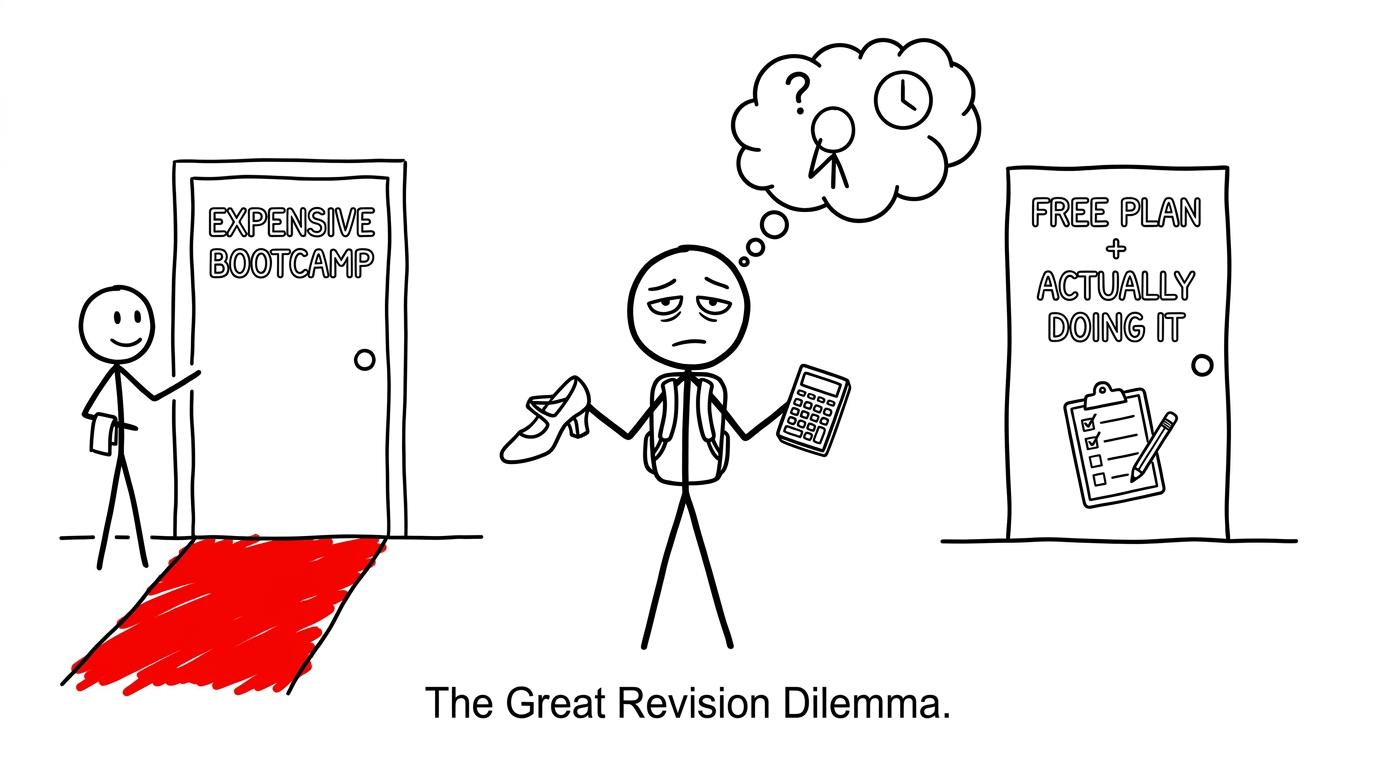 A student choosing between an expensive bootcamp and a practical revision plan
What GCSE Dance revision bootcamps actually offer
The phrase “bootcamp” is not a standard qualification term. Providers may use it for anything from a short online theory class to several days of studio training. Some holiday courses are designed around examination preparation; others are general dance intensives for young performers.
That difference is crucial.
A genuine GCSE revision course should connect its activities to the relevant specification and assessment criteria. For example, the current AQA GCSE Dance specification includes performance and choreography as a practical component worth 60%60\%60%, while dance appreciation is a written component worth 40%40\%40%. The written paper lasts 111 hour 303030 minutes and is marked out of 808080.
A specification-focused bootcamp might therefore include:
Written dance appreciation preparation
Useful theory sessions may cover choreographic processes, performing skills, critical appreciation of a student's own work and critical appreciation of the professional works in the GCSE Dance Anthology.
Strong courses should move beyond copying notes. They should help students interpret command words, select precise evidence and build analytical, interpretative and evaluative judgements. Timed questions followed by specific feedback are more valuable than simply hearing the content again.
Performance coaching
Practical sessions may focus on physical, technical, expressive and mental skills. Depending on the specification, this could include accuracy, timing, spatial awareness, projection, movement memory and communication of choreographic intent.
The important word is feedback. Repeating a phrase for two hours is not automatically productive. A tutor should identify what is limiting the performance, explain how that connects to the assessment criteria and give the student time to apply the correction safely.
Choreography support
A bootcamp may explore responses to stimuli, choreographic intention, motif development, structure, aural setting and choreographic devices. It should teach students how to make and justify their own decisions rather than create assessed work for them.
Because choreography forms part of non-exam assessment, students should ask their school what external support is appropriate. Their teacher remains the best source of guidance about the conditions under which assessed work must be completed.
Mock questions and revision materials
Some providers include booklets, model structures, quizzes or mock papers. These materials have value only when they match the current specification. Before booking, ask whether resources are included in the price and whether students receive feedback on completed responses.
A revision bootcamp is not the same as a dance camp
A holiday dance camp may offer ballet, contemporary, jazz, conditioning, routines, guest teachers and a final performance. Those experiences can be enjoyable and may develop general confidence or technique. They do not necessarily teach GCSE Dance.
A simple test is to inspect the timetable. If it does not mention the relevant assessment objectives, written appreciation, the set professional works or examination technique, treat it as an enrichment course rather than revision.
Neither type of course is inherently better. They simply have different purposes. Trouble begins when a family pays for enrichment while expecting a direct improvement in examination performance.
When paying is genuinely worthwhile
A bootcamp is most likely to represent good value in a few specific circumstances.
You have a clearly diagnosed weakness
Perhaps your practical work is secure but your written responses remain descriptive. Perhaps you know the professional works but struggle to select evidence under timed conditions. Or perhaps recurring feedback shows that your expressive skills are not communicating the intended meaning.
A precise problem makes it possible to judge whether the course provides a precise solution. This is the same principle that makes finding your weakest GCSE topics more effective than revising everything indiscriminately.
The tutor provides individual, specialist feedback
Small-group or individual feedback can be difficult to reproduce through a revision guide. It may justify the fee if the tutor understands the specification, watches each student closely and gives actionable advice.
Ask how many students will attend and how much individual feedback each person receives. “Interactive” can mean many things.
Your school has limited Dance provision
Some students receive less specialist contact time than others, particularly when classes are small or facilities are limited. A carefully chosen course may fill a genuine gap. Speak to your Dance teacher first: they can often tell you whether the provider's content is relevant and where additional support would help most.
The course creates accountable practice
Structure can have real value. A booked session establishes a time, place and task. Yet accountability is worth buying only if it leads to better practice. Attendance alone is not progress.
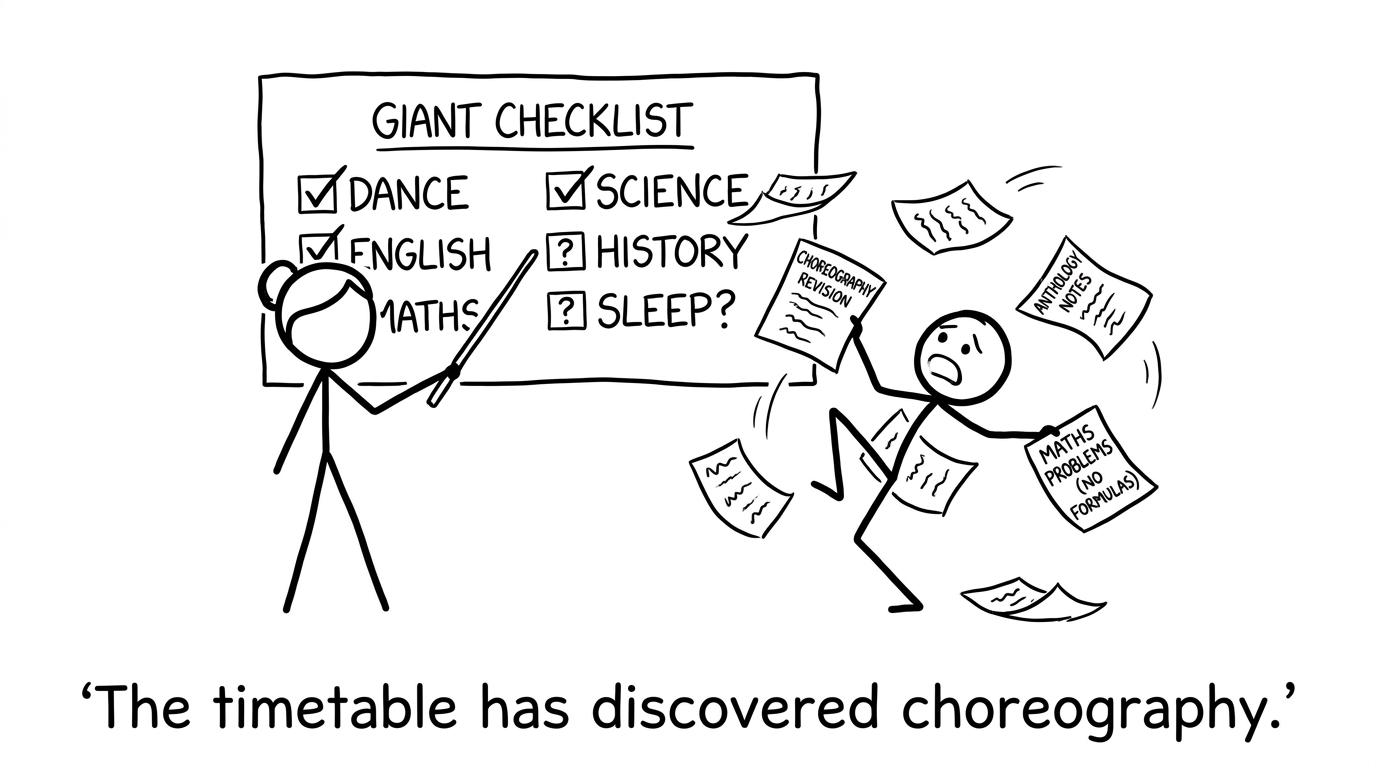 A revision timetable discovering choreography while a student balances GCSE subjects
When a bootcamp is probably not worth the cost
The course may be poor value if you are booking because revision feels frightening rather than because the programme solves a known problem.
Be cautious when:
- the advert says “GCSE” but does not identify the specification
- most of the timetable is generic technique training
- recorded videos are presented as personalised tuition
- there is no opportunity to submit work or receive feedback
- the tutor promises a particular grade
- the course duplicates support already available at school
- travel consumes a large part of the holiday
- paying would create financial pressure at home
- it removes time from weaker or more heavily examined subjects
No responsible provider can guarantee a grade. Your final result depends on several assessed elements, your existing preparation and what you do after the course.
How to compare the real cost
Do not compare headline prices alone. Compare what you receive.
You can calculate the basic cost per taught hour using:
Cost per taught hour=course feelive taught hours\text{Cost per taught hour}=\frac{\text{course fee}}{\text{live taught hours}}Cost per taught hour=live taught hourscourse feeThen include travel, accommodation, meals or required materials:
Total cost=fee+travel+extras\text{Total cost}=\text{fee}+\text{travel}+\text{extras}Total cost=fee+travel+extrasThe cheapest hourly rate is not automatically best. A focused session with individual feedback may be more useful than a longer course dominated by activities you do not need. Equally, a premium venue does not make teaching more relevant.
Ask for the full timetable before paying. Find out whether breaks, independent tasks and performances are being counted as tuition. Check cancellation terms and whether the fee includes resources or follow-up support.
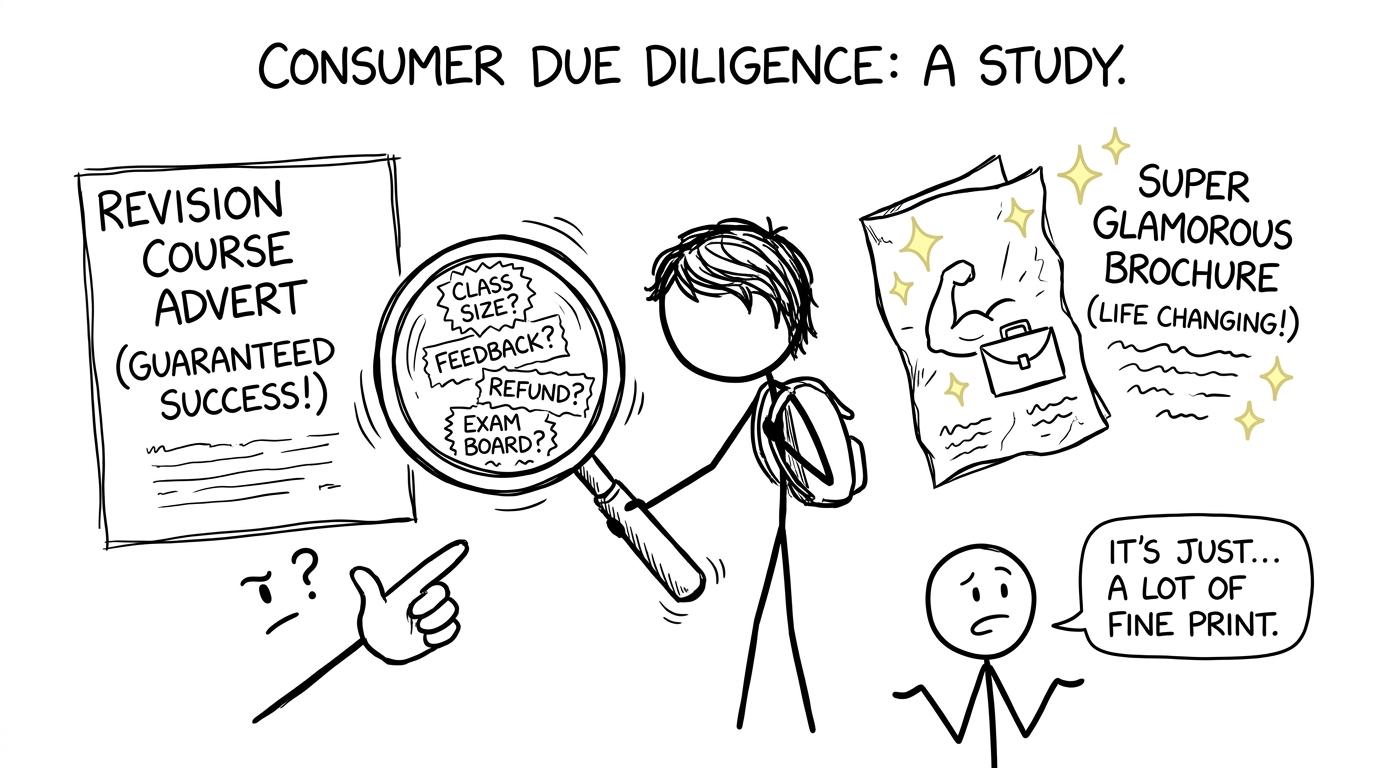 A student investigating the small print on a glamorous revision course advert
Protecting your maths revision during a Dance course
A Dance bootcamp occupies more than its advertised hours. There is travel, preparation and physical fatigue. That does not mean you should avoid it, but your timetable needs to acknowledge the true commitment.
Keep maths moving with short, deliberate sessions. The MathsGenie GCSE maths revision hub organises free resources by exam board, including Edexcel, AQA, OCR and Eduqas. Check your board and tier before choosing work.
On practical-course days, a focused routine is enough:
- revisit one weak maths skill using a revision lesson
- complete a short set of practice questions
- mark the work immediately
- record one error to repair later
The 20-minute GCSE maths revision routine is useful when your day is already full. On quieter days, use GCSE maths past papers to develop timing and identify gaps.
Near the examination period, Edexcel GCSE maths predicted papers can provide fresh exam-style practice for Edexcel students. Predicted papers should supplement specification coverage and real past papers, not replace them.
If the holiday course lasts several days, adapt the one-month GCSE maths revision plan around it. Place lighter retrieval sessions on intensive Dance days and longer paper practice elsewhere.
Questions to ask the provider before booking
Send a short list of direct questions:
- Which GCSE Dance specification does the course follow?
- Which assessment components will be taught?
- Is this examination revision or a general dance intensive?
- What is the maximum class size?
- What individual feedback will each student receive?
- Are written responses marked?
- Are resources included?
- What qualifications and specification experience does the tutor have?
- What happens if the course is cancelled or the student cannot attend?
Clear providers should be able to give clear answers. If the response relies mostly on phrases such as “boost confidence” or “unlock potential”, ask for the teaching detail underneath them.
Common mistakes when choosing a revision course
Booking before diagnosing the problem
Without a known weakness, it is impossible to tell whether the course content is relevant. Review school feedback and recent written work first.
Assuming expensive means personalised
Price, class size and feedback are separate facts. Verify each one.
Confusing activity with exam preparation
A busy day can feel productive while avoiding the exact skills assessed. Look for timed writing, specification language and feedback linked to criteria.
Ignoring the opportunity cost
Every course uses time that could go elsewhere. A student with major maths gaps may gain more from maintaining regular maths practice alongside targeted Dance support than from spending an entire holiday on one subject.
Expecting the bootcamp to finish revision
The course is an intervention, not a complete strategy. Notes and feedback only become useful when they are revisited and applied afterwards.
Make the decision based on evidence
A GCSE dance revision bootcamp is worth the cost when it matches your specification, targets an identified weakness and provides expert feedback you cannot easily obtain elsewhere. It is less convincing when it is a generic holiday camp carrying an examination label, or when its main benefit is making revision feel temporarily organised.
Ask what will be taught. Check the real cost. Protect time for your other subjects. Then decide whether the course changes what you can do, not merely how busy your calendar looks.
For maths, you do not need to buy a bootcamp to build that structure. Start with MathsGenie's free GCSE revision resources, learn through revision lessons, practise with topic questions and mini tests, then test yourself using past papers, mark schemes, video solutions and predicted papers. The best revision plan is rarely the most dramatic one. It is the one that gives you clear feedback and keeps working after the holiday ends.











