

GCSE Dance Exam Season Results: Does Timing Matter?
GCSE dance exam season results explained: whether summer or winter changes grades, what exam-series data means, and how to plan revision fairly.
A calendar can become surprisingly persuasive when exams feel uncertain. Summer looks crowded, warm and exhausting. Winter appears quieter, with more time to prepare. It is natural to wonder whether GCSE dance exam season results reveal an easier time to sit the qualification.
The short answer is no. Under the current AQA GCSE Dance specification, the written assessment is set in the summer of the certification year, so students do not normally choose between a summer and winter GCSE Dance paper. More broadly, where two assessment periods genuinely are available, there is no sound basis for assuming that one season automatically produces a better grade. Exam boards set boundaries to reflect assessment demand, while differences in published results can reflect the students entering each series rather than the month itself.
For maths students, there is an important contrast: GCSE Mathematics is available in a November series in England for eligible students aged 161616 or over, but that does not make November an easier version of the qualification.
The answer at a glance
Before comparing summer and winter, check these five things:
- Is there actually a choice of exam series? GCSE Dance is normally certified through the summer series.
- Are you comparing the same specification? Different qualifications, countries and assessment models cannot be treated as interchangeable.
- Are the students comparable? Summer entrants and later entrants may have very different ages, prior results and reasons for sitting.
- Are you looking at marks, grade boundaries or grade percentages? They answer different questions.
- Which factors can you control? Preparation, feedback, attendance, recovery and revision quality matter more than the season on the calendar.
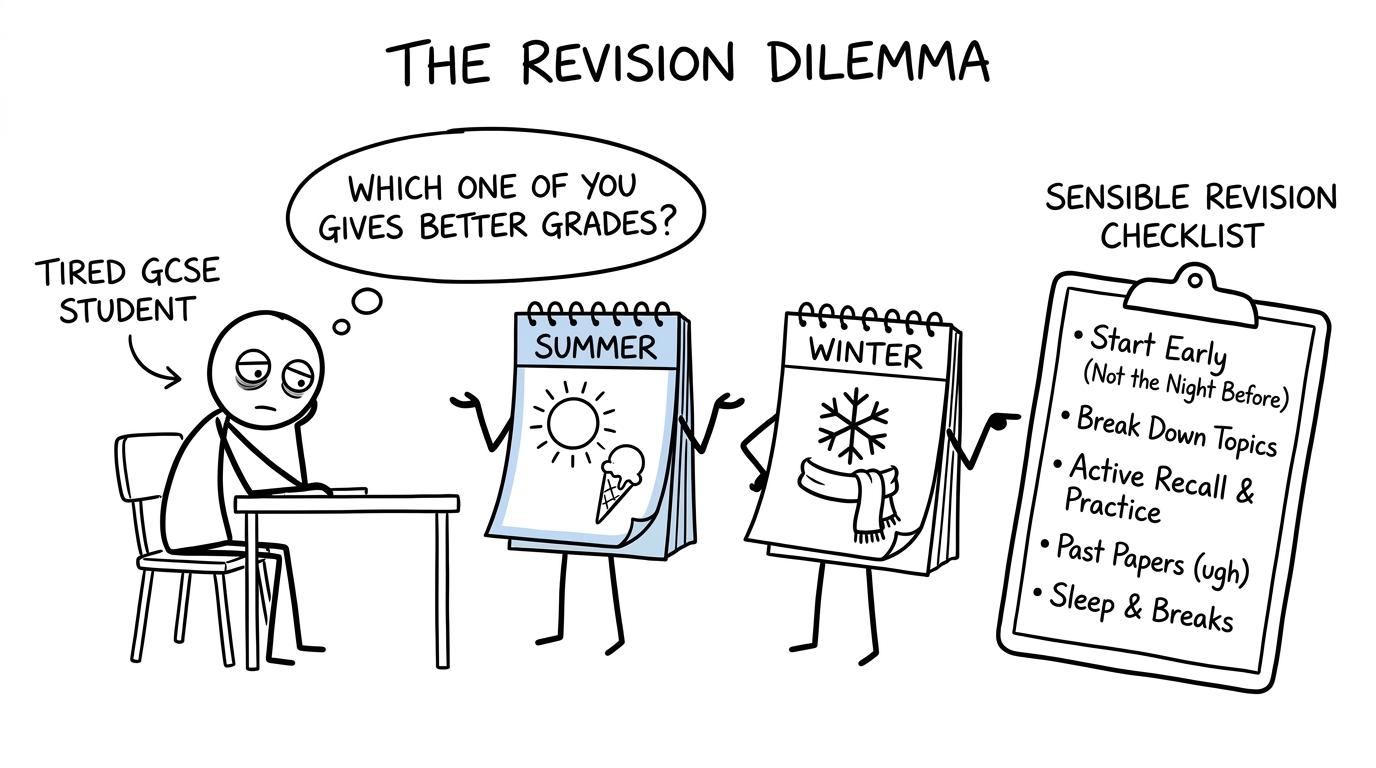 A student asks summer and winter calendars which gives better grades
Is there a winter sitting for GCSE Dance?
For the current AQA GCSE Dance qualification, the written Dance Appreciation examination is taken in the summer of the year in which the student receives the qualification. The practical performance and choreography work is non-exam assessment, completed according to the school’s schedule and submitted within the exam board’s assessment arrangements.
That means a school might record practical work during colder months, rehearse in spring and enter the written examination in summer. Those different dates are parts of one assessment journey, not separate winter and summer GCSE Dance qualifications from which a student can freely select the easier option.
This distinction matters because phrases such as “winter assessment” can describe several different things:
- an internal school assessment;
- a mock examination;
- the recording of practical work;
- a rescheduled activity within the centre;
- a formal external exam series.
Only the last of these creates a genuinely separate national sitting. Students should ask their teacher or exams officer for the qualification title, specification code and formal series before drawing conclusions from the date of an assessment.
How GCSE Dance results are calculated
AQA GCSE Dance contains two components. Performance and choreography account for 60%60\%60% of the qualification, while Dance Appreciation accounts for 40%40\%40%.
Both components have a maximum raw mark of 808080, but they are scaled differently. If PPP is the practical component mark and WWW is the written component mark, the total scaled mark can be represented as:
T=3P+2WT = 3P + 2WT=3P+2WThe maximum total is therefore:
Tmax=3(80)+2(80)=400T_{\max} = 3(80) + 2(80) = 400Tmax=3(80)+2(80)=400This is not a worked example for predicting a grade. It simply shows why equal raw marks in the two components do not have equal influence on the final result. Practical work carries the greater weighting.
A student worried about the summer written paper should keep that balance in perspective. The examination matters, but the final grade also reflects performance and choreography completed over time. Conversely, strong practical work should not become a reason to neglect the written paper, which contributes a substantial 40%40\%40%.
Why summer and winter result percentages can mislead
Suppose two exam-series reports show different proportions of students achieving a particular grade. It is tempting to conclude that the series with the higher percentage was easier. That conclusion does not follow from the data alone.
The percentage achieving a grade is:
Grade rate=number achieving the gradenumber entered×100%\text{Grade rate} = \frac{\text{number achieving the grade}}{\text{number entered}} \times 100\%Grade rate=number enterednumber achieving the grade×100%A change in that rate can arise because the students entered were different. One series might contain mostly Year 111111 students completing a two-year course. Another might contain older resit students, private candidates or a much smaller group. Their preparation, prior attainment and reasons for entering may differ considerably.
This is visible in GCSE Mathematics. In England, the November series is primarily a post-161616 opportunity, and most entrants are resitting. Ofqual explicitly warns that comparing its overall outcomes directly with summer outcomes is not meaningful because the cohorts are different. November’s lower or higher grade percentages do not prove that the paper or season caused those results.
Students exploring these patterns can review GCSE maths grade boundary history, but boundaries should never be interpreted without the paper, specification and cohort context.
Do grade boundaries make one season easier?
Grade boundaries are set after assessments have been completed and marked. They can move because papers do not have identical difficulty from one series to another.
A higher boundary does not automatically mean it was harder to earn the grade. It may indicate that the assessment was more accessible and students generally gained more marks. Similarly, a lower boundary may compensate for a more demanding paper.
The aim is to maintain a comparable standard of performance over time. Ofqual’s position for GCSE Mathematics is especially clear: a grade awarded in summer should represent the same standard as that grade awarded in November. Exam boards use statistical evidence, examiner judgement and students’ work when setting boundaries.
This does not mean every candidate has an identical experience. A particular paper may suit one student’s strengths better than another’s. Noise outside an exam room, illness, fatigue and confidence can also affect individual performance. Those are real personal effects, but they do not establish a national “best season”.
What if summer and winter genuinely are both available?
A student might encounter two dates because they are taking a different dance qualification, studying under another national system or considering a later assessment opportunity. In that situation, begin with availability and rules rather than historical percentages.
Confirm that the assessments are equivalent
Check the qualification, exam board, specification code, component structure and certification rules. An internal winter performance and an external summer examination measure different things. Results from one cannot reliably predict the other.
Compare your preparation, not the weather
If both dates are genuinely permitted, the better date is normally the one for which you can complete the required teaching, receive useful feedback and prepare without creating damaging pressure elsewhere.
A later sitting may offer more preparation time, but more time only helps when it is used deliberately. It can also prolong stress or collide with other commitments. An earlier sitting may reduce the number of simultaneous exams, yet it can leave less time for skills to develop.
There is no universal seasonal advantage. There is only the fit between the permitted assessment date and a student’s preparation.
Ask about consequences before changing plans
A school or college should confirm entry deadlines, assessment arrangements and whether changing a date is possible. Students should not withdraw from or postpone an assessment based on social media claims about boundaries. Formal decisions belong with the centre, exams officer and awarding organisation’s current rules.
What this means for GCSE maths students
The Dance question often points towards a wider worry: “Would I perform better if I sat my maths exam in another season?”
In England, GCSE Mathematics is available in November to students who were aged 161616 or over on 313131 August of that year, apart from limited reasonable-adjustment circumstances. It is commonly used for resits. Year 111111 students taking their normal GCSE course usually sit in summer.
November is not designed as an easier route. Its cohort is different, and published pass rates should not be used as an estimate of an individual student’s chance of success.
If you are preparing for a summer or resit series, begin at the GCSE Maths revision hub. Choose your board and tier, then identify the topics that are actually costing marks. The content overlaps nationally, but Edexcel, AQA, OCR and Eduqas organise and assess it differently, as the GCSE maths topics by board and tier guide explains.
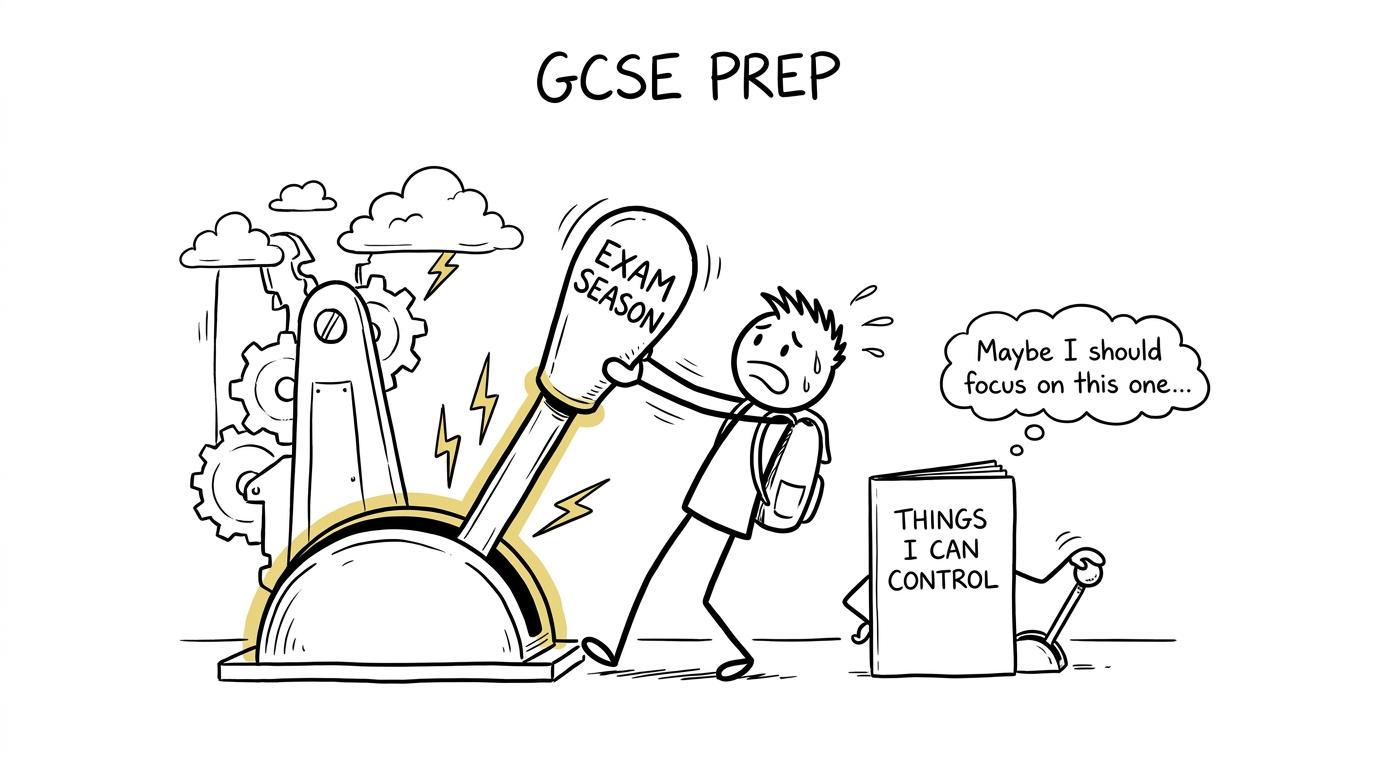 A giant exam-season lever distracts a student from a small revision lever
A preparation plan that works in any season
A reliable revision process is less dramatic than searching for the perfect month. It is also more useful.
Diagnose what is losing marks
Complete a suitable paper or mini test before deciding what to revise. Mark it carefully and separate errors into knowledge gaps, inaccurate execution and exam technique. The guide to finding your weakest GCSE topics provides a practical way to turn lost marks into a short priority list.
Repair individual skills
Use revision lessons and focused practice questions for one weak topic at a time. Avoid spending every session rereading notes. Retrieval and written practice reveal whether you can use a method independently.
Move into timed assessment
Once the underlying topics are becoming secure, use mixed questions and complete papers. MathsGenie’s Edexcel GCSE Maths past papers include official mark schemes and worked solutions where available. Students often gain more from one thoroughly reviewed paper than from several papers marked only with a total score.
The advice in when to start GCSE past papers can help you move from short sections towards full timed practice without exhausting your paper supply too early.
Use fresh questions near the examination
Predicted papers are useful for rehearsing unfamiliar combinations of topics, but they should supplement rather than replace official past papers. The Edexcel GCSE Maths predicted papers offer timed practice with mark schemes and solutions for the final stage of revision.
Common mistakes when comparing exam seasons
Assuming correlation proves causation. A different result percentage does not prove that temperature, daylight or the month caused the difference.
Ignoring who entered. Summer Year 111111 candidates and November post-161616 resit candidates are not equivalent groups.
Treating a mock as an official sitting. A school’s winter Dance assessment may be internal preparation or practical recording rather than a separate qualification series.
Reading boundaries as difficulty rankings. Higher boundaries can accompany a more accessible paper; lower boundaries can accompany a more demanding one.
Comparing different specifications. Component weightings, assessment objectives and qualification rules may differ.
Waiting for a supposedly easier series. Extra months do not create improvement by themselves. Deliberate practice, feedback and retesting do.
Letting Dance information determine maths decisions. GCSE Dance and GCSE Mathematics have different assessment structures and series availability. Always check the rules for the exact qualification.
Focus on the lever you can move
The season printed on an exam timetable feels important because it is visible. Preparation is quieter. It happens in corrected questions, repeated techniques and the decision to understand why a mark was lost.
For current GCSE Dance, students do not normally face a free choice between a winter and summer written examination. Where multiple dates genuinely exist under another arrangement, neither season offers an automatic grading advantage. Confirm the rules, compare like with like and choose according to readiness rather than rumours about national results.
For maths, make the controllable part simple. Open MathsGenie’s free GCSE resources, use revision lessons and practice questions to repair weak skills, then test them through mini tests, past papers and predicted papers. Mark every attempt with the mark scheme, use video solutions when a method remains unclear, and place each correction into your revision plan. The calendar sets the deadline. Your revision determines what you can do when it arrives.











