

GCSE Dance Coursework Weighting: 60% Explained
GCSE Dance coursework weighting explained: practical performance and choreography count for 60%, while the written Dance Appreciation exam counts for 40%.
There is a particular kind of uncertainty that appears when one subject is assessed in two completely different ways. You may feel confident in the studio but less certain at a desk, or enjoy analysing professional works while finding performance day daunting. The GCSE Dance coursework weighting makes the practical side more important, but not important enough to ignore the written paper.
For the current GCSE Dance structure in England, non-exam assessment accounts for 60%60\%60% of your final grade. The written Dance Appreciation exam contributes the remaining 40%40\%40%. Within the practical component, performance is worth 30%30\%30% and choreography is worth 30%30\%30%.
That simple split should shape how you use your revision time.
GCSE Dance coursework weighting at a glance
The official assessment structure is:
| Assessment | Percentage of final grade | Main focus |
|---|---|---|
| Performance | 30%30\%30% | Physical, technical, expressive and mental skills |
| Choreography | 30%30\%30% | Creating and communicating choreographic intention |
| Written Dance Appreciation exam | 40%40\%40% | Knowledge, analysis, interpretation and evaluation |
| Total | 100%100\%100% | Your complete GCSE Dance result |
Your practical work therefore contributes:
30%+30%=60%30\% + 30\% = 60\%30%+30%=60%The written examination contributes:
100%−60%=40%100\% - 60\% = 40\%100%−60%=40%A useful checklist is:
- Treat “coursework” as non-exam assessment, or NEA, rather than ordinary classwork.
- Remember that performance and choreography are equally weighted.
- Prepare for the written paper throughout the course, not only after practical assessments finish.
- Use feedback and the assessment criteria to improve specific weaknesses.
- Confirm your exact specification and arrangements with your teacher.
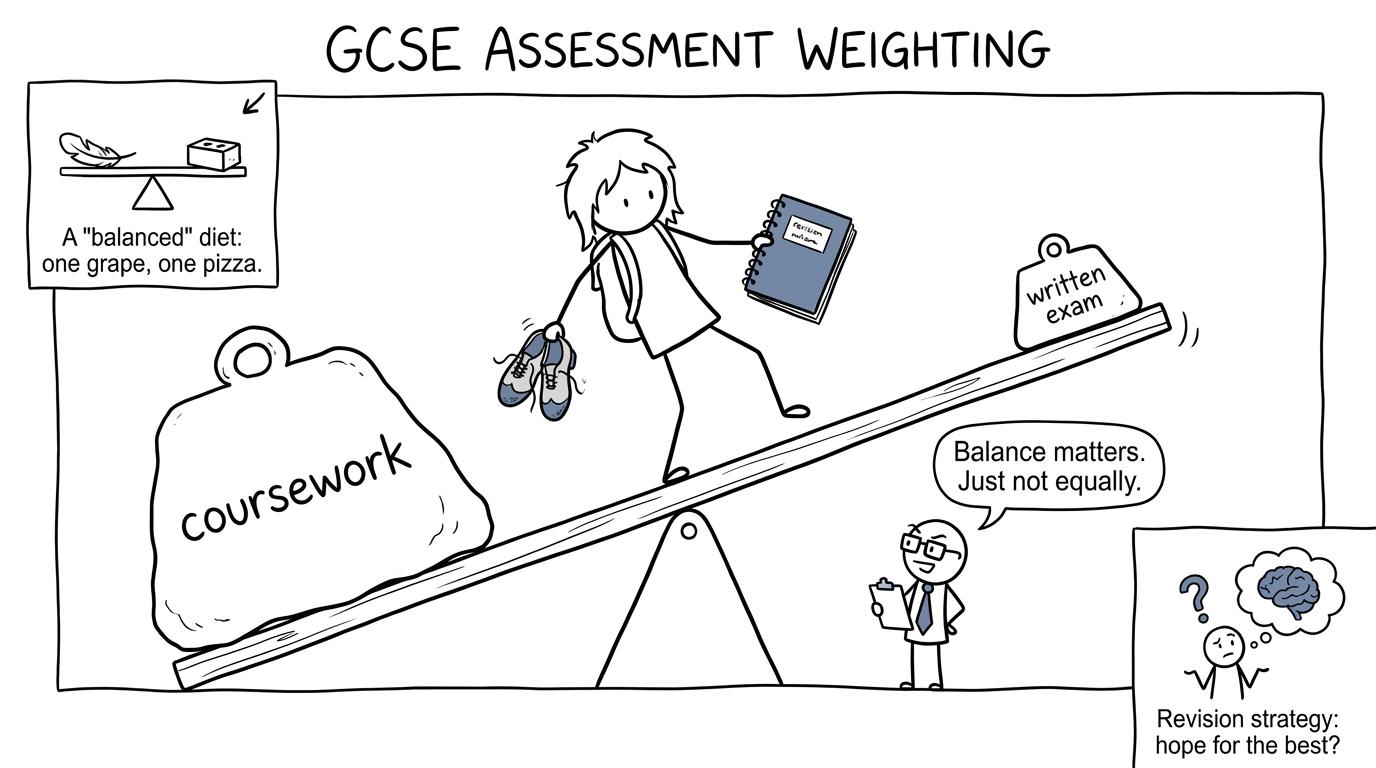 A student balancing dance coursework and the written exam on a seesaw
Is GCSE Dance coursework really coursework?
Students often use “coursework” as a convenient name for anything completed before the final exam. The formal term is non-exam assessment.
Under the current requirements for GCSE Dance qualifications in England, 60%60\%60% of the available marks must come from assessments which are not examinations. Half of that qualification weighting assesses performance and half assesses choreography.
This distinction matters because NEA is not simply a folder of work that gradually collects marks. The tasks, assessment conditions, evidence and marking arrangements are controlled by the specification. For AQA GCSE Dance, specification 823682368236, the performance and choreography component is internally marked by the centre and externally moderated by AQA.
Your teacher can guide your development, but marks are awarded against defined criteria. Consistent attendance, purposeful rehearsal and a clear response to feedback matter because the assessment captures skills that cannot be demonstrated properly in a written paper.
How the practical component is divided
The practical component is worth 60%60\%60% overall, but it contains two distinct areas.
Performance is worth 30%
Performance assesses your ability to perform dance while reflecting choreographic intention through physical, technical and expressive skills. In the AQA specification, the performance task has a maximum of 404040 raw marks.
Those marks are divided between:
- solo performance, worth 121212 raw marks;
- duet or trio performance, worth 242424 raw marks;
- mental skills and attributes demonstrated across the performances, worth 444 raw marks.
As proportions of the whole qualification, these correspond to:
- solo performance: 9%9\%9%;
- duet or trio performance: 18%18\%18%;
- mental skills and attributes: 3%3\%3%.
Together:
9%+18%+3%=30%9\% + 18\% + 3\% = 30\%9%+18%+3%=30%Mental skills are therefore not an optional extra. Commitment, concentration, confidence, movement memory and the capacity to improve can affect the assessed performance component.
Choreography is worth 30%
Choreography is also worth 30%30\%30% of the final qualification. The AQA choreography task is marked out of 404040 raw marks and requires a response to an externally set stimulus.
The assessment considers more than the number of movements included. It rewards the creation and development of material, the use of choreographic processes and devices, structural choices, aural setting and the communication of choreographic intention.
This is why adding complexity without purpose can be a poor bargain. A clear artistic intention, developed thoughtfully, is more valuable than a crowded sequence whose choices cannot be justified.
How much is the written GCSE Dance exam worth?
The written Dance Appreciation examination is worth 40%40\%40% of the final grade. For AQA GCSE Dance, it lasts 111 hour 303030 minutes and is marked out of 808080 raw marks.
The paper assesses knowledge and understanding of choreographic processes and performing skills, alongside the ability to analyse, interpret and evaluate your own work and professional dance works.
The assessment objectives behind the written component are:
- AO3, worth 15%15\%15% of the qualification;
- AO4, worth 25%25\%25% of the qualification.
Together:
15%+25%=40%15\% + 25\% = 40\%15%+25%=40%The larger AO4 weighting is a reminder that knowing facts is not enough. You must be able to make analytical and evaluative judgements, then support them with relevant dance knowledge.
A paper worth 40%40\%40% can substantially change the final outcome. Strong practical marks create a valuable foundation, but they do not make the written paper disposable.
How raw marks become your final result
AQA’s two components are each marked out of 808080 raw marks, yet they do not contribute equally. The practical component must be worth 60%60\%60%, while the examination must be worth 40%40\%40%.
AQA therefore scales the marks:
- performance and choreography: 808080 raw marks scaled by a factor of 333, producing up to 240240240 scaled marks;
- Dance Appreciation: 808080 raw marks scaled by a factor of 222, producing up to 160160160 scaled marks.
The maximum total is:
240+160=400240 + 160 = 400240+160=400The proportions are then:
240400×100=60%\frac{240}{400} \times 100 = 60\%400240×100=60%and
160400×100=40%\frac{160}{400} \times 100 = 40\%400160×100=40%This scaling is why two components with the same maximum raw mark can have different effects on your final grade. If percentages feel less secure than your choreography, MathsGenie’s Edexcel GCSE percentages revision and AQA GCSE percentages revision explain the underlying maths clearly.
Your scaled total is used when grade boundaries are applied. Grade boundaries can vary between exam series, so there is no responsible way to promise that one fixed raw mark will always produce a particular grade.
What the weighting means for your revision plan
The natural temptation is to divide your time in the same 60:4060:4060:40 ratio. That is a useful starting point, but not an unbreakable rule.
Revision time should respond to three things:
- how heavily an area is weighted;
- how close its assessment is;
- where your current weaknesses are.
During practical assessment periods, rehearsal may need the larger share of your Dance time. Once practical evidence has been completed, the written paper should become the clear priority. Throughout both stages, short and regular written recall is usually more manageable than trying to rebuild the entire course near the examination.
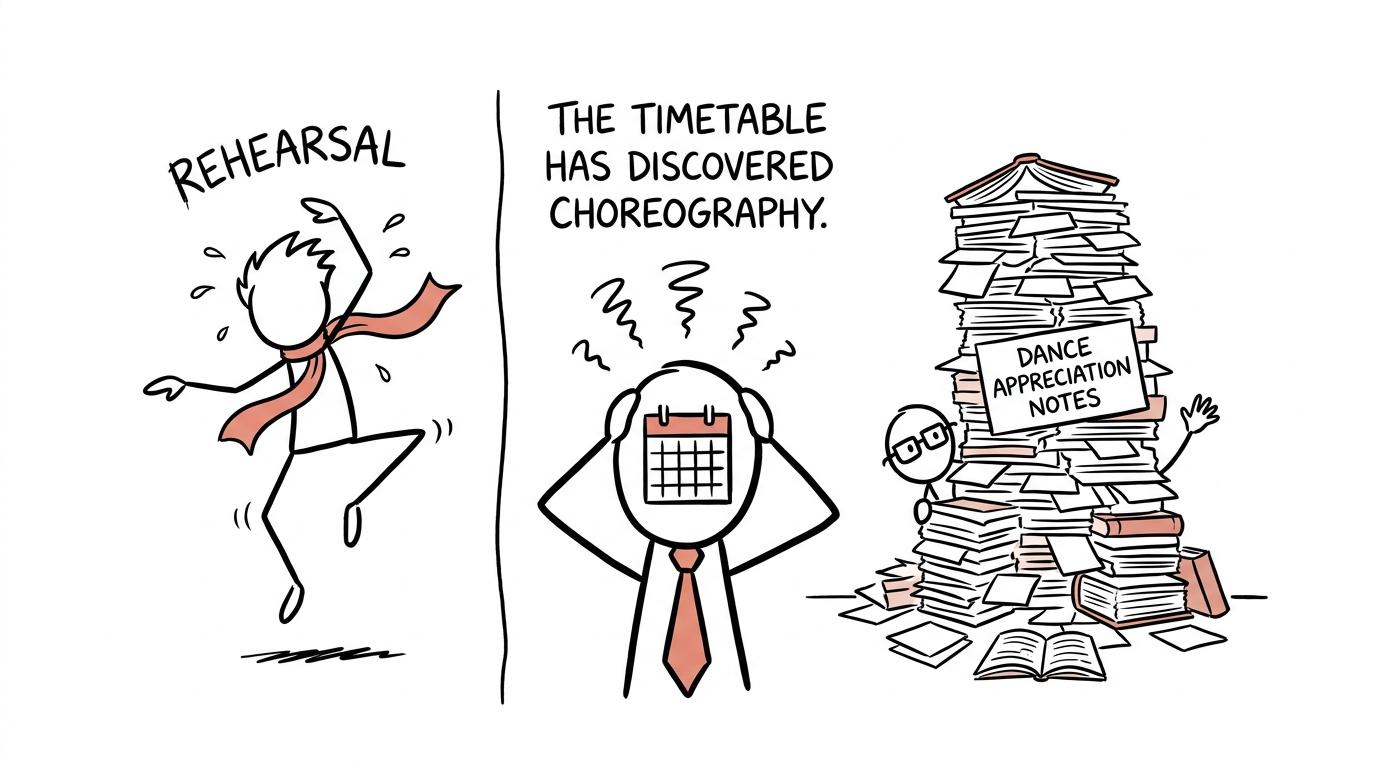 A calendar attempting to schedule dance rehearsal and written revision
A sensible weekly pattern might include practical rehearsal, focused improvement from teacher feedback, retrieval of key terminology and one timed written response. The important idea is not the precise timetable. It is that each session has a defined purpose.
The same principle applies when several GCSE subjects compete for attention. MathsGenie’s GCSE maths revision timetable guide can help you build a realistic week rather than a plan that looks impressive but cannot be sustained. You can also use the guide to finding your weakest GCSE topics to make revision decisions from evidence rather than anxiety.
Balancing Dance with GCSE maths revision
Dance coursework deadlines often arrive while maths knowledge still needs regular maintenance. The solution is not to abandon one subject until the other feels quieter. Quiet periods rarely arrive on schedule.
Keep maths moving through small, repeatable sessions. Choose one weak topic, review the lesson, answer practice questions and check the mark scheme. MathsGenie’s percentage practice questions are particularly relevant when you want to become more confident with assessment weightings and proportions.
As the maths examinations approach, move towards timed practice. The Edexcel GCSE maths past papers include mark schemes and worked solutions, while the guide to starting GCSE past papers explains how to introduce them without using all your newest papers too early.
A stable routine protects both subjects. Ten focused sessions are usually more useful than one heroic evening followed by exhaustion.
Common mistakes with GCSE Dance assessment
Assuming every lesson contributes marks
Practical lessons help you develop, but the final NEA mark comes from specified assessed work. Ask your teacher which performances, recordings and choreography tasks form the formal evidence.
Treating the entire 60% as performance
Performance contributes 30%30\%30%, not 60%60\%60%. Choreography supplies the other 30%30\%30% of the practical weighting.
Ignoring the written paper after strong practical work
The examination is worth 40%40\%40%. It can reinforce a strong practical result or limit the overall grade if preparation is neglected.
Confusing raw marks with weighted marks
Both AQA components have 808080 raw marks, but the practical component carries more weight after scaling. Equal raw totals do not mean equal qualification weightings.
Revising facts without practising analysis
AO4 alone contributes 25%25\%25% of the qualification. Effective preparation must include explaining effects, interpreting intention, comparing features and making supported judgements.
Using information for the wrong specification
Assessment details can change, and GCSE arrangements are not automatically identical across every UK qualification. Confirm the exam board and specification code used by your school. Students outside England should check the qualification requirements provided by their centre rather than assuming the AQA structure applies unchanged.
Make the weighting work for you
The final split is clear: GCSE Dance non-exam assessment contributes 60%60\%60%, divided equally between performance and choreography, while the written Dance Appreciation exam contributes 40%40\%40%.
But weightings are not predictions. They are a map. They show where marks come from, helping you decide where rehearsal, written practice and feedback will have the greatest value.
Then protect the rest of your GCSE revision. Use MathsGenie’s free revision lessons and practice questions to repair weak maths topics, build confidence with mini tests, and move towards past papers and predicted papers when you are ready. Mark your work carefully, use the video solutions when a method is unclear, and let each mistake determine the next useful step.











