

GCSE Computer Science Resit: Your Revision Plan
GCSE computer science resit plan for after results day: confirm your entry, diagnose lost marks, revise by milestone and practise papers confidently.

Results day can make one number feel like a final judgement. It is not. If you are considering a GCSE computer science resit, your result is better treated as diagnostic information: it shows where you are starting, not where you must finish.
Your first steps are practical. Speak to your school or college, confirm whether a resit supports your next course or career plan, identify your exam board and secure an exam entry. Computer Science is normally retaken in the summer exam series rather than November, so you have time to rebuild carefully; but you should arrange the entry promptly.
 A results-day folder produces a friendly robot carrying a next-plan clipboard
Your GCSE Computer Science resit checklist
Before beginning detailed revision:
- ask your school, college or private exam centre whether it can enter you;
- confirm the exam board and specification code;
- check which papers and practical arrangements apply;
- collect your previous mock papers and teacher feedback;
- download the specification and current assessment information;
- complete a diagnostic paper without notes;
- create a weekly timetable covering theory, programming and exam practice.
A GCSE Computer Science resit is optional in the way a GCSE maths or English resit may not be for students on certain post-16 programmes. Decide what improved grade you need and why. A clear reason makes a long revision plan easier to maintain.
Milestone one: confirm exactly what you are retaking
GCSE Computer Science is a linear qualification. You should therefore expect to take all required examined components in the relevant series, rather than keeping the result from one paper. Your centre must confirm the precise arrangement.
This matters because assessment differs between AQA, Edexcel, OCR and Eduqas. Some boards use written programming questions, while others include an onscreen programming assessment. Specifications also change over time. Do not assume that an old textbook or paper matches the qualification available for your retake.
Start at the GCSE Computer Science revision hub, select your board and compare its resources with the specification code supplied by your centre. OCR students, for example, can use the dedicated OCR GCSE Computer Science revision page.
Milestone two: diagnose the marks you lost
During the first two weeks, sit one suitable past paper or substantial paper section. The purpose is not to prove that you are ready. It is to expose the gaps while there is still time to fix them.
Mark it strictly and record each lost mark under one of four headings:
- knowledge: you could not recall the fact or definition;
- application: you knew the topic but could not use it in context;
- programming: tracing, designing, testing or refining code caused difficulty;
- exam technique: you misread the command word, gave insufficient detail or ran out of time.
You can track progress using:
mark percentage=marks earnedmarks available×100\text{mark percentage}=\frac{\text{marks earned}}{\text{marks available}}\times 100mark percentage=marks availablemarks earned×100The percentage is useful, but the error categories are more valuable. A score tells you what happened. An error log tells you what to do next.
Milestone three: rebuild topics systematically
For the next several months, divide the specification into manageable blocks. Common areas include algorithms, programming, data representation, computer systems, networks, cyber security, databases, and legal, ethical and environmental issues. Exact coverage depends on your board.
Use a repeatable revision cycle:
- learn one small topic;
- retrieve the key ideas without notes;
- answer exam-style questions;
- mark every response;
- write one correction for each lost mark;
- revisit the topic within a week.
The AQA GCSE Computer Science lessons provide structured topic coverage, while the AQA Computer Science question bank helps turn knowledge into examinable answers. For short recall sessions, use the AQA Computer Science flashcards.
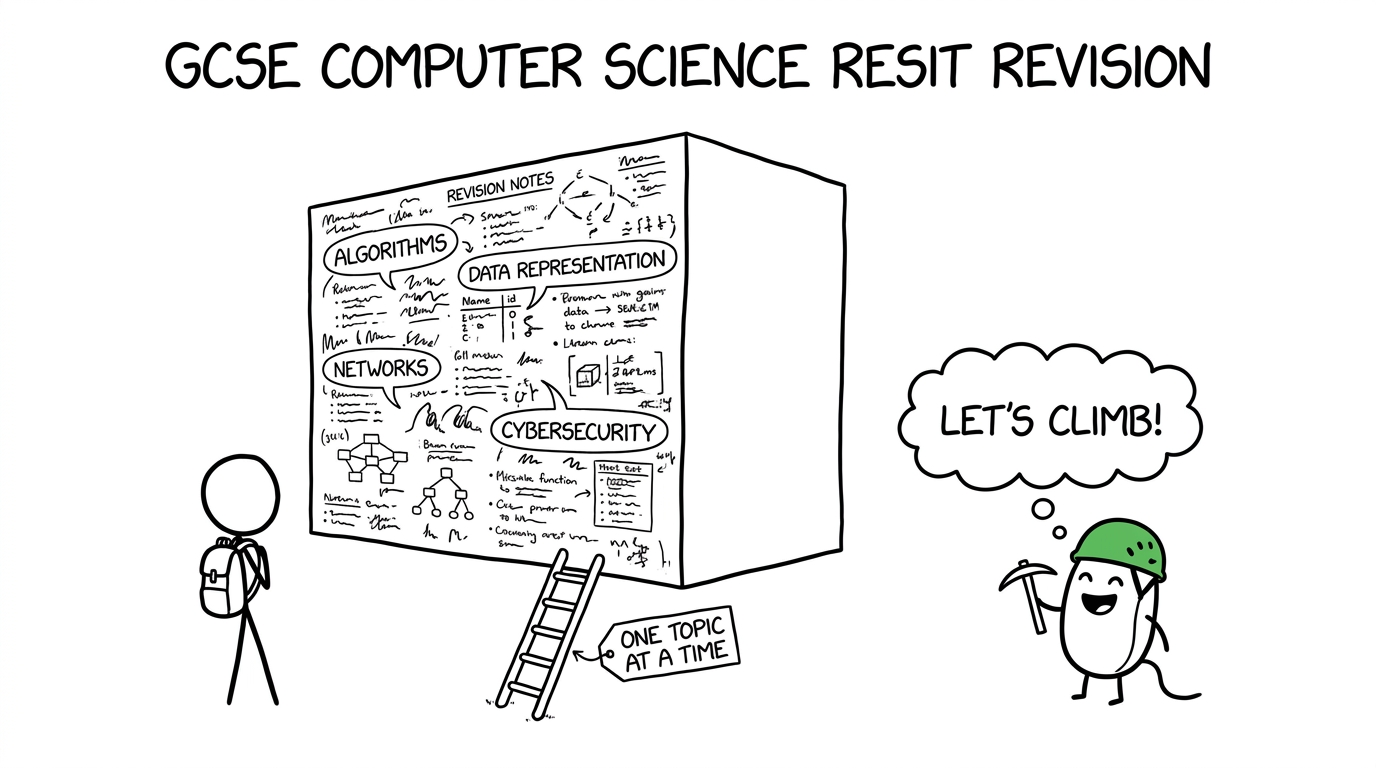 A student uses a small one-topic-at-a-time ladder to climb a wall of revision notes
Milestone four: practise programming every week
Programming cannot be revised effectively through reading alone. Official GCSE subject content requires students to design, write, test and refine programs. Even where the final assessment is written, practical experience makes tracing and algorithm questions more manageable.
Schedule at least one programming session each week. Rotate between decomposition, selection, iteration, arrays or lists, subroutines, validation, test data and debugging. Use the language required or supported by your current specification and centre.
When an algorithm feels unclear, the representing algorithms revision guide can help you distinguish the underlying plan from its implementation as code.
Do not neglect the mathematical parts of Computer Science. Binary arithmetic, Boolean logic and file-size calculations reward accurate, repeated practice. The binary arithmetic revision resources and OCR data storage revision guide provide focused support.
Milestone five: move into timed papers
In the final six weeks, shift from mostly topic revision towards timed assessment. Begin with individual sections, then complete whole papers under the correct conditions.
After every paper:
- use the mark scheme precisely;
- add mistakes to your error log;
- revise the weakest two topics;
- answer fresh questions on those topics;
- retest the same skills several days later.
A paper is not finished when you reach the final page. It is finished when its mistakes have changed your next week of revision.
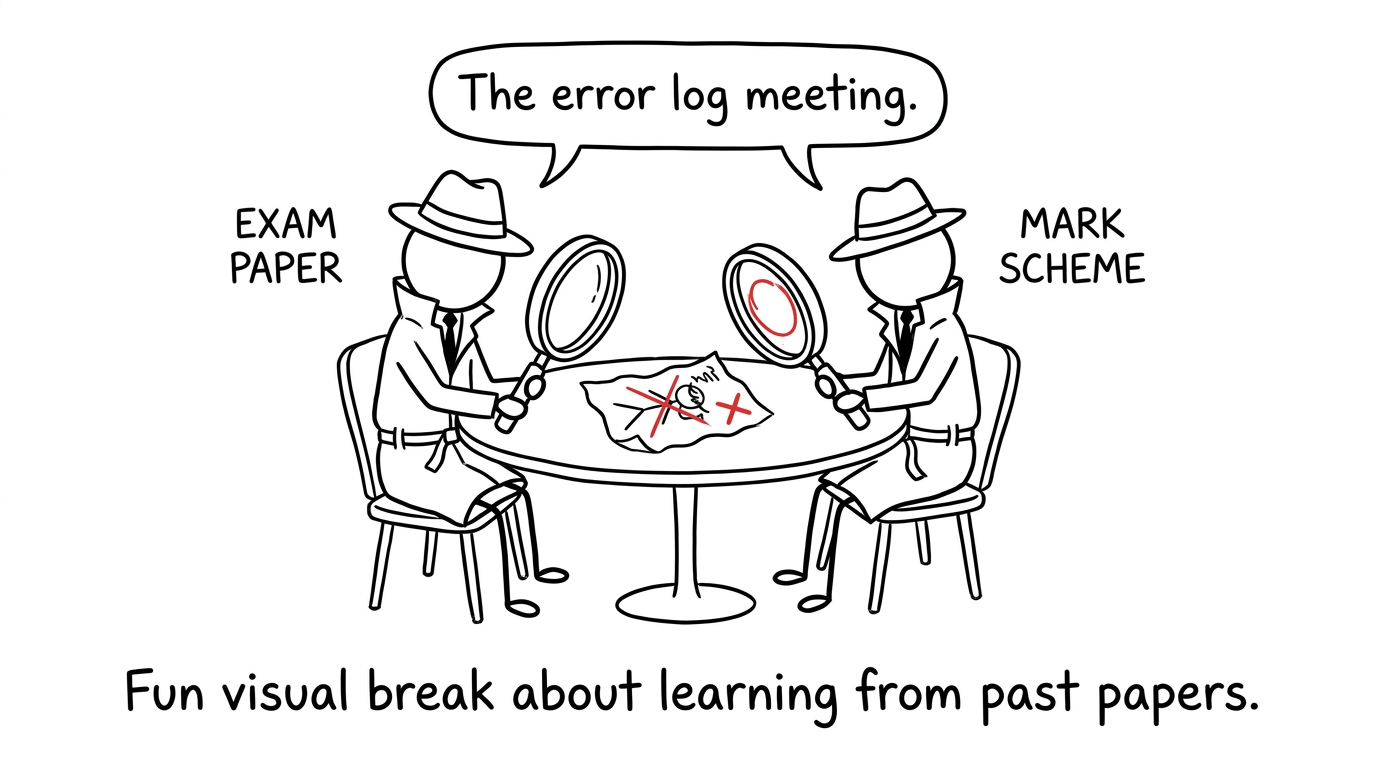 An exam paper and mark scheme investigate a crossed-out answer at an error-log meeting
Common GCSE Computer Science retake revision mistakes
Revising for the wrong specification
Check your board, entry code and current assessment format with your centre. This is especially important when specifications are changing.
Memorising notes without answering questions
Recognition can feel like understanding. Retrieval and exam questions reveal whether you can explain, apply and evaluate ideas for marks.
Avoiding programming until the end
Short weekly practice is more dependable than a last-minute coding marathon. Programming develops through use.
Completing papers without repairing mistakes
Repeated papers can reproduce the same weaknesses. Mark, diagnose, repair and retest before moving on.
Ignoring command words
A definition, explanation, comparison and evaluation require different forms of response. Study how the mark scheme rewards each one.
Turn your resit into a better system
Resitting GCSE Computer Science is not simply repeating Year 11. It is an opportunity to revise with better information: the correct specification, an honest diagnostic paper and a record of every recurring marks leak.
Begin with MathsGenie’s free GCSE Computer Science past papers, worksheets and revision resources. Build understanding through revision lessons, practise with topic questions and worksheets, then use past papers, mark schemes and mini tests to measure improvement. One result may have started this journey. A consistent system can decide where it ends.











