

GCSE Computer Science Remark: Results Day Guide
GCSE computer science remark guidance: learn how reviews work, check deadlines and risks, and decide whether to request one after results day.

Results day can turn a single mark into the most important number in the room. If your result is lower than expected, a GCSE computer science remark may be worth considering, but only when there is evidence that a marking error could have occurred.
The official service is called a review of marking, not a re-mark. Your school normally requests it from AQA, Edexcel, OCR or Eduqas after discussing the risks with you. A reviewer checks whether the original marking was completed correctly. Your mark can rise, stay unchanged or fall, so the decision should be based on more than disappointment.
GCSE computer science remark decision checklist
Before requesting a review, check the following:
- Confirm your exam board, component marks and overall grade.
- Read the grade boundary for the correct board and exam series.
- Calculate how many marks you are below the next grade.
- Ask your school to obtain your marked scripts where available.
- Have a Computer Science teacher compare the responses with the mark scheme.
- Identify a specific possible error, such as an unmarked response or misapplied marking guidance.
- Consider the risk of the mark falling.
- Ask about fees and your school's internal deadline.
- Give written consent only when you understand the possible outcomes.
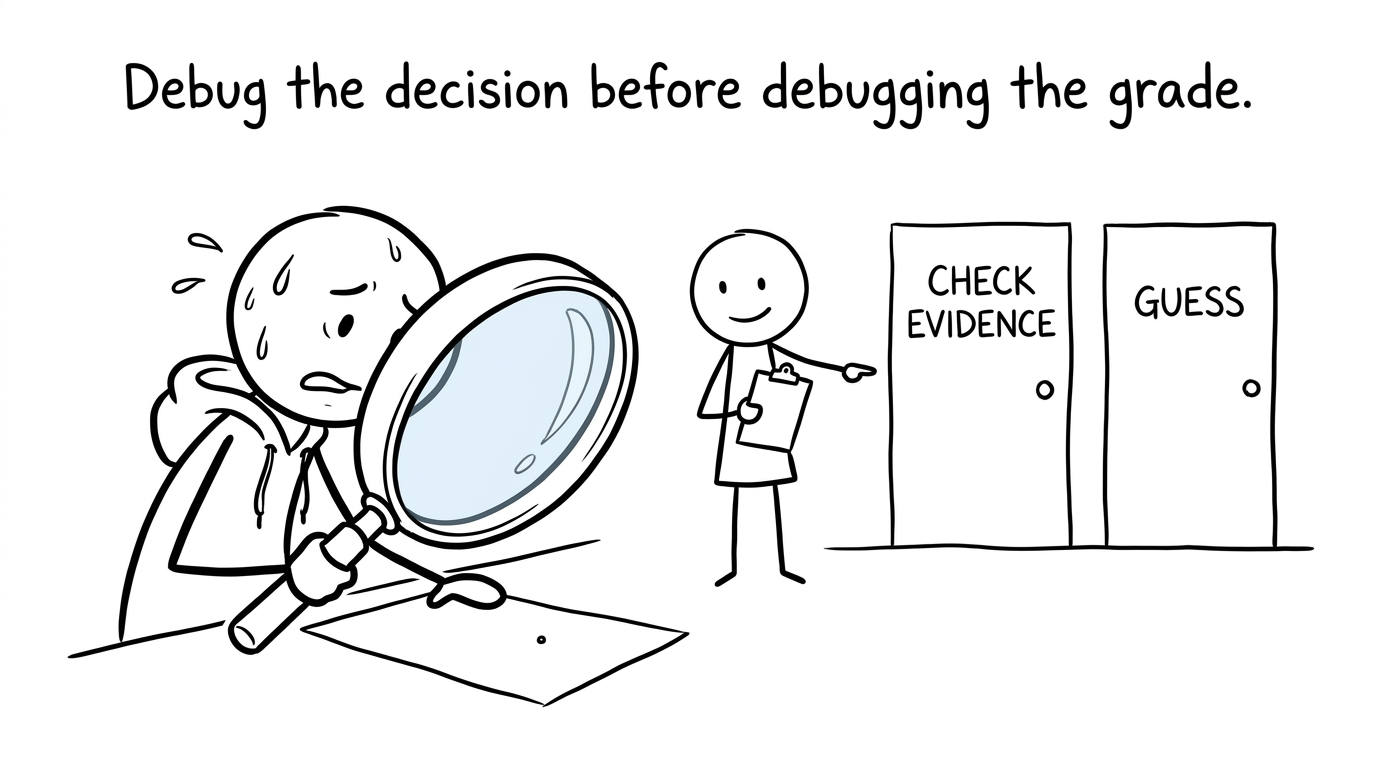 Student investigating an exam mark with an oversized magnifying glass
How the GCSE computer science re-mark process works
Check the grade boundary
Start with the published boundary for your qualification and exam series. MathsGenie provides a central GCSE grade boundaries hub, alongside subject-specific pages for AQA GCSE Computer Science grade boundaries, Eduqas GCSE Computer Science grade boundaries and WJEC GCSE Computer Science grade boundaries.
Edexcel students can also use the GCSE Computer Science grade calculator to understand how component marks combine.
Being close to a boundary does not prove that marking was wrong. It only tells you how much a changed component mark would need to affect the overall result. A student one mark below a grade boundary may have a stronger practical reason to investigate than someone much further away, but the script still matters more than the distance.
Request access to your marked scripts
Ask your exams officer whether your scripts can be accessed before a review. This allows a subject teacher to inspect the actual evidence rather than trying to reconstruct your answers from memory.
For Computer Science, the teacher should look particularly carefully at:
- algorithms and pseudocode where several valid approaches may exist;
- trace tables and logic questions with follow-through marking;
- extended explanations about networks, security, data representation or ethical issues;
- answers that continue onto additional pages;
- questions that appear unmarked or have inconsistent annotations.
A script may show a credible marking concern, but it may also confirm that the published mark scheme was applied correctly. Both outcomes are useful because they replace guesswork with evidence.
Choose the correct post-results service
A clerical re-check checks administrative details, including whether every response was marked and whether marks were totalled and recorded correctly.
A review of marking includes administrative checks and asks a reviewer to determine whether the mark scheme was applied correctly. It is not a completely fresh re-mark based on whether another examiner would personally have awarded a different mark.
If the concern involves centre-assessed work or moderation, the route is different. A review of moderation is requested by the school and normally concerns the centre's moderated sample rather than one student's work. Ask your exams officer which type of assessment contributed to your qualification.
Submit the request through your school
For school candidates, the school or college submits the request. Students and parents do not normally apply directly to the exam board. Private candidates are an exception and should contact their exam board or examination centre.
Written consent is required because there is no grade protection for an individual review of marking. If the corrected mark is lower, that lower mark and any resulting lower grade will stand.
For the June 2026 series, GCSE results are released to candidates on 20 August 2026, and awarding bodies must receive standard review-of-results requests by 24 September 2026. Your school's deadline will probably be earlier so that its exams team has time to check and submit the paperwork. Confirm the date immediately rather than waiting until late September.
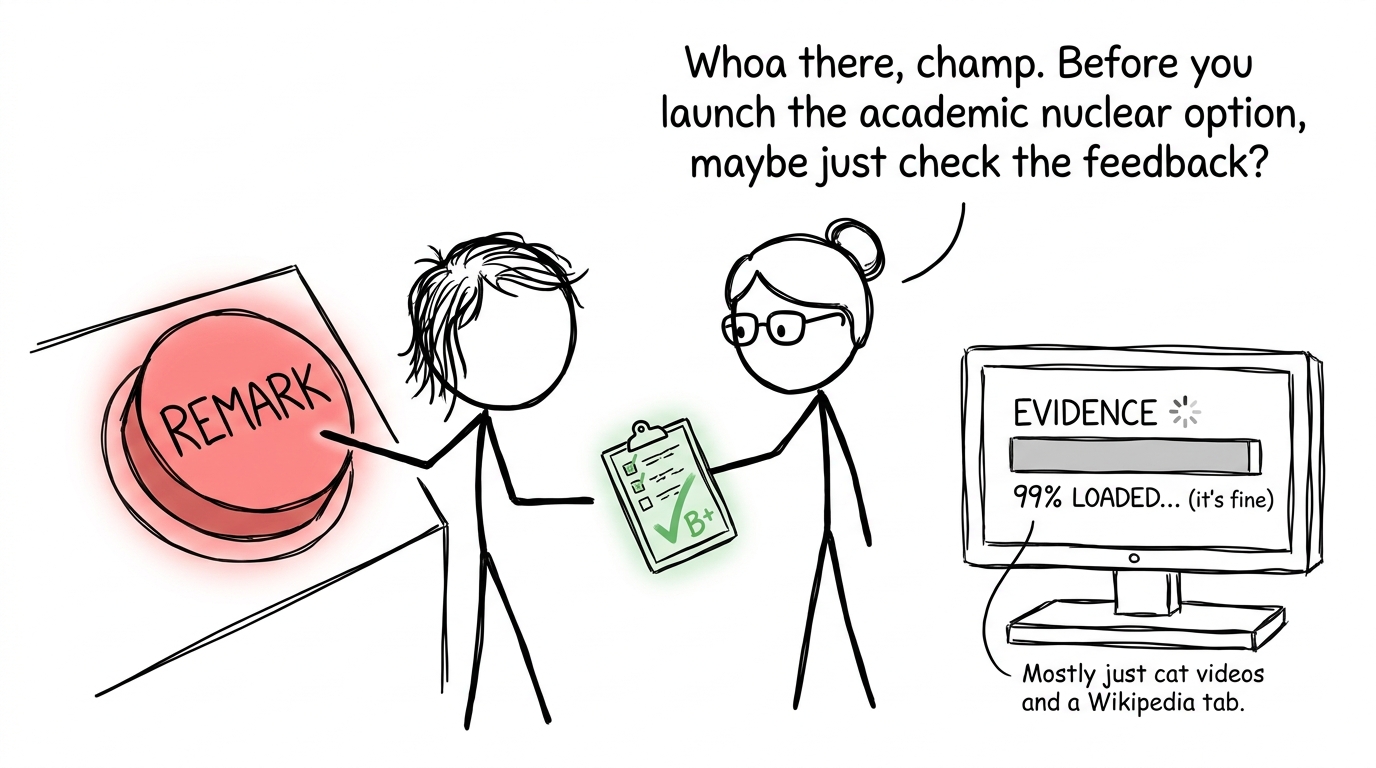 Student pausing before pressing a giant remark button while a teacher offers a checklist
When requesting a review makes sense
A review is most reasonable when your teacher can point to a plausible marking error and a change could affect an important grade. This may matter for a sixth-form course, college entry requirement or progression into A Level Computer Science.
It may be less sensible when the script has been checked carefully, the mark scheme appears to have been applied correctly and several additional marks would be required. Reviews correct errors; they are not a second chance to improve an answer after the examination.
Fees vary by exam board and service. Schools may pass the fee to families, although board policies can provide for fees not to be charged when a review changes the overall grade. Ask your school for its current policy before consenting.
Appealing a GCSE Computer Science grade
Appealing a GCSE Computer Science grade is a later stage, not another name for requesting a review. An appeal can normally happen only after the review outcome has been issued.
The school must have valid grounds, such as a procedural problem, an uncorrected administrative error or an unreasonable application of the mark scheme. Disagreeing with a grade boundary is not grounds for appeal. Internal candidates cannot usually submit the appeal themselves, although the school must have a procedure through which students can challenge its decision not to request a review.
Common mistakes to avoid
- Requesting a review because the grade feels unfair: compare the script with the mark scheme first.
- Looking at the wrong boundary: use the correct exam board, specification and exam series.
- Reviewing every component automatically: evidence may point towards one particular paper.
- Assuming marks cannot fall: a review can raise, confirm or lower the result.
- Missing the school deadline: internal deadlines are often earlier than the exam board deadline.
- Calling an appeal a re-mark: a review comes first; an appeal challenges an eligible error remaining afterwards.
Make the next decision evidence-led
A disappointing result deserves attention, but not panic. Check the boundary, obtain the script, consult a specialist teacher and ask the exams officer about deadlines and costs. That sequence turns an emotional decision into a careful one.
Start with MathsGenie's Computer Science and other GCSE grade boundaries, then keep your wider preparation moving through the free GCSE Maths revision hub. Revision lessons, practice questions, past papers, mark schemes, mini tests, video solutions and GCSE predicted papers give you something a review cannot: control over the marks you earn next time.











