

GCSE Computer Science Lower Grade Than Expected
GCSE computer science lower grade than expected? Follow a calm results-day plan to check marks, protect college options and prepare confidently for a resit.

Opening a results envelope can compress two years of work into one small line. If you received a GCSE Computer Science lower grade than expected, pause before deciding what it says about your ability. The result matters, but your next action matters more.
Start by checking whether the grade affects your sixth-form, college or apprenticeship place. Then speak to your teacher or exams officer about your marks, access to scripts and whether a review is sensible. If the grade is accurate, you can accept it, change your route or arrange a resit. None of those choices needs to be made alone.
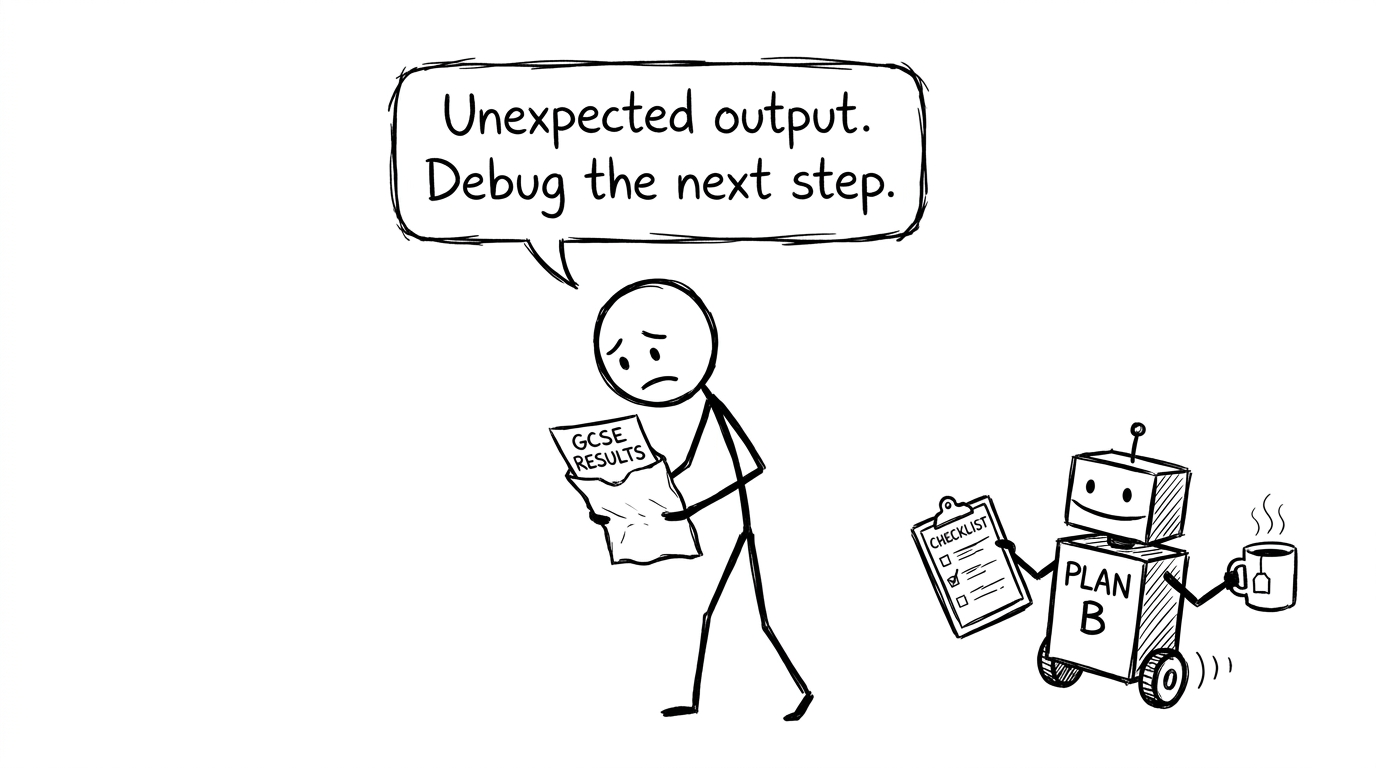 A student debugging an unexpected exam result with help from a tiny Plan B robot
Your immediate results-day checklist
- Tell a parent, carer, teacher or trusted adult how you feel.
- Confirm your exam board and marks for each paper.
- Check the entry requirements for your next course.
- Contact the sixth form, college or training provider if your place is affected.
- Ask your exams officer about accessing your marked scripts.
- Discuss the risks, deadline and possible fee before requesting a review.
- Consider a resit only after you understand what produced the result.
The purpose of this checklist is not to remove disappointment. It is to stop disappointment making the decisions.
Check what the grade changes
A disappointing GCSE Computer Science result may feel like a verdict, but its practical effect depends on your next destination.
Read the exact entry requirements for your chosen course. A college might require a particular Computer Science grade, consider your wider GCSE profile or offer a related subject instead. Requirements differ, so contact the admissions team rather than relying on assumptions or comparisons with friends.
If your place is at risk, call promptly. Explain the result clearly, mention any relevant circumstances and ask about alternatives. Possible routes might include another computing qualification, a different subject combination or beginning the course with additional support. The provider decides what it can offer.
Also protect your other subjects. If maths remains part of your plans, the free GCSE Maths revision hub brings together exam-board resources, lessons and practice. Skills involving logic, data representation and algorithms often benefit from secure numerical thinking, but one Computer Science grade does not automatically predict your future maths performance.
Ask for your marks and marked scripts
A grade alone is incomplete information. Ask your school for your component marks and how far the total was from the relevant grade boundary. Grade boundaries are set after exams have been taken and can change between series, so do not use a previous year's boundary as proof that your grade is wrong.
Your school or college can use the exam board's access-to-scripts service to obtain a marked paper where available. A teacher can then look for unanswered pages, incorrect totals or places where the mark scheme may not have been applied correctly.
This creates a better question than “Can I get one more grade?” The useful question is: “Is there evidence of a marking or administrative error?”
Decide whether to request a review of marking
Most students cannot submit a review directly. The school or college normally requests it from AQA, Edexcel, OCR or Eduqas and needs the student's written consent. Private candidates should contact their exam centre or exam board about the correct route.
An administrative error review checks matters such as whether every response was marked and whether marks were totalled and recorded correctly. A review of marking checks whether the mark scheme was applied properly. It is not an automatic fresh remark simply because the result was disappointing.
Crucially, a reviewed mark and grade can go down, stay unchanged or go up. Ask your teacher to inspect the available evidence and explain the risk before consenting. Fees and centre procedures vary. For the June 202620262026 series, the JCQ deadline for standard review requests is 242424 September 202620262026, but schools commonly set earlier internal deadlines.
If you remain concerned after a review, a formal appeal may be possible on permitted grounds. That is a later stage, not a substitute for requesting the appropriate review first.
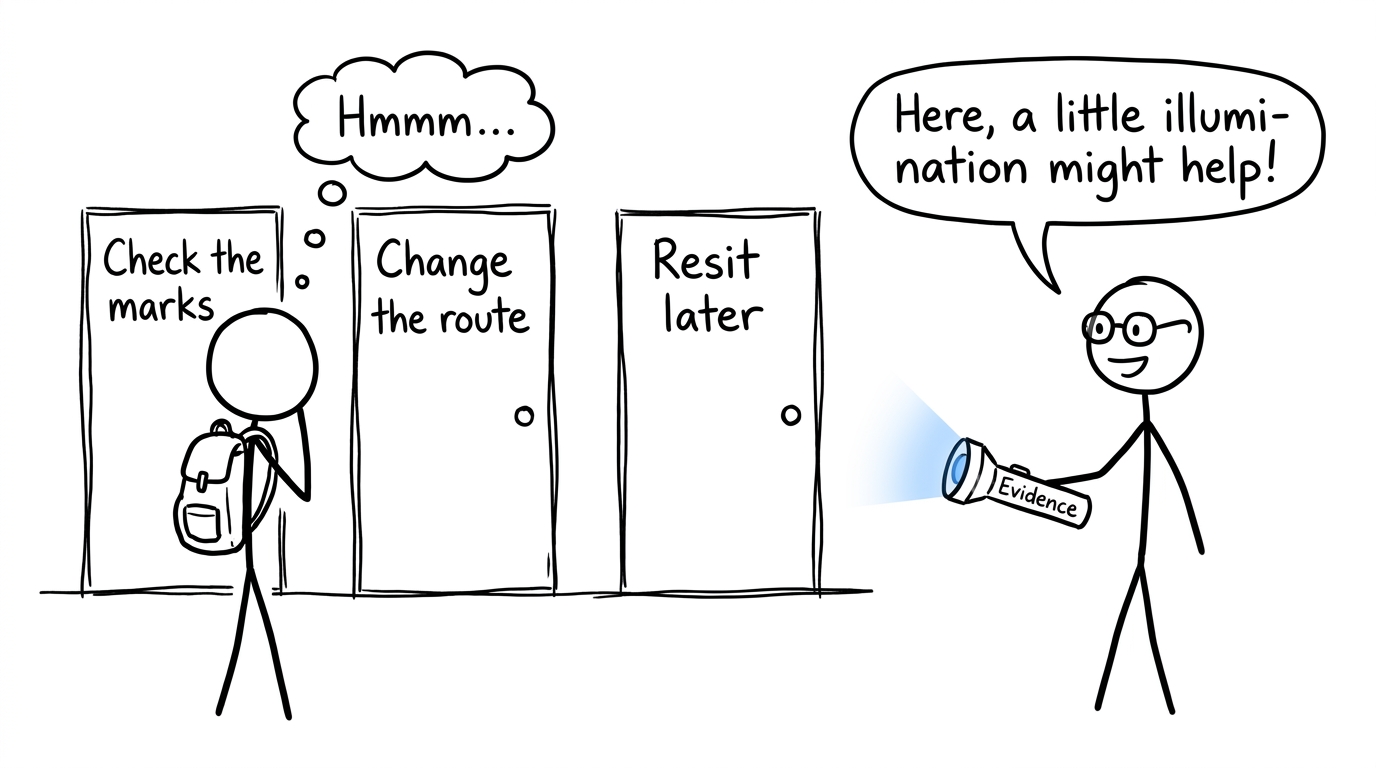 A student choosing between checking marks, changing route and resitting with a teacher holding an evidence torch
Consider accepting the result and continuing
Sometimes the evidence shows that the grade is accurate, yet the result does not block your next step. Accepting it is not the same as pretending it did not hurt.
Computer Science assessments test several different demands: recalling technical knowledge, applying concepts, analysing problems, reasoning about algorithms and communicating precise answers. A single grade combines those demands into one outcome. It cannot describe every strength you have or everything you could learn next.
If your chosen college accepts the result, ask whether a resit would genuinely improve your options. Your time may be better spent preparing for new courses, strengthening maths or developing programming experience. The sensible choice is the one that supports your future, not necessarily the one that repairs the appearance of your results sheet.
Plan a GCSE Computer Science resit
Computer Science does not normally have a November GCSE resit series. Unlike GCSE English language and maths, it will usually need to be retaken during the following summer exam series. Students resitting GCSEs generally retake all examined components, so confirm the current requirements with your centre and exam board.
Begin by finding a school, college or private exam centre willing to enter you. Ask about entry deadlines, fees, the specification and whether you will receive teaching support. Make sure you revise for the same exam board unless your centre has explained the consequences of changing specification.
Then diagnose the result rather than restarting the entire course blindly. Use the GCSE Computer Science revision hub to select AQA, Edexcel, Eduqas, OCR or WJEC resources. A useful resit cycle is:
- attempt a timed paper or section;
- mark it strictly using the mark scheme;
- label every lost mark by topic and cause;
- revise the weakest topic;
- answer targeted questions;
- retest the skill without notes.
AQA students can combine the AQA Computer Science revision area, AQA past papers and AQA topic question bank. OCR students can use the OCR Computer Science revision hub before testing progress with OCR Computer Science past papers. There is also a dedicated Edexcel Computer Science revision hub.
Common mistakes after a disappointing result
Requesting a review without evidence
Being close to a boundary does not prove a marking error. Ask a teacher to examine the script and explain whether a review is justified.
Missing the school's deadline
Exam-board deadlines are not necessarily your school's deadlines. Contact the exams officer immediately and get important information in writing.
Assuming a resit is available in November
The autumn GCSE series is generally for English language and maths. Computer Science is normally available again in the following summer.
Revising by rereading everything
A resit plan should target where marks were lost. Combine revision lessons, active recall, programming practice and exam questions with honest marking.
Treating the grade as an identity
A result records performance in a particular assessment series. It does not measure your curiosity, persistence or long-term potential.
Turn the result into a next step
An underwhelming result can make the future feel smaller for a few hours. Usually, the future has not vanished; it has simply become more specific. You need to check the impact, gather evidence and choose between a review, an alternative route and a resit.
If a resit is right for you, begin with MathsGenie's free GCSE Computer Science resources. Use revision lessons to rebuild understanding, practice questions to expose gaps, mark schemes and video solutions to learn from errors, and past papers, predicted papers and mini tests to prepare under pressure. The grade is already recorded. Your next move is still yours.











