

GCSE Computer Science Grade Boundaries 2026
GCSE computer science grade boundaries explained for 2026 results day, including release timing, total marks, a worked example and next steps for students.
The strange thing about results day is that a few seconds can seem to judge two years of work. You open the envelope, find Computer Science and immediately wonder what happened to every mark you earned.
Here is the short answer: GCSE computer science grade boundaries are the minimum total marks needed for each grade. They are set after the papers have been marked and may change each year to reflect paper difficulty. The official computer science grade boundaries 2026 will not be confirmed until results day.
For the June 2026 series, GCSE results day is Thursday 20 August 2026. Your school or exam centre will tell you when and how to collect your results.
 A student waiting for the results-day printer to finish compiling reality
Results-day checklist
Before interpreting your result, check these details:
- your final Computer Science grade;
- your exam board and specification code;
- your total raw or scaled mark, if it is provided;
- the official boundary table for the June 2026 series;
- any sixth-form or college entry requirement;
- your school's deadline for requesting a review of marking.
You can use MathsGenie's GCSE Computer Science revision hub to find board-specific resources and check that you are looking at the correct qualification.
How GCSE Computer Science grade boundaries work
A grade boundary is the lowest mark that receives a particular grade. If the grade 777 boundary is 120120120, for example, a total of 120120120 receives a grade 777. A total of 119119119 receives the grade below, assuming that is above the next boundary.
Boundaries are not fixed percentages. A grade 999 does not automatically require 90%90\%90%, and a grade 444 does not always require 40%40\%40%. Senior examiners and assessment experts set boundaries once marking is nearly complete, using evidence about paper difficulty, student performance and the standard demonstrated by scripts around important boundaries.
If a paper proves harder than expected, boundaries may be lower. If it proves easier, they may be higher. The purpose is consistency: the quality of work needed for a grade should remain comparable from one year to the next.
There is also no quota requiring a certain number of students to fail or limiting how many may receive a grade 999.
Why the 2026 boundaries cannot be predicted exactly
Historical data can provide context, but it cannot reveal the final 2026 thresholds. The exam boards need evidence from the completed and marked papers first.
That is why an online table claiming to show confirmed computer science grade boundaries 2026 before results day should be treated cautiously. It may be a prediction, an estimate or last year's data presented without enough explanation.
On results day, compare your mark only with the table for your own:
- exam board;
- specification;
- exam series;
- subject code.
MathsGenie provides historical pages for AQA GCSE Computer Science grade boundaries, an Edexcel Computer Science grade calculator and Eduqas Computer Science grade boundaries. Past boundaries show how marks have varied, not what must happen in 2026.
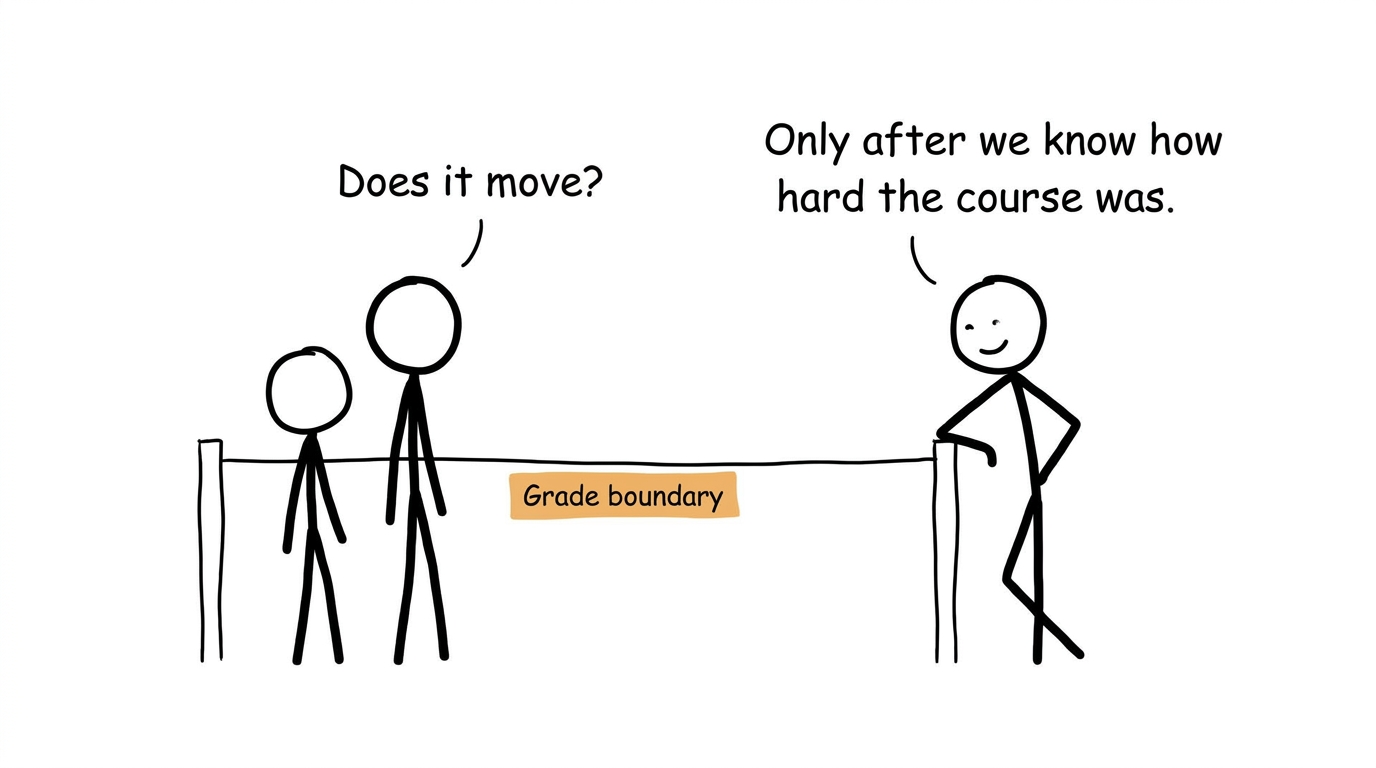 Students discovering that the grade-boundary limbo bar can move
A worked grade-boundary example
Consider the confirmed June 2025 OCR J277 boundaries. The qualification had a maximum of 160160160 marks, and the relevant overall boundaries included:
| Grade | Minimum total mark |
|---|---|
| 999 | 141141141 |
| 888 | 132132132 |
| 777 | 123123123 |
Suppose a student received 646464 marks on Component 010101 and 676767 marks on Component 020202. Their overall mark would be:
64+67=13164+67=13164+67=131As a percentage, this is:
131160×100=81.875%\frac{131}{160}\times 100=81.875\%160131×100=81.875%Because 131131131 is at least 123123123 but below 132132132, the final result would be a grade 777. It is one mark below the grade 888 boundary.
This example uses 2025 OCR data only. It does not predict the OCR boundaries for 2026. It also demonstrates why the overall qualification boundary matters: marks from both components are combined before the final grade is awarded.
Computer Science boundaries differ by exam board
GCSE Computer Science is normally a single-tier qualification, unlike foundation and higher tier GCSE Maths. However, assessment structures and maximum marks differ between boards.
For example, the specifications used for the 2026 examinations include different totals: AQA uses two papers contributing to a total of 180180180 marks, Edexcel uses two assessments totalling 150150150 marks, and OCR J277 uses two written papers totalling 160160160 marks. Eduqas applies component weighting when producing its overall subject mark.
This means an AQA total cannot be compared directly with an OCR or Edexcel total. Use the AQA Computer Science revision hub, Edexcel Computer Science revision guides, OCR Computer Science revision hub or Eduqas Computer Science revision hub to identify the structure of your course.
What to do if your result is close to a boundary
First, pause. Being one mark below a boundary does not automatically mean that marking was wrong.
Ask your teacher or exams officer for your component marks and advice. They can help you decide whether requesting the script, arranging a clerical re-check or applying for a review of marking is sensible. A review can leave the mark unchanged, raise it or lower it, so discuss the possible consequences and fees before proceeding.
If the grade affects your next course, speak to the sixth form or college as soon as possible. Entry decisions are made by the institution, and staff may consider your wider results and circumstances.
Common mistakes when reading grade boundaries
Using another board's table
AQA, Edexcel, OCR and Eduqas set boundaries for different assessments. Match the board and specification code shown by your school.
Treating a component boundary as a final grade
Some boards publish notional component boundaries to show how difficult an individual paper was. Your certificate records the overall qualification grade, based on the combined subject mark.
Assuming last year's marks must apply
Boundaries can move because paper difficulty changes. Historical figures are useful evidence, not a promise.
Confusing a predicted mark with an official result
A mock grade calculator estimates performance using previous boundaries. Only the awarding organisation can issue your final grade.
Your next step with MathsGenie
Results day turns uncertainty into information. Whatever the number, it tells you where you are, not where your ability ends.
If you are preparing for a resit, supporting a younger student or continuing with Computer Science, start with MathsGenie's free GCSE Computer Science revision guides. Build understanding through revision lessons, then use practice questions, mark schemes, flashcards, mini tests and past papers to expose the gaps that reading alone can hide.
Choose your exam board in the GCSE Computer Science revision centre, open one topic and begin with the next mark you can still earn.











