GCSE Combined vs Separate Science Grade Boundaries
GCSE combined science vs the alternative option grade boundaries: learn why neither route is automatically more generous and plan for your target grade.
A grade boundary can look like a promise: reach this mark and the grade is yours. But boundaries are not fixed fences. They move from one exam series to another because papers vary in difficulty.
That matters when comparing GCSE combined science vs the alternative option grade boundaries. If by “the alternative option” you mean separate sciences, often called triple science, the short answer is that neither route has consistently more generous boundaries. A lower-looking boundary does not automatically make one qualification easier. The total marks, paper content, tier, exam board and grading structure are different.
The useful question is not simply, “Which boundary is lower?” It is, “Which course gives me the best chance of producing the marks required for my target grade?”
The comparison at a glance
Before looking at published numbers, remember these distinctions:
- Combined Science normally leads to two GCSE grades, such as 777-777 or 666-555.
- Separate sciences lead to three individual GCSE grades in Biology, Chemistry and Physics.
- Combined Science boundaries are normally based on the total marks across the complete qualification, not separate grades for each science.
- Boundaries are set after papers have been marked and reviewed.
- Raw marks cannot be compared fairly unless the maximum marks and specification are also considered.
- Foundation and higher tier have different available grade ranges.
- Edexcel, AQA, OCR and Eduqas publish boundaries for their own specifications.
- Your latest official exam-board boundary is useful evidence, but it is not a guaranteed prediction for the next series.
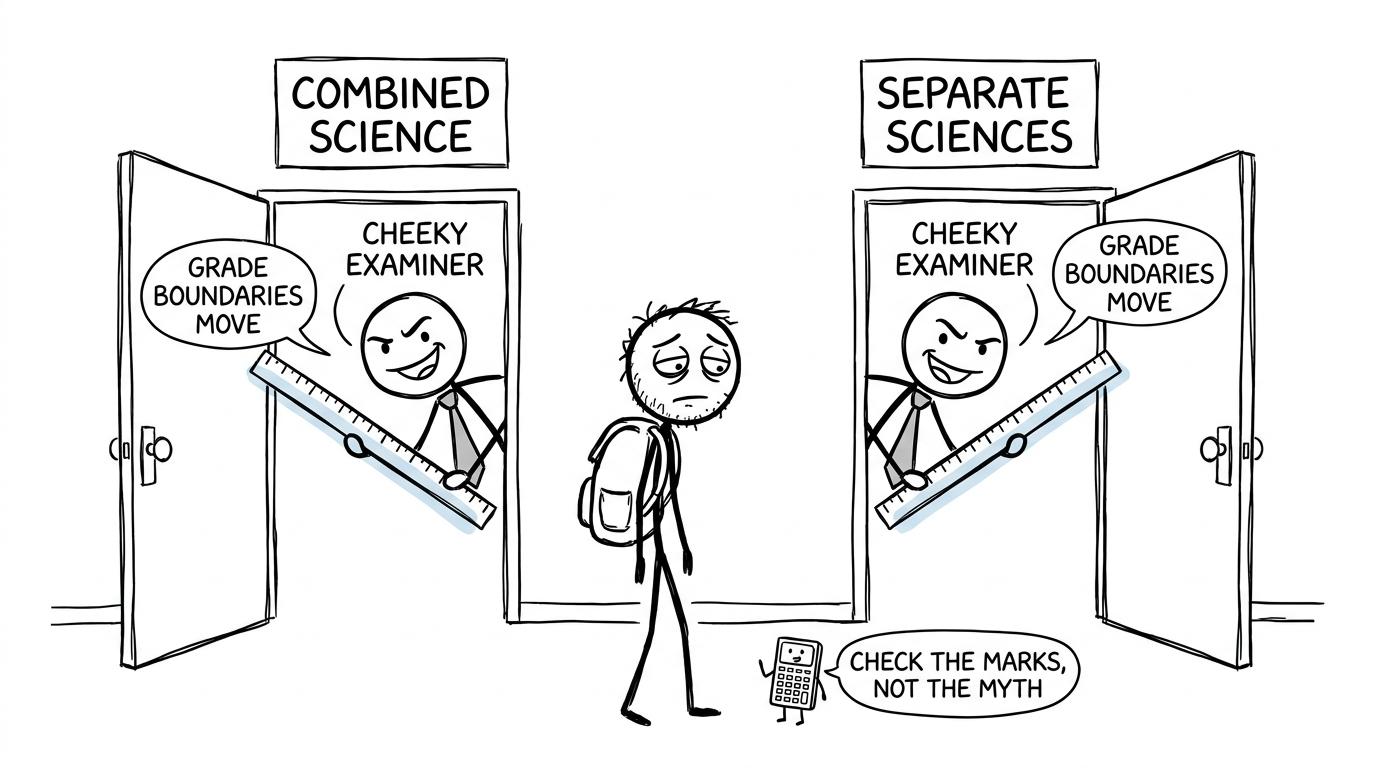 A student discovers that both science routes have moving grade boundaries
What is the alternative to GCSE Combined Science?
In most conversations, the alternative is separate sciences. This is also widely known as triple science because students receive three GCSE qualifications: GCSE Biology, GCSE Chemistry and GCSE Physics.
Combined Science still covers all three scientific disciplines, but it is worth two GCSEs rather than three. Separate science specifications include additional content and usually involve more teaching time and a greater total assessment load.
The difference is not that one route contains “proper science” and the other does not. Both are established GCSE routes. Nor does Combined Science prevent progression to A Level automatically. Sixth forms set their own entry requirements, often considering the grades achieved alongside GCSE Maths and other subjects, so students should check the requirements of their intended school or college.
The course available to you may also depend on your school’s curriculum and entry policy. It is therefore important to compare the actual specifications being taught rather than an imagined easy and hard version of science.
How Combined Science grades work
Combined Science uses paired grades. The available outcomes progress through adjacent and matching grades, including:
9-9, 9-8, 8-8, 8-7,…, 2-1, 1-1 9\text{-}9,\ 9\text{-}8,\ 8\text{-}8,\ 8\text{-}7,\ldots,\ 2\text{-}1,\ 1\text{-}1 9-9, 9-8, 8-8, 8-7,…, 2-1, 1-1This produces 171717 possible passing grade combinations.
A grade of 999-888 does not usually mean that you received a grade 999 in one named science and a grade 888 in another. It represents overall performance across the Combined Science qualification. Marks from Biology, Chemistry and Physics assessments contribute to the combined total.
That can help a student whose performance is reasonably balanced. A weaker paper may be offset by stronger marks elsewhere. But it also means that repeatedly neglecting one discipline can pull down the final paired grade.
Separate sciences work differently. Biology, Chemistry and Physics are awarded independently, so a student might receive a grade 888 in Biology, a grade 777 in Chemistry and a grade 666 in Physics. Strong performance in Biology does not alter the separately awarded Physics grade.
Are Combined Science grade boundaries more generous?
Not in any reliable, permanent sense.
Exam boards use statistical evidence and expert judgement when setting boundaries. The purpose is to maintain comparable standards when one year’s paper is more or less demanding than another. If a paper proves harder, the boundary required for a particular grade may be lower. If it proves more accessible, the boundary may rise.
This is why historical boundaries move. It is also why a boundary should never be interpreted without context.
Suppose one qualification has a lower raw-mark boundary than another. That comparison tells you little unless you also know:
- the maximum available marks;
- the number and length of papers;
- the content assessed;
- whether the papers were foundation or higher tier;
- the difficulty of that particular exam series;
- how the qualification combines marks into grades.
A more meaningful comparison is the proportion of available marks:
Percentage of marks=boundary markmaximum mark×100 \text{Percentage of marks}=\frac{\text{boundary mark}}{\text{maximum mark}}\times 100 Percentage of marks=maximum markboundary mark×100Even this percentage must be treated cautiously. Two papers requiring similar percentages may test different content and demand different levels of mathematical reasoning, practical knowledge and extended writing.
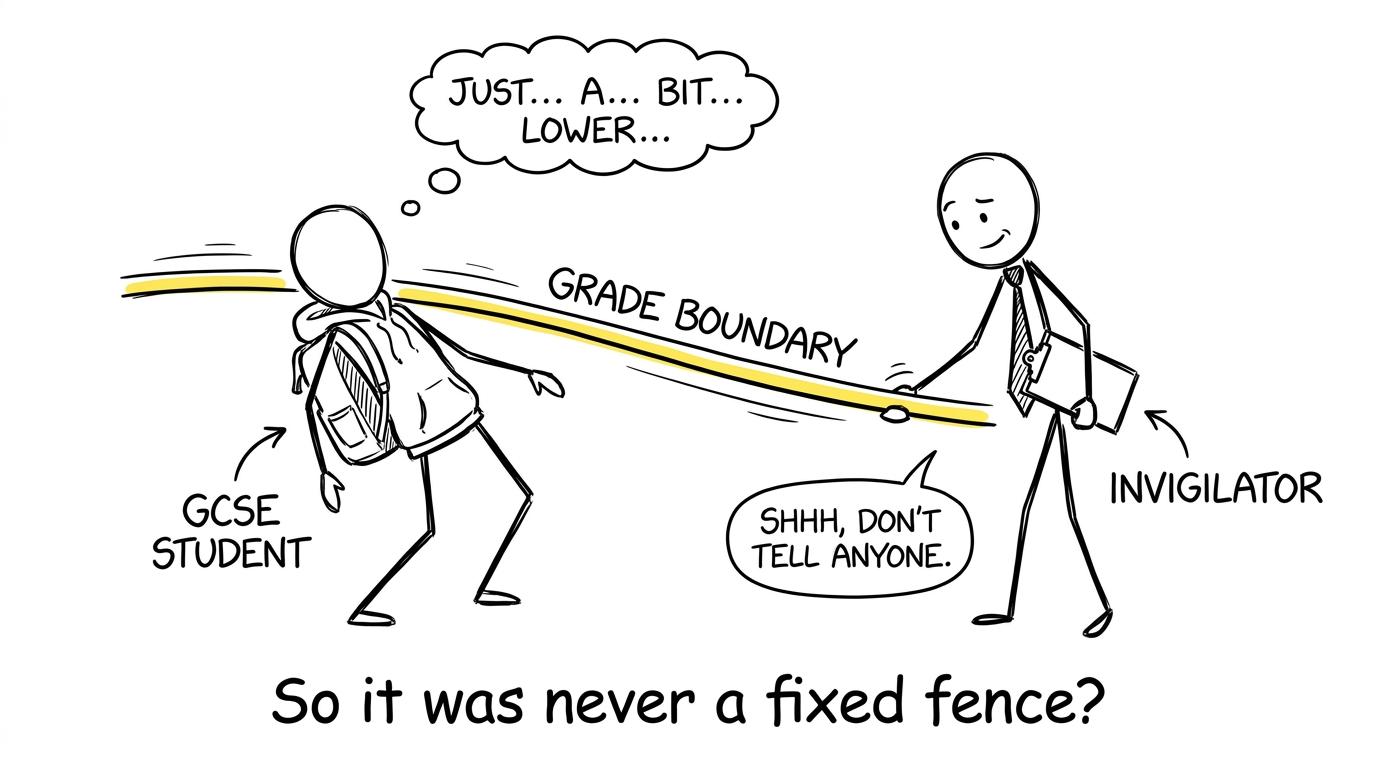 An examiner adjusts a grade boundary after seeing the paper difficulty
Why Separate Science boundaries can look different
Separate science cohorts are not identical to Combined Science cohorts. Schools may use attainment, interest, timetable capacity or other internal criteria when deciding which students take separate sciences. The amount of curriculum content and teaching time also differs.
Those factors can affect the distribution of marks, but they do not establish that one route is more generously graded. Grade boundaries are not a reward for choosing the longer course, nor are they designed to punish students taking Combined Science.
Separate sciences may suit a student who enjoys the subject, learns additional content confidently and values three independent results. Combined Science may suit a student who would benefit from concentrating revision across a slightly smaller body of science content while managing the rest of the GCSE timetable.
The more suitable route is the one in which you can learn the specification securely and perform consistently, not the one whose boundary looked friendliest in a previous year.
What the boundaries mean for your target grade
Begin with the qualification and tier you are actually taking. Foundation and higher tier offer different grade ranges. Broadly, Combined Science foundation tier offers outcomes up to 555-555, while higher tier provides access to the highest paired grades. Exam-board rules include specific arrangements near the bottom of higher tier, so check the current information supplied by your board and school.
Next, find several recent official boundaries for your precise specification. Do not combine an AQA Trilogy figure with an Edexcel Combined Science paper, or compare an OCR separate Physics boundary with your Combined Science total.
Treat those boundaries as a range, not a prophecy. A sensible revision target includes a margin above the previous threshold:
Target mark=reference boundary+safety margin \text{Target mark}=\text{reference boundary}+\text{safety margin} Target mark=reference boundary+safety marginThere is no universal safety margin that guarantees a grade. Its purpose is practical: it stops your plan depending on the next boundary remaining unchanged.
When completing a paper, record both the raw mark and the proportion achieved. Then analyse where the missing marks came from. In science, this may include weak subject knowledge, unfamiliar practical questions, unit errors, graph interpretation or incorrect equation rearrangement.
Maths skills can decide the science grade
Science grade boundaries receive attention, but boundaries cannot recover marks lost through avoidable calculation errors. GCSE science regularly calls on skills including percentages, ratios, standard form, substitution, rearranging formulae, graphs and unit conversions.
If these are weak, use the free GCSE maths revision programme to revisit the underlying skill. MathsGenie’s standard form revision is particularly relevant to very large and very small scientific quantities, while rearranging formulae practice supports equation-based questions.
Proportional relationships also appear throughout physics and chemistry. The direct and inverse proportion resources can help you recognise those relationships rather than relying on memorised steps. For data and practical work, revisiting graphs revision can strengthen your understanding of scales, gradients and trends.
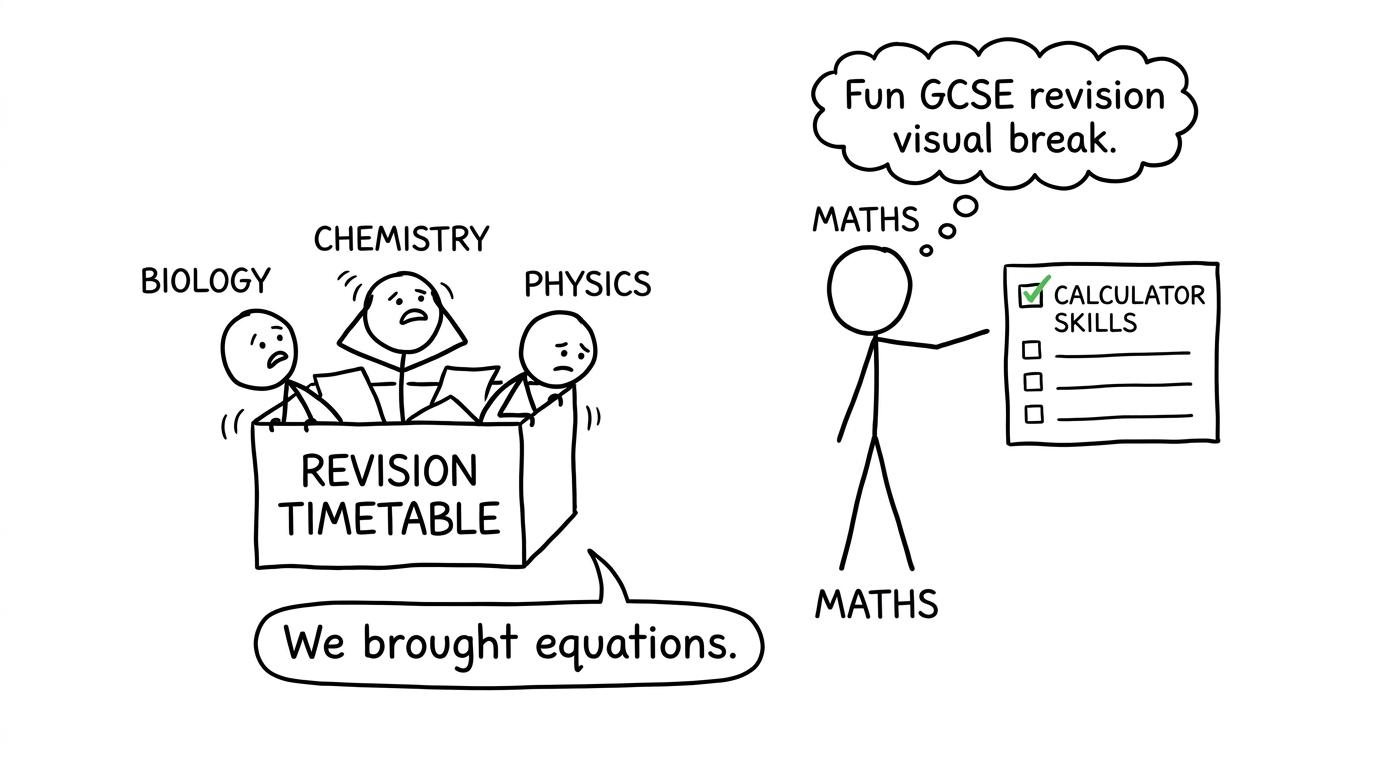 Biology, Chemistry and Physics arrive with equations for the revision timetable
A better way to compare your options
Use four questions rather than searching for the lowest historical boundary.
Which specification will I take?
Confirm the exam board, qualification title and tier. “Combined Science” is not one universal paper, and specifications from Edexcel, AQA, OCR and Eduqas should not be mixed.
How secure is my knowledge?
Look at topic-level performance rather than your favourite science. Separate sciences require additional content, while Combined Science still requires sustained work across Biology, Chemistry and Physics.
How consistently can I earn marks?
A student occasionally reaching a target is in a different position from one reaching it repeatedly. Complete timed assessments, mark them carefully and monitor your recent range.
Maths students can use GCSE past papers in the same way: complete, mark, diagnose and revisit. The value is not merely seeing a score. It is discovering which mistakes repeat.
What does my next step require?
Check the current entry requirements published by the sixth form or college you are considering. Do not assume that every provider treats Combined Science and separate sciences identically.
Common mistakes when comparing grade boundaries
Comparing raw marks with different totals
A boundary of 120120120 marks is not automatically more demanding than one of 100100100 marks. The maximum mark matters. Convert each figure to a proportion before making even a cautious comparison.
Treating last year’s boundary as a target
Historical boundaries describe an exam series that has already happened. They cannot tell you the exact threshold for an unseen paper. Build a safety margin into your revision goal.
Reading paired grades as subject grades
A Combined Science result such as 777-666 is an overall double-award result. It is not a statement that one named science received a grade 777 and another received a grade 666.
Comparing different boards or tiers
A foundation boundary from one board cannot answer what will be required on another board’s higher-tier specification. Check every label before using a figure.
Choosing a course only because it appears easier
Boundaries respond to paper difficulty and performance. Your understanding, consistency and interest are more controllable than a future threshold.
Focus on marks you can control
No historical table can reveal exactly where the next grade boundary will sit. That uncertainty feels inconvenient, but it points towards a better strategy: stop trying to predict the minimum and start building reliable marks.
For maths, create that reliability with MathsGenie’s revision lessons, videos and practice questions. Use GCSE past papers and mark schemes to test complete-paper performance, then turn each lost mark into a specific revision task. Closer to the exam, use MathsGenie predicted papers as additional practice rather than a promise of what will appear.
Combined Science is not automatically the generous route, and separate science is not automatically the harsher one. The boundary moves. Secure knowledge, accurate calculations and calm exam technique travel with you.