GCSE Combined Science Grade: Sixth Form Guide
GCSE combined science grade sixth form guide: understand double grades, typical A-level entry expectations, maths requirements and next steps for college.
A results slip can make two small numbers feel like a verdict on your future. They are not. The GCSE combined science grade meaning is straightforward: you receive a double grade worth two GCSEs, reflecting your overall performance across biology, chemistry and physics. For sixth-form science courses, the important question is whether that double grade meets the provider's published entry requirements.
Many sixth forms ask for around $6$-$6$ in Combined Science for A-level Biology, Chemistry or Physics, while some require $7$-$7$. Maths requirements are often added, especially for Chemistry and Physics. These are common expectations, not national rules; always check each course directly.
Your quick sixth-form checklist
Before choosing post-16 courses:
- Confirm whether your result is a double grade, such as
$6$-$6$or$7$-$6$. - Read the subject-specific requirements, not only the sixth form's general entry rules.
- Check the required GCSE Maths grade.
- Ask how the provider treats adjacent grades such as
$6$-$5$. - Compare academic A levels with suitable vocational science courses.
- Keep revising until the exams; predicted grades and conditional offers are not final results.
What does a Combined Science double grade mean?
Combined Science is worth two GCSEs. In England, its 171717 possible outcomes run from $9$-$9$ to $1$-$1$. The two grades are equal or adjacent, so $7$-$7$ and $7$-$6$ are possible, but $7$-$5$ is not. When they differ, the higher grade appears first.
Your result is not one grade for biology and another for chemistry. Exam marks across all three sciences are combined at qualification level. Stronger performance in one area can therefore compensate for weaker performance elsewhere.
Foundation tier normally offers outcomes up to $5$-$5$. Higher tier reaches $9$-$9$, with $4$-$3$ available as an allowed outcome for students narrowly below $4$-$4$; below the allowed threshold, the result is ungraded. Exact arrangements should always be checked against your exam board's current specification.
Students following AQA can use the AQA Combined Science revision hub, while equivalent resources are available for Edexcel Combined Science and OCR Combined Science.
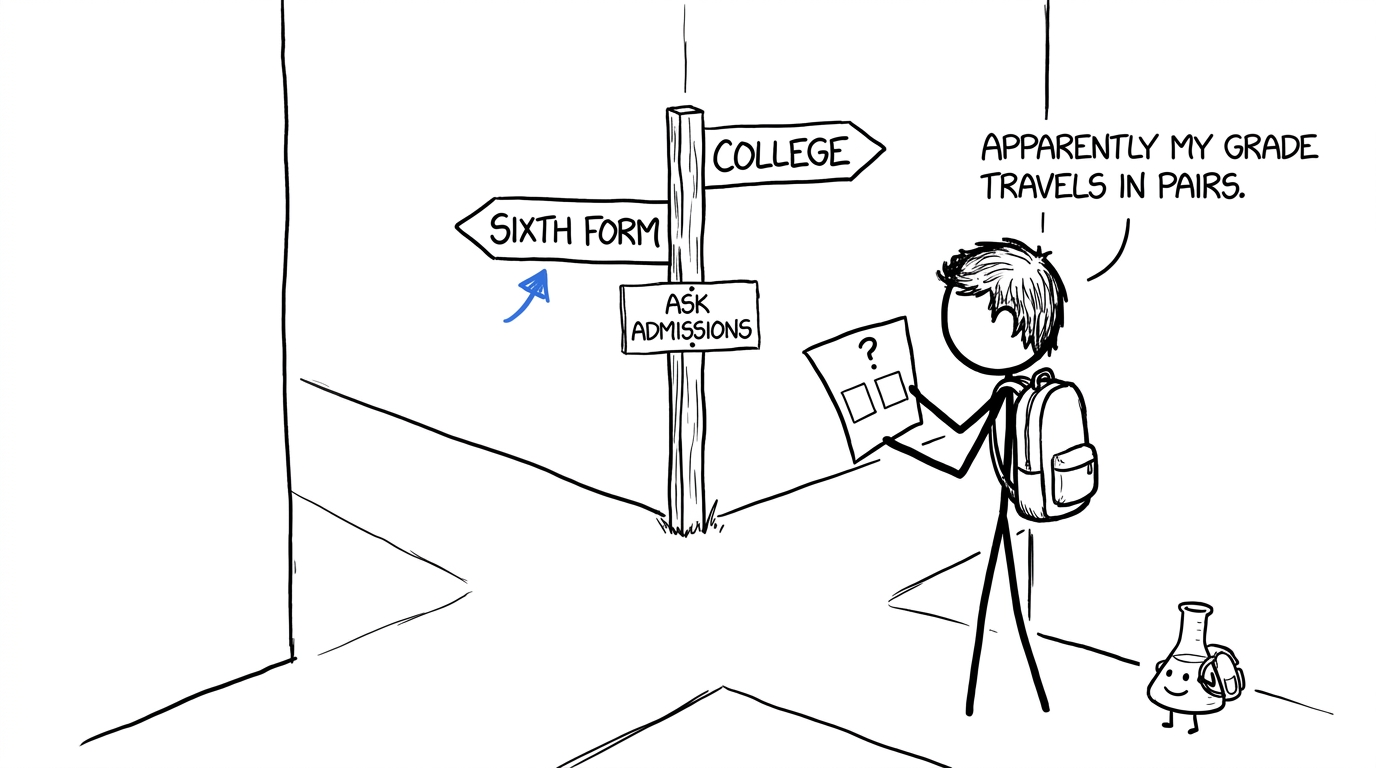 A student choosing between sixth form, college and asking admissions about a double science grade
Grade-by-grade sixth-form expectations
There is no universal national entry grade for an A-level subject. Schools and colleges set their own admissions criteria, and requirements can change between application years. This breakdown is therefore a guide to the options you are likely to encounter, not a guarantee of admission.
| Combined Science grade | What it may mean for post-16 choices |
|---|---|
$9$-$9$ to $8$-$8$ | Exceptionally strong preparation. You are likely to exceed the published science requirement at most providers, although Maths, English and overall GCSE conditions still apply. |
$8$-$7$ to $7$-$7$ | Strong preparation for individual science A levels. These grades meet the higher threshold used by some selective sixth forms. |
$7$-$6$ to $6$-$6$ | Often within the entry range for A-level Biology, Chemistry or Physics. Some providers insist on $6$-$6$, so ask whether $7$-$6$ is accepted under their wording. |
$6$-$5$ to $5$-$5$ | May meet general sixth-form entry rules but not every science A-level requirement. Applied Science or another Level 333 pathway may be available. |
$5$-$4$ to $4$-$4$ | Represents two GCSE outcomes around the standard-pass range, but direct entry to individual science A levels is less common. Consider vocational science, resits where appropriate, or subjects with different entry criteria. |
$4$-$3$ and below | A Level science entry is unlikely at providers requiring strong GCSE science passes. Speak to careers and admissions staff about Level 222 or Level 333 routes and progression opportunities. |
An adjacent grade needs careful reading. If a prospectus states “$6$-$6$ in Combined Science”, do not assume $7$-$5$ would be equivalent; that combination cannot be awarded anyway. Nor should you assume $6$-$5$ qualifies. Ask the admissions team and keep its answer in writing.
Progressing to A-level science from Combined Science
Students sometimes search for progressing to A-level Combined Science, but sixth forms usually offer separate A levels in Biology, Chemistry and Physics rather than an A-level qualification called Combined Science. Taking Combined Science at GCSE does not automatically prevent you from choosing one or more of them.
The real gatekeepers are your provider's subject requirements and your readiness for the course. Current published entry criteria show genuine variation: some providers request $6$-$6$ in Combined Science, while others ask for $7$-$7$. Requirements for GCSE Maths commonly sit around grades 555 or 666, with certain Physics routes asking for more or recommending A-level Maths.
That maths condition is not administrative decoration. Post-16 science involves rearranging formulae, interpreting graphs, using standard form, handling proportions and evaluating data. Strengthening those skills through the GCSE Maths revision hub can improve both your maths result and your preparation for science.
If A-level Maths is part of your plan, explore the A-level Maths revision hub to see how algebra, mechanics and statistics develop after GCSE.
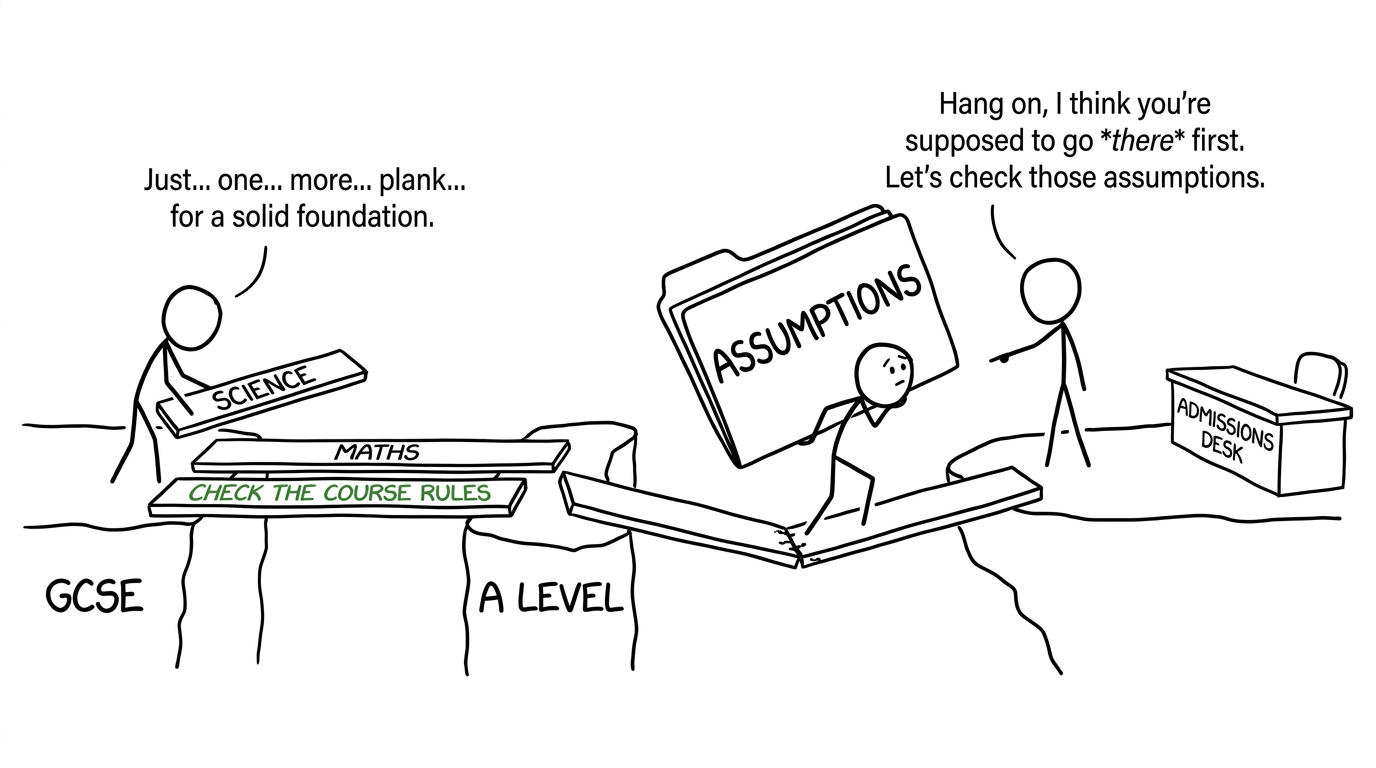 A student building a bridge from GCSE to A Level using science, maths and course requirements
How to improve your options before results day
A grade target becomes useful when it changes today's revision. Start with topic-level work, then move towards timed papers.
Use revision lessons and practice questions to repair specific gaps. Next, complete AQA Combined Science past papers or OCR Combined Science past papers, depending on your board. Mark every attempt carefully and revisit the reason each mark was lost.
For maths, use topic questions before full papers, then introduce GCSE predicted papers nearer the exams. Predicted papers are practice tools, not forecasts of your result or guarantees of the questions that will appear.
Common mistakes when interpreting your grade
Treating the numbers as separate sciences
A double grade is an overall Combined Science result. It does not mean the first number is biology and the second is chemistry or physics.
Assuming every sixth form uses the same threshold
Admissions rules are local. Check the latest prospectus for your intended year of entry and look for separate requirements for Biology, Chemistry and Physics.
Forgetting the Maths requirement
A strong science grade may not be enough if the course also requires a particular GCSE Maths result. Build calculation confidence alongside science knowledge.
Believing Combined Science blocks science A levels
It does not. Many providers explicitly accept Combined Science, provided the required double grade and any accompanying Maths grade are achieved.
Stopping revision after receiving an offer
A conditional offer depends on your final grades. Continue using lessons, mini tests, mark schemes and papers until the examination series is complete.
Turn the grade into a next step
Your Combined Science result matters, but its meaning comes from the course you want and the requirements attached to it. Check those requirements early, including how adjacent grades and GCSE Maths are treated. If anything is unclear, ask the sixth form or college rather than guessing.
Then return to what you can control. Use MathsGenie's free science and maths revision lessons, practice questions, past papers, predicted papers, mark schemes, video solutions and mini tests to turn weak areas into marks. Start with one topic today, review every error, and make your post-16 choice from evidence rather than anxiety.