GCSE Chinese Cram Guide: A Focused 1-Week Plan
GCSE Chinese cram guide 1 week: follow a focused plan for listening, speaking, reading and writing while keeping your GCSE maths revision on track.
A week before the exam, GCSE Chinese can feel less like a subject and more like four subjects arriving at once. There is vocabulary to recognise, speech to produce, audio to decode and writing to organise. The answer is not to cover everything. It is to identify what can still improve.
This GCSE Chinese cram guide 1 week plan gives you a focused route through the final seven days. You will practise listening, speaking, reading and writing, correct mistakes each day and protect enough time for your other GCSEs, particularly maths. Check every task against your own AQA or Pearson Edexcel specification, tier and exam timetable before beginning.
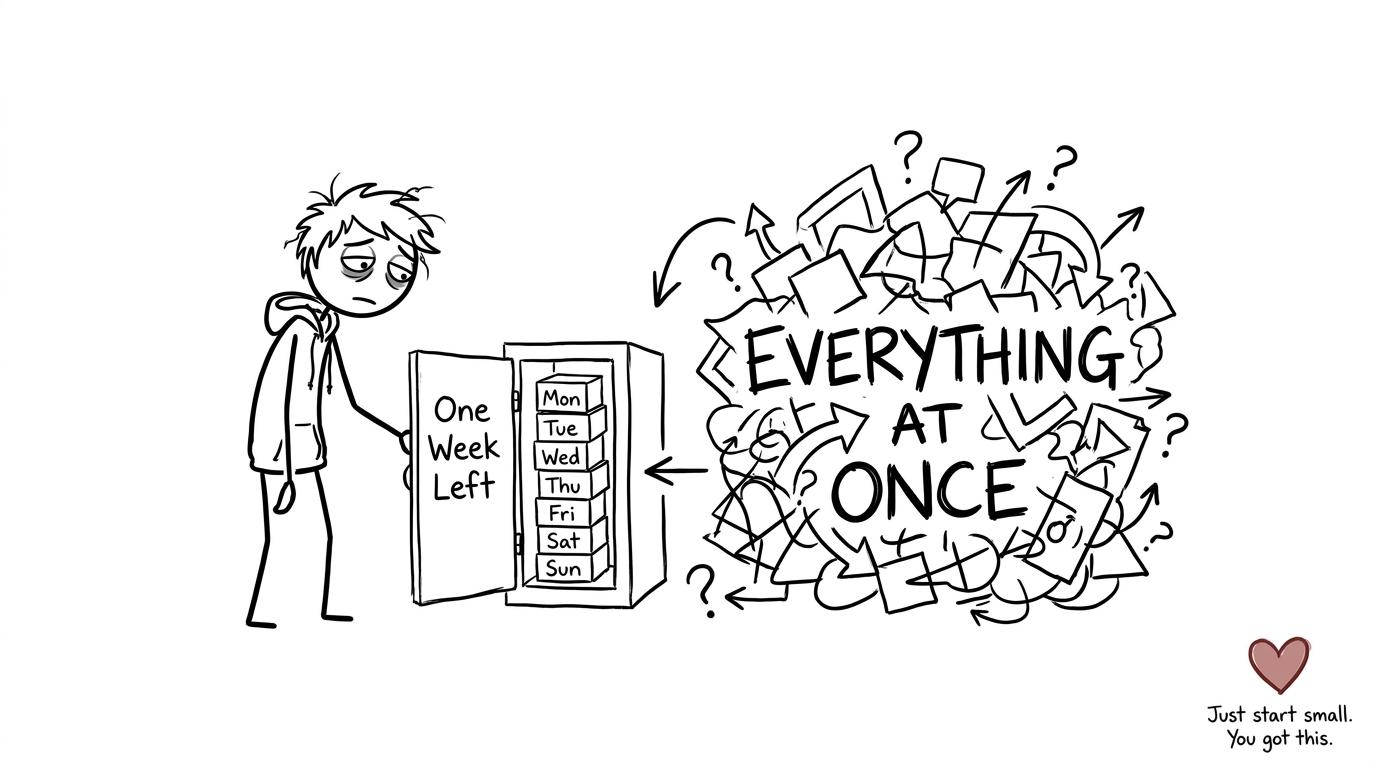 A student turns one week of revision panic into seven manageable boxes
Your one-week revision checklist
Before the first session, gather:
- your exam board's current GCSE Chinese specification
- your confirmed tier, where applicable
- the official exam timetable and speaking arrangements from your school
- past papers, audio files and mark schemes
- your teacher's vocabulary and grammar lists
- previous assessments with corrections
- a timer, blank paper and a simple error log
Current AQA and Pearson Edexcel GCSE Chinese qualifications assess listening, speaking, reading and writing. The precise question types, timings, instructions and arrangements depend on your qualification, so use the front of an official paper and your specification rather than relying on a generic online summary.
Aim for two focused Chinese sessions of roughly 454545 minutes each day, separated by a proper break. If you also have maths approaching, add one manageable maths block rather than abandoning it for a week. MathsGenie's GCSE maths revision resources organise topics by grade and include videos and exam-style questions, making it easier to choose a contained task.
The rule that makes cramming useful
Late revision fails when it becomes late reading. Looking over vocabulary may feel productive because every word is familiar while it remains on the page. The examination asks for something harder: recognition under pressure and recall without support.
Use a short cycle throughout this plan:
- Recall: answer, translate or speak without looking.
- Check: compare your response with a reliable answer or mark scheme.
- Fix: record the precise word, character, sound or structure that failed.
- Return: test that item later the same day and again the next day.
Your error log should be selective. Separate mistakes into vocabulary, characters, grammar, listening discrimination, task misunderstanding and timing. A page containing your most persistent errors is more useful than a beautiful rewrite of everything you already know.
Your seven-day GCSE Chinese plan
Day one: diagnose before revising
Complete short sections from an official paper across all four skills. This is diagnosis, not a prediction of your final grade. Work without notes and use the correct tier for your entry.
Mark what you can immediately. For speaking, record yourself answering prompts from material supplied by your school, then listen for hesitation, unclear pronunciation and incomplete development. Do not simply decide that the answer “sounds bad”; name the issue.
Finish by selecting three priorities. A useful priority is narrow, such as missing time phrases in listening or failing to justify opinions in speaking. “Learn Chinese” is not a plan.
Day two: rebuild high-frequency vocabulary
Concentrate on vocabulary from the themes in your own specification and your teacher's course materials. Sort words into three groups: secure, recognisable but difficult to produce, and unfamiliar. Spend most of the session on the middle group because those words are closest to becoming usable.
Test both directions where relevant. Recognising an English meaning is not the same as producing the Chinese word, and recognising a character is not the same as writing it accurately. Include dates, times, quantities, connectives, opinions and common verbs because they help across several contexts.
End with a brief listening task so the vocabulary is encountered as sound rather than only as text.
Day three: make listening active
Listening practice should not become repeated guessing. Before playing an official recording, read the question carefully and identify the information required. During the first attempt, listen for overall meaning. On a later permitted practice attempt, isolate the section that caused the problem.
Use the transcript only after you have committed to an answer. Then determine whether the barrier was an unknown word, familiar language spoken quickly, a distractor, a negative or a failure to read the question. Replay only the difficult phrase and shadow the audio aloud to connect sound with pronunciation.
Protect some time for other subjects. If maths is also close, select one weak area using the GCSE maths revision planner rather than choosing randomly.
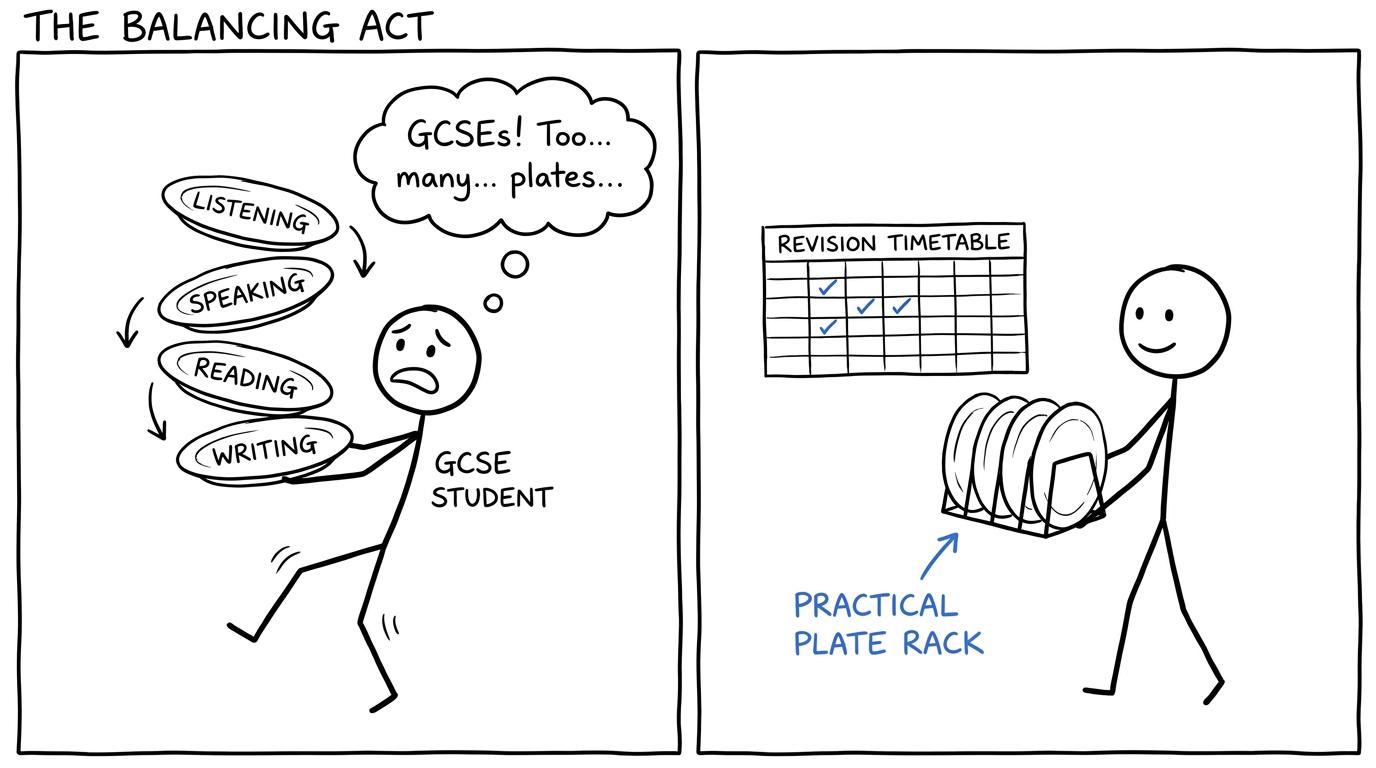 A timetable helps a student balance four GCSE Chinese skills
Day four: train speaking under pressure
Speaking improves through speaking, not through silently planning what you might say. Use the formats and preparation rules specified by your exam board and school. Record short responses, listen once and repeat them with one deliberate improvement.
Prioritise answers that are clear, relevant and expandable. Practise giving an opinion, supporting it with a reason, adding detail and referring to more than one time frame where the question makes that appropriate. However, do not force memorised material into an unrelated prompt.
Also rehearse repair strategies approved and taught within your course: pausing calmly, restarting a phrase and answering with simpler language you can control. Fluency is not the absence of every pause. It is the ability to keep communicating.
Day five: combine reading and writing
Begin with a timed reading section. Underline instructions and distinguish what you know from what you infer. Watch for negatives, contrasting connectives, changes of speaker and references to past or future events.
For writing, plan briefly before producing a response. Check that every bullet point has been addressed and that the content answers the actual task. Then review characters, word order, time phrases and whether your opinions have been developed clearly.
Do not spend the whole session creating one polished response with unlimited help. Complete at least part of the work under examination conditions, then use your notes to correct it afterwards. The distinction matters: supported writing reveals what you can understand; closed-book writing reveals what you can currently produce.
Day six: complete a controlled rehearsal
Choose the component that most needs a realistic rehearsal and complete an official paper or substantial section under the stated conditions. Follow the instructions printed on that paper, including its timing and permitted materials.
Mark it carefully. A mark scheme is not merely a score generator; it shows what the question rewarded. Look for patterns rather than mourning individual marks. If several mistakes came from misreading instructions, the remedy differs from several unknown words.
Keep your maths moving with a limited paper section or topic test. MathsGenie provides Edexcel GCSE maths past papers, AQA GCSE maths past papers and OCR GCSE maths past papers, with mark schemes for checking your work.
Day seven: consolidate and stop
The final day is for retrieval, not expansion. Test the vocabulary and structures in your error log, complete one short activity in each skill and rehearse practical details such as the examination time and required equipment.
Avoid beginning a huge new topic because it appears in somebody else's revision list. Your last session should strengthen accessible knowledge and reduce avoidable mistakes. Finish at a sensible time. Fatigue makes listening, character recognition and careful reading harder, precisely when you need those skills most.
For maths, a short set of GCSE maths mini tests can maintain recall without turning the evening into another full mock.
How to divide each revision session
A practical 454545-minute session can contain:
- about 555 minutes of closed-book retrieval
- about 252525 minutes on one examination skill
- about 101010 minutes marking and correcting
- about 555 minutes retesting previous errors
The exact split is less important than the sequence. Practice without checking repeats mistakes; checking without retesting produces recognition rather than recall.
Across the week, give extra time to your weakest component without allowing any skill to disappear completely. If listening is weakest, it might receive several full sessions, but speaking should still be practised aloud and writing should still happen without notes.
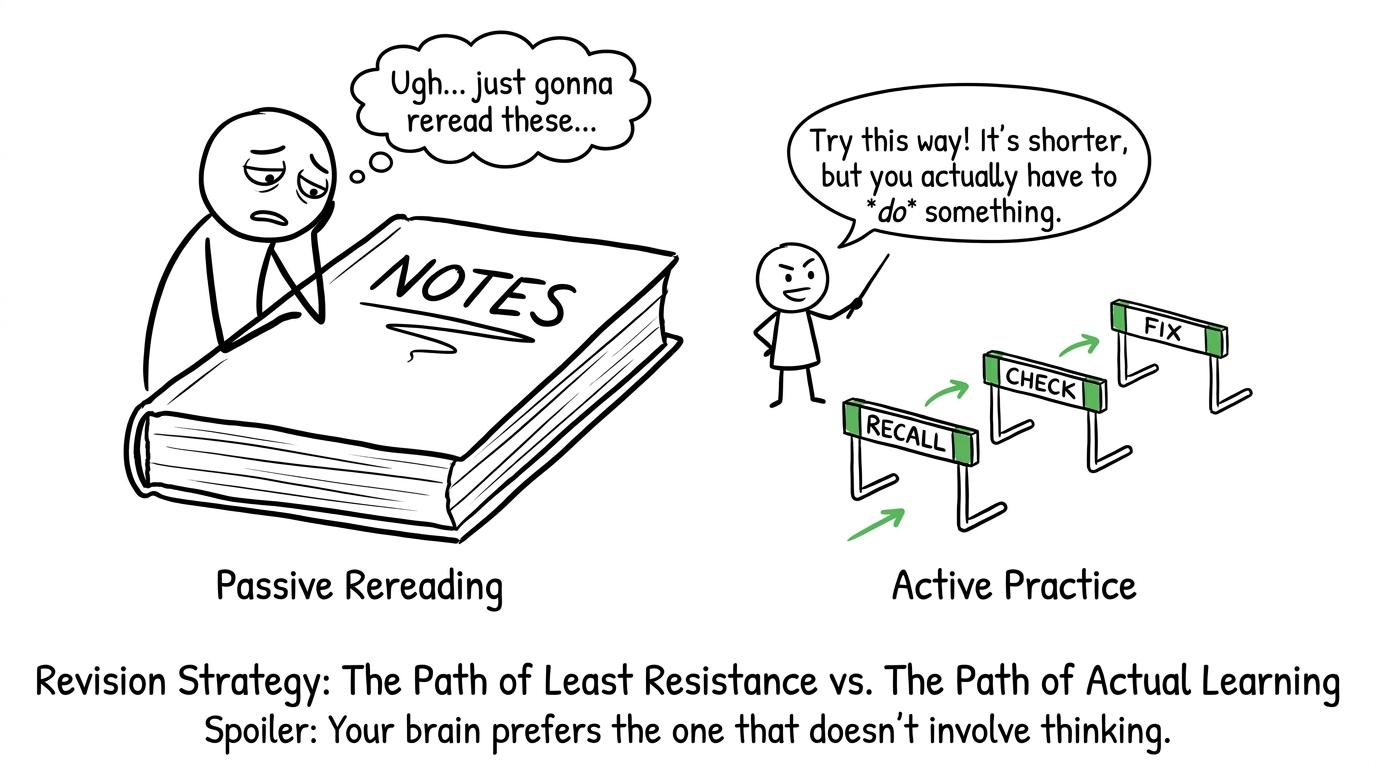 A student chooses recall, checking and fixing instead of rereading everything
Keeping GCSE maths revision on track
Chinese and maths test different knowledge, but effective revision shares the same architecture: retrieve, attempt, mark, correct and revisit. That means you do not need two completely different planning systems.
On each of the seven days, choose one maths action that can be completed properly. This might be a revision lesson, a set of practice questions or part of a past paper. Use GCSE maths exam papers for authentic practice, then return to the relevant topic lesson when the mark scheme exposes a gap.
Near the examination, MathsGenie predicted papers can provide additional maths practice. They should complement revision lessons and official past papers rather than replace them, and they cannot guarantee which questions will appear.
Common mistakes during a one-week Chinese cram
Revising only comfortable topics
Confidence is pleasant, but the largest short-term gains usually sit inside specific weaknesses. Use your diagnostic work and error log to decide where time goes.
Treating recognition as recall
A word can look familiar while remaining impossible to produce. Close the book, say or write the answer, and then check it.
Memorising scripts without flexibility
A memorised paragraph may not answer the prompt you receive. Build adaptable phrases and practise responding to variations instead.
Ignoring task instructions
Marks can be lost when a response misses a bullet point, uses the wrong information or exceeds what the task asks. Read the command and required language carefully.
Using unofficial timings or formats
Do not assume that another student's paper follows your rules. Confirm your exam board, specification, tier and arrangements with your school and official materials.
Sacrificing sleep for one more session
A late night may add minutes of exposure while reducing concentration the next day. Set a stopping time, prepare your equipment and let the final evening become quieter.
One week can still be organised
Seven days cannot replace a term of revision, but they can replace panic with useful decisions. Diagnose first. Practise all four skills. Retrieve rather than reread. Mark honestly, correct precisely and revisit the mistakes most likely to recur.
Then apply the same discipline to maths. Start with a MathsGenie GCSE revision lesson, answer the practice questions, use video solutions and mark schemes to understand errors, and move on to past papers or predicted papers when you are ready. A late start limits the available time; it does not remove your ability to use that time well.