

GCSE Chemistry Weekend Revision: Final Weeks Plan
GCSE chemistry weekend revision made manageable: build a focused Saturday and Sunday plan using recall, exam questions, maths skills and proper rest.
The final weekends before a Chemistry exam can feel strangely unhelpful. There is enough time to do something useful, but not enough time to revise everything. That uncertainty often leads to hours of rereading without discovering what you can actually answer.
A better GCSE chemistry weekend revision routine has four parts: retrieve key knowledge, answer exam questions, repair the mistakes you find and revisit them the next day. Keep each block focused, include the maths that Chemistry requires and finish early enough to protect your sleep.
This plan works whether you study separate Chemistry or Combined Science, but always check the specification and paper content for your own exam board, Edexcel, AQA, OCR or Eduqas, before choosing topics.
Your weekend revision checklist
Before Saturday begins, gather only what you will use:
- your exam board specification or topic checklist;
- one suitable past paper or a selection of exam questions;
- the corresponding mark scheme;
- your calculator, ruler and normal exam equipment;
- a blank error log;
- notes on required practical activities;
- a list of formulas, units and recurring maths errors.
Then make three decisions.
- Choose the correct paper content. Paper structures and topic groupings differ between specifications.
- Choose no more than three priority areas. Base these on assessments, past-paper mistakes or a self-assessment checklist.
- Decide when you will stop. A clear finishing time prevents a useful day becoming an exhausting one.
If Chemistry calculations are exposing weaknesses that may also affect your maths papers, open the GCSE Maths revision hub alongside your science materials. It brings together free lessons, worksheets, exam questions and papers across the main UK exam boards.
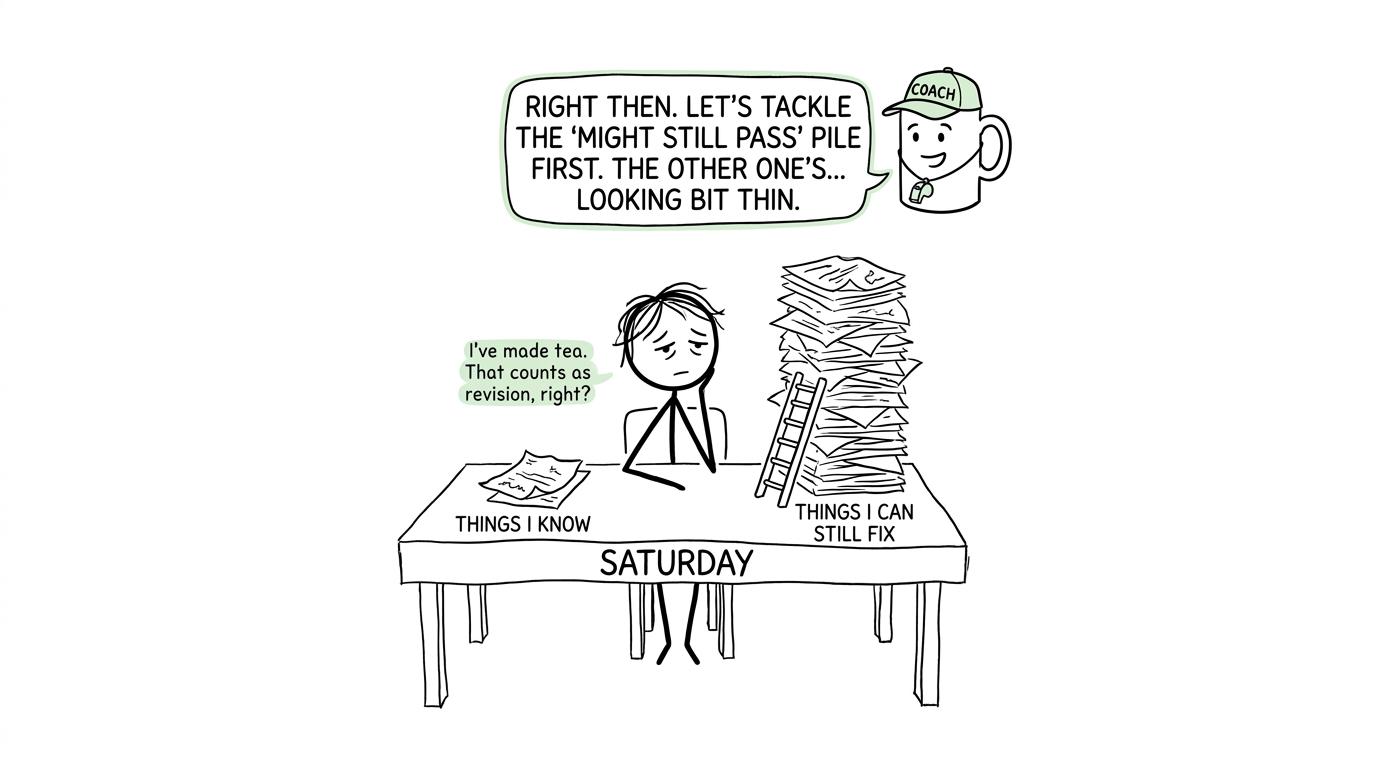 A student facing a surprisingly large but fixable revision pile
Saturday morning: diagnose before you revise
Start with a short, closed-book check rather than a long review of your notes. Spend around 202020 minutes retrieving definitions, processes, equations and practical methods from memory. You might use flashcards, a blank-page brain dump or short-answer questions.
Next, complete a timed exam section for approximately 303030 to 454545 minutes. Choose questions covering the part of the course you are about to revise. Do not pause to look things up. The purpose is diagnosis, not reassurance.
Mark the work immediately and classify each lost mark:
- knowledge: you did not know the fact, definition or process;
- application: you knew the content but could not use it in an unfamiliar context;
- practical understanding: you missed a variable, risk, apparatus choice or evaluation point;
- maths: the formula, conversion, graph or calculation went wrong;
- exam technique: you misread the command word or gave insufficient detail.
This distinction matters. Copying a definition will not repair an algebra error, and practising calculations will not fix an imprecise explanation. A useful error log tells you both what went wrong and what action comes next.
The same diagnostic habit is central to MathsGenie's one-week GCSE revision plan: attempt, mark, identify the leak and return to the relevant skill.
Saturday afternoon: repair the biggest mark leaks
After a proper break, choose the two most important gaps from your morning work. Give each one a focused block of about 353535 to 454545 minutes.
Rebuild knowledge actively
For a content gap, read or watch a concise explanation, close the resource and reproduce the idea from memory. Then answer fresh questions. Revision becomes useful when you have to retrieve and apply information, not when the page merely looks familiar.
Use exact scientific language. If a question asks you to explain, connect the relevant cause and effect. If it asks you to compare, refer to both items. If it asks you to evaluate, use the evidence provided and reach a justified conclusion.
Revisit required practical activities
Practical questions are not a minor extra. Under the current rules for GCSE single sciences in England, at least 15%15\%15% of qualification marks must assess knowledge, skills and understanding relating to practical work.
For each relevant practical, be ready to recall:
- the purpose and broad method;
- independent, dependent and control variables;
- suitable apparatus and measurements;
- hazards and ways to reduce risk;
- how results should be recorded or presented;
- limitations, sources of uncertainty and realistic improvements.
Do not memorise a method as an isolated paragraph. Ask why each step exists. That makes it easier to adapt your knowledge when the exam changes the apparatus or context.
Strengthen the maths inside Chemistry
For GCSE single Chemistry qualifications regulated in England, mathematical skills account for at least 20%20\%20% of the marks. These may involve ratios, percentages, standard form, significant figures, substitution, rearranging formulas, graphs and rates of change.
Useful relationships to review include:
percentage yield=actual yieldtheoretical yield×100\text{percentage yield}=\frac{\text{actual yield}}{\text{theoretical yield}}\times 100percentage yield=theoretical yieldactual yield×100 rate=quantity changedtime taken\text{rate}=\frac{\text{quantity changed}}{\text{time taken}}rate=time takenquantity changed concentration=mass of solutevolume of solution\text{concentration}=\frac{\text{mass of solute}}{\text{volume of solution}}concentration=volume of solutionmass of soluteCheck which equations and quantitative topics apply to your specification and tier. Practise writing the relationship first, substituting carefully, retaining full calculator accuracy until the end and including the correct unit.
If percentages are unreliable, use MathsGenie's percentage change revision guide. For a broader explanation of the overlap between the subjects, read how GCSE maths supports science.
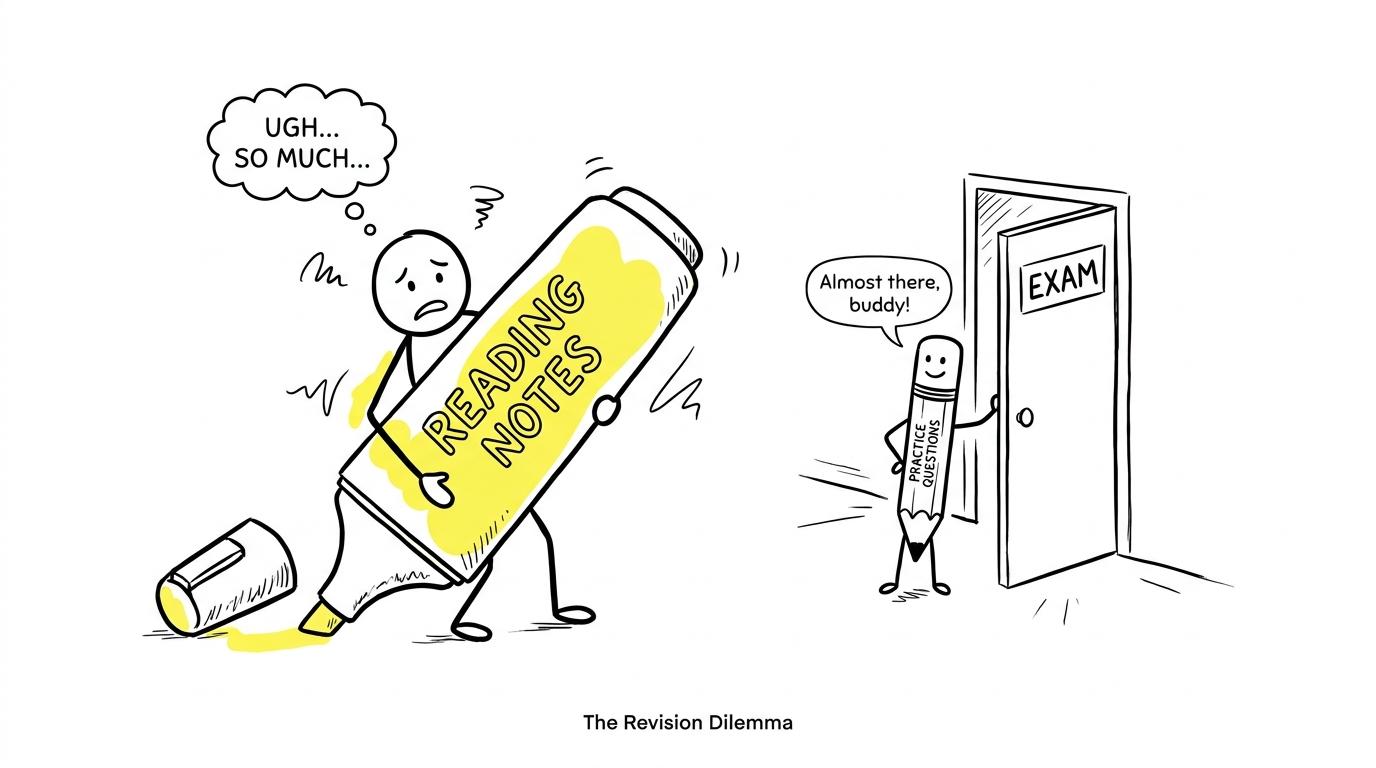 A giant highlighter discovers that practice questions reached the exam door first
Saturday evening: consolidate without cramming
Saturday evening should be lighter than the afternoon. Spend around 252525 minutes recalling what you repaired, followed by 151515 minutes correcting any remaining errors.
Create a one-page Sunday list containing:
- three facts or definitions to retrieve again;
- two exam questions to redo without help;
- one required practical to explain aloud;
- one mathematical skill to check.
Then stop. An extra late-night hour of unfocused highlighting is usually less valuable than returning rested and testing yourself properly on Sunday.
Sunday morning: retest without your notes
Sunday begins with the questions you got wrong on Saturday. Use clean paper and no prompts. If you can now answer them accurately, the repair is beginning to hold. If not, narrow the problem further.
For example, do not write “quantitative chemistry” in your error log. Record a precise issue such as “choose the original amount in percentage change”, “convert the volume before substitution” or “round only after completing the calculation”. Precision makes the next revision block obvious.
Follow the retest with a mixed set of questions. Chemistry exams require more than recall: students must apply knowledge, interpret information, analyse evidence and evaluate procedures. Mixed practice helps you switch between those demands.
Students following OCR can borrow the focused attempt-mark-repeat structure from the OCR GCSE revision plan. The CCEA Chemistry revision guide also shows how an error log and targeted maths practice can fit around Chemistry revision.
Sunday afternoon: practise under exam conditions
Use the afternoon for one controlled exam block. This could be half a paper, one complete topic section or a carefully chosen collection of questions. Match the material to your course, paper and tier where applicable.
Recreate sensible exam conditions:
- put your phone in another room;
- use only the permitted equipment;
- work continuously for the chosen time;
- show calculation stages clearly;
- leave difficult questions and return later;
- reserve a few minutes for checking.
When marking, study the mark scheme rather than looking only at the total. Notice the scientific terms, calculation stages and comparative statements that earn marks. Then rewrite incomplete answers in a concise, accurate form.
Predicted topics should never replace specification coverage or past-paper practice. MathsGenie's guide to using GCSE predicted topics sensibly explains why predictions are best treated as an extra practice tool rather than a promise about the exam.
Sunday evening: close the loop
Finish with a calm 202020 303030 minute review. Retrieve the weekend's main ideas, check your error log and select the first task for your next revision session.
A useful closing record contains:
- what is now secure;
- what still needs attention;
- the exact question or resource you will use next;
- one exam habit to remember, such as checking units.
Do not start a large new topic on Sunday night. The aim is to leave the weekend with fewer uncertainties and a clear next step, not with another unfinished pile of notes.
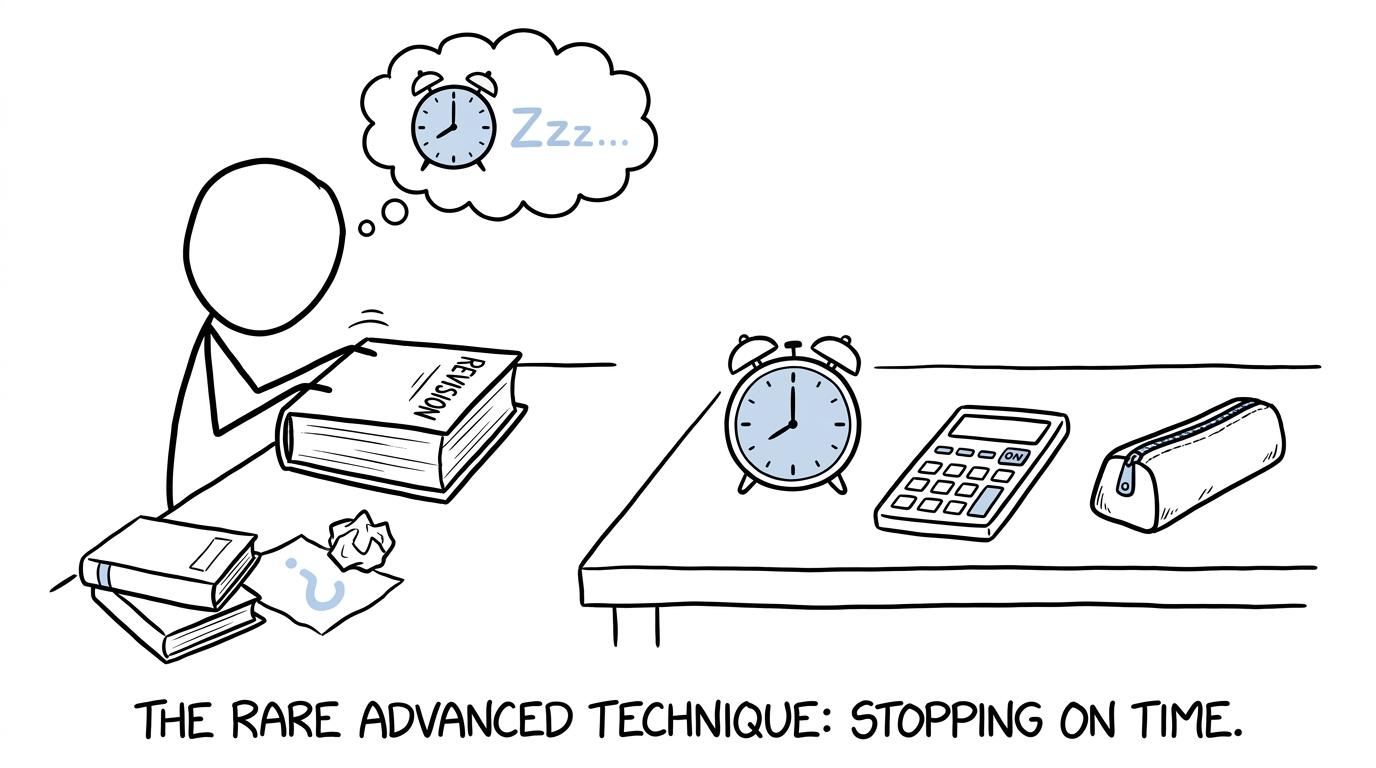 The advanced Sunday evening revision technique of stopping on time
Common GCSE chemistry weekend revision mistakes
Trying to cover the whole course
A weekend cannot carry the entire specification. Prioritise topics using evidence from questions and assessments, while keeping a list of untouched areas for later sessions.
Rereading instead of retrieving
Familiar notes can create false confidence. Close the book, write what you remember and test it with questions.
Marking without correcting
A score identifies the symptom. Improvement comes from explaining the error, revising the missing idea and attempting a similar question without support.
Ignoring calculations and graphs
Chemistry contains substantial mathematical assessment. Include ratios, percentages, units, formula substitution, significant figures, standard form and graph interpretation in your plan. The GCSE Chemistry and maths exam-week checklist offers a compact routine for these skills.
Using the wrong resources
Check the exam board, qualification, paper content and tier before beginning. Separate Chemistry and Combined Science do not have identical content arrangements.
Sacrificing rest for one more session
Set a finishing time on both days. A sustainable routine is easier to repeat and leaves you better prepared for the coming school week.
Make this weekend produce a useful Monday
The best GCSE chemistry weekend revision plan is not the one with the longest timetable. It is the one that produces evidence: questions attempted, errors classified, weak skills repaired and answers successfully retested.
Begin with your Chemistry specification and board-specific science papers. Then use MathsGenie to strengthen the maths beneath your calculation marks and prepare for your maths exams. The free GCSE Maths revision area gives you revision lessons, practice questions, mini tests, past papers, mark schemes, predicted papers and video solutions in one place.
Choose one weakness, practise it properly and mark it honestly. By Sunday evening, you do not need to know everything. You need to know more than you did on Saturday and know exactly what to do next.











