

GCSE Chemistry Remark: Results Day Guide
GCSE chemistry remark guide: understand reviews of marking, deadlines, grade boundaries, risks and when challenging your result may be worthwhile.
Results day can reduce two years of work to one uncomfortable question: what if the mark is wrong? If you are considering a GCSE chemistry remark, speak to your school’s exams officer promptly, check how far you are from the relevant grade boundary and, where possible, ask a chemistry teacher to inspect your marked papers first. A review can raise, confirm or lower your mark.
The official term is review of marking, not re-mark. The reviewer checks whether the original examiner applied the mark scheme correctly; they do not simply mark the entire paper again from scratch.
GCSE chemistry remark decision checklist
Before requesting a review, check that:
- you know whether you took separate GCSE Chemistry or Combined Science;
- you have the marks for each examined component;
- you have checked the correct exam board, tier and summer-series boundary;
- your school has explained its deadline and any fee;
- a chemistry teacher has reviewed your script, if time permits;
- there is credible evidence of a marking error;
- you understand that your mark and grade can fall;
- you have given written consent.
For the June 2026 series, GCSE results are issued on 20 August and the JCQ deadline for standard reviews of results is 24 September 2026. Schools commonly impose earlier internal deadlines, so do not treat 24 September as your personal submission date.
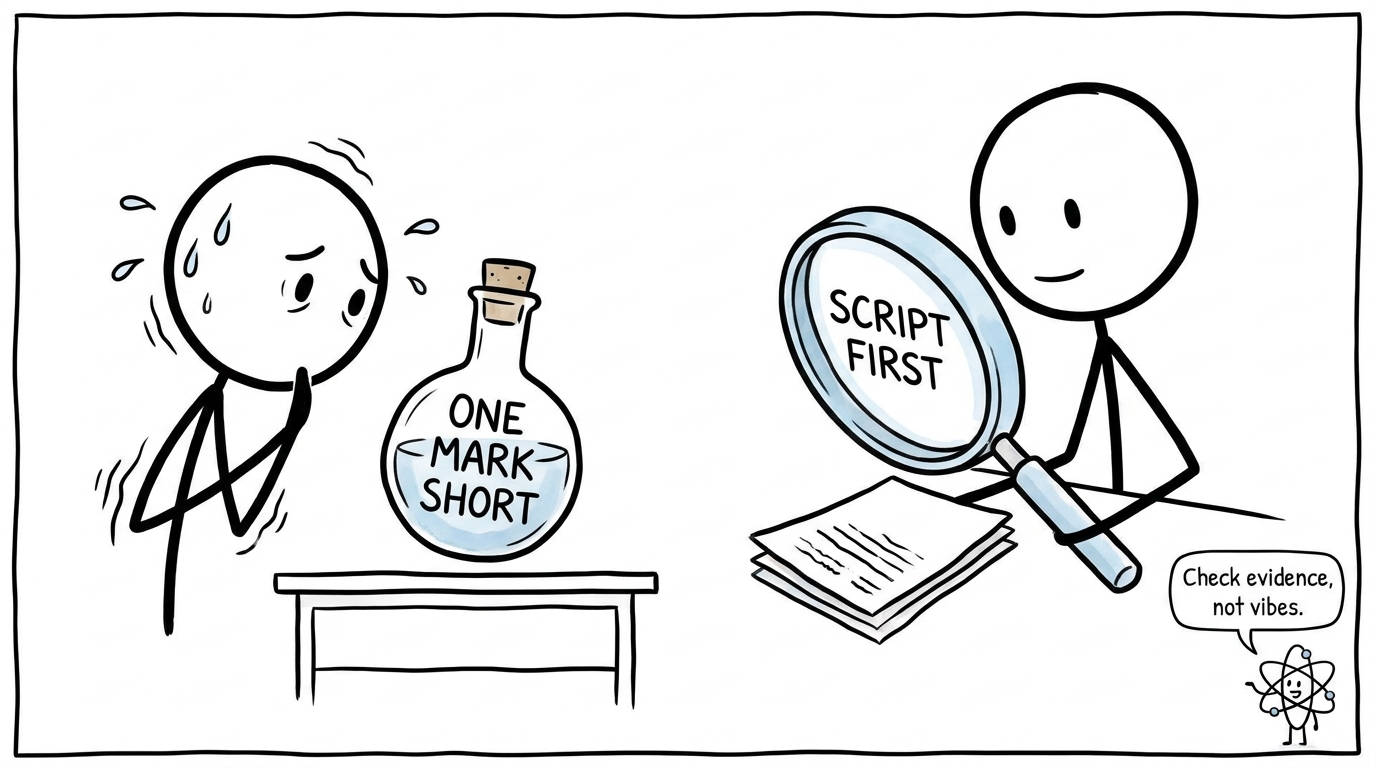 A student and teacher choosing evidence over results-day panic
How the GCSE chemistry re-mark process works
Confirm your qualification and marks
First, establish exactly what result you received. Separate Chemistry and Combined Science are different qualifications, with different specifications, component combinations and grade boundaries. Your results slip may not show all the detail needed, so ask your exams officer for your component marks.
Then compare your total with the correct published boundary. MathsGenie collects GCSE grade boundaries for the major exam boards, including dedicated pages for AQA GCSE Chemistry grade boundaries and Edexcel GCSE Chemistry grade boundaries.
Being one mark below a boundary does not prove an error. It simply tells you how much change would be needed for the qualification grade to rise.
Ask for access to your scripts
Exam boards provide access-to-scripts services for GCSE papers. Your school can usually obtain electronic copies with your permission, although board deadlines and procedures differ.
Ask a chemistry teacher to look for specific evidence:
- an unanswered page that appears not to have been marked;
- a correct calculation or unit that was denied credit;
- an answer matching an accepted mark-scheme alternative;
- an extended response where the awarded level appears inconsistent with the criteria;
- a possible transcription or addition error.
Chemistry contains both objective questions and responses requiring academic judgement. A correct numerical answer is comparatively straightforward to check. In a longer explanation about bonding, rates or required practicals, two reasonable examiners may legitimately reach the same or slightly different judgements. A review changes a mark only where an error is identified, including an unreasonable exercise of academic judgement.
Choose the appropriate service
A clerical re-check checks administrative matters such as whether every response was marked and whether marks were totalled and recorded correctly.
A review of marking, often called Service 2, includes clerical checks and examines whether the mark scheme was applied correctly. It normally applies to a particular externally assessed component, so your teacher should help identify which chemistry paper offers the strongest grounds.
For standard June 2026 reviews, JCQ says awarding bodies must complete the service within 20 calendar days of receiving the request. Priority arrangements vary: Pearson currently offers a priority review for GCSEs, while other boards generally reserve priority marking reviews for Level 3 qualifications. Confirm the current position with your exams officer rather than assuming that an urgent GCSE service is available.
Submit the request through your centre
Students and parents do not normally submit reviews directly. Your school or college sends the request to AQA, Edexcel, OCR or Eduqas after obtaining your written consent. Private candidates can normally work through their entry centre or follow the exam board’s direct procedure.
Fees differ by board, component and school policy. Ask whether the charge is refunded if the review changes the grade, and get the school’s deadline in writing.
When requesting a review may be sensible
A review is most defensible when several pieces of evidence align:
- you are close enough to a boundary for a plausible correction to matter;
- a teacher has inspected the paper and identified a likely error;
- the disputed marks are concentrated in one component;
- the grade affects a sixth-form subject requirement or another firm progression condition;
- you accept the possibility of a lower outcome.
Distance from a boundary matters, but evidence matters more. A student two marks short with no identifiable marking problem may have a weaker case than a student farther away whose script contains a clearly unmarked page.
Use the Edexcel Chemistry grade calculator only with the correct series and tier. Historical boundaries are useful context, but they cannot replace the official boundary for your examination series.
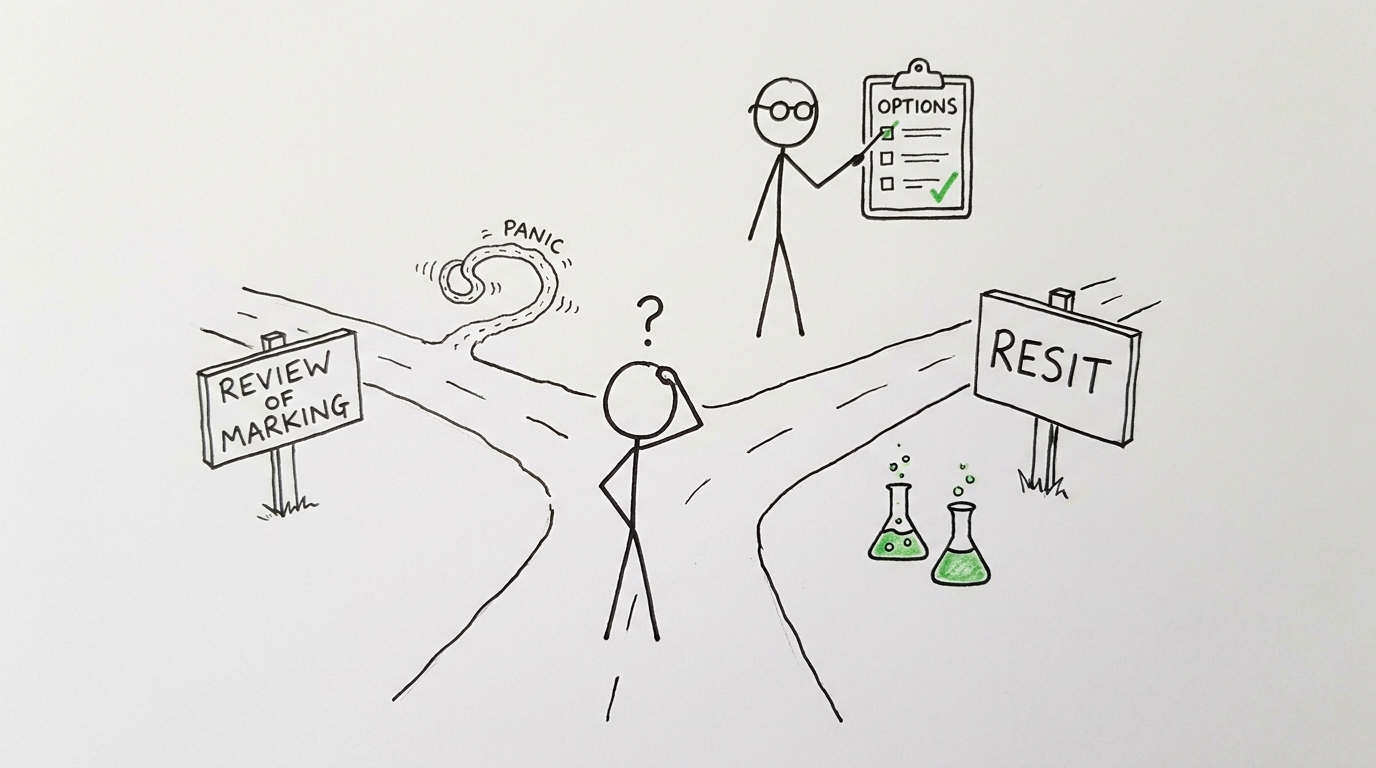 A calm decision path between review, resit and panic
Appealing a GCSE chemistry grade
An appeal is not the first stage. Your centre must normally receive the outcome of the review of marking before it can appeal to the exam board. Under the JCQ appeals process effective for June 2026, an appeal may concern a remaining marking error or a failure to apply procedures consistently, properly or fairly.
For internal candidates, the head of centre submits the appeal. JCQ states that appeals against review outcomes must be made within 30 calendar days of the exam board issuing that outcome. Private candidates may apply directly in the circumstances set out by the board.
If the final exam-board appeal process has been completed and procedural concerns remain, a centre or private candidate may ask Ofqual’s Exam Procedures Review Service to examine whether the board followed its procedures. Ofqual does not re-mark the script or directly replace the grade.
Common mistakes to avoid
- Calling it a guaranteed re-mark. It is a review of the original marking, with changes made only when errors are found.
- Using the wrong boundary. Check the board, qualification, tier and exam series.
- Looking only at the overall grade. Obtain component marks so the right paper can be investigated.
- Requesting every paper automatically. Reviews are component-based and may carry separate fees.
- Ignoring the downside. Written consent is required because marks and grades can go down, remain unchanged or rise.
- Missing the school deadline. Your centre may close requests well before the JCQ deadline.
- Appealing before completing the review. A review outcome normally comes first.
Make the next result less uncertain
Once the decision is submitted, focus on what you can control. If you are continuing with GCSE maths or preparing for sixth-form entry tests, use MathsGenie’s GCSE maths revision hub for revision lessons, practice questions, past papers and mark schemes. The AQA GCSE Maths resources and GCSE predicted papers can turn a disappointing result into a precise revision plan rather than a vague worry.
Start by checking the relevant GCSE Chemistry grade boundaries, then contact your exams officer and ask whether your teacher can inspect the scripts. A good review request is not built on hope alone. It is built on the correct boundary, the correct paper and clear evidence.











