

GCSE Chemistry Grade: What It Means for Sixth Form
GCSE chemistry grade sixth form guide: compare grades 4-9, typical A-level Chemistry entry rules, maths expectations and practical next steps for students.
A results sheet can make one number feel like a verdict. It is not. Your grade records how you performed in a particular set of assessments; your sixth form or college decides what that result allows you to study next.
The short answer to the GCSE chemistry grade sixth form question is that many providers ask for grade 666 in Chemistry, or grades 666 666 in Combined Science, before allowing students to take A-level Chemistry. Some ask for grade 777 or 777 777, while a few accept grade 555 alongside other conditions. A GCSE Maths requirement, commonly between grades 555 and 777, may also apply.
Requirements vary, so always check the current prospectus for every sixth form or college you are considering.
Your quick sixth-form checklist
Before submitting your post-161616 choices:
- Check the provider's general sixth-form entry requirements.
- Find the subject-specific requirement for A-level Chemistry.
- Check whether Separate Chemistry and Combined Science have different rules.
- Look for a separate GCSE Maths requirement.
- Ask what happens if you miss the required grade by one grade.
- Keep an alternative course or provider in mind.
Your predicted grade helps you plan, but your achieved result will normally determine whether you meet a published offer.
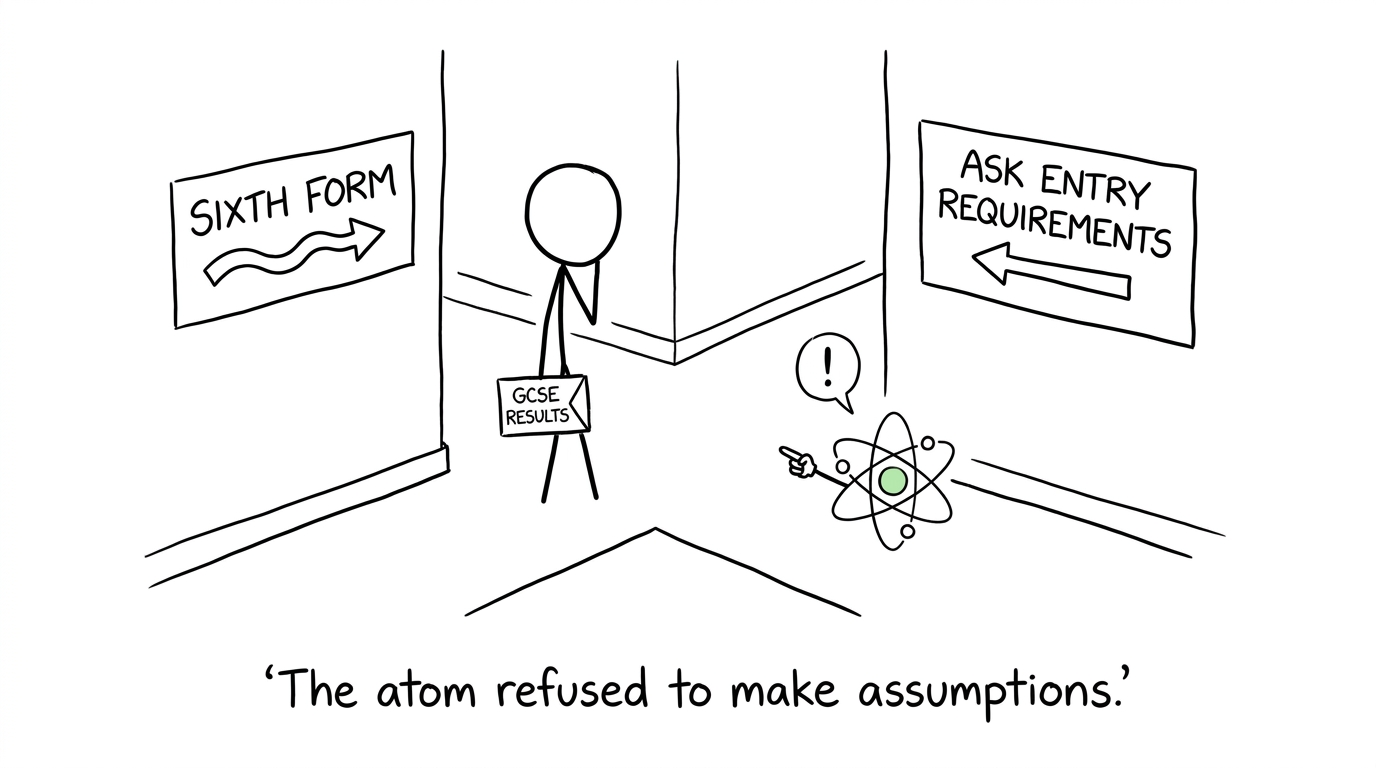 A student wisely checks sixth-form entry requirements instead of asking an atom to guess
GCSE chemistry grade meaning: a grade-by-grade guide
England uses GCSE grades 999 111, with grade 999 the highest. Grade 444 is described as a standard pass and grade 555 as a strong pass. Those labels do not create an automatic right to enter a particular A-level course, however. Subject entry rules are set locally.
Grades 999 and 888
These grades place you comfortably above the usual minimum published by most sixth forms. They suggest that you have handled demanding chemical concepts, calculations and unfamiliar applications successfully.
You are likely to satisfy the Chemistry component of an entry offer, but do not overlook Maths or general admission rules. A provider can still require a particular Maths grade or a minimum set of GCSE results overall.
Grade 777
Grade 777 meets the Chemistry threshold at many selective providers, including those that set requirements above grade 666. It is a strong platform for progressing to A-level Chemistry, although it does not mean the transition will be effortless.
A-level work becomes more quantitative and expects greater precision. Start strengthening algebra, ratios and data interpretation rather than treating the summer as a long pause.
Grade 666
Grade 666 is a common minimum for A-level Chemistry. Current published requirements from UK sixth forms frequently pair it with grade 666 in Maths, although individual policies range more widely.
This grade may therefore open the door, but it is often the threshold rather than a guarantee. If your provider asks for grade 777, contact its admissions team instead of assuming that every college applies the same rule.
Grade 555
A grade 555 is a strong GCSE pass, but it falls below the Chemistry requirement used by many providers. Some colleges do accept grade 555, perhaps with a higher Combined Science result, a suitable Maths grade or another STEM subject.
Read the exact wording. “Grade 666 in Chemistry” and “grade 666 555 in Combined Science” are not interchangeable conditions. If A-level Chemistry remains your aim, ask about foundation pathways, resits or alternative colleges.
Grade 444
Grade 444 is a standard pass, but it is not normally enough for direct entry to A-level Chemistry where the course requires grade 666 or 777.
That does not close every science route. A college may offer an applied science qualification, a Level 222 or Level 333 pathway with different criteria, or the chance to strengthen your GCSE profile first. Discuss the destination as well as the course title because different qualifications support different university and career routes.
Grades 333 111 or U
These results are unlikely to meet direct A-level Chemistry entry requirements. Your next step should be a conversation with your school or college about retaking relevant qualifications and choosing an appropriate post-161616 programme.
This is a route decision, not a judgement about your long-term ability. The useful question is: what foundation must be rebuilt before the next course becomes manageable?
Combined Science and Separate Chemistry
Separate Science students receive an individual Chemistry grade. Combined Science students receive a double grade, such as 666 666 or 777 666.
Sixth forms may require an individual grade 666 or 777 in Separate Chemistry but specify a double-grade combination for Combined Science. Some also inspect performance in Chemistry papers or require strength in another science. Never convert the rule yourself; use the provider's exact admissions wording.
Why your GCSE Maths grade matters
A-level Chemistry is not an A-level Maths course, but maths is part of its language. Across A-level Chemistry specifications, at least 20%20\%20% of examination marks assess mathematical skills in a chemical context at Level 222 or above. This includes skills at least comparable with higher-tier GCSE Maths, alongside more advanced applications such as logarithms.
You will meet ratios, percentages, significant figures, standard form, graphs, units and rearranged equations. Secure these foundations through GCSE Maths revision, or choose your board through the Edexcel GCSE Maths hub.
Particularly useful preparation includes ratio revision for AQA GCSE Maths, standard form practice and rearranging harder formulae. These are not side topics. They reduce the mental effort required when chemical ideas and calculations appear together.
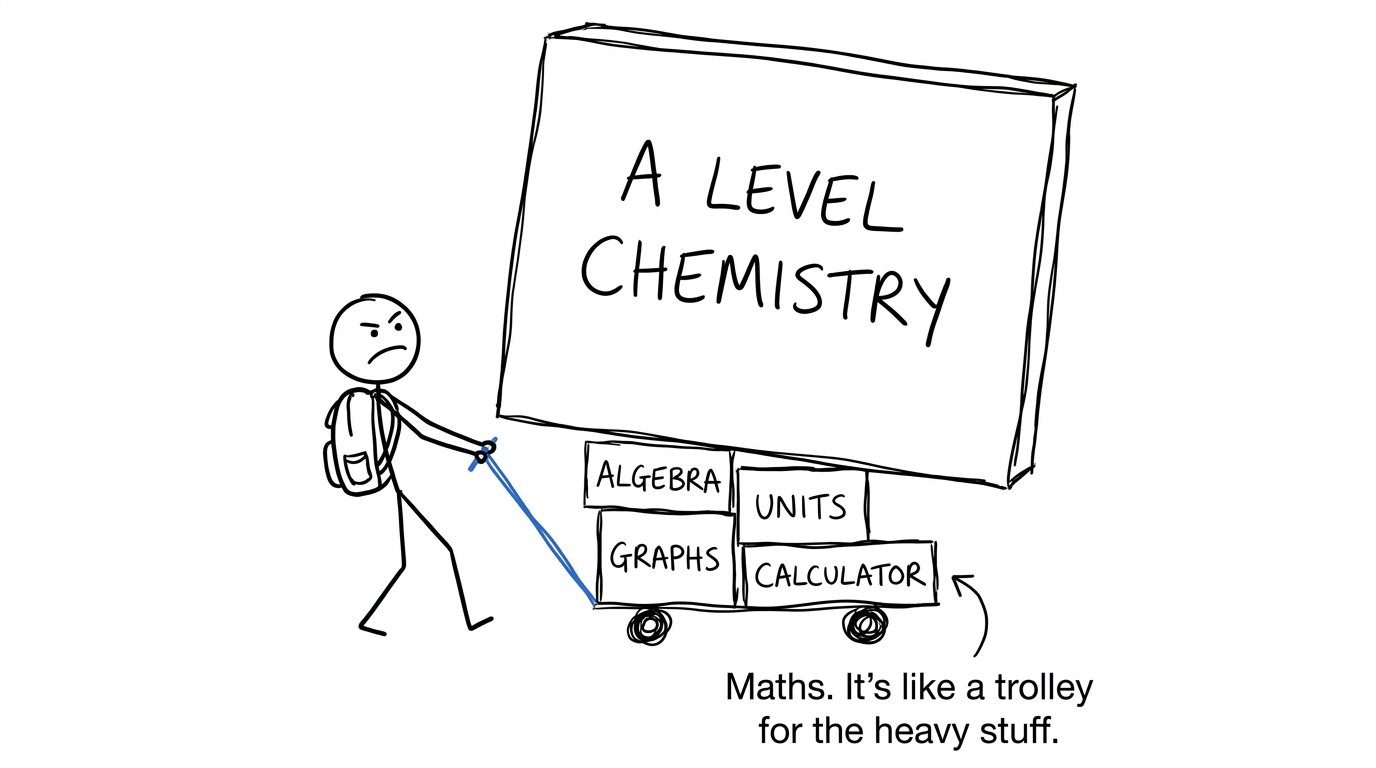 Maths skills forming a trolley underneath the heavy box of A-level Chemistry
Common mistakes when choosing A-level Chemistry
- Assuming every sixth form has the same threshold: published requirements currently range across providers.
- Checking Chemistry but not Maths: a strong science grade may not compensate for a missed Maths condition.
- Confusing Combined and Separate Science rules: copy the requirement exactly before comparing it with your grades.
- Treating the minimum grade as proof of readiness: entry gets you onto the course; secure knowledge keeps you there.
- Waiting until results day to investigate alternatives: identify a first choice and a realistic backup in advance.
Build the bridge before Year 12
If you are progressing to A-level Chemistry, begin with the skills that support both subjects. Use the MathsGenie revision planner to schedule short sessions, then move from revision lessons to practice questions and mark schemes.
When your place is confirmed, explore the AQA A-level Chemistry revision page and its topic-by-topic Chemistry revision guides. If your provider uses Edexcel, OCR or another specification, confirm the exam board before planning topic revision.
Your GCSE grade is best understood as a signpost. Check the local rule, strengthen the maths beneath the science, and keep more than one route open. MathsGenie can help you make that next step with free revision lessons, practice questions, mini tests, past papers, predicted papers, mark schemes and video solutions. Start with one weak skill today, then let consistent practice do what one results-day number cannot: show how far you can still progress.











