

GCSE Business Study Group: Make It Actually Work
GCSE business study group advice for building a focused team that meets, quizzes, marks answers and practises calculations for valuable exam marks.
A group chat can look like a study group from a distance. It has members, ambitious plans and perhaps even a name involving the word “revision”. Yet nobody quite decides when to meet, what to revise or who is bringing the questions.
A GCSE business study group works only when it turns good intentions into specific actions. Keep the group small, agree a regular meeting time, follow a short agenda and make every member produce something. For students also preparing for GCSE Maths, there is an extra advantage: Business requires calculations involving percentages, averages, profit, cash flow and data interpretation, so well-planned sessions can strengthen useful numerical skills.
The quick study group checklist
Before inviting everyone in your class, establish these essentials:
- Keep the core group to around 333 to 555 reliable students.
- Check that everyone follows the correct exam board specification.
- Meet at the same time and place each week where possible.
- Set one Business topic and one exam skill for every session.
- Give each person a clear role.
- Use closed-book quizzes, exam questions and mark schemes.
- Record mistakes and assign individual follow-up work.
- Confirm the next meeting before leaving.
The aim is not to create the biggest group. It is to create the smallest group that reliably does the work.
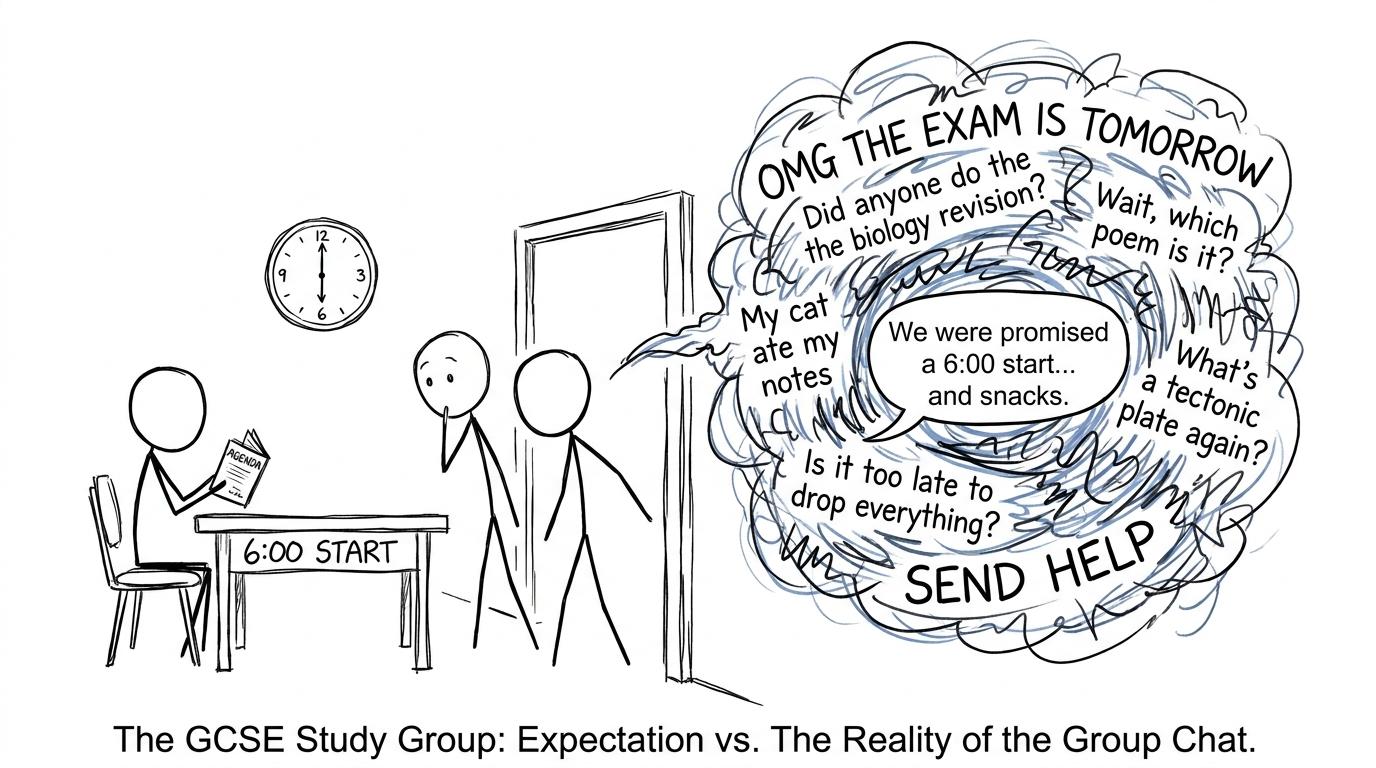 A revision agenda keeps the group chat outside
Why a GCSE business study group needs structure
Collaborative learning can be valuable, but simply placing students together does not guarantee learning. The useful part is the interaction: retrieving knowledge, explaining decisions, challenging weak reasoning and checking answers against reliable evidence.
That matters in GCSE Business because the subject asks for more than remembered definitions. Students must apply business concepts to a context, analyse consequences, interpret evidence and make justified judgements. Specifications differ between Edexcel, AQA, OCR and Eduqas, so the group should use the specification and command words for the board its members actually sit.
Official GCSE Business requirements also include quantitative skills. At least 10%10\%10% of the qualification marks must reward these skills at a demand equivalent to at least Key Stage 333, and the calculations must appear within business contexts rather than as isolated arithmetic. Required areas include percentages, percentage change, averages, revenue, costs, profit, profitability ratios, average rate of return and cash-flow forecasts.
That makes numerical practice a serious part of Business revision, not an optional extra.
Choose people who improve the room
A productive group does not require everyone to have the same target grade. Different strengths can help: one member may remember precise terminology, another may notice missing context, while another confidently checks calculations.
Reliability matters more than current attainment. Invite students who are willing to:
- arrive on time;
- attempt questions before seeing answers;
- explain their reasoning;
- accept corrections without turning them into arguments;
- complete agreed tasks between meetings.
Avoid building a group entirely around friendship. Friends can revise brilliantly together, but only if they accept that the meeting has a purpose. If eight people join and three do the work, you do not have an eight-person study group. You have a three-person study group with an audience.
Set one clear operating agreement
The group needs a few rules, not a constitution. Write them in the chat description or shared document so expectations are visible.
Agree the meeting length, location and cancellation rule. A focused session of roughly 454545 to 606060 minutes is usually easier to sustain than an open-ended evening. Decide that cancellations should be sent by a particular time and that one absence does not automatically cancel the meeting for everyone else.
The group chat should handle logistics and resources. It should not become the place where revision is endlessly discussed but never completed. A useful message answers one of three questions: when are we meeting, what are we doing, or what must we bring?
Give every meeting a repeatable agenda
A familiar structure removes decisions and makes starting easier. Use the same sequence each week while changing the content.
Begin with closed-book retrieval
Spend the first 101010 minutes answering short questions without notes. Include definitions, formulas, advantages and disadvantages, or questions that ask members to identify an appropriate business objective.
Retrieval practice means bringing information to mind rather than merely rereading it. It also exposes uncertainty quickly. When nobody can accurately define a term, the group has found a gap worth fixing.
Compare and correct
Use the next 101010 minutes to check answers against class materials, the specification or an official mark scheme. Do not accept the most confident voice as the answer key.
Record errors precisely. “Finance is weak” is too broad. “Confused revenue with profit” identifies something that can be repaired. The same principle helps with maths revision: MathsGenie’s guide to finding your weakest GCSE topics explains how to turn lost marks into focused next steps.
Complete an exam task
Spend around 202020 to 252525 minutes on one exam-style task. Members should first write independently. Discussion is useful after everyone has committed to an answer; otherwise, one student thinks while everyone else copies.
Compare how each answer uses the case context, develops chains of reasoning and reaches a supported judgement. Where a calculation is involved, check both the method and its interpretation. A correct figure without a business conclusion may not fully answer the question.
Finish with commitments
Use the final 555 minutes to record:
- the topic covered;
- each member’s main error;
- the follow-up task;
- the topic, leader and date for the next session.
This small ending is what turns a pleasant meeting into a revision system.
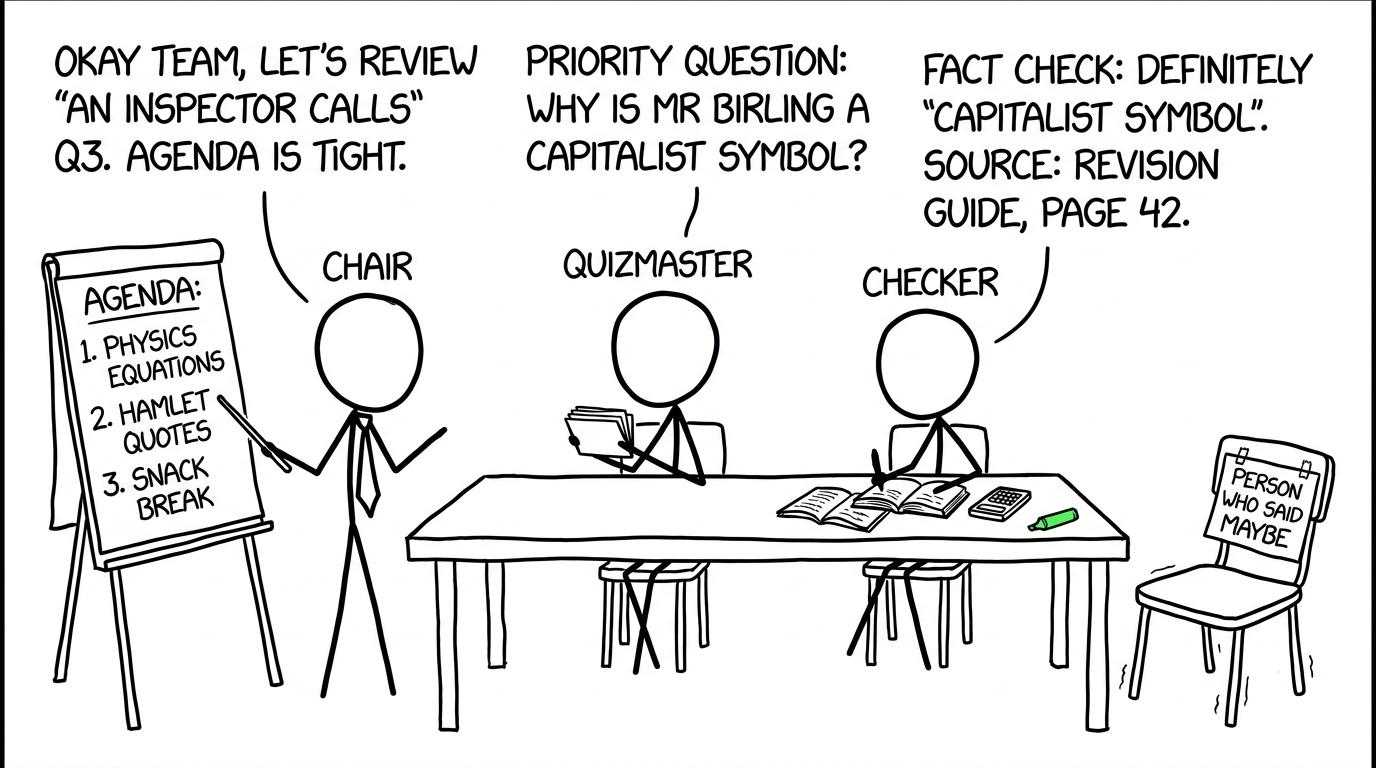 Study group members take clear revision roles
Rotate roles so everyone contributes
Roles prevent one organised student from carrying the whole group. Rotate these each meeting:
- Chair: starts on time and moves the agenda forward.
- Quizmaster: prepares retrieval questions before the session.
- Specification checker: confirms that the content matches the correct board.
- Mark-scheme checker: leads careful marking without simply reading answers aloud.
- Recorder: notes mistakes, actions and the next meeting.
In a smaller group, one person can hold two roles. The important condition is that every member arrives with a responsibility.
Build Business calculations into the plan
A strong group alternates written analysis with quantitative practice. The core relationships should be recalled accurately before they are applied to a case, including:
Revenue=selling price×quantity sold\text{Revenue}=\text{selling price}\times\text{quantity sold}Revenue=selling price×quantity sold Profit=total revenue−total costs\text{Profit}=\text{total revenue}-\text{total costs}Profit=total revenue−total costs Percentage change=changeoriginal value×100\text{Percentage change}=\frac{\text{change}}{\text{original value}}\times 100Percentage change=original valuechange×100 Gross profit margin=gross profitrevenue×100\text{Gross profit margin}=\frac{\text{gross profit}}{\text{revenue}}\times 100Gross profit margin=revenuegross profit×100 Net cash flow=cash inflows−cash outflows\text{Net cash flow}=\text{cash inflows}-\text{cash outflows}Net cash flow=cash inflows−cash outflowsStudents should verify the precise formulas and terminology required by their own Business specification. For the underlying numerical methods, MathsGenie provides a focused percentage change lesson, topic-based GCSE Maths exam booklets and a broader Edexcel GCSE Maths revision hub.
A useful group routine is to make one person calculate, one check the units and method, and one explain what the result means for the business. Then rotate. Business marks often depend on using quantitative evidence to support a decision, not merely producing a number.
Keep individual accountability inside group revision
Group revision becomes passive when members divide the syllabus and teach only their assigned section. Preparing an explanation can help the speaker, but the listeners still need to retrieve and apply the content themselves.
Use a simple accountability rule: everyone writes before anyone discusses. For calculation questions, everyone records their own working. For extended responses, everyone writes a judgement or planning chain before comparing ideas.
Short independent tests can help expose gaps without consuming an entire meeting. MathsGenie’s GCSE Maths mini tests are useful when the group needs to check supporting skills quickly. Students who are unsure what to revisit first can also use the recommended order for GCSE Maths topics to rebuild number, percentage, ratio and graph skills logically.
Make the group improve between meetings
The meeting is only the visible part of the system. Progress comes from what happens afterwards.
Maintain a shared mistake log with four short fields: topic, error, correction and retest date. Revisit selected questions after a gap rather than assuming that understanding them once means they will be remembered. The MathsGenie guide to stopping forgotten GCSE Maths content offers a practical cycle of retrieval, spacing and mixed practice.
As exams approach, move from topic questions towards timed paper sections. Past papers reveal how knowledge, calculations and interpretation are combined under pressure. The advice on when to start GCSE past papers can help the group progress from short tests to fuller timed practice without abandoning targeted repair work.
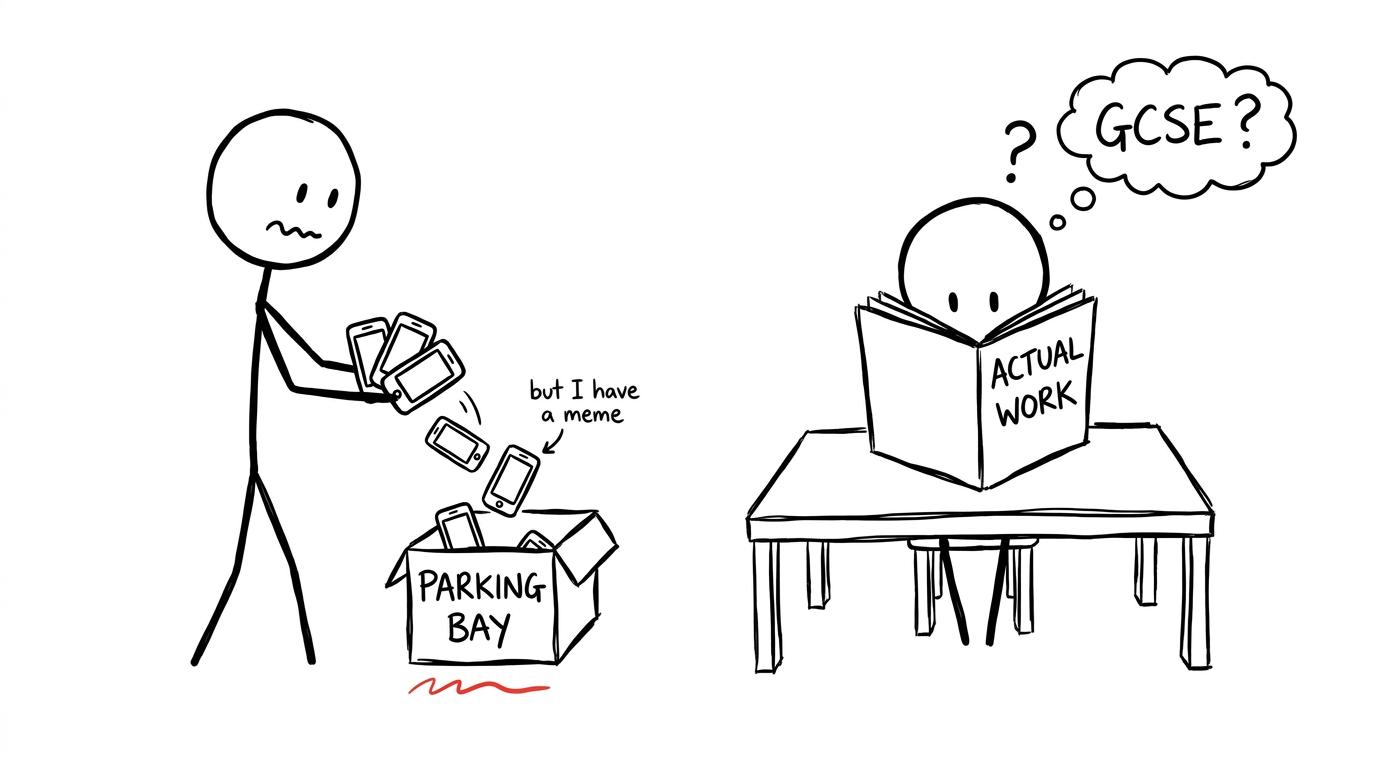 Phones enter the parking bay while actual revision begins
Common mistakes that stop study groups working
Inviting too many people
Large groups create more scheduling problems and less individual accountability. Start small. Additional members should join only if they improve the group’s consistency.
Meeting without a topic
“Revise Business” is not a plan. Choose a precise area such as cash flow, marketing research or business growth, then select the exam skill to practise.
Turning explanation into copying
Watching the strongest member answer every question feels productive because the answer eventually appears. It does little to test everyone else. Require an independent attempt first.
Using unreliable answers
A persuasive explanation can still be wrong. Resolve disagreements with the specification, teacher materials and official mark schemes rather than a vote.
Marking only final answers
For calculations, inspect the formula, substitution, units and interpretation. For extended responses, inspect application, developed reasoning and the final judgement.
Ignoring the maths
Business students can lose avoidable marks through weak percentage, average or graph skills. Use the GCSE Maths topics by board and tier checklist to identify supporting methods, while keeping Business practice aligned with your own exam board.
Turn meetings into a dependable revision habit
The best study group is not the one with the liveliest chat or the most elaborate shared folder. It is the one that meets, retrieves knowledge, attempts questions, checks evidence and returns to its mistakes.
Set a time. Choose a topic. Give everyone a role. Then make each session produce visible work.
For the numerical skills behind GCSE Business, use MathsGenie as your free revision base. Revisit methods through clear revision lessons, practise with topic questions and mini tests, and build exam confidence using past papers, predicted papers, mark schemes and video solutions. Add those tasks to your revision planner, bring the difficult questions to the next meeting and let the group do what it was created to do: make each member think more carefully than they would alone.











